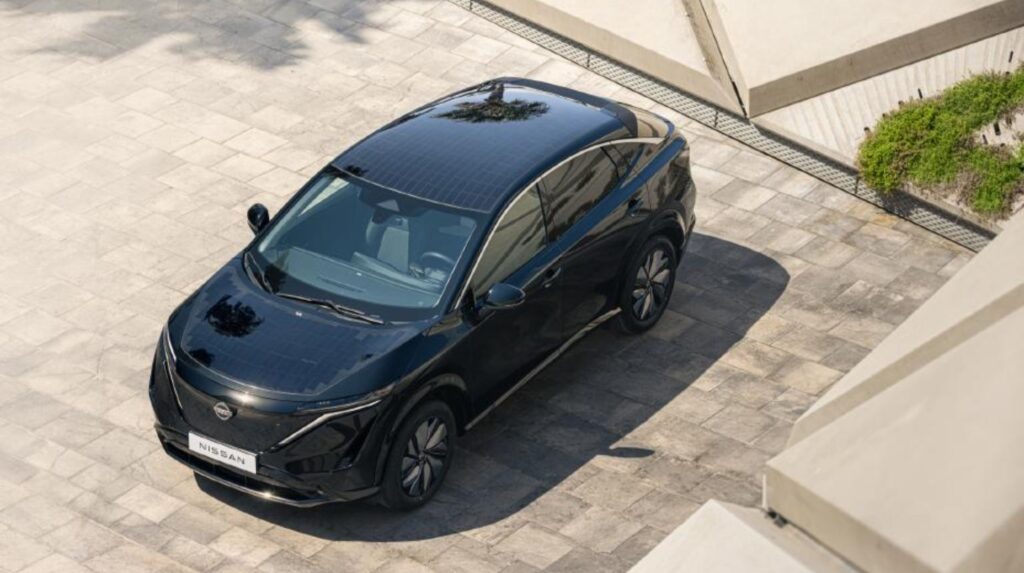
Nissan has presented a solar‑powered Ariya concept that it describes as “an exploration of how future electric vehicles could harness the world’s most abundant renewable energy source: the sun.”
Developed by engineers from Nissan’s Advanced Product Planning team in Dubai, UAE, and Powertrain Planning team in Barcelona, Spain, and presented on Clean Energy Day (Jan 26), the concept features 3.8m² of high‑efficiency photovoltaic panels integrated into the hood, roof and tailgate. These polymer and glass-based solar panels convert sunlight into DC power, managed through an advanced controller designed to optimize energy use and reduce reliance on external charging infrastructure.
New EV freedom
Real‑world testing has revealed what the auto maker says is “the transformative potential of the system.” In ideal conditions, the system can deliver up to 23km of additional range per day. In cities with high solar exposure, such as Barcelona, the vehicle can generate an average of 17.6km of daily solar driving range. Year‑round averages show significant gains globally – 10.2km/day in London, UK; 18.9 km/day in New Delhi, India; and 21.2 km/day in Dubai.
With this technology, drivers could reduce their charging frequency by 35–65%, depending on use, and a two‑hour, 80km journey could produce 0.5 kWh of clean energy, adding up to 3km of free, zero‑emission range.
During initial long‑distance testing, including a 1,550km journey between the Netherlands and Barcelona, the concept demonstrated that solar integration could cut annual charging visits for a 6,000km/year commuter from 23 to eight.
A collaboration that turned a bold idea into reality
Nissan partnered with Dutch solar-mobility company Lightyear, which provided a next-generation solar panel technology that Nissan’s engineering teams worked with to explore the potential for electric vehicles to charge themselves.
“The solar‑powered Ariya concept embodies Nissan’s belief that innovation and sustainability must move forward hand‑in‑hand,” said Shunsuke Shigemoto, vice president e-powertrain and internal combustion engine powertrain, technology research and advanced engineering, and chief powertrain engineer, Nissan AMIEO.
“By exploring how vehicles can generate their own renewable energy, we are opening the door to new opportunities for customers – greater freedom, reduced charging dependency, and a cleaner future. This concept is not just a technical milestone; it’s a vision of how Nissan intends to lead the next phase of electric mobility.”
In related news, take a peek behind the scenes of Nissan’s third-gen Leaf