 Company Logo
Opportunities within the Global Electric Two-Wheeler Charging Infrastructure Market include rapid urbanization driving the need for efficient micro-mobility, battery swapping tech bolstering growth in dense areas, and last-mile delivery electrification creating demand for dedicated charging hubs. AI and IoT-enhanced smart charging systems, along with solar-powered off-grid solutions, are crucial trends.
Electric Two-Wheeler Charging Infrastructure Market
Electric Two-Wheeler Charging Infrastructure Market · GlobeNewswire Inc.
Dublin, Jan. 30, 2026 (GLOBE NEWSWIRE) — The “Electric Two-Wheeler Charging Infrastructure Market – Global Industry Size, Share, Trends, Opportunity, and Forecast, 2021-2031” has been added to ResearchAndMarkets.com’s offering.
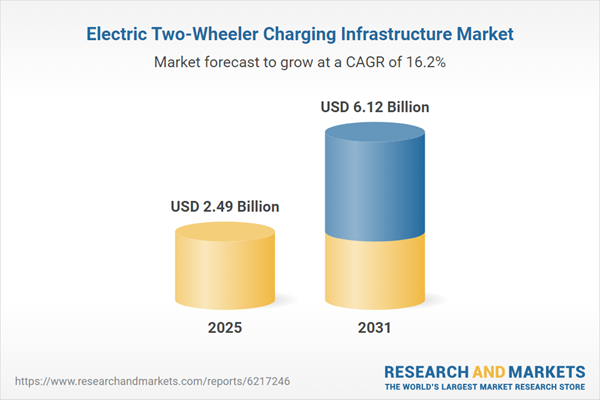
The Global Electric Two-Wheeler Charging Infrastructure Market is projected to expand from a valuation of USD 2.49 Billion in 2025 to USD 6.12 Billion by 2031, registering a CAGR of 16.17%.
This market encompasses the entire ecosystem of hardware and software required to power electric motorcycles and scooters, ranging from plug-in terminals to battery swapping stations.
The sector’s growth is fundamentally underpinned by strict government mandates designed to curb vehicular emissions and the rapid rate of global urbanization, which creates an urgent need for cost-effective, efficient micro-mobility solutions. These core drivers establish a solid regulatory and economic foundation for long-term infrastructure investment, operating independently of transient trends such as specific battery technologies or business models.
Despite this positive growth trajectory, the industry confronts a major obstacle in the form of hardware standardization. The absence of a universal interface for charging connectors and swappable battery packs leads to a fragmented landscape, which complicates interoperability and reduces user convenience. The magnitude of this challenge is underscored by the massive scale of infrastructure needed; the International Energy Agency noted that the global stock of publicly accessible charging points exceeded 5 million in 2024. While this figure represents robust expansion, the lack of unified standards across these networks continues to hinder the seamless cross-platform integration required to support mass market adoption.
Market Drivers
The widespread adoption of battery swapping technology serves as a primary engine for market growth, especially in dense urban areas where the dwell time required for plug-in charging is often impractical. This model effectively overcomes significant barriers to adoption, such as high upfront asset costs and range anxiety, by separating battery ownership from the vehicle itself.
Consequently, infrastructure providers are prioritizing the rollout of swapping stations that can service multiple original equipment manufacturers, thereby maximizing utilization and profitability. As evidence of this model’s commercial viability, Gogoro Inc. reported in its ‘Q2 2024 Business Update’ in August 2024 that its network supports over 605,000 monthly active users, highlighting the high consumer reliance on swapping infrastructure for daily transportation.
In parallel, the electrification of last-mile delivery fleets acts as a strong driver for dedicated infrastructure, distinct from public consumer networks. Logistics and quick-commerce firms are aggressively shifting to electric two-wheelers to lower operational costs, creating a demand for captive charging hubs and high-speed public terminals that minimize vehicle downtime.
This corporate demand ensures a consistent base load for charging networks, offering lower investment risks compared to purely public systems. For instance, Zypp Electric announced in a February 2024 press statement that it intends to deploy 200,000 electric scooters by 2026, a strategic expansion necessitating a massive increase in dedicated charging points. This momentum is further supported by regional trends; according to the Federation of Automobile Dealers Associations, electric two-wheeler retail sales in India surged by approximately 30 percent year-on-year in 2024, intensifying the global need for accessible charging solutions.
Market Challenges
The lack of hardware standardization stands as a formidable barrier to the Global Electric Two-Wheeler Charging Infrastructure Market. The current prevalence of incompatible swappable battery designs and proprietary charging connectors results in the development of fragmented, brand-specific networks.
This absence of interoperability severely restricts the potential market for any single charging point, forcing infrastructure providers to risk capital on technology that serves only a fraction of the total vehicle fleet. Such fragmentation creates a disjointed experience for users, exacerbating range anxiety and discouraging the transition from internal combustion engines to electric alternatives.
This friction effectively halts the momentum required for widespread infrastructure profitability and deployment. The consequences of these adoption hurdles are visible in recent sector performance, which indicates a struggle to sustain growth. According to the European Association of Motorcycle Manufacturers (ACEM), 2025 statistics revealed that moped registrations in key European markets dropped by 6.5% in 2024.
This contraction in the light mobility sector, a major user of public charging solutions, demonstrates how structural inefficiencies like non-standardized hardware continue to impede the broader expansion of the ecosystem.
Market Trends
The incorporation of AI and IoT for Smart Charging Management is fundamentally transforming the Global Electric Two-Wheeler Charging Infrastructure Market by allowing operators to optimize energy distribution through data-centric software. Moving beyond passive hardware installations, these intelligent networks employ connected operating systems to automate payment processing, monitor grid health, and balance electrical loads in real-time, capabilities that are essential for managing the unpredictable charging behaviors of large scooter fleets.
This shift toward software-defined infrastructure is demonstrated by the rapid growth of connected networks; in its ‘2024: A Year of Milestones’ update from January 2025, Bolt.Earth reported that its smart charging network expanded to over 36,000 active points by the end of 2024, a vital growth driven by an intelligent system designed to maximize throughput in fragmented urban settings.
Simultaneously, the deployment of solar-powered and off-grid charging solutions has emerged as a crucial trend to reduce operational costs and mitigate grid instability, particularly in emerging markets with high motorcycle density. Infrastructure providers are circumventing traditional utility limitations by establishing self-sufficient hubs that use renewable energy to guarantee service availability for commercial riders, regardless of central power failures.
This trend toward decentralized energy resilience is gaining commercial traction; as noted by KBC Digital in November 2024 in the article ‘Roam to add 10 solar-powered charging stations in Nairobi,’ the mobility firm Roam secured funding to install ten new off-grid solar hubs, each capable of handling up to 500 daily charging or swapping transactions, effectively decoupling service reliability from local grid fluctuations.
Key Players Profiled in the Electric Two-Wheeler Charging Infrastructure Market:
Tesla Inc.
ChargePoint Inc.
ABB Ltd.
Delta Electronics Inc.
Schneider Electric SE
BP Pulse
EVgo Services LLC
Gogoro Inc.
SUN Mobility Pvt Ltd.
Ather Energy Pvt Ltd.
Report Scope:
Electric Two-Wheeler Charging Infrastructure Market, by Type:
Electric Two-Wheeler Charging Infrastructure Market, by Charging Mode:
Electric Two-Wheeler Charging Infrastructure Market, by Installed Location:
Electric Two-Wheeler Charging Infrastructure Market, by Connector Type:
UK 3-Pin
Industrial Commando
Type 1
Type 2
CHAdeMO
CCS
Electric Two-Wheeler Charging Infrastructure Market, by Type of Charging:
Electric Two-Wheeler Charging Infrastructure Market, by Region:
North America
Europe
Asia-Pacific
South America
Middle East & Africa
Key Attributes:
Report Attribute
Details
No. of Pages
182
Forecast Period
2025 – 2031
Estimated Market Value (USD) in 2025
$2.49 Billion
Forecasted Market Value (USD) by 2031
$6.12 Billion
Compound Annual Growth Rate
16.1%
Regions Covered
Global
For more information about this report visit https://www.researchandmarkets.com/r/m5y4pf
About ResearchAndMarkets.com
ResearchAndMarkets.com is the world’s leading source for international market research reports and market data. We provide you with the latest data on international and regional markets, key industries, the top companies, new products and the latest trends.
Attachment
CONTACT: CONTACT: ResearchAndMarkets.com Laura Wood,Senior Press Manager press@researchandmarkets.com For E.S.T Office Hours Call 1-917-300-0470 For U.S./ CAN Toll Free Call 1-800-526-8630 For GMT Office Hours Call +353-1-416-8900