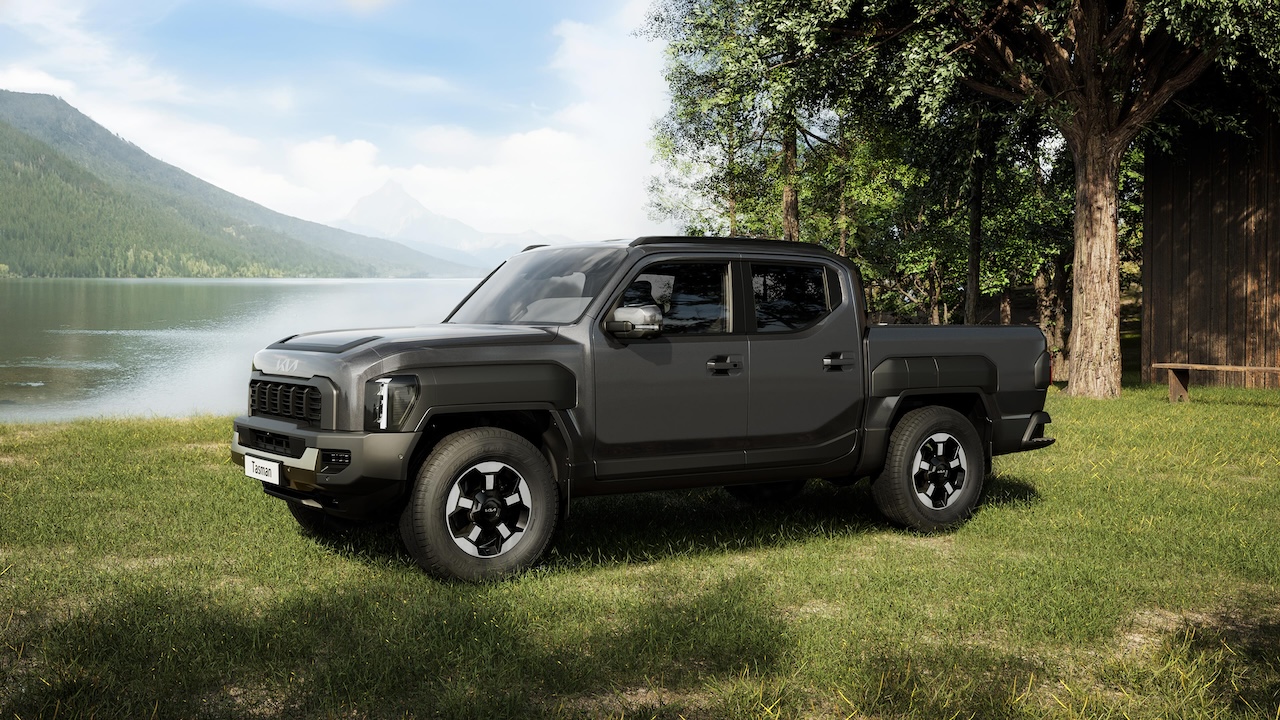
A plug-in hybrid is now emerging as the preferred next step for the struggling Kia Tasman ute as the brand looks for ways to lift sales and prepare for Australia’s tightening emissions rules.
The renewed focus on a PHEV Tasman comes as the BYD Shark 6 posts record numbers for a plug-in ute, a performance Kia Australia boss Damien Meredith is watching closely.
A conventional petrol-electric hybrid using the new-generation 2.5-litre system already seen in the Hyundai Palisade had been widely expected to be the first alternative to the Tasman’s existing 2.2-litre turbo-diesel.
READ MORE: Dual-cab game-changer? New Kia Tasman ute eyes potent turbo-hybrid to battle Ford Ranger and Toyota HiLux – but promised EV a no-show for now
READ MORE: Kia EV4 sedan priced for Australia: Korean contender undercuts Tesla Model 3, challenges BYD Seal
READ MORE: Kia’s refreshed Kia EV6 arrives in Australia: There are a lot of changes, but pricing isn’t one of them
That option remains under consideration, but Meredith has made it clear he would rather see a plug-in hybrid, and ultimately a fully electric Tasman, join the range.
“I would like a plug-in, and I would like an EV,” Meredith said. “So if I’m being greedy, so be it. But that’s what I’d like to help with the success of Tasman.”
He added that while he would still take the hybrid, but he believes both a PHEV and an EV would be better suited to the Australian market as the New Vehicle Efficiency Standard progressively tightens CO2 limits and places pressure on diesel and petrol-powered utes.
Meredith’s view does not automatically guarantee the PHEV will be prioritised. One of the key arguments in favour of the hybrid within Kia is that it would be a more affordable option to bring to market.
Even so, the sales success of the Shark 6 has clearly influenced thinking. The BYD has become Australia’s best-selling plug-in hybrid vehicle despite only being on sale for a year, and Meredith concedes Tasman buyers have been lost to the electrified rival.
The Tasman’s original pre-launch target of 20,000 sales per year has not been met. After six months on-sale it is tracking towards about 8392 units over 12 months, while the Shark 6 recorded more than 18,000 sales in 2025.
“Nothing’s off the table in regards to how we do this, how we grow our share and grow our volume,” Meredith said. “And I think that’s the same as it is from a point of view from head office.
“We’ve got great faith in Tasman as a product. And we will continue to work exceptionally hard to make sure that it is a success in the Australian market.
“We’re not making or looking for excuses in regards to its slow start. It’s only been in market seven months. It hasn’t been in market seven years, it’s been in market seven months.”
At this stage, either the hybrid or the plug-in hybrid could join the Tasman line-up late in 2027 or into 2028. That timing would align with a planned update to the ute’s styling, which has proven controversial.
It would also coincide with the arrival of Hyundai’s own dual-cab ute based on the same ladder-frame platform as Tasman.
Hyundai’s Australian boss Don Romano has already strongly endorsed a plug-in solution for that vehicle, hinting it could adopt a range-extender style set-up, also known as an extended-range electric vehicle.
In this configuration the internal combustion engine acts only as a generator for the battery, while the electric motors drive the wheels. A conventional PHEV, by contrast, can use its engine to drive the wheels directly as well.
A fully electric Tasman remains a more distant and technically challenging proposition. While it has been proposed and postponed, issues such as range expectations for ute buyers and likely demand have reportedly pushed it further down the development timeline.
In the meantime, Kia continues to work on improving the efficiency of the existing diesel Tasman, with features such as idle-stop technology due to be introduced this year as part of a broader effort to reduce fuel use and emissions.