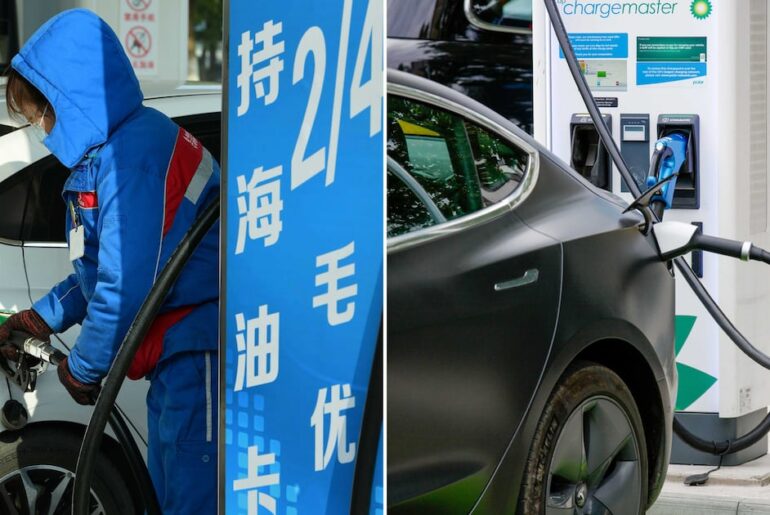
(Photo by DBenitostock/Getty Images)
Five awardees are on track to receive a combined $12.1 million in federal funding to build and operate electric vehicle charging stations at 14 locations along highways in Washington state.
The state Department of Transportation announced the National Electric Vehicle Infrastructure program grants on Thursday, after moves by the Trump administration and legal wrangling waylaid the money’s release.
Chargers will be installed along Interstate 90 and U.S. routes 97, 195 and 395. Those that will receive the funding include Seattle-based startup Electric Era, Energy Northwest, which is a consortium of public utility districts and municipalities, EvGateway, EVgo and Tesla.
Washington and 13 other states sued in response to the Trump administration’s attempts to withhold the funding, which was provided under a 2021 federal infrastructure law signed by former President Joe Biden.
U.S. District Court Judge Tana Lin issued a preliminary ruling last June ordering the administration to unfreeze the money. Lin made a final ruling in favor of the states this month.
“These projects fill key gaps in the state’s highway EV charging network and will make electric vehicle travel even more convenient,” Washington state Secretary of Transportation Julie Meredith said in a statement.
“We’re pleased to invest these federal funds with companies that will now build, operate and maintain these charging stations,” she added.
Plans call for the charging stations to be built in the next two years, with 96 fast-charging ports available across the 14 locations.
The state’s transportation department said it received 49 applications for the grants, totaling around $44.3 million.
Electric Era is set to receive about $4.2 million, the largest chunk of the funding announced Thursday. EVgo would receive the least, $650,531, for a project in the Colville area.
The transportation department cautioned that awards are contingent on final negotiations over details for the projects.
In full, the state is slated to get a $71 million through the National Electric Vehicle Infrastructure program, and the state transportation department expects to award funding to more projects.