For most companies, a 46% year-over-year drop in profits would sound major alarm bells. But Tesla isn’t most companies.
To Tesla and its investors, the short-term pain is no big deal. Because it’s just the automaker moving toward its next phase defined by autonomy and robotics.
The must-read auto and tech briefing, every weekday.
Welcome back to Critical Materials, your daily roundup for all things electric and tech in the automotive space. Also on deck: Tesla buys stake in xAI and an autonomous trucking provider says its operating “at scale” in the U.S.
25%: Profits, Plummet and Pivot—A Tesla Story

Photo by: Tesla
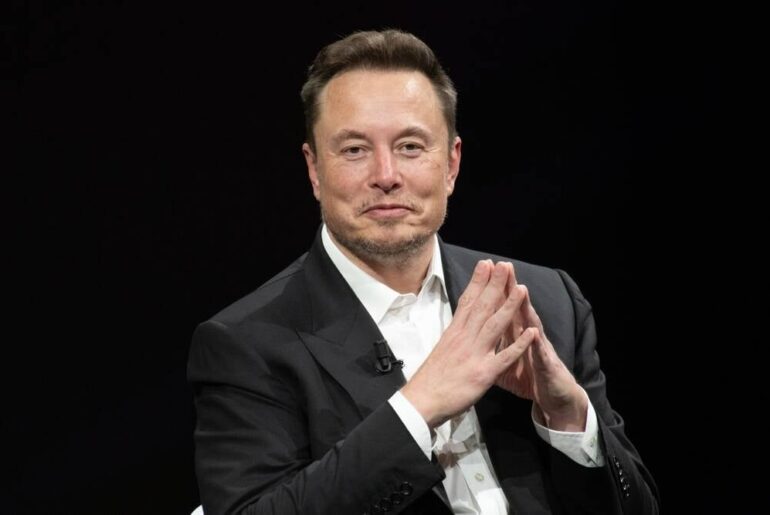
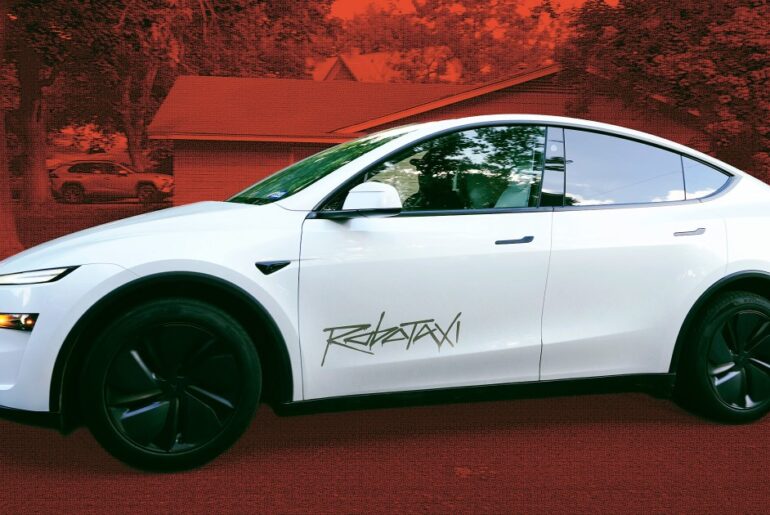
Tesla the car company is becoming a thing of the past, as last year’s fairly underwhelming product launches drove home. Instead, Elon Musk envisions a Tesla that will someday become the most valuable company on Earth thanks to its robots and robotaxis.
That “someday” is doing a lot of heavy lifting right now. Because according to Tesla’s 2025 earnings report released on Wednesday, profits aren’t looking great.
Tesla’s total revenue for 2025 fell from $97.7 billion to $94.8 billion, which on its own may not seem like a big deal. However, its profits plunged a whopping 46% year-over-year, from $7.1 billion to $3.8 billion.
Looking back, Tesla’s 2025 was tough. Between political meddling by Elon Musk, increasing competition around the globe and policy headwinds in the U.S., its car sales fell for the second year in a row. Its total automotive revenue fell 10% in 2025 to $69.5 billion. Meanwhile, Tesla’s energy and services businesses (which includes income streams like Supercharging) propped up its overall revenue.
To Tesla’s credit, it’s actually still very good at building profitable cars that are extremely attractive to EV buyers, especially from a software standpoint. However, other automakers are eating into Tesla’s wide lead, so it needs a new way to become innovative and grow its business.
One way to to do that would be to invest in expanding and improving its vehicle lineup. But Musk has chosen a different path. There’s no better symbol of that than one piece of news that Musk dropped on Tesla’s earnings call yesterday evening: The automaker is discontinuing the Model S and Model X to make more room to build Optimus robots.
50%: Tesla Invests $2 Billion In xAI
Photo by: Tesla
Tesla is giving $2 billion to Musk. No, we’re not talking about another huge payday or a bonus. It’s actually just headed to one of Musk’s other companies: xAI, maker of the controversial Grok chatbot.
The automaker revealed the investment in its year-end earnings statement. Tesla is betting big that autonomy—from robotaxis to Optimus—is its future, and writing a huge check to xAI is essentially Tesla doubling down on that narrative.
Tesla said the investment and an accompanying agreement “are intended to enhance Tesla’s ability to develop and deploy AI products and services into the physical world at scale.”
Notably, the move involves a potential conflict of interest, since Musk runs both companies. TechCrunch explains a few other points that make it controversial:
This is a truly circular deal and one that Tesla shareholders voted against last year. In November, shareholders were asked in a nonbinding measure to allow the Tesla board to authorize an investment in xAI. About 1.06 billion votes were in favor, and 916.3 million opposed, per Bloomberg’s reporting at the time. While that would seem like an approval, the number of abstentions — which count as votes against in Tesla’s bylaws — meant the measure was rejected.
Tesla proceeded anyway and offered up an argument in support of the investment. Tesla’s justification appears to be tied to xAI’s alignment with its most recent master plan — and how these companies are about to get a lot closer.
The $2 billion investment is expected to close before the end of the quarter.
75%: There’s Finally A Company Launching Driverless Commercial Trucks At Scale
Photo by: Gatik
Robotaxis might be promising a driverless future for folks who need to get to work and the grocery store, but there’s real money in the boring business of logistics too. That’s why so many companies are racing to get their driverless big rigs on the road.
With $600 million in contract revenue and nobody behind the wheel, autonomous trucking company Gatik now claims that it is the first company to have deployed fully driverless commercial delivery trucks “at scale.”
The company has actually been operating this way since mid-2025. As of this week, Gatik says that it has completed 60,000 fully driverless orders without incident using both 26- and 30-foot trucks. That’s across both highways and surface streets, which its trucks are operating on during the day and at night.
Gatik says that its trucks have covered more than 10,000 miles around Dallas-Forth Worth, Phoenix and Arkansas. Some of its routes even span over 400 miles, which have helped log over 2,000 hours of driverless operations.
Those numbers might seem small when compared to the sort of mileage Waymo is doing. But these are very different businesses too. If nothing else, Gatik provides a glimpse into the future of how autonomy can cut down on repetitive driving tasks—and how quickly autonomous vehicles went from a pie-in-the-sky project to something verging on a real business.
100%: Model S and Model X Are Dead—Now What?
Photo by: Tesla
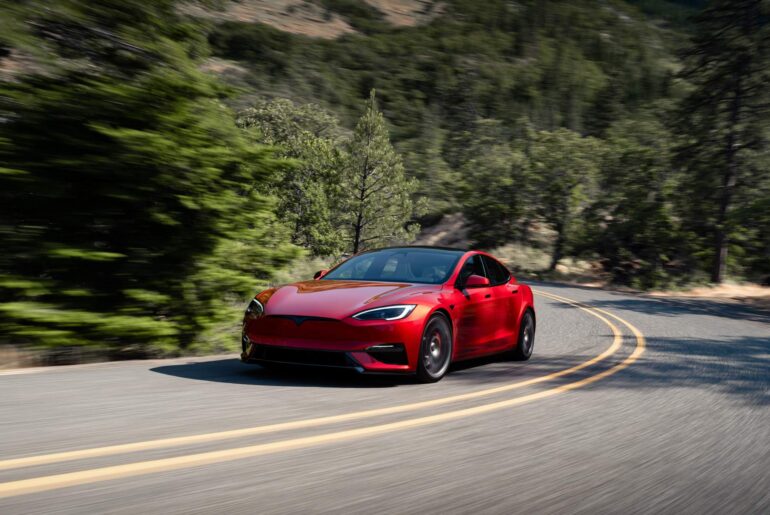
Well, it’s official. The Tesla Model S and Model X’s days are numbered. Tesla is sacrificing the production lines in order to make room for Optimus, which leaves Tesla without a premium vehicle in its lineup (other than the Cybertruck).
Where does this leave Tesla? Do you think that the automaker will need to launch something else to replace these luxury badges, or should it leave the job up to other marques in the space?
We want your opinion!
What would you like to see on Insideevs.com?
– The InsideEVs team