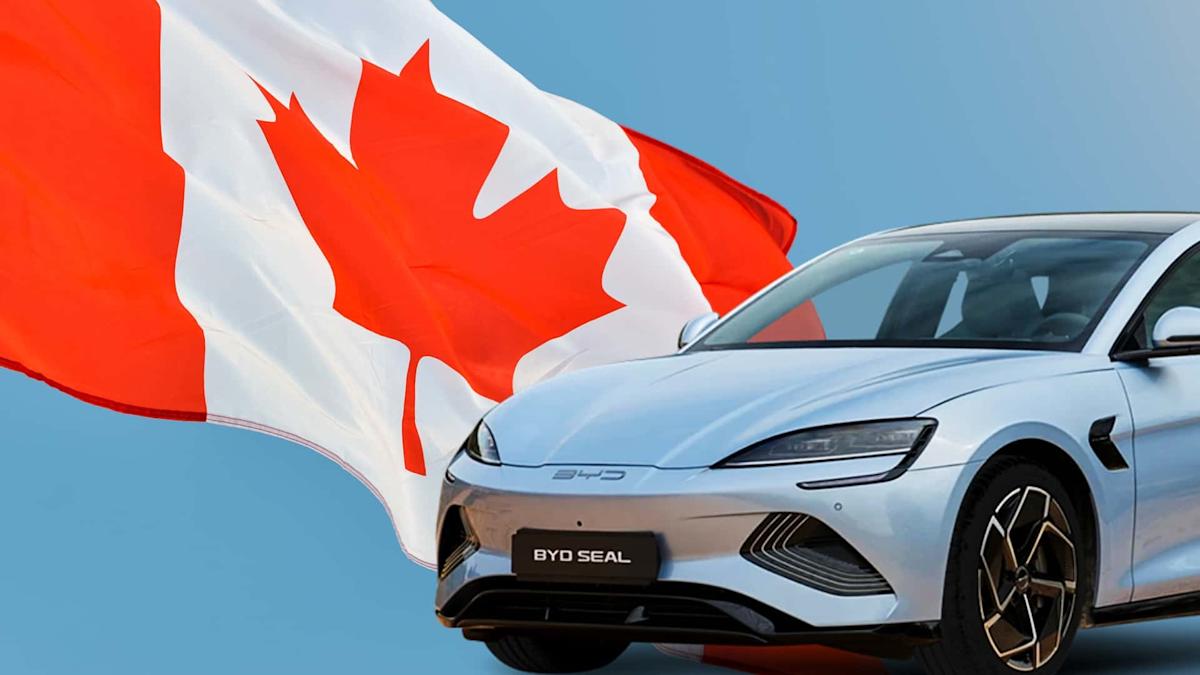
Breaking with the U.S., Canada will slash 100% tariff on Chinese electric cars, opening the doors to imports that cost less than $25,000.
Canada agreed to cut its 100% tariff on Chinese electric vehicles in exchange for lower tariffs on Canadian farm products.
The decision was made during Prime Minister Mark Carney’s visit to Beijing to improve strained Canada–China relations.
The move breaks with the U.S. on anti-China tariffs, and opens the doors to much more affordable EV imports—possibly around $35,000 Canadian, or $25,000 U.S.
The Chinese automotive industry received the green light to make a deeper incursion into North America on Friday as Canada agreed to cut its 100% tariffs on Chinese-made electric vehicles, opening the door to cheap imports and potentially upending the car industry on this continent.
According to the AP, Canadian Prime Minister Mark Carney announced that anti-Chinese EV tariffs would be slashed after two days of meetings with Chinese leaders in Beijing. In return for lower tariffs on EVs, Canada has agreed to reduce its tariffs on Canadian farm goods, including canola seeds.
But Chinese EV imports won’t flood into the country just yet. Carney said that the deal includes an initial annual cap of 49,000 vehicles on Chinese EV exports to Canada, although that grows to about 70,000 over five years. Carney said Canadians purchase about 1.8 million vehicles annually, almost a tenth of the U.S.’ sales volume.
Still, the move represents a major break between Canada and the U.S., which once moved in lockstep to protect a deeply intertwined North American automotive industry.

Stay informed with our newsletter every weekday back Subscribe For more info, read our Privacy Policy & Terms of Use.
Carney, according to the AP, touted the move as part of the growth of a whole new auto sector, and a win for Canadians seeking more affordable new-car options at a time of record-high prices. He added that most of these cars would have an import price of less than $35,000 Canadian, or about $25,000 U.S. The average new vehicle costs around $63,000 Canadian.
“We’re building a new part of our car industry, building cars of the future in partnership, bringing affordable autos for Canadians at a time when affordability is top of mind, and doing it at a scale that allows for a smooth transition in the sector,” Carney said.
The deal is a groundbreaking one on several levels. First and foremost, it represents arguably the biggest automotive break in trade relations yet between the U.S. and Canada, whose once-close relations have become deeply strained in the era of President Donald Trump’s tariffs and his remarks about the country becoming “the 51st state.”
Previously, Canada acted with the U.S. to enact 100% tariffs on Chinese-made EVs as a way to protect the North American automotive industry. Automakers, parts suppliers and other components of the car business run between both countries, and the growth of Chinese imports into Canada was widely seen as a threat to the operations of companies like General Motors, Ford, Honda, Toyota and so on, who collectively employ millions of people in both countries.
It is not clear which, if any, Chinese automakers could announce a move toward Canadian imports. In theory, doing so would be the first move toward more localized North American production, a long-sought goal of Chinese companies eager to expand into this continent and its massive auto market. As sales in China slow down after years of explosive growth, most large Chinese automakers are seeking growth by expanding into Europe, Latin America, the Middle East and Africa.
Sales of plug-in cars rose globally in 2025, except for North America, due to an end to U.S. EV tax credits and fuel economy rules driving a more-electric market. One exception was Mexico, which saw 29% more plug-in sales in 2025—most of which were imported from China.
In Detroit earlier this week, Trump also expressed an openness to Chinese automakers coming to the U.S., as long as they build cars stateside, too. “If they want to come in and build a plant and hire you and hire your friends and your neighbors, that’s great, I love that,” Trump said during a meeting of the Detroit Economic Club. “Let China come in.”
Contact the author: patrick.george@insideevs.com