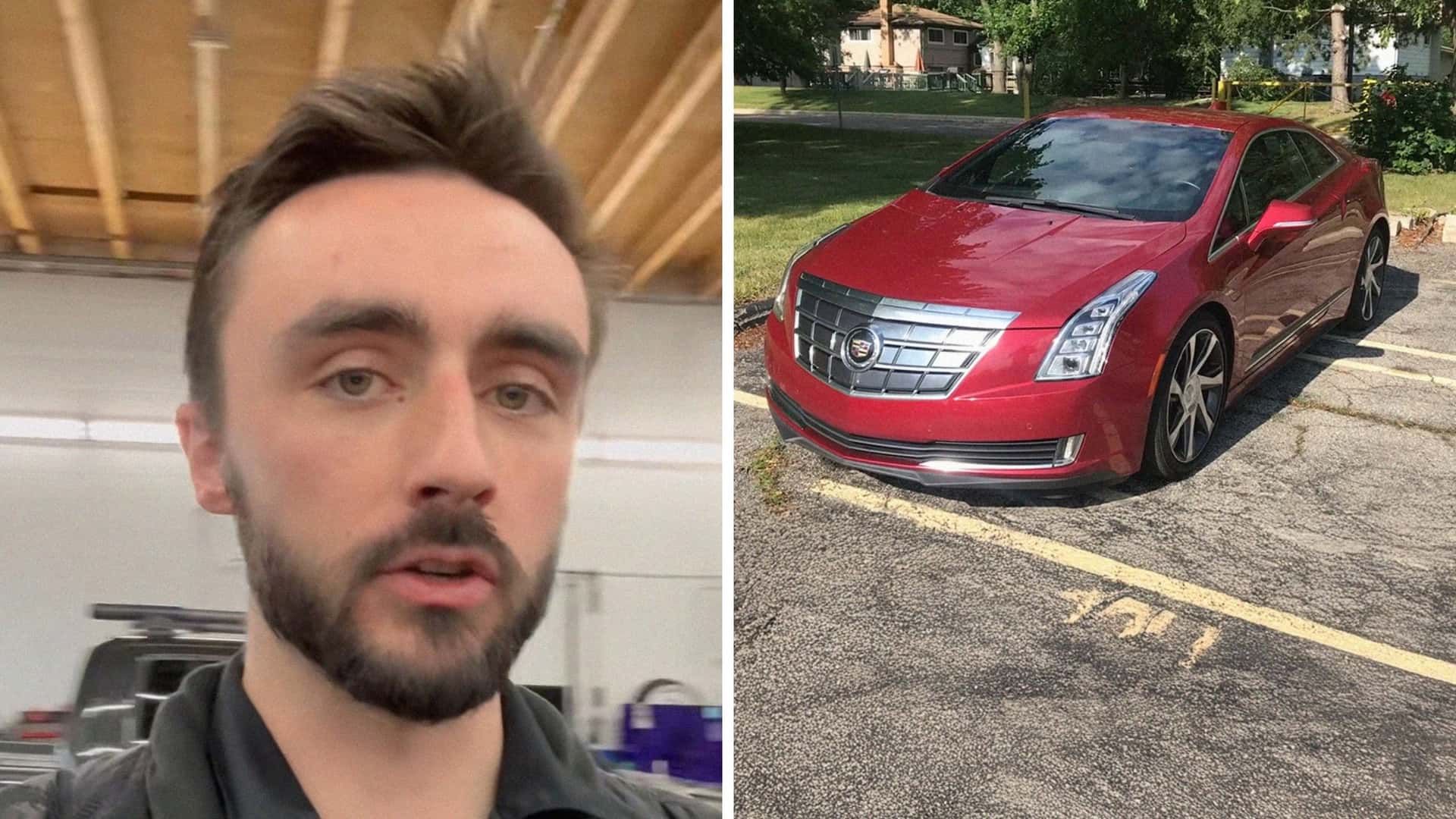
At first glance, the car looks like just another sleek Cadillac coupe parked in a repair shop. But open the hood, and it reveals an idea that keeps resurfacing in EV debates: an electric vehicle with a gasoline engine that never touches the wheels. It’s not a prototype. It’s not a concept car. It’s a production model most people forgot existed.
The Cadillac ELR is the humble star of a recent viral TikTok clip from the repair techs at Darrell’s Point S Tire & Auto (@darrellspoints) in Utah. The vehicle is in the garage for an undisclosed repair or maintenance job, and it becomes something of a curiosity for the staff.
“There were only 3,000 of them made, and they actually do have a gasoline engine that generates power for the hybrid battery,” the unidentified narrator shares in the clip that’s been viewed more than 9,500 times. “It was maybe just a little bit ahead of its time. See, production of these things ended in 2016, long before sort of the EV or hybrid boom.”
What makes the Cadillac ELR so confusing and fascinating is that it occupies a narrow technical category most consumers never fully understood. While many commenters immediately labeled it “just a Prius,” the ELR wasn’t a conventional hybrid at all.
Instead, it used a series hybrid, or range-extended EV, configuration. The car’s wheels were driven exclusively by an electric motor. The onboard gasoline engine is never mechanically connected to the drivetrain. Its sole job was to act as a generator, producing electricity once the battery was depleted. That electricity either powered the motor directly or topped up the battery, depending on operating conditions.
This distinction matters, even if it sounds academic. In a traditional hybrid like the Toyota Prius, the gasoline engine can directly drive the wheels, work alongside the electric motor, or switch roles depending on speed and load. In the ELR, the gas engine was essentially a rolling power plant. For drivers, the experience remained electric-first, with instant torque and quiet operation, even after the engine kicked on.
Luxury Spin on the Chevy Volt
Underneath its angular coupe styling and premium interior, the ELR shared much of its DNA with the Chevrolet Volt, GM’s far more successful plug-in vehicle. The Volt debuted in 2010 and went on to sell roughly 177,000 units globally through the end of production in 2019.
Viral bits from across the social media landscape
Our team of experts tracks what’s trending so you don’t have to—from viral videos to online debates that have everyone talking.
The ELR used a similar powertrain architecture and battery capacity, offering roughly 35 to 40 miles of all-electric driving before the generator engaged. While the Volt was marketed as an efficiency-forward, tech-savvy solution for mainstream buyers, the ELR arrived as a $75,000-plus luxury coupe at a time when Cadillac buyers weren’t exactly clamoring for experimental electrification.
The TikTok’s comment section reads like a crash course in transportation history. Viewers invoked diesel-electric locomotives, transit buses, and even ships, all from industries that have relied on generator-fed electric drivetrains for decades. They weren’t off the mark, since series hybrid systems are proven, durable, and often more efficient in heavy-duty applications where torque and steady-state operation matter more than outright speed.
For many drivers, the logic feels obvious: use electricity for daily driving, avoid range anxiety on road trips, and rely on a small engine only when necessary. The frustration voiced in the comments reflects a lingering sense that the industry zigged when it should have zagged.
Automakers did try. BMW offered a small range-extender engine on early versions of the BMW i3, though it was eventually discontinued as battery technology improved. Mazda publicly explored a rotary-engine range extender concept. GM itself shelved the Volt platform as it pivoted toward fully electric architectures like Ultium.
Ahead of Its Time, Or Just Poorly Timed?
The ELR’s failure wasn’t due to flawed engineering. By most technical measures, it worked exactly as intended. The problem was timing, pricing, and perception.
When production ended in 2016, EVs were still a niche market. Public charging infrastructure was sparse, battery costs were high, and gas prices were relatively low. At the same time, American buyers were still warming up to the idea of smaller engines and electrification in general. Ford’s turbocharged EcoBoost engines were still controversial, and the notion of a four-cylinder or hybrid powertrain in anything aspirational was often met with skepticism.
Against that backdrop, a quiet, electrically driven Cadillac coupe that occasionally fired up a four-cylinder generator was a tough sell. It asked buyers to understand a new category before they were ready to care.
A decade later, the context has changed. Battery costs have fallen, EV adoption has surged, and concerns about charging access are driving renewed interest in hybridized solutions.
That’s why companies like Edison Motors are attracting attention with diesel-electric truck designs that echo the same principles used in the ELR.
Viewed through today’s lens, the ELR feels less like a failure and more like a preview. It wasn’t the wrong idea. It was the wrong car, at the wrong price, for the wrong moment in automotive culture.
That’s what makes the TikTok clip resonate. The question it poses—why not just attach a generator to an EV?—keeps coming back because it still feels unresolved. The Cadillac ELR shows that the industry didn’t ignore the idea. It tested it, refined it, and quietly moved on.
InsideEVs reached out to the creator via email and direct message. We’ll update this if he responds.
We want your opinion!
What would you like to see on Insideevs.com?
– The InsideEVs team