Tesla has had a rough couple of years. Between its stagnating sales, the Cybertruck’s failure to fix that and Elon Musk’s sinking reputation among the company’s core buyer demographic, it’s tough to deny that.
Despite it all, the company has retained an astonishing stranglehold over America’s EV market. And the latest sales numbers prove it.
The must-read briefing on the future of cars, delivered daily.
Welcome back to Critical Materials, your daily roundup of the biggest stories shaping the high-tech evolution of the car business. Also on my radar today: We know how electric car sales fared in 2025 as a whole, and it’s not as dire as you might think. Plus, BMW is bringing the heat to Mercedes.
Let’s jump in!
25%: The Tesla Model Y Reigns Supreme

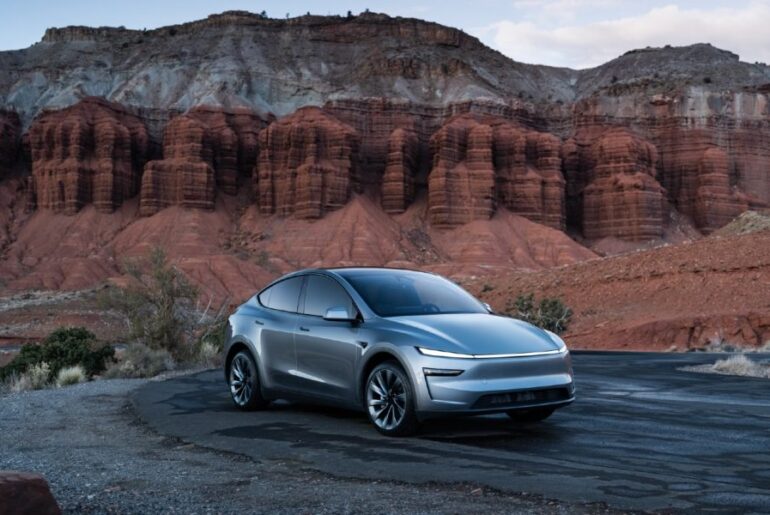
The Tesla Model Y was America’s most popular EV by far in 2025.
Photo by: Tesla
If you just read the most sensational headlines, you might think Tesla is dead in the water. But its Model Y crossover is still America’s most popular EV. And it’s not even close.
In 2025, Tesla sold over 357,000 Model Ys in the U.S., according to estimates out Tuesday from Cox Automotive. (Tesla doesn’t break out its sales by region, so we have to go off of third-party analyses.) That’s a 4% decline from 2024, when Tesla sold an estimated 373,000 Model Ys.
Despite the dip, Tesla’s crossover accounted for 28% of all U.S. EV sales in 2025. And it claimed a whopping 39.5% market share in the final quarter of the year.
The company has steadily lost share in the face of growing competition from cars like the Cadillac Lyriq, Hyundai Ioniq 5 and Ford Mustang Mach-E. But it’s still the king. The Tesla Model 3 came in second place in 2025, with approximately 192,000 units sold. Roughly four in 10 EV buyers last year went home in a Model 3 or a Model Y.
Third place went to the Chevrolet Equinox EV. GM says it sold 57,945 of those last year. And a couple of other non-Teslas wound up close to that too. The gulf between Elon Musk’s firm and the rest is immense.
Arguably, this is a sign of an unhealthy and immature market. But it’s also a good sign for the electric car space as a whole, and I’ll explain why.
Every time somebody implies that Americans “just don’t want EVs,” I think of the Model Y. The fact that the Model Y sells in such huge numbers, and has for years now, is a strong rebuttal of that narrative. People do want to make the switch, as long as it’s to an EV that doesn’t feel like a compromise. And even years after its launch, the Model Y is still one of the easiest EVs to live with—hands down. It’s why I argued recently that Tesla should get back to making cars.
50%: Where Did EV Sales End Up In 2025?
The Chevy Equinox EV was one of America’s best-selling electric cars last year.
Photo by: Mack Hogan/InsideEVs
What about the electric market as a whole? Cox’s figures shed some light on how EVs finished out 2025, and the results may not be as grim as you think.
To recap: EV sales soared in the third quarter of last year as buyers rushed to claim that sweet, sweet $7,500 tax credit. Then, as everyone predicted, the market crashed in Q4. That was mainly because so many people pulled forward purchases they would’ve otherwise made later.
“2025 unfolded largely as anticipated, with changes to federal EV incentives reshaping the demand patterns that drove record Q3 sales,” Stephanie Valdez Streaty, director of industry insights at Cox, said in a statement.
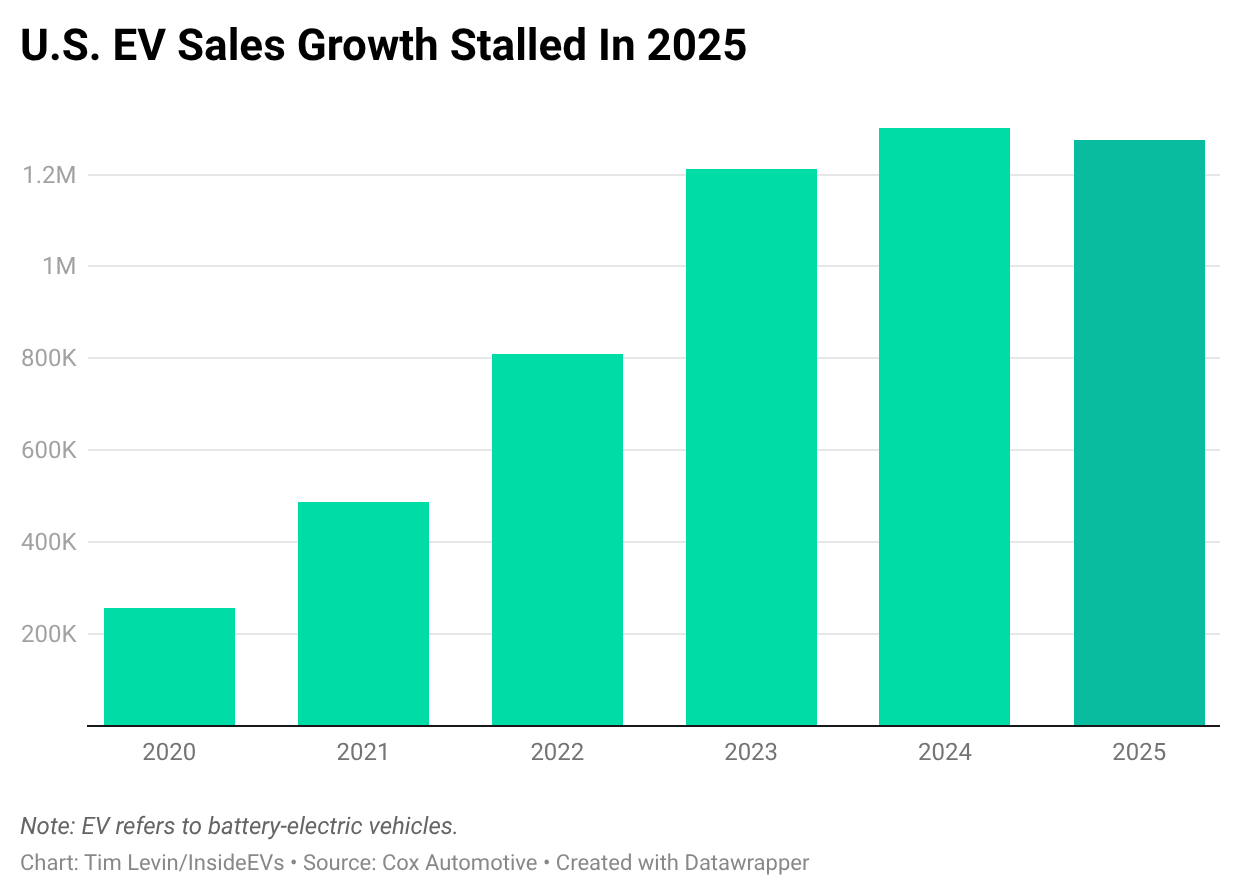
Photo by: Tim Levin/InsideEVs
The boom-and-bust cycle left EV sales ever so slightly down year-over-year. In 2025, Americans bought 1.28 million new electric cars, about a 2% drop from 2024. At the end of the day, given the models that were canceled and the hoopla around demand tanking, that’s not a terrible result.
But it’s not great news for America’s EV space either. Moves by Congress and President Trump to roll back pro-EV policies and clean-air standards put an end to several years of rapid expansion. In 2020—not all that long ago—around a quarter-million electric cars hit the road in the United States. And things exploded from there until sales peaked in 2024.
Cox expects the electric share of the market to be roughly flat again in 2026, as car companies react to the new policy environment.
“Cox Automotive believes EV sales will increase in the long run, and the U.S. market will become more electrified in the coming decade, with product innovation and infrastructure improvements supporting gradual sales growth,” the firm said.
75%: BMW Beats Mercedes
BMW’s EV sales are growing. Mercedes-Benz’s are shrinking.
BMW and Mercedes are locked in an eternal battle to be the German luxury carmaker. As far as EVs are concerned, BMW has a healthy lead.
As Bloomberg pointed out this week, the gap between the two companies’ EV sales is widening. Last year, Mercedes sold 168,800 battery-electric vehicles, a 9% drop from 2024. BMW shipped a whopping 442,072, a slight increase.
BMW largely got things right with its electric portfolio. Mercedes’ EQ cars didn’t quite hit, and so it went back to the drawing board. Now both companies are coming out with next-generation, clean-slate EVs in 2026. For Mercedes, the tip of the spear is the CLA. For BMW, it’s the iX3. The early verdict on both of those models is good, based on testing by Patrick George and me, respectively.

In the coming years, those cars and their platform mates will decide whether Mercedes begins to catch up—or BMW keeps pulling away.
100%: Who Are You Betting On?
Will BMW keep eating Benz’s lunch here? Or does Mercedes have what it takes to come out ahead?
Contact the author: Tim.Levin@InsideEVs.com
We want your opinion!
What would you like to see on Insideevs.com?
– The InsideEVs team