A court case in which an electric vehicle driver claimed his car moved on its own because of a fault, killing a young boy, has shone a spotlight on the safety of EVs.
Ashenafei Demissie, 53, was behind the wheel of a Volkswagen ID.4 when it suddenly accelerated forward outside his home in south London, killing his five-year-old neighbour Fareed Amir and seriously injuring his own 12-year-old son, in November 2022.
After a trial at the Old Bailey, he was found not guilty of causing death and serious injury by careless driving, though the case did not identify any specific issues with the car involved.
During the case, jurors were not told that as a result of publicity, a dozen EV drivers got in touch with case lawyers to report concerns about their cars, including some with the same model that Demissie had been driving.
What happened?
In November 2022, minicab driver Demissie was behind the wheel of a Volkswagen ID.4 when it suddenly accelerated forward, killing Fareed and seriously injuring his own son.
The 53-year-old was prosecuted for causing death and serious injury by careless driving.
The prosecution had said Demissie had inadvertently pressed the accelerator pedal, but the defendant insisted he had not touched the accelerator at the time of the incident and claimed the car had moved forward by itself, possibly because of a software malfunction.
A police traffic collision investigator said he could find no evidence of a fault with the vehicle and it was a case of “pedal misapplication” by the defendant, but under cross-examination, he admitted that he was not a computer expert nor a software engineer.
Demissie was found not guilty by a jury on Monday (12 January).
How safe are electric cars for pedestrians?
Concerns around how safe electric cars are around pedestrians aren’t necessarily new.
Once described as ‘silent killers’, safety concerns around EVs have often related to how quiet they were – with some concerned they posed a danger to pedestrians, especially those with visual and hearing impairments.
However, UK and EU regulations, which came into effect in 2019, meant that all new electric and hybrid vehicles had to be equipped with an Acoustic Vehicle Alerting System (AVAS), which emits a sound when the vehicle is travelling at low speeds to alert pedestrians and cyclists. Many existing cars have also been retrofitted with this system.
In 2024, a study by researchers at the London School of Hygiene & Tropical Medicine (LSHTM) suggested that pedestrians were twice as likely to be hit by an electric or hybrid-electric car than a petrol or diesel car.
The researchers analysed Road Safety Data (STATS19) datasets, which hold all reports of pedestrians injured by collisions with cars or taxis in Great Britain between 2013 and 2017.
They found that of the 96,285 pedestrians who had been hit by a car or taxi, 74% (71,666) were hit by a petrol or diesel vehicle, and 2% (1,652) were hit by an electric or hybrid-electric vehicle. The propulsion of vehicles involved in the other 24% (22,829) of collisions was not recorded.
The researchers calculated the average annual casualty rates of pedestrians per 100 million miles for electric or hybrid-electric cars/taxis was 5.16 and for petrol or diesel cars/taxis was 2.40 – suggesting that electric or hybrid-electric vehicle collisions with pedestrians were on average twice as likely.
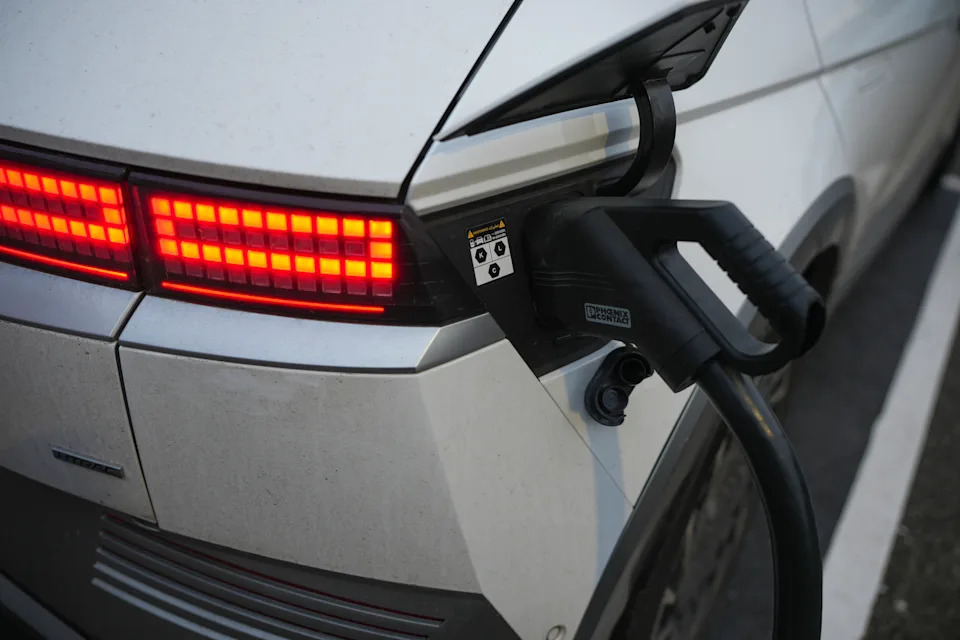
Research has suggested EVs aren’t any more dangerous to pedestrians than conventional cars. (Getty)
However, in December a study published by the University of Leeds found that electric vehicles are no more dangerous to pedestrians than traditional petrol or diesel cars.
The research into UK collisions involving pedestrians and cars found no significant difference in the pedestrian casualty rates between EVs and conventional vehicles and also found that in the case of crashes, injuries sustained by pedestrians were no more severe when caused by an EV than a non-electric car – despite the heavier weight of EVs.
The paper ‘Comparing pedestrian safety between electric and internal combustion engine vehicles’ by Zia Wadud, Professor of Mobility and Energy Futures at Leeds, found that with around 250 billion miles driven by cars in the UK each year, the average pedestrian casualty rates were 57.8 for EVs and 58.9 for non-electric vehicles, per billion miles of driving, between the years 2019 and 2023.
Professor Wadud, based in the Institute for Transport Studies and School of Chemical and Process Engineering at Leeds, said: “There were two worries about EVs and road safety. First, whether EVs would increase the number of collisions with pedestrians because they were quieter than traditional vehicles.
“Second, where there is a collision, whether the injuries to the pedestrians would be more severe when involving an EV because the vehicles are heavier. Our results show that this is not the case.”
In a blog post in 2024, Chris Pateman-Jones, CEO of Connected Kerb, argued that electric vehicles’ ‘one pedal’ mode capability, which enables the vehicle to start braking as soon as the driver lifts their foot from the accelerator, before it’s put down on the brake pedal essentially helps to reduce reaction time and reduce risk of accidents, though he admitted there was “limited data on this topic”.
He also suggested that the need to charge an EV meant that drivers are more likely to take frequent breaks on long journeys, improving safety, which arguably would include when they are around pedestrians.
“Charging breaks mean EV drivers are more likely to take pitstops more often, refreshing themselves and having an increased level of focus and therefore safety,” he wrote.
Which EVs have a high safety rating?
According to a safety rating system created by Euro NCAP (European New Car Assessment Programme), an independent organisation that crash-tests new cars and assigns them a rating from zero to five stars, the Mercedes Benz CLA ranks highest for safety among all EVs, followed by the firefly, the Tesla Model 3 and the Tesla Model Y.
The safety ratings are determined from a series of vehicle tests, designed and carried out by Euro NCAP, which are said to represent, in a simplified way, important real-life accident scenarios that could result in injured or killed car occupants or other road users.
The safety rating is based on assessment in four areas:-
Adult Occupant Protection (for the driver and passenger);
Child Occupant Protection;
Pedestrian Protection which has been expanded to include cyclists and is now known as Vulnerable Road User (VRU) protection; and
Safety Assist, which evaluated driver-assistance and crash-avoidance technologies.
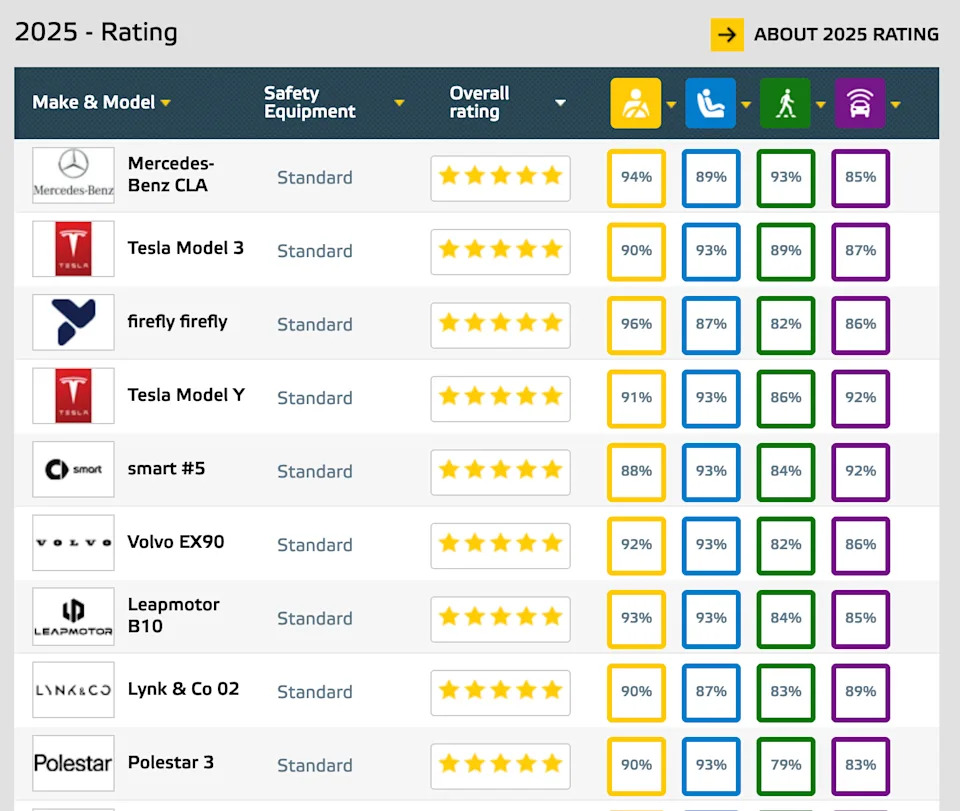
Euro NCAP safety ratings assess vehicles on various safety aspects. (Euro NCAP)
Other electric vehicles that were awarded five stars in the latest ratings include models from popular manufacturers including: Volvo, MAZDA, Porsche, Mini, Skoda, Hyundai, Kia, VW, Toyota, Peugeot.
Euro NCAP notes that the number of stars reflects how well the car performs in Euro NCAP tests, but it is also influenced by the safety equipment that the vehicle manufacturer offers in each market.
“So a high number of stars shows not only that the test result was good, but also that safety equipment on the tested model is readily available to all consumers in Europe,” it says on its website.
“The star rating goes beyond the legal requirements and not all new vehicles need to undergo Euro NCAP tests. A car that just meets the minimum legal demands would not be eligible for any stars. This also means that a car which is rated poorly is not necessarily unsafe, but it is not as safe as its competitors that were rated better.”
What has Volkswagen said?
During Demissie’s trial at the Old Bailey, Metropolitan Police traffic collision investigator Mark Still told the court he had examined the vehicle in December 2022 and couldn’t find any evidence of a fault.
He told jurors: “I was unable to find any defect that contributed to the collision and I was unable to make the car accelerate without the driver driving.
“I found no faults with the operation of the vehicle, including steering, brake and acceleration.
“I was unable to make the vehicle move without any additional input. You had to make an action to make the vehicle move.”
The officer described a “phenomenon” relating to a number of previous collisions in which drivers had claimed their vehicles had accelerated when they believed they had been braking.
He said: “They have put their foot on the wrong pedal. The result of that is the car will start moving. Because the driver thinks they have their foot on the brake, they will likely press harder to make it stop…It spirals out of control.”

The recent case centred around a Volkswagen ID.4. (Getty)
He told the court he had concluded the collision was a “case of pedal misapplication”, adding: “The fault alleged could not be replicated.”
Asked by the prosecution what had caused the car to move forward, he said: “Input by the driver was the only way I could make the car move. No faults were identified on the car that would make it move.”
However, under cross-examination, he agreed that he was not a computer expert or software engineer and had no way to test the software, but said he had considered whether there could have been a mechanical failure, which would include an electrical fault.
The case is not the first time the spotlight has been shone on the car manufacturer over its EVs, with class-action lawsuits filed in the US focusing on the ID.4 SUV’s touch-sensitive steering wheel controls that plaintiffs suggested trigger unintended acceleration, causing crashes and damages.
The lawsuits allege that hypersensitive, capacitive steering wheel buttons for features like Adaptive Cruise Control can be accidentally activated by a light touch, causing sudden lurching or unintended acceleration.
Volkswagen declined to comment when approached by Yahoo News.