Not just a green push
For the longest time, electric vehicles have been marketed to buyers as the environmentally friendly alternative to our everyday gas-powered cars. Companies like Tesla transformed this pitch from a niche proposition into a mainstream movement, with Elon Musk’s brand being eternally linked with the EV revolution. Its early success helped push legacy automakers and new manufacturers to pivot and develop their own zero-emission vehicles.
Actual policy only helped accelerate this push, as sweeping initiatives regarding EVs at the Federal level significantly influenced the auto industry as a whole. The EPA imposed stricter emissions standards designed to promote the sale of new electric vehicles. In addition, the 2022 Inflation Reduction Act offered substantial tax credits of up to $7,500 for new EVs, which made electric vehicles more attractive to American car buyers. However, the landscape has shifted dramatically under today’s current leadership, as they have moved quickly to reverse course on electric vehicle policies.
Patrick T. Fallon / AFP via Getty Images
Lucid CEO: Buyers want space and power, not the eco-lecture
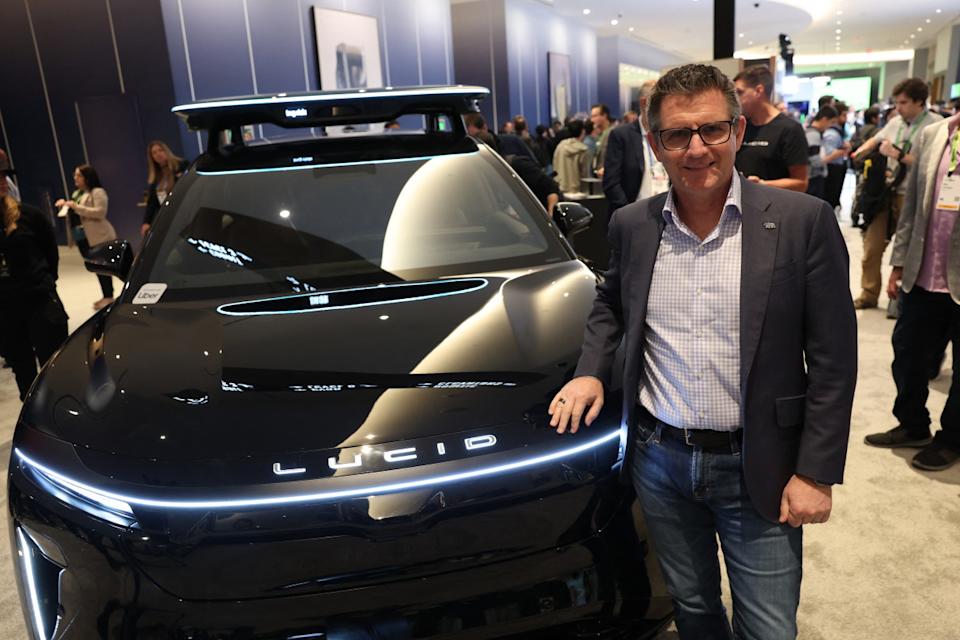
In an interview with InsideEVs on the floor of the 2026 Consumer Electronics Show (CES) in Las Vegas, Marc Winterhoff, the interim CEO of Lucid Motors, said that while EVs are a “better platform,” automakers haven’t pivoted very far from pitching them as purely environmentally-friendly, gas-free cars. He argues that in an environment where today’s mainstream car buyers are looking for value, EV companies can do more to show that their models offer more than the equivalent gas-powered cars.
“I think what we need to do is better explain the superiority of that technology, versus what we have unfortunately done,” he said, referring to the EV industry as a whole.
Using the $94,900 Lucid Gravity Grand Touring as an example, Winterhoff argued that, spec-for-spec, his car is a more compelling choice against luxury competitors from mainstays like BMW and Mercedes-Benz, as well as more expensive examples from prestigious marques.
“When you look at the specs, our actual competitors are the Mercedes-AMG GLS 63 or the likes of the BMW X7 M60i. Throw in a Lamborghini Urus, if you want, and the Porsche Cayenne GTS and the Range Rover SV. And when you compare the specs, acceleration, interior space, and range, the Gravity has the highest range,” he said. According to the EPA, the Gravity Grand Touring has an estimated range of 450 miles, while the gas options offer combined fuel economies of 17-19 MPG.
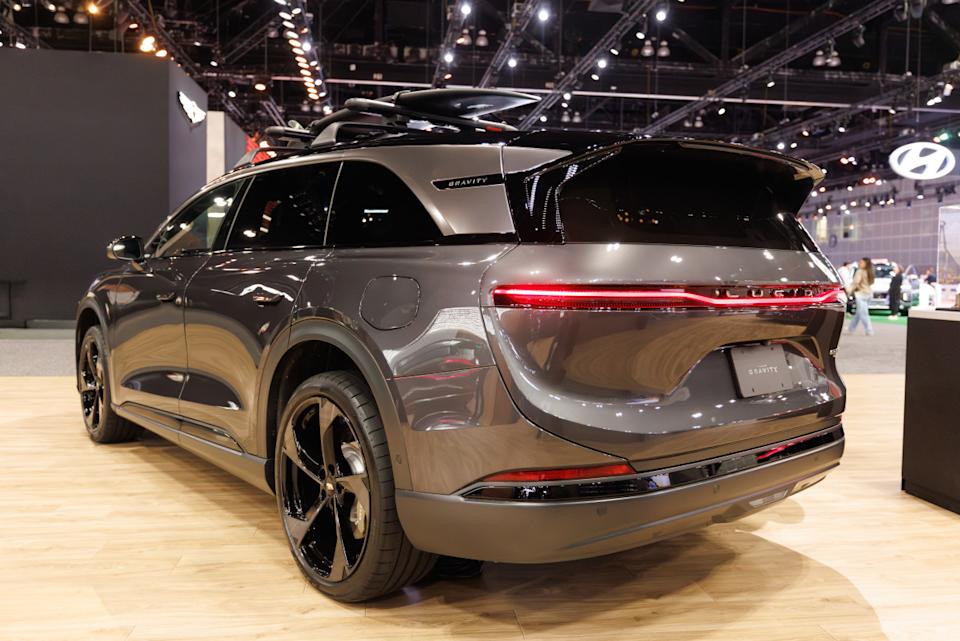
Photo by Josh Lefkowitz/Getty Images
New survey shows that buyers are not keen on EVs, but on value
New data about U.S. car buyers suggests that Winterhoff’s proposal may be beneficial to the industry, as consumer interest in EVs remains at single digits. According to Deloitte and its 2026 Global Automotive Consumer Study, just 7% of U.S. car buyers told the accounting firm and management consulting specialists that they plan on buying an electric vehicle for their next car, while an overwhelming 61% said that they want cars powered by conventional gas-or diesel-powered internal combustion engines (ICE).
At the same time, they found that value and “bang-for-your-buck” attributes are heavily influencing U.S. car buyers to switch from one car brand to another. Just 45% of buyers said that their vehicle was from the same brand as their last one, and 53% of U.S. buyers surveyed said that they plan on choosing a model from a different automotive brand for their next car. In addition, they found that the most important factors that drive U.S. consumers’ choice of car brand are quality (58%), vehicle performance like fuel economy or electric range (51%), and price (46%).
Although his example is centered around one automaker and an expensive luxury SUV it sells, Winterhoff noted that automakers that offer electric vehicles need to switch up the way they talk about their EVs, as customers’ needs have shifted.
“We have said, ‘EV is sustainable, and ICE is not,’ but if you focus on the specs that you get, I think that’s what we need to do as an EV industry to overcome the current ‘winter’ that we see,” he said.
Final thoughts
In today’s car market, it has become glaringly clear that simply discussing the environmental benefits of electric vehicles (EVs) is not enough to win over consumers. After all, EVs command a premium over gas-powered cars, and with more buyers focused on performance, value, and overall driving experience, automakers really need to highlight cool features, tech, and other attributes apart from fitting an eco-friendly mantra.
As companies like Lucid Motors begin to recognize this shift in consumer behavior, new avenues for EV adoption may emerge. Automakers have a chance to reshape the narrative around electric vehicles by meeting them where they are and addressing their needs for performance and value. In the end, owning an EV can be just as worthwhile as its traditional gas-powered counterparts if it can effectively communicate that.
This story was originally published by Autoblog on Jan 13, 2026, where it first appeared in the News section. Add Autoblog as a Preferred Source by clicking here.