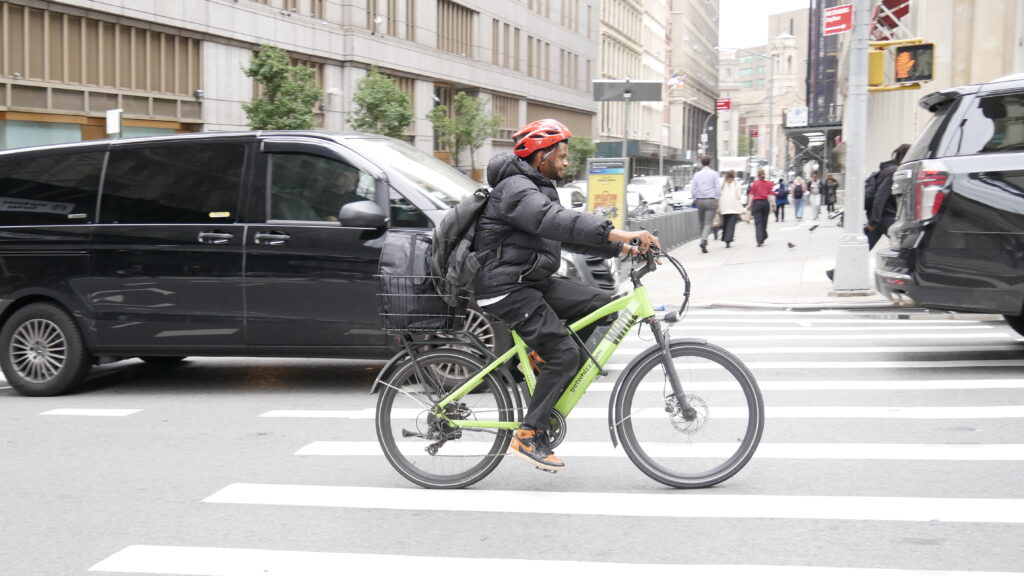
The New Jersey state legislature will vote within days on a revanchist bill that would compel the owners of low-speed e-bikes to register their bicycles with the same state agency that regulates four-wheeled vehicles.
The bill, S4834/A6235, requires cyclists to register any class of electric bicycle with New Jersey’s Motor Vehicle Commission — the Garden State’s version of the DMV — and obtain liability insurance for class 2 electric bicycles.
The legislation’s smooth passage through Trenton drew alarm from cycling advocates, who successfully lobbied against an even more backwards version of the legislation that would have applied its requirements to bikeshare networks.
“Drivers are killing people — and our solution is to restrict access to devices that weigh less than 80 pounds and go less than 20 miles per hour?” asked Corey Hannigan of the Tri-State Transportation Campaign.
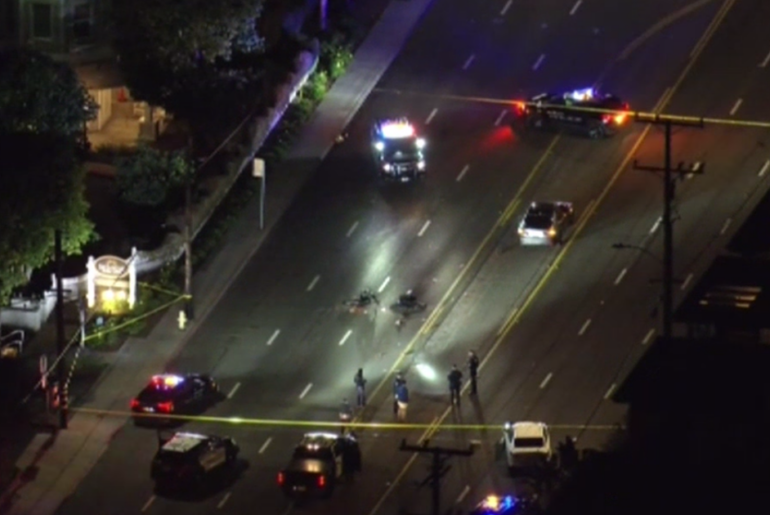
In October, the bill’s sponsor, State Senate president Nicholas Scutari (D-Union County), told reporters that he wanted to do something to rein in e-bikes after high-profile crashes involving them — even though in all instances the victims of the crashes were e-bike riders and the perpetrator of the road violence was a driver. Nonetheless, Scutari cited three cases: a truck driver who killed a 13-year-old boy in Scotch Plains; a motorist who hit and killed a 22-year-old in Orange; and a teenage hit-and-run driver who killed two teen girls.
Scutari introduced his legislation in early November. Last Thursday night, six members of the state Assembly’s 11-member Appropriations Committee voted to send a modified version of the bill to both legislature chambers for a full vote sometime this week.
The modifications exempted bikeshare systems such as Citi Bike, but the bill’s remaining language creates a “huge burden for people who already own e-bikes across the state,” said Hannigan.
New Jersey divides e-bikes into three classes. Class 1 are pedal-assist bikes that go up to 15 miles per hour; Class 2 are bikes with throttles that go up to 20 miles per hour; Class 3 are pedal assist bikes that can get up to 28 miles per hour. The state classifies Class 1 and Class 2 bikes as “low-speed electric bikes” and Class 3 e-bikes and mopeds as “motorized bicycles.” The latter already requires a license, registration and insurance.
Scutari’s bill allows the owners of Class 1 electric bikes to refrain from buying insurance, while preserving the requirement for state registration. It also prohibits online retailers from selling any kind of electric bike in New Jersey for an entire year after its passage. The bill does not specify how the state would enforce this ban, and Scutari did not respond to Streetsblog’s request for clarification.
“You can see how poorly thought out and rushed this is,” said Hannigan. “People feel like there’s this wave of e-bikes coming to take over the state, and they want to do something about it, and we’re offering solutions, but they’re not giving us enough time to actually work with the legislation and write good policy.”
Hannigan said the Tri-State Transportation Campaign persuaded Scutari to adopt one of its policy recommendations: prohibiting the sale of kits that modify Class 2 e-bike speed governors to make them faster and more dangerous. As with the online sales ban, however, the updated bill does not explain its mechanism of enforcing this ban, either.
Jack McKee, a campaign organizer with Hudson County Complete Streets, hopes legislators will alter the bill ahead of next week’s vote. McKee moved to Jersey City in 2023 and testified against the bill at Thursday’s hearing. “I got rid of my car insurance because I have e-bike access,” he said.
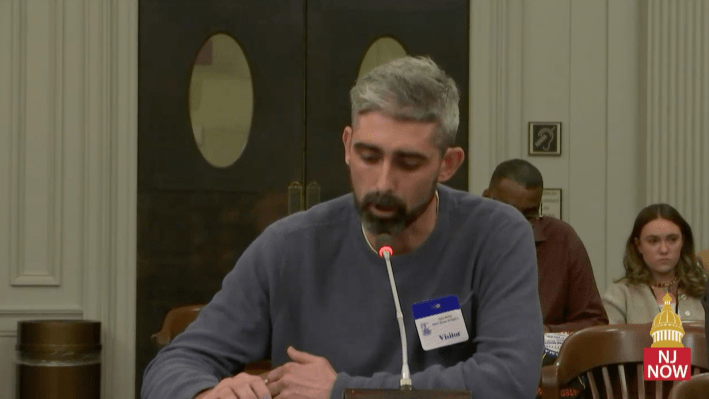 Jack McKee testifies at the Assembly Appropriations Committee hearing against e-bike registration legislation.Screenshot: NJ Now
The bill’s biggest issue remains the most obvious one: it does absolutely nothing to contain the deadliest road users. “The main problem is that drivers are running over teenagers and killing them, whether they’re on a bike or on an e-bike,” said Hannigan. “There’s no safe place to ride a bicycle in suburban New Jersey.”
Another activist stressed that high-speed “e-motos” — which resemble e-bikes and are often marketed as such — have given regular e-bikes a bad name.
“This bill is literally throwing the bicycle out with the bathwater,” testified Doug O’Malley, the state director of Environment New Jersey. “This bill is trying to address e-motos, it’s trying to address vehicles moving at a high rate of speed. But … Class 1 and Class 2 are below 20 miles per hour. Many of the instances that have risen into headlines [are] e-motos.” Such “e-motos” are not street-legal in New Jersey.
Recommended
The bill doesn’t address the state’s existing bureaucratic mess, either. In theory, existing state law mandates that owners of Class 3 bikes register their rides with the Motor Vehicle Commission. In practice, however, the MVC is not equipped to process these registrations. Residents testified at prior hearings that the agency has not yet caught up with the law for Class 3 bikes. They doubted that a new registration scheme would be any different.
“I have five bikes, three are Class 3, and I tried [to register them],” said Bruce Fletcher, a retired state law enforcement officer who testified against the bill in December. “They told me, ‘Oh we don’t do that, it’s not happening.’ If this bill turns into law, it’s going to mess everybody up.”
When questioned by Streetsblog, the MVC did not offer an explanation for Fletcher’s situation and declined to comment on the pending bill.