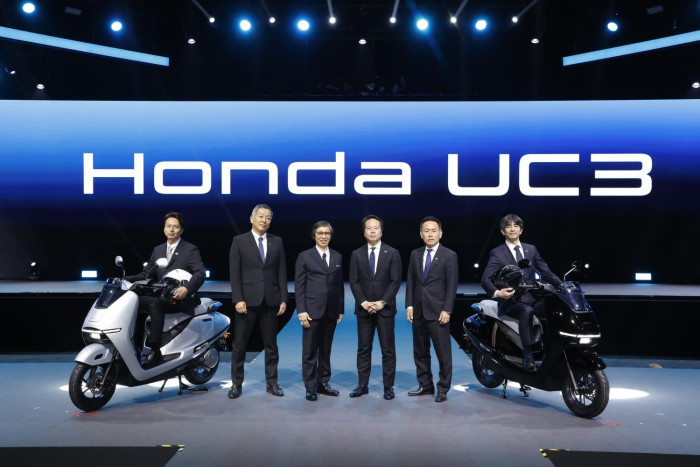
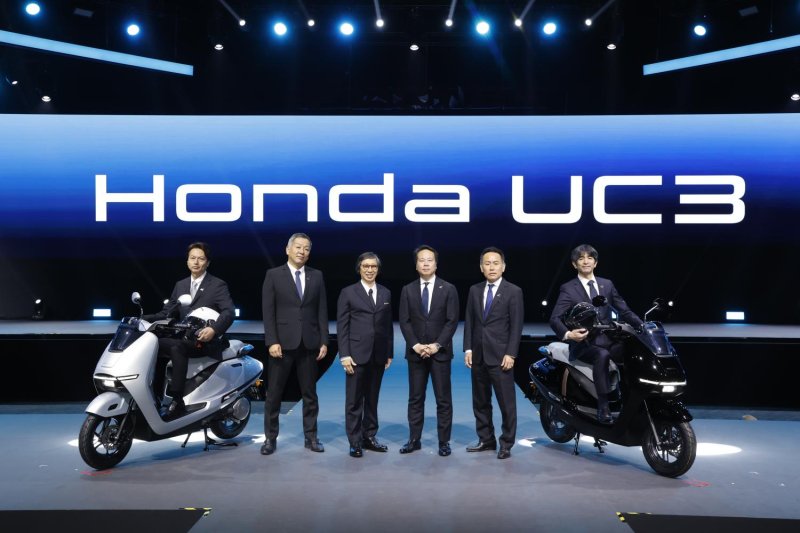
Mr Shimizu, second left, and Mr Mihara, third right, launch Thai Honda’s first electric motorcycle in Bangkok.
Thai Honda, a leading manufacturer and distributor of motorcycles and multipurpose engines, has unveiled its first electric motorcycle in Thailand, marking a major step in the company’s strategy and positioning the country as a key export hub.
The new model, UC3, was designed by a Thai engineer and is scheduled for production at Thai Honda’s local factory.
The company plans to begin exports to Vietnam later this year, according to Daiki Mihara, executive in charge of motorcycle and power product electrification at Honda Motor, the parent company of Thai Honda.
“Thai Honda was granted approval to join the government’s EV3.5 scheme,” Mr Mihara said, referring to Thailand’s incentive programme that provides subsidies of up to 10,000 baht per electric motorcycle priced less than 150,000 baht with at least a 3 kilowatt-hour battery.
The scheme, running from 2024 to 2027, also includes tax cuts to encourage local electric vehicle production and adoption.
Yuichi Shimizu, president of Thai Honda, said the company wants to launch 11 new motorcycle models this year, including both internal combustion engine (ICE) and electric models.
The UC3, priced at 132,000 baht, offers a range of 122 kilometres per charge.
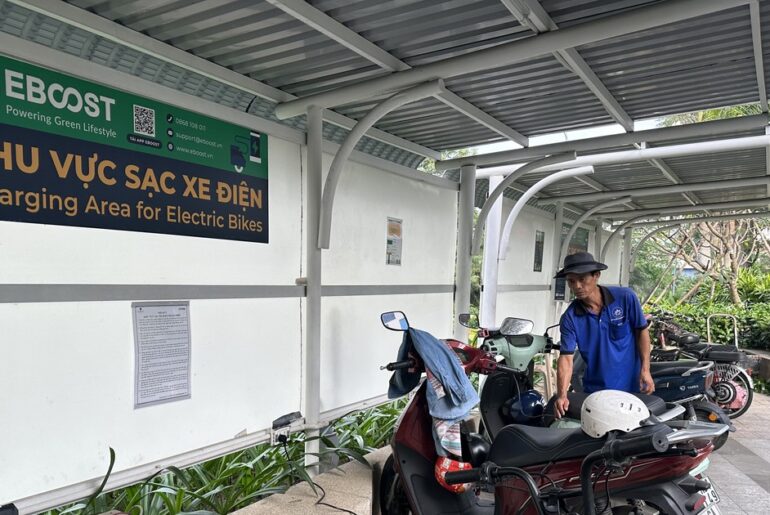
To support the rollout, Thai Honda plans to expand charging infrastructure nationwide.
Nattachai Srisowanna, chief executive of Thai Honda’s business planning group, said the company will increase charging outlets to 460 locations in 230 areas this year.
The company plans to partner with Tesco Lotus and Central Group to install stations at community malls. The investment in charging services is estimated at 100 million baht, he said.
Thai Honda is also conducting a feasibility study on establishing a motorcycle battery recycling plant under Honda’s global circular value chain strategy, aiming to meet growing demand for sustainable battery solutions.
According to the company, Thailand’s total motorcycle sales tallied 1.73 million units last year, with projections for 2026 ranging between 1.68-1.73 million units.
Mr Shimizu noted high household debt and an economic slowdown continue to pressure the domestic market, as banks tighten lending criteria to avoid non-performing loans.
Thai Honda predicts its sales to reach 1.36-1.40 million units this year, slightly down from 1.40 million last year.
Honda sold 21 million motorcycles globally in 2025, capturing a 40% market share.
The company set an ambitious target of 60 million units by 2030, combining ICE and electric models.