
by Laura Garber
The year 2025 brought news of devastating fires, and troubling incidents involving minors on e-bikes. But the year also saw Hermosa Beach children becoming published authors, local bands releasing new albums and playing major first-time stages, and a balanced City budget.
Even as conflict dominated the broader conversation, evident in heated City Council debates, the heart of Hermosa Beach kept beating: neighbors rallied behind plans for a public pool and dog park, volunteers showed up for beach cleanups and perhaps most tellingly, locals continued the community’s most endearingly Hermosa traditions: Independence Day Ironman, Fiesta Hermosa, and the holiday’s sand snowman building competition and Surfing Santa.
The top ten news stories of Hermosa Beach serve as an archive of change reflecting what it means to live in a small, tight-knit beach city.
Reckless e-bike riding and alleged assault charges draw national spotlight
An alleged assault in late November, involving 13 to 15-year-olds on e-bikes near 11th Court in downtown Hermosa Beach, has become part of a multilayered national conversation on the impact of reckless e-bike riding in neighborhoods.
The subsided threat of e-bikes and their slow gain of public acceptance was reported in 2024.
“Stepped up traffic enforcement, accompanied by stiff fines, and technology all contributed to their broader tolerance,” Easy Reader wrote.
But the troubles of reckless riding, which some residents claim is high among youth, came back in full swing for 2025. Residents urged Mayor Rob Saemann at his October 6, Town Hall, before the attack, to implement more enforcement to stop reckless e-bike riding. Mayor Saemann suggested hiring contract enforcement officers.
“I remember 10 or 20 years ago, we used to have regular patrols on bikes, at least two policemen,” he said at the Town Hall. “I would like to recommend now and say, why can’t we put two police officers on The Strand again?”
During the event, then interim City Manager, Steve Napolitano organized a public safety forum to be held on November 1. Hermosa Beach Police Department’s Chief Landon Phillips spoke at the forum about e-bike enforcement data and officer resources.
KTLA broke the November 21 assault, broadcasting surveillance footage allegedly showing the teens beating a 57-year-old resident unconscious.
Residents pressed the Hermosa Beach Police Department for updates on the investigation and to make arrests in connection with the alleged assault.
HBPD responded with three community updates, one of which sent social media comments into a fury after some inferred the update placed blame on the victim.
“The HBPD’s ongoing investigation has determined that the November 21 incident was not a targeted assault,” the department’s press release read. “And that the resident walked past his intended destination to initiate contact with the juveniles.”
Hundreds of comments on social media questioned the press release.
“This update reflects poorly on your department. It reads like an unsuccessful attempt to change the narrative. Why?” read one Instagram comment.
Attorneys for two of the teens spoke to news outlets claiming the victim had initiated the contact with the minors.
“The early characterizations circulating in the media are inaccurate,” J. Patrick Carey, one of the minor’s attorneys said. “This was not an unprovoked assault, nor was it part of any pattern of coordinated attacks by kids on e-bikes. The evidence will show that the minors reacted when an adult man aggressively confronted and attacked their friend.”
The Hermosa Beach e-bike assault story was also picked up locally by Fox 11 and Los Angeles Times, and nationally by the New York Times and the New Yorker magazine.
In response to the community’s concerns, HBPD stepped up enforcement along Pier Plaza and The Strand. A traffic sign on Pier Plaza now oscillates between ‘No e-bikes on The Strand’ and ‘when under power.’
Two of the seven juveniles involved in the attack have been charged with felony assault charges. Their next court hearing is set for January 12.
STVR Judgment Day
In 2016, Hermosa Beach and Manhattan Beach passed similar short term vacation rental (STVR) bans. The bans were popular with residents who feared neighborhoods would be disrupted by the constant turnover resulting from vacation rentals.
In 2018, Hermosa won a lawsuit challenging its ban on STVRs in the Coastal Zone
The following year, Manhattan lost a lawsuit challenging its ban in the coastal zone.
This past March, Hermosa was again served with a lawsuit challenging its Coastal Zone ban.
At a March Hermosa Beach City Council meeting, then City Attorney Patrick Donegan told the council, “My position is that the city’s STVR ordinance is valid and enforceable.”
The city will find out this coming year. In March, a hearing will be held on the merits of the case before the same judge who ruled in favor of Hermosa in its 2018 STVR case, but who ruled against Manhattan its STVR case a year later.
The Manhattan Beach lawsuit was won by attorney Frank Angel, who now represents the plaintiff in the Hermosa lawsuit.
If Hermosa loses its lawsuit, it can take consolation in the knowledge that Manhattan Beach has been collecting $1 million annually in Transient Occupy Taxes (bed taxes) since lifting its ban.
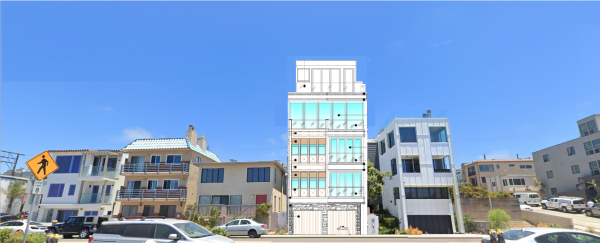 Artists conception of a recently proposed five-unit, 50-foot high residential building in north Hermosa Beach. The owners proposed a 35 foot height building which passed a Planning Commission vote. Illustration by Roger Deuerlein
Community rallied against a Builder’s Remedy project
After a public notice of a 50-foot high remodel caught the attention of residents along the 3400 block of Palm Drive and Hermosa Avenue, dozens of neighbors expressed opposition to the plan before the Planning Commission.
Property owner Tony Ferraro proposed utilizing State Builder’s Remedy legislation to bypass local height and parking zoning requirements. The state legislation is meant to increase affordable housing, though the Ferraro proposal did not include affordable housing,
Neighbors, who packed several planning commission meetings, asked that the largely single family residential character of the neighborhood be protected.
“We have a cautionary tale in the Redondo Esplanade,” Realtor Robb Stroyke told the Planning Commission.
“As a kid I saw one of the most beautiful stretches of the Santa Monica Bay destroyed by eight and 12 story apartments and condominiums that blocked the ocean views of all the cottages behind them,” Stroyke said. “Once you open the floodgates it’s going to destroy our community.”
Resident Elka Worner organized a “grassroots” effort, called “Save Hermosa,” that mailed yard signs to supporters and organized a march along The Strand to raise community awareness.
Ferrao’s architects responded with an alternate design that would bring the proposed 50 foot structure down to 35 feet, just five over the City’s limit. The plan was approved unanimously by planning commissioners at the September 16 meeting.
“I’m in awe, to be honest, I wasn’t expecting that,” Tony Ferraro said after the meeting. “There was a lot of negative stuff said over the months while we were working diligently behind the scenes to come up with a solution to make the community happy.”
“There was one neighbor, in particular, who came to us and said, ‘I see what you’re doing. I think there’s a better way of doing it. You have the community opposed to you.’ He worked really well with us for six months. If it wasn’t for him, I don’t think we’d be here today.”
Ferraro didn’t identify the neighbor.
Starbucks decaffeinated in Hermosa
Then there was one. While only 1% of nationwide Starbucks closed, Hermosa Beach saw all three standalone stores shutter their doors: the shop on Hermosa Avenue and two on Pacific Coast Highway, across the street from one another. The only Starbucks remaining in Hermosa Beach is the kiosk inside Pavilions grocery store in Plaza Hermosa.
 Downtown Hermosa Starbucks barista Julia Kovacs serves regular David Pio. He said he and his dog, Dodger, visit the store almost daily because the employees are “always welcoming and friendly.” Photo by Laura Garber
Despite these closures, Hermosa’s commercial vacancy rate is healthy, according to Tony Cordi, a South Bay commercial real estate broker.
“Contrary to what some people might think, most of the city is a high occupancy area,” he said. “It won’t take long before the Starbucks locations are filled. I wouldn’t be surprised if they are replaced by other coffee houses.”
The late Java Man and Ocean Diner owner, Rick Hankus, commented on the franchise’s abrupt closures earlier this year, “It seemed a little much to have four Starbucks in Hermosa, a little bit overkill. I think it’s better that the independents are not going away.”
But the proliferation of Starbucks did have one benefit, he said.
“People didn’t know what a cappuccino was when I opened 30 years ago,” he said.
Chef-driven restaurants drive out Hermosa nightlife
From roots of a punk, middle class surfburbian fever dream, Hermosa Beach has now joined the class of neighborhoods ushering in chef-driven restaurants for affluent residents and visitors.
Evidence of the upscale shift included removal of the Waterman’s Safe House for Surfers sign on Pier Plaza in September.
Waterman’s will be replaced by Brick and Mortar, whose theme will tap into the 100 year old, Pier Plaza building’s art deco architecture.
“We’ll have more of a Roaring ‘20s, Palm Springs, tropical vibe than a beach vibe,” Brick and Mortar owner Justin Safier said.
Safier also owns Vista, across Pier Plaza from Brick and Mortar.
Brick and Mortar’s chef, Andrew Adams, who is also Vista’s chef, plans a California cuisine menu that will change quarterly, based on the availability of seasonal produce.
At the end of 2024, Vin Folk, a fine-dining restaurant operated by executive chef Kevin de los Santos and chef-partner Katya Shastova, opened on Hermosa Avenue.
 Vin Folk chefs Satya Shastova and Kevin De los Santos prepare half jidori chicken with roasted eggplant chicken jus. Photo by Tony LaBruno
The 2025 Michelin Guide recognized the Vin Folk with its Bib Gourmand designation, a rare honor for such a new restaurant.
In March, AttaGirl, a coastal Mediterranean restaurant founded by chefs Alice Mai, a protege of Manhattan Post chef David LeFevre, opened next to the Japanese-inspired and sister restaurant, RYLA.
Restaurant broker Tony Cordi, of the Innate Group, compared the upscale shift in Hermosa restaurants to the shift that began in Manhattan Beach in 2011, when chef Neal Fraser opened The Strand House, and chef LeFevre opened Manhattan Beach Post.
Cordi attributes Hermosa’s shift to high-end restaurants largely to economic and demographic changes.
“Restaurant prices have been flatlining. But rents, and food, and labor costs, keep rising. So restaurants have to raise prices,” he said.
Additionally, Cordi noted, the median home price in Hermosa Beach is $2.2 million.
“Hermosa homeowners aren’t 25 year olds who drink on Pier Plaza on Saturday night,” he said.
Family owned restaurants with distinct geographical cuisine such as Stecca Taverna on Pier Avenue, a Piedmonte inspired Italian restaurant and Coni’Seafood, a Nayarit-style mariscos restaurant on Hermosa Avenue, also debuted in 2025.
Restaurants with artisanal cocktail forward menus, such as the Polynesian inspired Tiki Kai, which opened at the tailend of 2025 on Pier Plaza, also marked the shift toward higher-end clientele.
City Manager Transition Dominates Hermosa Beach’s 2025
The departure of City Manager Suja Lowenthal and subsequent hiring of Steve Napolitano marked Hermosa Beach’s most contentious political saga of 2025, dividing the community and exposing deep rifts within the City Council.
The drama began in April when the Council conducted two marathon closed sessions—totaling over five hours—to review Lowenthal’s performance. Public comment sessions revealed a community split down the middle, with passionate supporters, including recently retired Police Chief Paul LeBaron, praising her leadership, while others calling her aloof and insensitive toward residents
“In my 32-and-a-half years, I’ve never worked for anybody I admire more than her,” LeBaron told the Council, noting he postponed retirement specifically to work with Lowenthal.
The closed sessions concluded with no public action reported, leaving residents in suspense. Days later, on May 8, Lowenthal resigned after nearly seven years as city manager.
The controversy intensified when the Council voted 3-2 to appoint former Manhattan Beach Councilmember Steve Napolitano as interim City Manager in late May. Councilmembers Michael Detoy and Raymond Jackson opposed the appointment, citing concerns about the selection process.
“This Council has lacked transparency from the very beginning,” Jackson declared at a heated July meeting, calling council approval of a $30,000 executive search “a charade,” and arguing everyone knew Napolitano’s permanent appointment was “a done deal.”
Mayor Rob Saemann defended the decision as “the best thing we could have done for our City” and objected to being called a conspirator.
The search ultimately yielded 56 candidates. Three were interviewed. In December, the Council voted 4-1 to hire Napolitano at $270,000 annually — approximately $11,000 less than Lowenthal’s salary.
Jackson again dissented, questioning why compensation was “considered too much money” for the “highly qualified” female city manager but acceptable for someone he deemed “less qualified.”
Napolitano, 59, brings three decades of civic government experience, including five terms on Manhattan Beach’s City Council. He now oversees 150 employees and a $55.5 million budget.
“I think we have a big advantage by having Steve on our team,” Councilmember Michael Keegan said after the vote at the Dec. 9 City Council meeting. “We have some of the toughest fiscal times we’re going to face in our 120-year history.”
Hermosa pins new Police Chief
Landon Phillips was officially sworn in as Hermosa Beach Police Chief in July, marking the first internal chief hire in 24 years. The badge pinning ceremony at the Community Theatre featured a playful moment when Phillips asked officers with Nerf guns to shoot foam bullets at him each time he said “I” or “me,” emphasizing that leadership isn’t about one person.
Phillips and his father Bruce, a retired, 25-year HBPD veteran, became the first father-son duo to serve simultaneously in the department’s 94-year history. Bruce Phillips pinned his son’s badge at the ceremony.
The new chief has implemented expanded defensive tactics training, requiring first-year officers to complete four hours monthly, significantly exceeding the state’s requirement of two hours annually. Department statistics show officer injuries during use-of-force incidents dropped from 35 in 2020-2021 to zero in 2022 following implementation of the Police Grappling Control Techniques program.
 Pinned Hermosa Beach Police chief Landon Phillips, flanked by Captain Eric Cahalan and Acting Captain Joe Polstra. Photos by Danny Mitchell (DannyByTheSea.com)
Phillips plans to establish a dedicated Crime Scene Investigation team and expand the drone program to include Community Service Officers. In March 2024, HBPD received a $1 million federal grant through Congressional Representative Ted Lieu to develop a Real Time Crime Center It is expected to be operational by early-to-mid 2026.
The alleged November e-bike assault involving juveniles led the Chief to address questions from news outlets and the public, including a Public Safety Forum in November and a December City Council meeting to ease reckless driving and safety concerns.
Chief Phillips reported that the crime rate in Hermosa Beach has lowered for the third time in three years.
Saint Rocke closing
The story of Saint Rocke in the last few years achieved an almost mythical arc. From concert hall crucifixions to repeated resurrections, the music venue endured COVID and the promise of new ownership. The national trend toward teetotal patrons was the final nail for Saint Rocke. The new owners said they couldn’t survive failing alcohol sales.
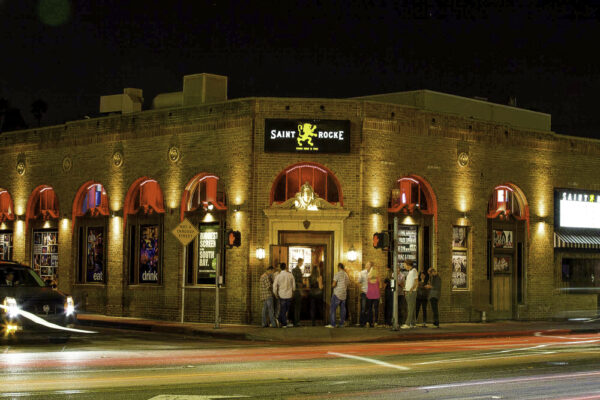 Saint Rocke, April 2018. Photo by Paul Joiner/Saint Rocke
The venue’s New Year’s Day show with Black Flag headlining was an apropos band to kick off a new year celebrating Hermosa’s contribution to culture.
Saint Rocke closed on Saturday, December 6 with a performance by The Spazmatics. The venue faced declining attendance and alcohol sales that dropped more than 40%—trends affecting independent music venues nationwide, according to Larry Little, the former owner.
“The decision to close wasn’t made lightly,” Little said. “We’ve been honored to be part of the South Bay music community, but the economic realities facing independent venues have made it impossible to sustain operations.”
Little cited competition from music festivals like BeachLife and Coachella, which feature multiple bands and leave audiences less inclined to attend local shows. The beach itself proved both the venue’s unique draw and its biggest competitor.
“There is a beach life culture,” Little said. “When the weather’s nice and people have been drinking all afternoon, they may not make it in.”
A local group will take over the lease, though Little couldn’t disclose details. “We really want it to live on for the community,” he said.
For Hermosa to continue its streak of cultural contributions in music, 2026 will hopefully bring a movement to promote the garage-styles of time’s past and uplift the new sounds that define Hermosa Beach. ER