Ford is designing what it claims will be the cheapest electric motors in the world to power its next-generation electric pickup that will go on sale in 2027. Doug Field, Ford’s head of EVs, told MotorTrend that the Ford-built motors will cost less than any motor his team could find, including those made in China where immense economies of scale, cheap labor, and highly automated manufacturing have given carmakers an advantage that Western companies have struggled to match. The low-cost motors are one of several engineering efforts Ford has undertaken to unlock a $30,000 starting price for its so-called Universal EV.
Field also clarified public comments from Ford CEO Jim Farley that implied the electric pickup will only be offered with rear-wheel drive. While it will be sold in a single four-door crew cab body style, Field told MT that the truck will be offered with both rear-wheel drive and a two-motor, all-wheel-drive powertrain at launch. Rear-drive models will use a permanent-magnet motor, while dual-motor trucks will add an induction motor at the front axle, just like the Tesla Model 3, which was developed under Field’s leadership. The Ford exec also told MotorTrend that the midsize electric pickup will be available with more than one battery pack, allowing buyers to choose between a lower price or longer range.

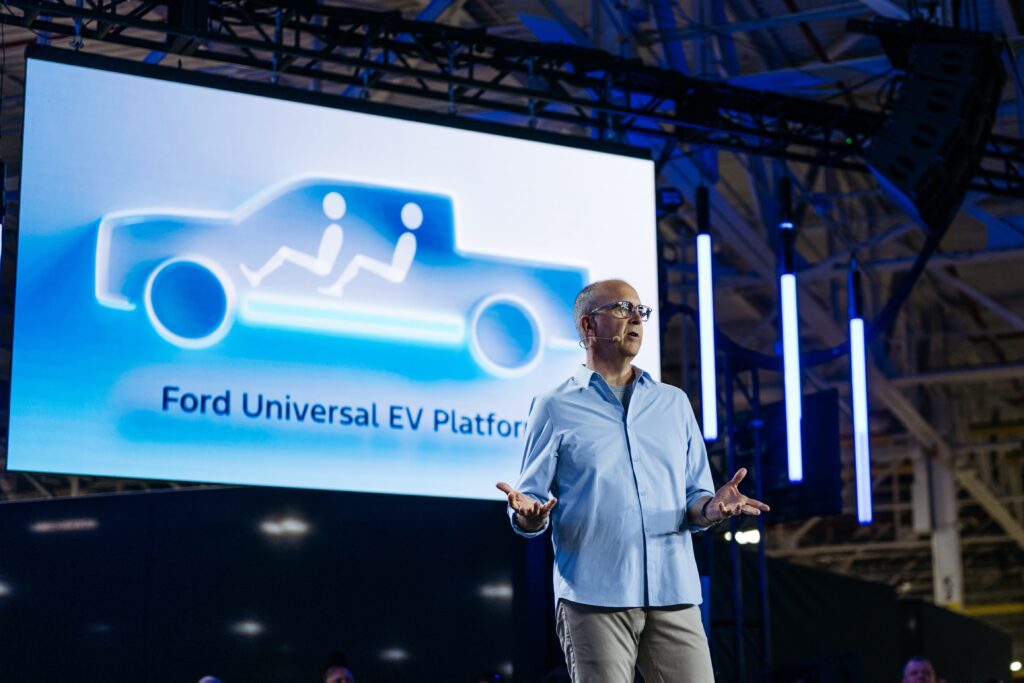
Doug Field, Ford Chief of EVs, Digital, and Design
The key to the low-cost motors isn’t new materials or a technological breakthrough but the result of hiring the most talented engineers Ford could find, Field told MotorTrend. The Universal EV program is being developed by a team of roughly 500 employees, most of whom work out of a secretive office in Long Beach, California, geographically and organizationally removed from Ford’s Michigan operations. Field stressed the importance of identifying and attracting 20x contributors—individuals who produce 20 times more than an average employee—with many engineers hired from California tech companies such as Tesla, Rivian, and Apple, among others.
According to Field, these low-cost motors could only be developed outside of the larger Ford organization. The Detroit automakers have historically excelled at minimizing the cost of mature technologies like internal-combustion engines largely through supplier negotiations. EV motors, though, haven’t yet fully matured and so Field sees a limited window of time when a lean, nimble team unencumbered by organizational red tape can carve out an advantage over the competition.

The Universal EV project all hinges on a major rethink of how Ford designs and manufactures vehicles with an aim to slash thousands of dollars in per-unit cost. To that end, the Universal EV is built with 25 percent fewer fasteners than the typical vehicle and a wiring harness 4,000 feet shorter and 22 pounds lighter than what went into the Mustang Mach-E. The next-gen truck combines dozens of structural components into large aluminum unicastings and the top of the battery pack doubles as the floor of the cabin.
The automaker claims the next-gen EV will roll off the line at its Louisville, Kentucky, assembly plant 15 percent faster than the Ford Escape that was previously assembled there. The key to that, Field said, isn’t necessarily automating tasks that otherwise be carried out by humans but eliminating tasks entirely. Ford has previously announced the number of workstations in the Louisville plant will be reduced by 40 percent.