Is Renewable Energy Cheaper?
When we decided to install a rooftop solar system in 2018, it was based on the premise that adding rooftop solar would be a cheaper option than our electric system in the long run. That same thinking was part of the calculus to purchase electric vehicles. But is powering your home with renewable energy and driving cars powered by electricity cheaper? In a word, yes! It is saving us over $6,341 a year in fuel costs alone to power our home and cars using renewable energy rather than relying solely on fossil fuels.
Those who know me know I’m a bit of a spreadsheet nerd. So it seemed logical after we installed our solar panels to capture all of those kilowatt-hour data points into neat little columns and rows.
I’ve literally ‘got the receipts’ of our power bills going back to 2020, when the idea came to me to track our solar production, so the data is very complete.
When we sized our solar system, we tracked previous years’ worth of bills too, so we knew that our annual energy usage for our 2,100 square foot home was approximately 18,000 kilowatt hours (kWh). Even though we had just purchased a used EV and knew it would increase our usage, we decided to go forward with a system designed to offset about 18,000 kWh.
The cost to power a home that uses 18,000 kWh annually in Florida fluctuates based on several factors, such as hurricane surcharges or fuel price fluctuations. These fees roll on and off bills at various points in the year, so it’s hard to get a precise annual rate. For this example, I calculated it on actual data, dividing the kWh we used by the total paid to Duke Florida. Thus, it captures not just the price per kWh but all the fees, fines, and taxes per kWh too. In 2025, it worked out to $.211/kWh. The calculations below lay out the costs of powering a home with and without rooftop solar, and calculate fuel costs of driving a gas car versus an electric vehicle.
Estimate Cost To Power An Average Home In Florida
The average 2,100 square foot home in FL uses an estimated 18,000 kWh annually. Duke Power Florida charged us $.211 a kWh, including taxes and fees, in 2025.
Annual home energy costs $3,798. Average monthly costs $316.50
18,000 kWh X $.211 per kWh = $3,798
Estimate Cost To Fuel A Gas Car
A gas car that drives 12,000 miles a year, at an efficiency of 25 miles per gallon, uses approximately 480 gallons of gas (at $3/gallon) per year.
12,000 miles / 25 mpg = 480 gallons
The average annual gas energy costs $1,440. Average monthly costs $120.00
480 gallons X $3 per gallon = $1,440
Estimate Cost To Fuel An Electric Car
An EV that drives 12,000 miles a year, at an efficiency of 3.5 miles per kWh, uses approximately 3,428.6 kWh per year.
12,000 miles / 3.5 miles per kWh = 3,428kWh
Annual EV energy costs $723. Average monthly costs $60.00
3,428 kWh X $.211 per kWh = $723.31
Actual Cost To Power A Home And Three Electric Cars With Solar
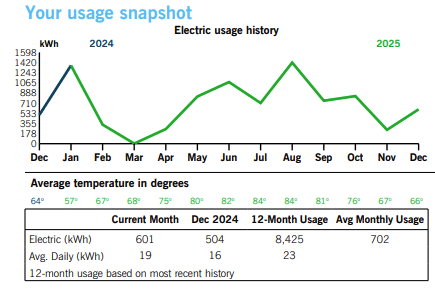
We used 8,425 kWh of power in 2025. That includes the solar we generated minus the energy we used powering our home and three EVs.
Our annual home energy costs, including fuel costs for three cars, were $1,780. Average monthly cost $148.00
8,425 kWh X $.211 per kWh = $1,780

Author’s Actual Duke Energy Florida bill showing annual and monthly energy consumption in kWh.Estimate Costs To Fuel A Home Without Solar And With Three Gas Cars
Using the calculations above, the annual home energy costs to power a home without solar are $3,798. Add to that the average annual gas energy costs $1,440 per car (for three cars = 4,320), and you get $8,118. The average monthly cost is $677.
$3,798 home energy costs + 4,320 gas car fuel costs= $8,118
Solar and EV Power/Fuel Savings Calculated
We spent $1,780 to power our house and three electric cars in 2025. We saved $6,341 in 2025 by powering our home and cars with solar energy. That’s $528 a month that we can now spend on anything other than power/fuel bills.
$8,118 (no solar and 3 gas cars) – $1,777 (solar and 3 electric cars) = $6,341 annual savings
Clean, Affordable Energy
Living in the Sunshine State, it only makes sense that we are tapping into an infinite energy source (the sun). Every kilowatt hour we produce is local and the lowest cost option. In fact, 91% of new renewable projects are now cheaper than fossil fuel alternatives. Producing most of our energy needs on our roof helps us to buffer against the skyrocketing cost of fossil fuels.
Clean Energy is Cheap Energy
The initial investment was $14,000 for the solar panels because of federal tax credits that were available to install the solar panels. When we installed the solar panels in 2018, we projected we would recoup that initial investment in about eight years. However, the runaway costs of fossil fuels have made power bills so high that we actually broke even in 2023. So from that point on, all of the monthly savings truly are free and clear.
Since 2018, without rooftop solar, our power bills would have totaled $33,821. In that same time, with rooftop solar and driving electric, we’ve spent $10,094, plus the initial investment of $14,000. So in total, $24,094. Energy demand in the U.S. is rising along with utility bills. Experts predict utility bills will continue to rise, making a fixed-cost solar system a powerful “hedge” against volatile fuel prices. The cost of inaction and continued reliance on fossil fuels is far greater than taking control of proven renewable energy.
Taking Action
If you’re curious, you can make a copy of this template to track your utility bills for 2026 or go back to your utility provider and fill in the data from 2025. Just adjust the monthly amount you are billed for and the cost.
Electrify the South is a Southern Alliance for Clean Energy program that leverages research, advocacy, and outreach to promote renewable energy and accelerate the equitable transition to electric transportation throughout the Southeast. Visit ElectrifytheSouth.org to learn more and connect with us.