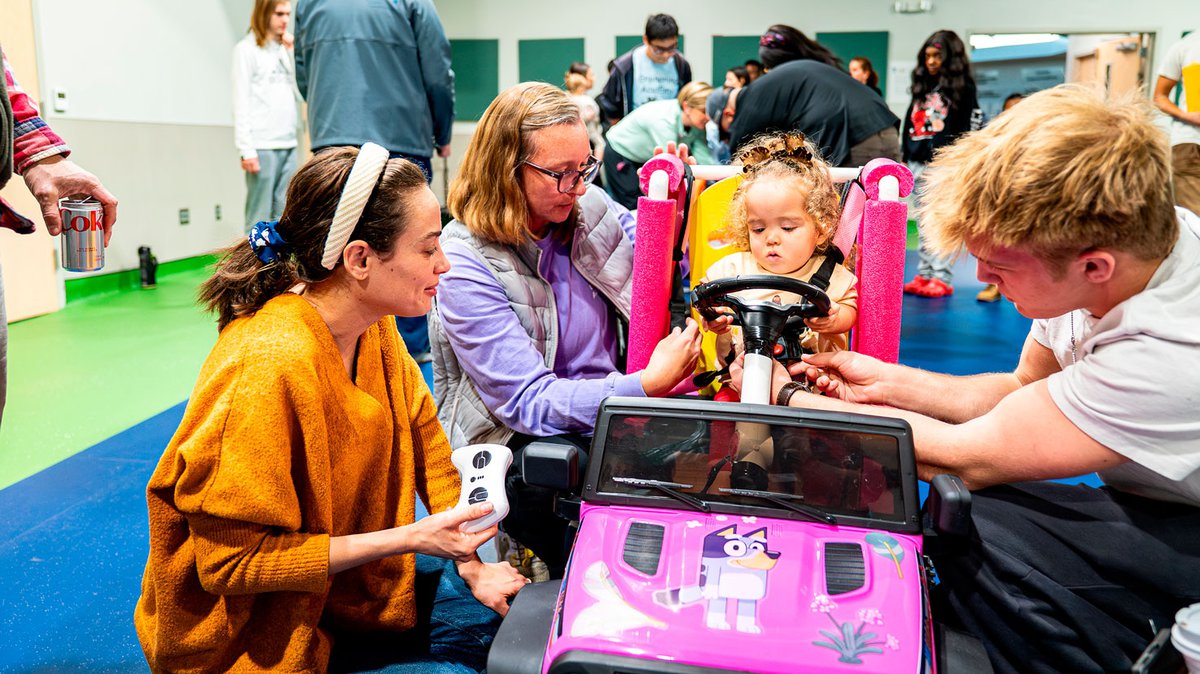
A months-long collaboration between Spain Park High School’s Engineering Academy and United Ability’s Hand In Hand Early Learning Program has resulted in a fleet of brightly colored, custom-engineered electric cars that are transforming the lives of young children with disabilities.
The partnership, now in its fourth year, began when Engineering Academy Director Elizabeth Browne reached out to United Ability in search of meaningful, real-world design opportunities for her seniors.
The idea for modifying electric ride-on cars originated during that first visit.
“A young lady with spina bifida who received outpatient therapy at United Ability had a need for a modified ride-on car,” Browne said. “One group took on the project … and through this project, we found out about the Go Baby Go initiative,” a national network that helps connect engineers and therapists working to adapt mobility toys for children with disabilities.
With support from a Toshiba grant, Spain Park students spent months applying advanced engineering skills — circuit modification, 3D printing and fabrication of custom harnesses — to ensure each child could independently operate their car.
“Students must apply complex skills learned throughout their previous three years in Engineering Academy,” Browne noted. “The ultimate goal is to grant these young ‘clients’ independent mobility.”
For the high school students, the opportunity was thrilling from the start. “My first reaction when I learned that I would be designing electric cars for children was like, ‘Wow! This is awesome,’” Spain Park student Andrew Mbugua said.
The work presented technical and logistical challenges, especially because students couldn’t meet their assigned children until the delivery day. They relied heavily on therapists’ and parents’ emailed feedback, and some teams had to redesign parts after the first handoff. Student Bradley Williams said time was one of the biggest obstacles.
“We only worked on them during our class period, and that would leave days where we took all day just searching for a part,” Williams said. “However, in the last week when a few of my teammates were out of town, I went in during other classes to work more so that we wouldn’t be late.”
The project also changed how students view the impact of engineering.
“It showed me that engineering can make a real difference, even in small ways,” student Nipun Mittal said. “Seeing how our modifications helped create a safe and enjoyable experience for the child makes me realize how engineering can support families, improve accessibility and positively impact the community.”
Despite the hurdles, Browne said she watched remarkable growth — technical, collaborative and personal. “Each student grew in their technical knowledge … and especially in their levels of empathy for people of differing abilities,” she said.
The emotional payoff came on delivery day, when the children finally tested their vehicles. Student Xavier Winston described the moment he saw his assigned child driving her car: “I realized the difference I made in her life,” he said.
For Browne, witnessing her students bring their designs to life was equally moving.
“My first day teaching high school was many of these particular students’ first day of high school four years ago,” she reflected. “To witness them all grow, … create these awesome cars and deliver them to the families was so special.”
The success of the project has strengthened the school’s commitment to continuing the collaboration. “We plan to continue this project as a first group project for the Senior Capstone class each year,” Browne said, noting that future funding will be essential.
For the children who climbed into their custom vehicles — smiling, steering and moving freely — the cars provided far more than mobility. They offered independence, joy and a powerful reminder of what can happen when engineering and empathy move forward together.
![First look at the Kia EV2 driving and the interior [Video]](https://www.evshift.com/wp-content/uploads/2026/01/1768594849_Kia-EV-2-first-look-driving-770x515.jpeg "First look at the Kia EV2 driving and the interior [Video]")