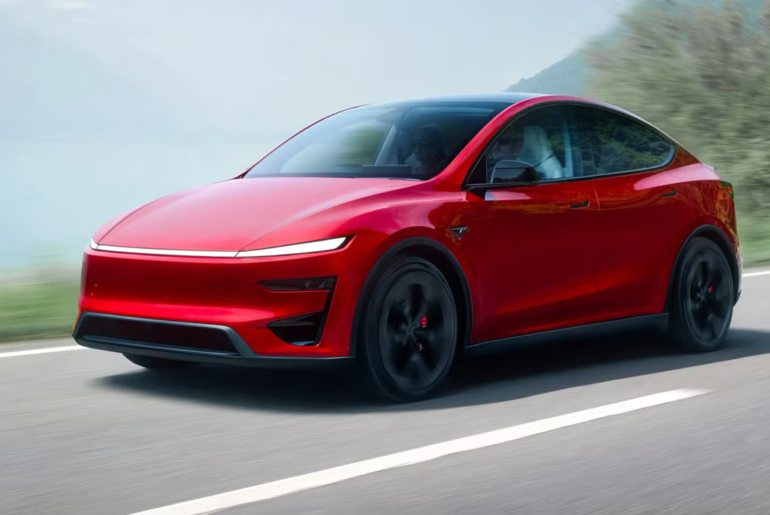
entered 2026 facing a clearer test of its core business after annual vehicle deliveries declined for a second consecutive year, underscoring how dependent demand had become on policy support rather than organic growth. Total deliveries fell 9% in 2025, with the fourth quarter marking a sharper inflection as volumes dropped 16% from a year earlier. The reversal mattered because it followed a temporary third-quarter lift driven by U.S. buyers pulling purchases forward ahead of the expiration of a $7,500 federal tax credit, revealing demand elasticity rather than sustained momentum. When that incentive disappeared, sales resumed their downward trajectory, leaving Tesla with 418,227 deliveries for the quarter, short of the 422,850 units analysts had expected.
Markets initially treated the miss with restraint, pushing shares up 1.8% in premarket trading, reflecting confidence that near-term delivery pressure does not yet threaten Tesla’s balance sheet or long-term ambitions. That response was also shaped by the company’s disclosure of 49% growth in its energy business, a segment still small relative to vehicles but increasingly important to the valuation narrative. Even so, automotive sales continue to account for roughly three-fourths of revenue, making the delivery slowdown more than a statistical disappointment. It directly challenges the assumption that Tesla can maintain scale advantages while transitioning toward a future centered on autonomy, robotics, and artificial intelligence.
The decline also highlights the limits of tactical pricing and product adjustments. In October, Tesla introduced lower-cost, stripped-down versions of the Model 3 and Model Y to stimulate demand, yet industry data show U.S. sales still fell in the first 2 months of the quarter. That outcome suggests affordability alone is no longer sufficient to offset softer consumer sentiment, intensifying competition, and the absence of subsidies that previously compressed effective purchase prices. As a result, the automotive business now appears caught between margin preservation and volume defense, with neither lever offering an easy resolution.
This tension sits uncomfortably alongside Tesla’s strategic pivot toward robotics and autonomous mobility. Products such as the Optimus humanoid robot and the steering-wheel-free Cybercab remain under development, while the company’s latest master plan frames its next phase around a vision of “sustainable abundance” driven by artificial intelligence, robotics, and energy storage. Investors have been willing to underwrite that vision, as reflected in the approval of a new performance-linked compensation package for Elon Musk in November, which could eventually hinge on Tesla achieving an $8.5 trillion market capitalization alongside operational milestones, including higher vehicle sales and a successful robotics launch. The immediate delivery data, however, reinforce how distant that future remains from today’s revenue reality.
For investors, the base case is that Tesla stabilizes deliveries in 2026 through incremental product refreshes, continued energy segment expansion, and gradual progress on autonomy, allowing the market to tolerate slower automotive growth while optionality remains intact. The risk scenario is that subsidy-free demand continues to weaken, forcing deeper price cuts that pressure margins before non-automotive businesses are large enough to compensate, eroding confidence in the long-term growth narrative. The next signals to watch will be delivery trends in early 2026, margin resilience in the automotive segment, and concrete timelines for scaling autonomy and robotics from concept to commercial contribution.


!['[They] knew or should have known'](https://www.evshift.com/wp-content/uploads/2026/01/tesla-Depositphotos_318693426_XL-770x515.jpg "‘[They] knew or should have known’")