
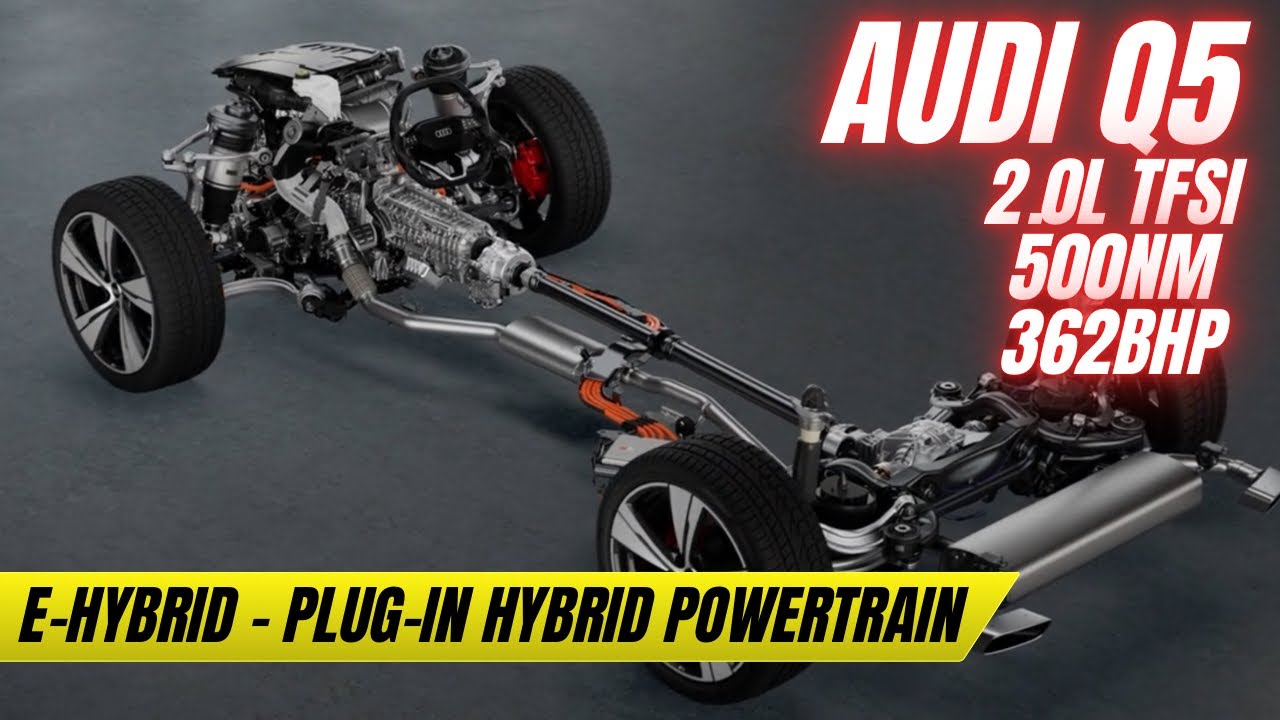
New Audi Q5 Plug-In e-Hybrid Explained: Power Unit, Tech & Charging modes. 500 Nm with 270 kW output
Hi guys, welcome back to Garage Tech. In this video, we’re going to take a look at the Audi Q5E hybrid. So, the new electrified Q5 series has two power outputs, so you can have 220 kW or the 270 kW. The drive unit has a 4 cylinder 2 L turbocharged FSI combustion engine in conjunction with electrified dualclutch transmission. So the high voltage battery has an advanced cell chemistry and has 25.9 kwatt hours. It has improved electrical driving experience, being able to use 100% of the accelerator pedal up to 140 km an hour with a range of up to 100 km. Depending on the driving situation, the driving is either electric or hybrid. In addition, the target state of the charge of the battery can be selected individually. When route guidance is activated, the electrical range is optimally utilized for the remaining distance. In S driving mode, the combustion engine is permanently active for immediate access to the full system output. utilizes smart recuperation strategy which can also be used in corporation with the root guidance data. Okay guys, that’s it. Thanks for watching. If you like these videos, hit the subscribe, hit the thumbs up, and I’ll catch you on the next one. Take care.
The Audi Q5 Plug-In e-Hybrid features a combined system output of 270 kW, (367 PS or 362 BHP), achieved through the integration of a turbocharged combustion engine and an electric motor. Power delivery is managed by Audi’s hybrid control unit, which optimizes torque distribution, efficiency, and drive modes depending on operating conditions.
Audi Q5 e-hybrid – Plug-in hybrid powertrain
Intelligent drive management for greater efficiency
The hybrid management system of the new models is designed for efficiency, flexibility, and maximum customer comfort and automatically selects the optimal operating strategy. The electric drive is provided by a permanently excited synchronous motor with a peak output of 105 kW. The electric motor is integrated into the housing of the seven-speed S tronic.
Working in conjunction with a 2 litre turbocharged FSI engine.
The full system torque is available even at close to idle speed – 500 Nm with 270 kW system output and 450 Nm for the 220 kW power variant.
The power electronics (pulse inverter) used in the plug-in hybrid models of the Q5 are a new development. The pulse inverter is smaller, lighter, and more efficient, thus reducing electrical consumption. Consumption in hybrid mode is therefore also lower.
Battery capacity and energy density significantly increased
The heart of the new Q5 plug-in hybrids is the new high-voltage battery (HV battery) at the rear of the vehicle. Audi has boosted its capacity to 25.9 kWh (net 20.7 kWh), roughly 45 percent more than its predecessor. The HV battery is 517 × 880 × 302 millimeters (20.4 × 34.6 × 11.9 in) in size for the best possible integration into the available installation space.
The further developed and significantly optimized interaction between the mechanical friction brake and energy recovery via the electric motor has also increased regenerative braking performance. The battery cells for the Q5 SUV e-hybrid quattro and Q5 Sportback e-hybrid quattro are arranged on two levels due to the available space and are integrated into the rear section of the car.
Each prismatic cell stores approximately 46 percent more energy than the cells previously used in high-floor vehicles in the C segment. Each cell has a charge capacity of 70 ampere-hours (Ah). The raw material composition of the 102 cells enables a higher energy density. Six stacks with 17 cells each form a unit and are connected in series. As far as the arrangement of the battery cells is concerned, Audi is pursuing a new approach with cell-to-pack. In this process, the cells are no longer placed in a battery module but are glued directly into the battery housing.
The higher packing density means that the energy content and energy density of the HV system can be increased while taking up less space. Thanks to technical developments in cell chemistry, higher electrical output is available compared to the previous generation, even at a low state of charge and low outside temperatures. The maximum possible AC charging power has been increased from two-phase 7.4 kW to three-phase 11 kW, depending on the respective infrastructure. With this increase, the HV battery’s zero-to-100-percent charging time has been reduced to just 2.5 hours.
A charging cable (mode 3, plug type 2) for convenient charging at home and on the road is included as standard. Audi’s own charging service, Audi charging, provides access to numerous AC charging points in 28 European countries on request.
#AudiQ5
#AudiHybrid
#PlugInHybrid
#AudiEHybrid
#HybridTechnology
#LuxurySUV
#ElectricDriving
#AudiTech
#CarTech
#FutureMobility
#HybridSUV
#PremiumSUV
#AutoInnovation
#EVTechnology
#AudiExplained