Maruti Suzuki e Vitara review – Maruti finally gets its Green Card | Autocar India
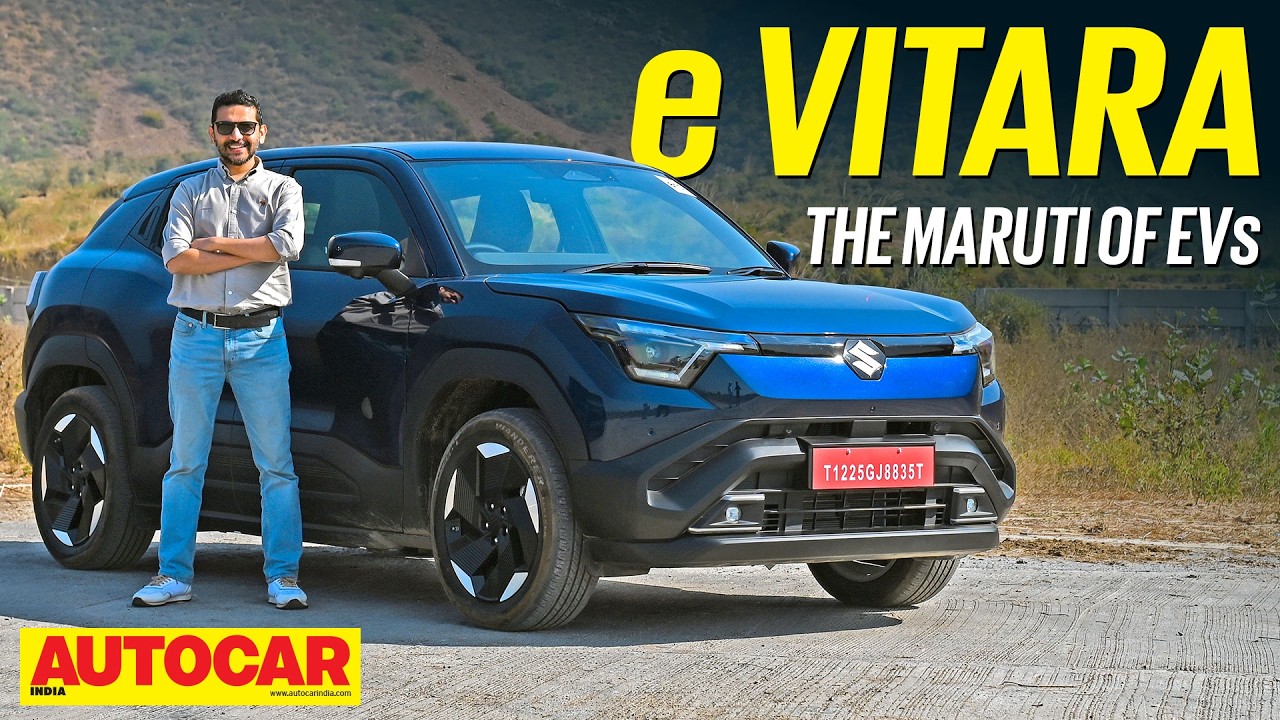
At long last, here we are driving the Maruti Suzuki E Vitara on Indian roads where it matters the most. Now, the name might sound familiar. Suzuki uses Vitara for a number of its different SUVs after all, but I assure you the car it’s attached to is not because this is after all Maruti Suzuki’s first ever electric vehicle for India. And they’re not targeting the compact mass market segments where they dominate. Oh no, they’re going straight for the jugular, the midsize electric SUV segment. Now, it’s always interesting when the market leader goes into a new segment because it has its implications for where that segment goes next. Will that be the case with the EVA? We’ll have to wait and see. But for now, one thing’s very clear. This SUV has a lot riding on its broad sculpted shoulders, more so than you may think. Because while Maruti may be the market leader overall when it comes to electric cars, they’ve got some catching up to do. Now, I hope you’ve liked, shared, and subscribed. And before we go any further, I have to give you one massive, massive disclaimer. While this car has been around for quite a while, it made its global debut in November last year, its India debut at the Auto Expo in January this year. It went into production sometime in the middle of the year, and it’s already on sale in a number of different countries while being produced here in India. It hasn’t yet gone on sale in India itself. That’s right. We don’t have prices for this car and they will only be revealed in 2026. What’s more, here we are at the press drive and Maroti Suzuki hasn’t been able to provide us with any specs of feature information. So, while we can speculate based on the UK car which Sergio drove a little while ago, check out that video if you haven’t, a lot of this review will be assumption and speculation. So, let us know what you think down in the comments and we’ll do our best to give you the most detailed review we can. Yes, it’s incredibly odd that Marauti hasn’t finalized specifications for its allimportant EV 4 months after production began, but you make of that what you will. What we can tell you is about everything we get to see or experience. So, that’s what we’re going to do. Starting with the looks. Now, when it comes to the design and styling of this car, I think it’s a good mix of the familiar and the allnew. There is a bit of Suzuki design language in there. But of course, this is a brand new look that you won’t see on any other Marati Suzuki vehicle. Now, Marati Suzuki says this new platform called Heart E is a Born Electric platform. But I do have my doubts because for one, it’s frontwheel drive and born electric platforms don’t need to do that. And uh there’s no frank underneath there, just some electronic goubbins. But that aside, they’ve taken the opportunity to design and style it completely differently. It’s got quite a lot of musculature to it. The front is obviously closed off because it doesn’t need a conventional grill. It’s got this bulge in the bonnet and down here you’ll find this thick chunky plastic cladding. There’s the camera and the radar module down there. And while the cladding does give it that butch look, I feel like it lacks that wow factor that people kind of expect in an EV. Tell me what you think down in the comments. But I feel like a more technical look would have served this EV well. Over the sides, I like this unique on its side Y-shaped DRL. That’s going to be a signature of this car that you’ll see in your rear view mirror. And the headlight projector is in there. Down here, you’ll find the fog lamps with a little bit of silver accenture. And as you move around the side, you’ll see more of that cladding over the wheel arches. Here’s where you’ll find the charging port. flips open right there. And under the chunky cladded wheel arches, you’ll find a set of 18in wheels. Now, in Europe, Suzuki offers the Evitara with 19in wheels, but even these 18s look nice and big. I think they’re the biggest on any Maruti Suzuki on offer in India. Correct me if I’m wrong. The tires are 2255 R18s and that gives it a good amount of sidewall. Let’s see how that works out on the road. A bit more sculpture in the doors. Again, loads of cladding down here. And once again, I feel like a more technical or techy look would work better for an EV, not the sort of rugged thing that you’d find on a Jimny perhaps, but that’s just me. Tell me what you think. And up here, you’ll find a rising belt line, a big chunky hunch over here, and the rear door handle is up here like in the old Swift. the roof line starts to taper and there’s just quite a small area for this really really wide SE-pillar and we’ll see the consequences of that when we step into the back seat over at the rear. Those broad shoulders do give it a nice squat muscular stance and seeing this from behind I think will impart a really nice SUV sense to whoever takes a look at this car. It’s got a pretty upright tailgate. My favorite detail though is this sort of glass housing. It’s very three-dimensional. Extends the width of the car and sort of dips indents inside under the tail lamps. The tail lamps themselves are these very slim LED elements just on the outside. They don’t join in the center, but I think that’s fine. It gives a premium look nonetheless. The rear windscreen is quite small and it’s shrouded by this spoiler as well as these arrow looking bits on the sides. But here too, like at the front, the cladding is extremely prominent. It takes up at least half the height of the car. And while I get that it’s meant to look butch and rugged, it just looks a bit ordinary in what is supposed to be a techy EV. In fact, the tailgate switch is in the middle of the cladding. It’s not up here where you think it might be. And when you open this up, you’ll first notice that it’s not powered. And you’ll find that inside here, there’s not a lot of room. Again, Mari Suzuki hasn’t revealed the figures, but we believe that even with everything in place, the seat pushed all the way back and folded up, you only get about 306 to 310 L. That’s not a lot at all. That’s less than what you get in a Boleno. And as you can see, this really high loading lip gives room for about two or three small strollies. Uh, you can’t fit a whole lot more than that. And in a midsize SUV, that seems like not enough. However, the good thing is underneath this floor, you do get all your charging paraphernalia and a full size spare tire. The cockpit of the E Vitara is where I think it has made the most appreciable improvement when it comes to Maruti interiors and frankly this sets a new standard of both design and quality for Maruti Suzuki which I hope filters down into all the other models to come. It starts with the design which is this lovely horizontal layout dominated by this beautiful soft touch brown material. It really uplifts the cabin and this is punctuated by these gunmetal gray AC vents that look unique and feel quite premium to use. There is of course this dual screen binnicle which I’ll get back to in a little bit and this new squirrel design for the steering wheel with two spokes which I’ll also get back to as well. Up here you’ll find a floating center console with some storage and USB ports. Uh down below, this houses the wireless charger, some cup holders, some physical controls, and a pretty healthy storage bay down here. As for these controls, you get regen, snow mode, drive modes, and your electronic parking brake, and a very unique drive selector. Now, you have to push it down, twist it right or left to go into reverse or drive, and press over there. It sounds a bit complicated, but actually it’s very intuitive to use on the go, and I’ve gotten used to it in no time. What I also like about this steering wheel is that it offers both rake and reach adjust, so finding a comfy position should be pretty easy. Although this squirrel design does take a little getting used to, some bits do return from older Marautis. This I particularly like. It is a nice physical set of AC controls with a lovely rotary knob. That’s how it should be done. These stalks return, but one thing that doesn’t return are the window switches. They’re brand new. They feel much more premium and a huge improvement over the old 2005 Swift controls. One design detail that I really like is this little console up here. It doesn’t house too many functions, just the microphones, an SOS button, and some lamps. But the way it’s designed and executed is just superb. It’s very European looking and feeling. It’s very high quality and it gives the cabin a little bit more of an upmarket look. That unfortunately can’t be said about the roof lining which still uses this very basic and cheap feeling textured fabric that unfortunately also extends onto the shade for the sunroof which is a large but single piece unit that doesn’t open. As for the seats, I think they’re really comfortable. They’re a good mix of support and cushioning. The driver’s seat is powered. The passenger seat is not. But the thing about the driving position is that because the floor is so high, you do find yourself adjusting the seat a lot to find enough leg room between you and the pedals. It’s just a slightly small footwell again because you’re sat quite knees up. So to get that ideal driving position takes a little bit of time. But now on to these screens. Yes, those with OCD might find it a little bit annoying that it’s not lined up perfectly. The AC vents are off to the side. The screen is lined up with the center console here. And most of all, the screen is set higher while the instrument panel is set a little bit lower with a lot of unused bezel area around it. While that can be a little bit annoying at first glance, in practice it works quite well because the screen is at the right height in your line of sight and it doesn’t impede your vision too much. Whereas these lower set dials fall perfectly into this gap in the steering wheel so you can see them exactly where you need them to be. The screen appears to be around 10 in. I can’t tell you exactly how much that is because Marati hasn’t given us the spec, but it is a good size and it uses a new interface that seems to be different from even the Victorious, which is the other new Marathi that was launched this year. Things are where you expect them to be. There’s a good amount of information on display and all in all, I think it works quite well. As for features, again, Marati hasn’t given us specifics, but we can take a look and see some of them on offer. I mean there is wireless Apple CarPlay and Android Auto. There’s single zone autoclimate control. There’s level 2 AS digital screens of course. And initially we thought there were no ventilated seats, but it turns out there are. It’s just that the controls are buried inside the AC menu of the touchscreen with no shortcut buttons on the outside. All in all, it appears to be decently well equipped, but rivals nowadays simply offer more. Once again, it’s unfortunate we don’t have the complete feature list to give you, and this lack of information continues when it comes to the powertrain. So, let’s just go out onto the road and experience it, shall we? Now, as per the UK spec car, the front motor produce either 144 horsepower or 174. I’m going to take the liberty of assuming this is the more powerful one because I also assume this has the larger battery. And out here on the highway cruising at three-digit speeds, it feels powerful enough, but it doesn’t quite feel like 174 horsepower. True to Mari’s brand positioning of efficiency and ease of use, this feels quite conservatively tuned. Now, that’s not necessarily a bad thing because I think we’re over that phase of EVs all having to have brake neck acceleration. You can tell that this does have a good reserve of power. It just doesn’t leap forward like some other EVs do. We did a quick test with our testing equipment and the Evitara managed a 0 to 100 time of 9.25 seconds, which is on par with the Tata Curve EV, but there are other EVs that are quicker. It does have three drive modes, eco, normal, and sport. And there is some difference, although it’s not that vast between each of the drive modes. I found eco mode to be the least appealing of the lot because in its attempt to dull power, it made the progress less smooth. And frankly, normal mode worked a whole lot better in that respect. Sport, meanwhile, adds a bit more pep, but it’s a marginal amount, and it’s not particularly noticeable. Certainly not out here on the highway. So, in normal mode at least, acceleration and the build of performance is smooth. It’s progressive. It’s not spiky, which I like. And though it doesn’t have too much character, I think that’s perfectly fine in a car like this. It’s not attempting to be anything that it’s not. At low speeds, it’s also accompanied by a nice humming sound, which is typical of an EV, and that just reminds you of the acceleration that you’re making. However, out here at speed that is all overwhelmed by a considerable amount of road and wind noise. It’s out here that I can also tell you that the ADAS systems work really well. They’re nicely calibrated, not overly sensitive, much like we saw in the Victorius. The lane keep assist only lightly nudges at the steering wheel. The auto emergency braking doesn’t cut in too early and the dynamic cruise control does well to keep a distance from the vehicle ahead. It’s out here that I can also point out that road holding is decent at high doubledigit speeds, but once you cross the 100 kph park, which you might do on a wide expressway like this, it does get quite floaty and bouncy. And that combined with the light steering means you have to have your wits about you on a long highway journey. Now, it’s not been all wide high-speed highways. We have driven this car around town and on smaller roads as well. And I have to say it equates itself better in that situation than it does out here. For one, you can better appreciate the smoothness of the power delivery at lower speeds. And the steering, which feels maybe just a little too light out here on the highway, feels right at home in traffic where it aids maneuverability like it should. This is an EV after all. Remember, its primary use case is around town and not long distances. It’s at lower speeds also that the ride quality and road noise doesn’t feel like as much of an issue as it does over here. Yes, you can feel that underlying firmness that this car has been set up with. You also have to remember that again based on the UK car, this should weigh somewhere around 1.8 8 tons. And while there are other EVs that are heavier than it, that still makes this the most heavy Maruti Suzuki car by far. And working with that extra weight, you can tell the suspension is doing a much harder job than it has to in the lighter Maruti vehicles. And while by no means a handling test, we did find a couple of stray corners just off the highway. And we drove this around them and yeah, as you might imagine, the steering felt slow. It felt loose, as did the body, which moved around quite a bit. So yeah, not exactly going to set your pants on fire in terms of handling, but then it handles like a marathi, and that is to say, safe. What about range? Well, again, we could by no means do a proper range test on this very rush day that involved all different sorts of driving and shooting. That’s never an accurate representation of realw world range. And while out here on the highway, it’s showing an efficiency of 4.8 km per kilowatt hour, which is not amazing. When we were driving around town, it was actually displaying 7 to 7 1/2 km per kilowatt hour. Presuming we have the high capacity battery here that should be 61 kilowatt hours that is rated on the MIDC or AI cycle at 543 km of range in a petrol car. An AI fuel efficiency figure will not be accurate but it will at least give you an accurate indication of where the real world figure would lie and you could easily compare them car to car. With EVs though, we’ve noticed that it varies drastically. Some EVs get very close to that AR figure, and some don’t. But with this car’s high efficiency, especially around town, I get the feeling that it just might out in the real world. But stay subscribed and stay tuned because when we get this car on home turf, we’re going to do our full Autoc Car India range test. Before we finish, we have to visit the rear seat because an EV this may be, but it’s also a midsize SUV and chauffeurdriven comfort is always a consideration in India. While the most pleasant surprise of the Marauti Suzuki Evitara was up at the front, the same unfortunately can’t be said of the back seat. As I mentioned before, the glass roof only goes as far as there. So, it doesn’t come all the way back here. And that of course limits the amount of light that comes into the cabin. Also not helping that sensation are these windows. Although they’re quite long, they’re not very tall. So the aperture remains quite small and lets a limited amount of light in. If you had to have a sun shade over here, it would be quite a long sun shade, which is why I suppose there isn’t one at all, which is another miss. You do get these slightly old-fashioned looking reading lamps here, but I suppose they get the job done. And down there you’ll find a pair of AC vents and USB ports. And now let’s talk about seat comfort. I got to start by saying the cushioning is really rather good like it is in the front. The seats feel generously bolstered and softly cushioned. So you can really sink into them especially the back rest and that gives you a really comfy feeling. Apart from that however the news is not amazing. First of all, the floor is very, very high. As you can see, even with my feet tucked as far as they’ll go, if your driver puts the seat quite low down, there’s no place for your feet underneath there, and you can’t help but sit in a knees up seating position. Even if you were to squeeze yourself down, the seat squab isn’t particularly long, and so thigh support does suffer on that front. As for the seat back, yes, it does have a recline function, but this is as far as it goes, which you’ll agree is not too far. It’s pretty upright. I find this okay, but don’t be fooled. It won’t go any further than that. And finally, though, this car gets three full-sized headrests, which is a good thing, and three threepoint seat belts. I bet you’re wondering where the armrest and the cup holders are. Well, they’re actually inside this center seat which flips down over here. Well, that does sound quite cool and yeah, you do get the cup holders right there. What that means is that you’re kind of exposed to whatever’s in the boot, which is fine in normal circumstances, but if you have loose stuff lying around, I wouldn’t be surprised if something comes flying through under hard breaking. Unfortunately, also where we noticed a slightly busy ride up front. It’s even more pronounced sitting back here. You’re also somehow more exposed to the road and wind noise. Maybe it’s this echo chamber that’s opened up here when you flip down this armrest. But yeah, you can hear a whole lot more of what’s going on from under the wheels, right through this wheel arch just behind you. It’s an unfortunate thing that really dampens the chauffeurdriven experience in this car because that is something that has to be considered in a market like ours in a segment like this. With limited time and even less information, this review feels a bit incomplete and frankly doesn’t show a lot of confidence from a car maker in its product. We’ll just have to wait until the Evitara is launched, the full brochure is out and we can drive it in a more familiar setting to give you a complete picture. So, make sure you’re subscribed and tune back in for that. From our short drive, it appears the Evitara has gotten its fundamentals right. It’s smooth with a good amount of power. It’s easy to maneuver. Quality is high. It’s decently equipped and has a unique design appeal both inside and out. Most of all though, it seems to have Mari’s ultimate calling card of superb efficiency, though a full range test will have to confirm that. It does however come with some big shortcomings like a busy ride, considerable road noise, and most of all limited boot and rear seat space. Will Marauti come through with a knockout price that’s aggressive enough to overlook these? Only time will tell, but one thing’s for sure, EVs have seriously disrupted the market with legacy players and new upstarts duking it out on an equal footing. So far, the Evitara has got its basics right, but it certainly has its work cut out for it.
Maruti Suzuki has taken its time to come out with its EVs but the first in a line-up of electric vehicles is finally here. It’s called the e Vitara and Gavin D’Souza has just sampled it.
Editor: Deven Bhalla
Chapters –
0:00 – Introduction
1:09 – Disclaimer
2:45 – Platform
3:05 – Design and styling
6:00 – Boot capacity
6:58 – Interior, quality and features
11:51 – Power and performance
14:20 – ADAS
14:42 – High speed manners
15:00 – City driving
16:18 – Handling
16:45 – Range
18:09 – Rear seat space and comfort
21:20 – Price expectation and verdict
SUBSCRIBE to Autocar India for the hottest automotive news and the most comprehensive reviews ► http://bit.ly/AutocarInd
Autocar India is your one-stop source for test drive reviews & comparison tests of every new car and motorcycle launched in India. We also offer a great mix of other automotive content, including weekly news, motor show reports, travelogues and other special features.
Website: http://www.autocarindia.com
Facebook: http://www.facebook.com/autocarindiamag
Instagram: https://www.instagram.com/autocar_india/
Twitter: http://www.twitter.com/autocarindiamag
New car reviews ►http://bit.ly/ACI-NewCarReviews
Comparison tests ►http://bit.ly/ACI-Comparison
New bike reviews ►http://bit.ly/ACI-BikeReviews
Features ►http://bit.ly/ACI-Features
#autocarindia #marutisuzuki #marutisuzukievitara #evitara #maruti #suzuki