
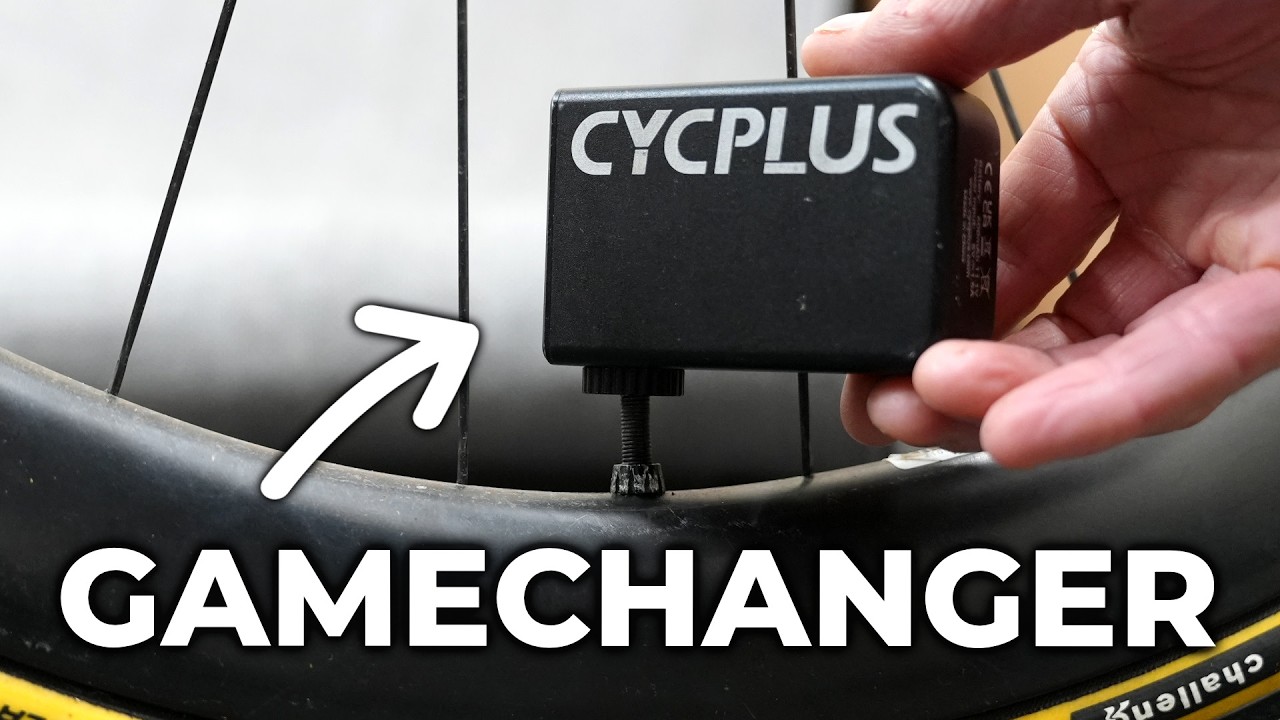
This is a GAME CHANGER!
Hello and welcome to Just Ride Bikes. I’m David and a question for you. Could an electric pump like one of these replace an old-fashioned mini pump like this or even CO2? Well, to find out, to try and answer that question, for the past 6 months, I’ve been testing these two pumps to see whether they’re worth the hype, worth the money, and worth replacing an oldfashioned pump like this. Now, these have become crazy popular over the last few months, maybe the last year or two, and you might own one. Let me know if you do by dropping a comment down below. And I was keen to see what all the fuss was about and whether they’re actually any good or not. And I’ll admit I was a bit skeptical because there are some obvious downsides. There are batteries inside and they have a limited run time. And what happens if they go flat during a ride and the beauty of a mini pump like this? It never runs out of battery. But I have to admit, I have been surprised and impressed and shocked. and I do genuinely think they might just be the best product I’ve used this year. Now, full transparency, this video is not sponsored by this brand. They reached out about eight months ago asking if I wanted to test them, and I said yes, and they sent out the two models. But there are loads of brands out there making similar products, and they’re all fairly similar in terms of how they work. But this brand seems to be the most popular. If you do a Google search, they come up high in the rankings, and lots of people I know own these. So it made sense to test these as sort of the market leader if they are that I think. So they have a range of options. This is their small one, the AS2 Pro Tiny Pump and it cost $109. And this is a bigger AS2 Pro Max which cost $129. So basically small and not so small. These two have the pressure gauge on the back. They do version without a pressure gauge which are cheaper. But for me, the pressure gauge is part of the gamechanging appeal of the pumps because the downside to mini pump is when you get a puncture you no idea what pressure you achieved when you pump it. It could be 40, 50, 60, you don’t know. But this one, you set the pressure you want. So 58, put it on and it means you inflate your tire to 58 PSI. So that for me is part of the game changer. takes the guess work out and they are very easy to use and the ease of use is definitely a trump card compared to a mini pump because you simply you put on the valve, you press a button and you hold it there. It’s that easy. With this with my Wedi arms, you get a sore arm after a fair bit of stroking. And it’s also a bit quicker than a mini pump as well, depending on the quality of your mini pump and how fast you can uh pump the pump. So, for me, they’re quicker. Although speed is not really a priority, never in a rush to inflate a tire. As long as it does a job in a reasonable time frame, it’s okay. You’re not using it for racing, are you? I mean, in a gravel event, it’s okay. I use it in Badlands and it I mean, Badlands, I wasn’t worried about losing a minute using that or that. So, it’s fine. So, the simplicity, the speed, they are quite noisy. The noise is the only downside really. And the other one I guess a big elephant in the room is the battery and the runtime. Now batteries are built into them and they’re not replaceable. And of course there’s a whole dilemma issue debate around more batteries uh disposal batteries and yeah the world we live in there’s a lot of waste and that’s really a topic for another video and that’s for you to make your own judgment on whether it aligns with your morals around batteries and electronics and disposables. Hopefully you can recycle them in the future. But the big question mark for me was a run time. How long would a battery last? I mean there’s no battery here to run out ever. But obviously this will last longer, will give you more uses than a one-time hit from a CO2 cartridge. So better than that. And the company claims the the mini one will do three 28 mil wide tires from zero to 80 PSI. And the bigger one would do the same tire 10 times. But for my use case, I’m not always going from zero to 80. I mean, I don’t run a tire at 80 PSI anyway. And my tire pressures max out about 55 PSI these days. And the other factor is I’m not always going from zero to 55 PSI because if I get a tuner puncher and I plug the hole before the air all escapes, I might be going from 20 PSI up to 55 PSI. And that helps extend the battery run time as well. And so far, touchwood, I not had even them be flat when I need it in an emergency. And if you do use it when you have a puncher on a ride, when you get home, you just top it up and they sit there for months and months and not lose any charge at all. And when you need it, it’s ready to go. So, in terms of it being charged when I need it in that emergency scenario, it’s not an issue. Doesn’t lose charge over time. It’s not flat when I need it most. It’s ready to go, fully charged. And the run time is more than enough for one or two punches on a ride. If you’re having three, four, five punches, then you’re into territory where you probably run out of tubes or plugs or patches for the tubes anyway. So, you run into other problems aside from the run time on these. So, for me, in my six months of testing them, they haven’t gone flat. I’ve not had limited run time when I need it most. The run time been fine. The battery use has been just fine. Not any issues at all. So for me, I use a small one in my saddle bag because it fits in a saddle bag or in a down tube of my Specialized Epic mountain bike or in your bike packing. And this bigger one I use in my kit bag when I’m going to bike races in the back of the car or the van when I’m going traveling in my bike bag because it has a bigger battery so it lasts longer and is perfect as a replacement for a track pump. And even here in the studio, I now use it instead of a track pump because it’s well, I’m lazy, I guess. So I use this instead of a track bump and I don’t have a compressor in here. So two versions, two sizes for different scenarios and that’s how I tend to use them. This one on the bike, this one off the bike. There are a few downsides to these pumps for me though. The first one is the fact they’re not waterproof, which is a real shame and means you have to put them in a plastic bag to protect them from the elements. But in a plastic bag, they are well protected in your saddle bag, your kit bag, wherever it might be. They can get quite warm to touch during extended use and there’s a silicon case that goes around them, but I dispense that to save weight and space and don’t really need that to be honest. And there’s a small hose extender that can go onto the valve. You have to take care with some valves like plastic valves on TPU inner tubes because the heat from this could potentially melt the valve, but with metal valves, I find it go straight on here with no issue at all. I had great hopes of these being fantastic for installing inflating new tubeless tires as I have here a nice new PL tire for testing. But as I’ll demonstrate, not so onto the valve. Press button. Nothing. Not going up at all. Nada. I’ve tried removing the valve core. Makes no difference. I guess it can’t move enough air quickly enough to give that tire that boost it needs to inflate onto the uh onto the wheel, which means I still have to use my my tubless track pump. Another one, I guess, is the price. They’re not exactly cheap. $110 and $130. They are quite an investment, and there are cheaper options on the market as well. And there are more expensive options from the likes of Silka. So, you can spend more or less if you want. So yeah, they’re not cheap and that could be a downside for you, but you can spend a, you know, a reasonable amount of money on a good quality manual mini pump if you want to. So value for money, I don’t think bad. Yes, expensive, but the convenience, the speed, the ease of use, the reliability, in my experience, yeah, fantastic. If they were waterproof, they would be phenomenal. So there we go. Often surprising how a small product like this can really impress you the most. So yeah, the game changer. I wasn’t expecting them to be a gimmick. They’re not. So I will continue using them for the next 6 months and beyond because I am really impressed with how good they are. Reliable, simple, no faf and no sore arms anymore. So where are you on electric pumps? Do you agree with my assessment of them or do you disagree? Let me know by dropping a comment down below. And if you want to see some other cool bike product reviews, then watch a video right up here. But that is all for today. Thank you so much for watching. I’ll see you again very soon.
Buy the Cycplus AS2 Pro pump https://amzn.to/4pErXgl
Buy the Cycplus AS2 Pro Max pump https://amzn.to/4qiTB2G
Are electric mini pumps actually any good and worth it for cyclists? I’ve been testing two for the past 6 months to find out
Content
00:00 intro
2:07 the reason for switching
2:46 timed test
3:20 noise test
4:00 battery run time concerns
6:41 downsides
7:23 Tubeless install test
7:59 value for money?
8:43 verdict
Recommended products:
Buy the new Insta360 X5 here https://store.insta360.com/product/x5?utm_term=INRS1KM
Buy Bikestow Stance stand here https://bit.ly/3LSZQXZ
Castelli clothing https://bit.ly/justridebikes
Sidi shoes https://bit.ly/3tjQ8UP
HJC helmet https://bit.ly/3sRiB2Z
Join this channel to get access to perks:
https://www.youtube.com/channel/UCybgi4WCjGaoEEVjB7tBfCg/join
JOIN MY WEEKLY NEWSLETTER http://eepurl.com/inIvGk
Follow me:
Instagram: https://www.instagram.com/davidjarthur/
Twitter: https://twitter.com/davearthur
Facebook: https://www.facebook.com/justridebikesvideo