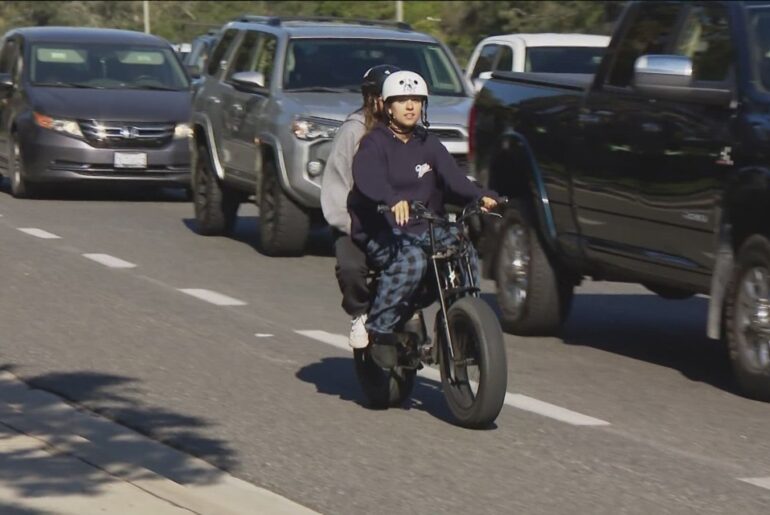
They have been praised by clubbers in England for the freedom they offer, but some careless riders have strewn them across pavements, broken bones and flouted traffic rules.
As the first dockless electric bikes arrive en masse on the streets of Scotland’s two largest cities, Edinburgh and Glasgow, and with winter setting in, the take-up of the scheme is firmly under the microscope.
A thousand of the e-bikes, launched by the Swedish firm Voi, are available to hire in Glasgow. But just how do they handle the morning commute to work?
Voi has two models of bicycle — the Explorer and the Explorer Light, which weighs a quarter less and is designed for people like me who need a lighter frame. I chose to test an Explorer from the line-up of cheerful orange bikes and wheeled the heavy frame gracelessly out to the road. Once I was wobbling on the edge of the road I gave the pedals a push, the battery kicked in and the bike swept forward.
This was better than the beaten-up electric hire bikes I had ridden through central London. Firstly, it seemed pristine, which may not be the case for long, and had a speedometer to tell me I had reached a top speed of 25 km/h. The other e-bikes I’ve ridden change pace quite unpredictably, from crawling forward to lurching with abandon towards the back of a bus. But I could feel the Voi gently clicking into higher gears.
The M8, which I cross every day from Glasgow’s West End to the city centre, has a cyclist’s bridge like a concrete helter-skelter connecting the neighbourhoods divided by the motorway. It was known as the unfinished “bridge to nowhere” for decades because funding ran out but was eventually completed in 2013.
The bike wound up the spiralling slope to the summit of this symbolically redeemed infrastructure. I was just beginning to congratulate myself on my new commute. Then, the battery died.

Going nowhere fast on the bridge over the M8
JAMES CHAPELARD FOR THE SUNDAY TIMES
I was left in the middle of the flyover with a powerless e-bike. Its wheels had locked up and it was too heavy to drag. I thought mournfully about its predecessors, the docked rental push bikes that had been tossed into the Clyde by vandals. If I wanted to throw a Voi Explorer into the Clyde, I’d need a winch.
Abandoning it, I found another bike to rent a few streets over. When I was parking this replacement, I found Michael MacDonald tending to the parked Vois. Sheepishly, I told him about the bike I’d left above the M8, but he already knew. And there it was parked near by. My old friend, its batteries replaced, had been returned to a sensible parking spot less than half an hour after I deserted it.
MacDonald, who had also maintained bikes in the previous scheme, said the Vois were much sturdier than their predecessors.
In the previous scheme, a maintenance team would check the bikes every two months. MacDonald showed me a live map where my bike and I, forlorn and with a flat battery, had been flagged for rescue. Voi’s technology is also sensitive enough to detect when a bike has fallen over.
Glasgow’s old scheme ran for 11 years before Voi took over in November and had more than 1,200 bikes available at docking stations. Only about 200 of these were e-bikes. On average, each bike would be rented only three or four times a week — relatively low numbers for a city of about 650,000 people.
Voi has been more successful. Since Glasgow got those thousand dockless e-bikes on November 10, more than 7,000 people have ridden a total of 75,000km. That’s 55 per cent more rides than this time last year.
The new bikes cost about 16p a minute to hire and 30 minutes paid upfront is £2.79. In Edinburgh, where a similar scheme was launched in September, a 20-minute journey costs about £2.20. Compared to Lime bikes in London, which charge £1 to unlock a bike and 29p a minute while cycling, these are reasonable.

Voi e-bikes for hire in Edinburgh
ALAMY
In cold, rainy November, the number of Voi hires in Edinburgh beat the previous scheme’s all-time peak, which had been during lockdown cycling frenzy of June 2020. This is despite the Voi fleet being a third of the size after a gradual introduction.
In both cities, most people are using the bikes to make short, 15-minute journeys of about 3km, whereas I’d cycled for more than an hour on a low battery before it died.
Harry Foskin, Voi’s public policy manager for the UK and Ireland, said Edinburgh and Glasgow were its first UK schemes outside England and important for active travel in Scotland. Aberdeen is next, the red-and-black bikes coming to Scotland’s third-largest city in the spring.
Foskin said: “November is not the ideal time to launch a micro-mobility scheme. Ideally, you’d do it when you have nicer weather. But regardless, we’re really encouraged by how things are going.”
In London, dockless e-bike parking has become so chaotic that Kensington and Chelsea council has removed a thousand of them and collected £81,000 in seizure and storage fees from their operators.

Lime bikes have been
ALAMY
Robert Powell, 81,the actor who starred in Jesus of Nazareth, and his wife Barbara Lord, of Pan’s People, complained about finding more than 100 rental e-bikes on the pavement outside their front door.
E-bikes carelessly parked across pavements have been reported as an obstacle for all pedestrians but particularly people with disabilities. A Royal National Institute of Blind People (RNIB) survey published last year found that one in ten blind or partially sighted people had collided with one. Almost half found that scooters and dockless bikes stopped them getting out and about.
Voi does not have docking stations to lock the bikes into between rides, which the RNIB advocates for. But it does enforce 4 sq m zones where the bikes can park. If you put them elsewhere, the app continues to charge you by the minute.
In Edinburgh, the local cycling campaign edi.bike called for Voi to stop riders parking in cycling racks, where other cyclists need to lock pushbikes. But the racks also stop bikes falling over in the street.
Edinburgh’s rental scheme is on a trial contract for two years, at no cost to the council. Stephen Jenkinson, Edinburgh council’s transport and environment boss, said the council was reviewing on a weekly basis where and how the bikes were parked.

Stephen Jenkinson, Edinburgh council’s travel boss, has tested the e-bikes himself
EDI.BIKE
“The previous scheme failed actually because of vandalism and theft,” he said. Voi’s bikes are sturdier, and heavier, and their GPS technology is advanced enough to locate them, which officials in both cities hope will prevent a repeat of the former destruction.
Damage to bikes is not the only concern. In London, the BBC reported that 150 broken bones from e-bike accidents came through the Royal London Hospital in Whitechapel in the six months to September.
In Glasgow, where the council has invested in cycle lanes, electronic boards installed to count passing cyclists recorded an increase of 43 per cent in the number of Glaswegians pedalling past compared with last year. A city council spokesperson said: “By encouraging people to swap short car journeys for cycling as a practical, affordable way to get around, we can reduce emissions and create healthier, more connected communities.”
Cycling home over the former bridge to nowhere, I read the electronic counter. “Cyclists eastbound: 45 today, have a nice day!” it said.
Almost four weeks into the Voi takeover, the new routes around the city are starting to come together. Now all those wanting to take one for a spin need is a warm summer’s day.