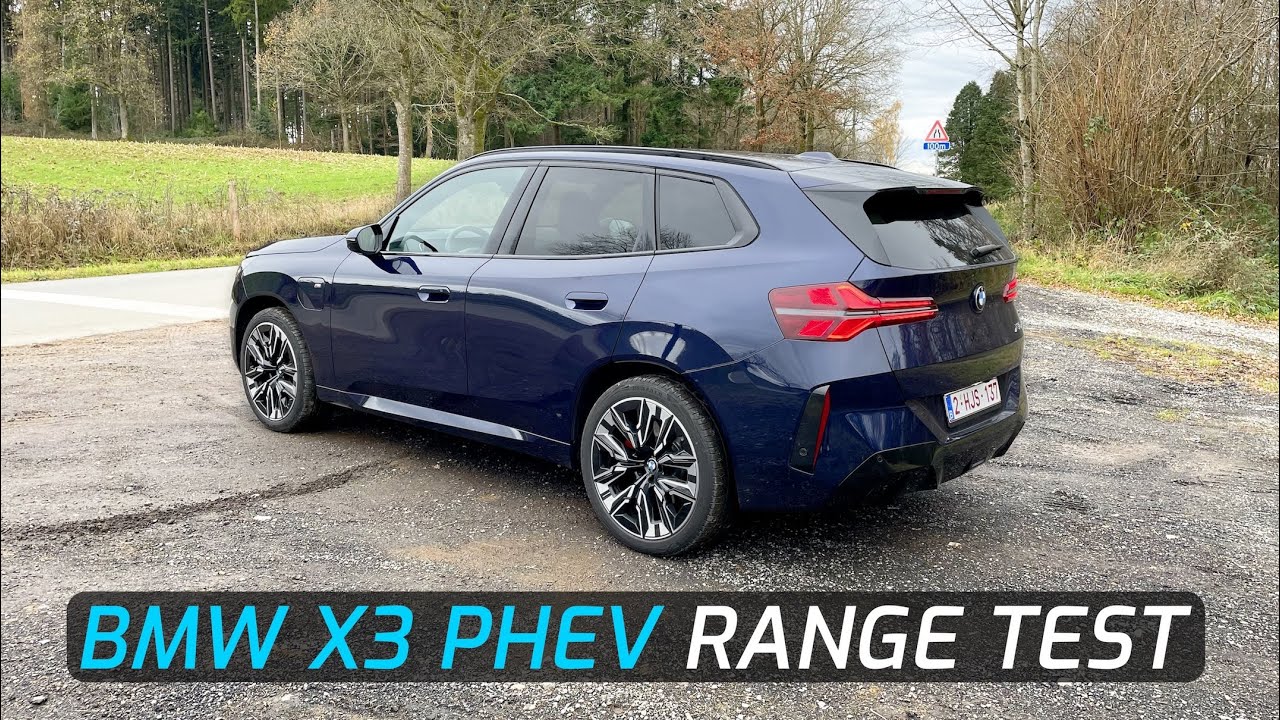
NEW 2025 BMW X3 PLUG-IN HYBRID RANGE TEST
This is the new BMW X3 Plug-in Hybrid. In
this video, I want to find out what the real-world driving range is. I’m going to test
the range on regional roads to figure out the maximum range possible. I’ll also do a second
test on the highway at higher average speeds, to find the minimum range. I also wanted to
see how long it takes to charge the battery. This is the new model of the X3. BMW introduced
this generation in the second half of 2024. This X3 packs a 2-liter four-cylinder petrol
engine, combined with a synchronous electric motor. This electric motor is integrated into the
8-speed Steptronic transmission. The power from both the petrol engine and the electric motor
can be sent to all four wheels via BMW xDrive. It accelerates from 0 to 100 km/h in
6.2 seconds. It feels punchy enough, but not extremely fast. Especially if you
compare it to your average electric car. The system output is 299 horsepower. The
top speed is 215 km/h, and for more stats: the torque sits at a nice 450 Newton-meters.
The base price starts around 70,050 euros. This X3 has received a larger battery compared
to the previous generation. It’s a Lithium-ion battery sitting under the rear seats, with a net capacity of 19.7 kWh. The
WLTP range is between 81 and 90 km. The boot space holds 460 to 1600 liters. The
regular petrol version has a capacity of 570 to 1700 liters, so you do lose about 100 liters.
I think it’s mostly in the boot floor, which ramps up slightly towards the rear seats. I don’t get
the impression I’ve lost much headroom, though. In any case, there is enough headroom in the back,
even though you are sitting on top of the battery. I’m going to test the range on regional roads
first. I wanted to figure out the car’s maximum range, by testing it at lower average speeds.
I’m doing the test in the evening to avoid being held up by too much traffic. At
the start of the test, the battery is fully charged to 100%. The range indicator
shows 79 km. I did this test in December, and it was about 10 degrees Celsius at the start.
Before I can hit the regional roads, I have to get out of Brussels first. Honestly, in terms of
consumption, starting the test like this is no gift. On the contrary, in city traffic, I’m seeing
consumption of 24.2 kWh per 100 km. After 15 km of fairly heavy city traffic, I’ve already drained
nearly a quarter of the battery. The counter shows only 65 km of range left by the time I finally
reach the regional roads where I can cruise. At the first check-in with the battery at half
charge, consumption has already dropped to 21.1 kWh per 100 km. I’ve driven 45 km, and
the indicator still shows 44 km remaining. That’s looking promising. The temperature
has dropped to 7 degrees in the meantime. With the battery at 25%, the indicator shows 22
km of range left. I’ve driven nearly 75 km now and consumption is sitting at 20 kWh per 100 km. For
the final stretch, I’m leaving the regional roads and heading back towards the city. Let’s just jump
to the final result. I finished with a solid 96.6 km range when the combustion engine kicked back
in. That’s pretty impressive and actually beats the WLTP range, despite the lower temperatures.
I think there was a little bit more range in it if I hadn’t hit that city traffic earlier.
If you want to read through the results of this test at your own pace, head over to my
site. I will link it below. You’ll find not just this test, but range tests for dozens of
other cars, and nearly 400 test drive videos. Okay, we know the maximum range. But what is the
minimum range? To find out, I’m going to drain the battery on the highway at higher average speeds.
The battery is recharged. Now the indicator shows 92 km range. For practical reasons, I’m starting
the test at 8:30 AM in Brussels. I hit the highway and had to drive a bit slower at first, but
afterwards, I could cruise comfortably at 120 km/h. The temperature is around 7.5 degrees.
Halfway through, consumption is at 22.4 kWh per 100 km, I’ve driven 34 km, and there’s still 45 km
on the range indicator. Let’s look straight at the result. I drove the battery completely empty, and
at a solid 72.8 km, the battery was empty and the combustion engine kicked back in. I noted that the
average consumption stood at 23.1 kWh per 100 km. Now let’s look at how long it takes
to charge the battery. Tech-wise, the X3 is equipped with an on-board charger
capable of 11 kW AC charging. According to BMW, the battery can go from 0 to
100% in 2 hours and 15 minutes. I started my real-world test at 5%, and the
dashboard told me it would take 2 hours and 11 minutes to go from 5% to 100%. So, 2
hours 15 from 0 to 100% seems accurate. You can’t fast-charge the X3. That’s a small
downside, because with Mercedes, for example, some plug-in hybrids do offer fast charging. If
you can charge at home, it doesn’t matter much, but if you have to rely on public charging,
I’d find it handy to have fast charging. What do you guys think? Would you want fast charging on a plug-in hybrid?
Let me know in the comments. In the previous generation, you could also
fully charge the battery while driving. After some digging, I found out you can
still do this in the newest generation, but only to a very limited extent. There
is a “maintain charge” function. I did a test on the highway. After driving for 22
minutes at 120 km/h and covering 35 km, I gained 7 km of driving range. I get
the impression you can’t get much more than that 7 km back. The consumption during
that run came out to 9.2 liters per 100 km. Speaking of fuel consumption, I did a test
drive starting with a completely empty battery. After 172 km, I ended up with
a consumption of 8.3 liters per 100 km, of which 34 km was driven electrically. Wondering how much range you have on fuel
alone? Well, the tank capacity is 50 liters, so at a consumption of, let’s say 8.3 liters
per 100 km, you can drive about 600 km. One last thing you might be wondering is: how are
the performance levels with an empty battery? I did an acceleration test with a sufficiently
charged battery and then another one with an empty battery. I didn’t immediately notice a
big difference. With just the electric motor, you have 184 horsepower. That gives you a top
speed of 140 km/h. Purely on the petrol engine, you have 190 horsepower. I did have the impression
that, even with an empty battery, I had more power available than just those 190 horses. So, perhaps
some capacity is kept in reserve for that boost. In conclusion, I can say that the range
of the BMW X3 xDrive30e Plug-In Hybrid, at lower temperatures of around 7 to 10
degrees, lies between 96 km on regional roads and 72 km on the highway. In heavy city
traffic, I think you’ll be sitting closer to that 72 km range figure. All in all, very nice
results. In the summer, you might be able to squeeze out even better numbers.
Want to read all the details and figures from this test again? Definitely
check my website. Thanks for watching, and see you next time! And don’t forget to
subscribe so you don’t miss the next video. Which car would you like to see a range test for
next on this channel? Let me know in the comments.
2025 BMW X3 Plug-in Hybrid Range test. I did a range test with the 2025 BMW X3 xDrive30e PHEV. I will review the range on the highway to find out the minimum range of the BMW X3 Plug-In Hybrid 2025 model. I will also do a full range test at lower average speeds in the city and on regional roads to find out the maximum electric range of the BMW X3 PHEV. I will also do a charging test with the BMW X3 xDrive30e at a public AC charger to find out how long it takes to fully charge the battery. In addition to that I also tested if you can charge the battery while driving by using the battery maintain mode.
Chapters in this video:
0:00 intro and useful info about the BMW X3 xDrive30e
2:00 range Test Regional Roads
4:07 range Test Highway
5:05 charging test at a public charger
6:01 charging test while driving by using maintain battery charge mode
6:36 what about fuel consumption?
7:07 what about performance with an empty battery?
7:45 conclusion and final thoughts
Here you can read the results of this test: https://proefritten.be/en/2025-bmw-x3-plug-in-hybrid-range-test/
More info about this car such as results of my range test on my website in English, Dutch, FR, DE, ES, IT: www.Proefritten.be
The questions that I asked myself about the BMW X3 Plug-in Hybrid 2025 that I wanted to answer in this video, were: what is the real life minimum range of the BMW X3 xDrive30e? What is the real world maximum range of the 2025 BMW X3 xDrive30e? I also wanted to know what is the charging time of the 2025 BMW X3 xDrive30e at a public charger?
Technical specs of the 2025 BMW X3 xDrive30e Plug-In Hybrid:
* Brand: BMW
* Model: X3 30e xDrive
* Type: Plug-in hybrid Petrol
* Engine: 1,998 cc petrol
* Drive: All-wheel drive
* Transmission: 8-speed automatic
Battery and electric motor:
* Net battery capacity (kWh): 19.7
* WLTP range (km): 81–90
* Electric motor power (kW): 135
* Electric motor power (hp): 184
* Max. Electric motor torque (Nm): 250
* Top electric speed (km/h): 140
* AC charging speed (kW): 11
* AC charging time 0%-100% at 11 kW: 2:15
Gasoline engine performance:
* Power in kW: 140
* Power in horsepower: 190
* Max. torque (Nm): 310
System power:
* Power in kW: 220
* Power in horsepower: 299
* Top speed (km/h): 215
* Acceleration 0-100 km/h in seconds: 6.2
* Max. torque (Nm): 450
Prices in Belgium:
* Base price (€): 70,050
My car website in English, Dutch, German, French, Spanish, Italian, Polish and Norwegian with 350 test drives, range tests and night drives: https://proefritten.be/en/
Make a small donation with PayPal and support the channel: https://proefritten.be/en/donate/
YouTube: https://www.youtube.com/johandehaes
Check out my channel in Dutch: https://www.youtube.com/Proefritten
Business inquiries: info@johandehaes.com