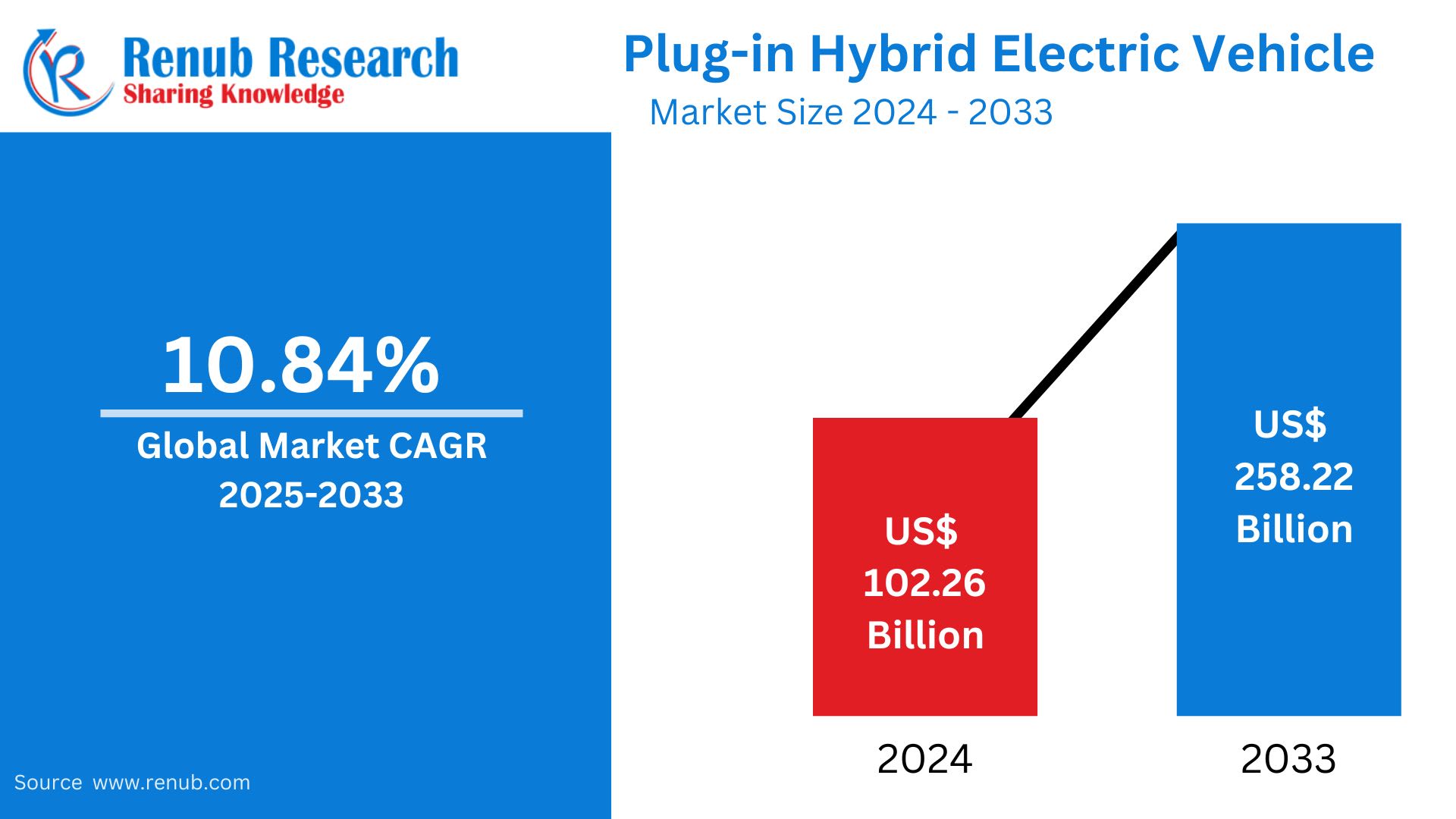
The global plug-in hybrid electric vehicle (PHEV) market is entering a transformative growth phase driven by sustainability goals, policy incentives, and automotive innovation. According to Renub Research, the market is projected to climb to US$ 258.22 billion by 2033, up from US$ 102.26 billion in 2024, expanding at a CAGR of 10.84% between 2025 and 2033. The shift is clear: consumers and governments worldwide now view PHEVs as a critical stepping-stone on the path to fully electric mobility.
Unlike conventional hybrids, PHEVs can operate in electric-only mode for daily commutes while maintaining the extended range of a gasoline engine. This dual advantage—cleaner driving plus range confidence—is boosting their popularity globally, especially in markets still building robust EV charging networks.
With rising environmental consciousness, stronger regulations on emissions, and significant battery technology improvements, the PHEV market is set for a decade of dynamic expansion.
Plug-In Hybrid Electric Vehicle Market Overview
A plug-in hybrid electric vehicle combines a conventional internal combustion engine with an electric motor powered by a rechargeable battery. What sets PHEVs apart is their ability to be plugged into an electrical outlet or home charger, enabling all-electric driving for short distances.
This capability reduces fuel consumption, lowers emissions, and provides flexibility unmatched by other powertrain types. Drivers can run errands or commute using electric power alone and rely on gasoline for longer trips or when the battery depletes.
Three major benefits drive consumer preference for PHEVs:
1. Environmental Advantage
PHEVs emit significantly less greenhouse gas compared to traditional vehicles, especially when used primarily in electric mode. This aligns with the lifestyle of urban and eco-conscious consumers.
2. Flexibility & Convenience
The EV range typically suffices for daily travel needs, while the gasoline engine eliminates range anxiety—one of the biggest barriers to EV adoption.
3. Cost Efficiency
Electricity is cheaper per mile than fuel. Over time, the combined savings from reduced fuel consumption and government incentives make PHEVs financially appealing.
As charging infrastructure grows globally and battery technology advances, the plug-in hybrid platform is increasingly seen as the pragmatic middle ground for consumers transitioning from gasoline to electric.
Key Growth Drivers in the Plug-in Hybrid Electric Vehicle Market
1. Government Incentives and Emission Regulations
Governments across Europe, North America, and Asia are offering tax credits, rebates, exemption from road taxes, reduced registration fees, and purchase subsidies to encourage the adoption of electric vehicles—including PHEVs.
Regulatory pressure is equally important. Strict carbon emission targets are forcing automakers to expand their electrified lineups. PHEVs help manufacturers meet fleet-wide CO₂ standards without relying entirely on fully electric vehicle production.
As countries continue advancing climate policies, PHEVs benefit immediately from being the easiest EV-adjacent technology for mass adoption.
2. Growing Environmental Awareness
Consumers are more climate-conscious than ever. Rising concerns over air pollution, global warming, and sustainability have driven a shift toward eco-friendly mobility solutions.
PHEVs resonate with this shift because they:
Slash emissions during short electric trips
Reduce dependency on fossil fuels
Allow drivers to adopt greener practices without sacrificing convenience
This mindset is especially prevalent among younger consumers and urban professionals who use vehicles for short, predictable daily commutes.
3. Technological Advancements in Battery Systems
Battery innovation is redefining the PHEV experience. Improvements in:
Battery capacity (longer electric-only range)
Charging speed
Thermal stability and safety
Overall efficiency and weight reduction
have made plug-in hybrids far more competitive than early-generation models.
Decreasing battery prices—thanks to economies of scale and innovation—further reduce the cost of PHEVs, making them accessible to a broader audience.
Battery performance improvements will remain a strong catalyst for market growth through 2033.
Challenges Facing the Plug-in Hybrid Electric Vehicle Market
1. High Initial Purchase Cost
PHEVs carry both an electric powertrain and a conventional engine, making them more expensive to manufacture. The larger battery pack adds to the cost burden.
Even though incentives help, the upfront price of PHEVs remains a major barrier for consumers in cost-sensitive markets.
This challenge is most evident in developing regions where government subsidies are limited or inconsistent.
2. Limited Charging Infrastructure
While PHEVs are more flexible than fully electric vehicles, the availability of public charging stations still influences consumer confidence.
In regions with underdeveloped charging networks, buyers may hesitate to invest in vehicles designed partly for electric driving.
Expanding fast-charging facilities, integrating home-charging solutions, and developing smart grid systems will be crucial for future adoption.
Market Segments and Emerging Trends
Mid-Priced Vehicle Market
This segment represents a large share of global PHEV demand, appealing to consumers seeking advanced electrification without premium price tags.
Automakers like Honda, Ford, and Hyundai are focusing aggressively on this class with competitive models that balance:
electric range
affordability
reliability
fuel economy
The mid-priced category is expected to be one of the strongest contributors to global PHEV volume growth.
SUV PHEV Market
SUVs are the most popular vehicle body type worldwide, and electrified SUVs are becoming a top choice for families and professionals.
Leading brands such as Tesla, Volvo, and Mitsubishi have launched PHEV SUVs that offer:
larger cabin space
powerful hybrid performance
higher electric-only range
strong fuel savings
The demand for practical, spacious, yet eco-friendly vehicles is pushing SUV PHEVs to become one of the fastest-growing subsegments.
Regional Market Analysis
United States Plug-in Hybrid Electric Vehicle Market
The United States is witnessing steady PHEV growth powered by:
Federal tax incentives
State-level rebates
Growing environmental awareness
Expansion of EV charging infrastructure
Major American automakers—including Ford and GM—are increasing their PHEV offerings to remain competitive.
Although the U.S. EV market trails Europe in maturity, rising climate-consciousness and regulatory pressure are accelerating PHEV adoption.
France Plug-in Hybrid Electric Vehicle Market
France is one of Europe’s strongest PHEV adopters, thanks to:
Aggressive government subsidies
Strict carbon emission goals
Demand for urban-friendly green mobility
French automakers Renault, Peugeot, and Citroën are rapidly expanding their PHEV lineups. Growing charging infrastructure and increased environmental awareness further support market growth.
China Plug-in Hybrid Electric Vehicle Market
China—the world’s largest automobile market—continues to dominate global PHEV demand.
Key growth factors include:
Strong government incentives
High urban pollution driving consumer preference for clean mobility
Massive EV infrastructure expansion
Leadership of domestic players like BYD, Geely, and NIO
China is expected to remain the fastest-growing PHEV market through 2033.
Saudi Arabia Plug-in Hybrid Electric Vehicle Market
Saudi Arabia’s PHEV market is in its early stages but growing rapidly due to:
Vision 2030 sustainability initiatives
Renewable energy transition goals
Increasing environmental awareness
Rising availability of charging infrastructure
Automakers such as Toyota, BMW, and Audi are introducing PHEV models tailored to regional driving conditions.
Saudi Arabia’s commitment to cleaner energy and transport modernization positions the country for strong long-term PHEV adoption.
Global Plug-in Hybrid Electric Vehicle Market Key Players
Major players shaping the global PHEV landscape include:
Tesla
BMW Group
BYD Company Ltd.
Mercedes-Benz Group AG
Ford Motor Company
General Motors
Nissan Motor Co. Ltd.
Toyota Motor Corporation
Notably, Toyota announced a US$ 35 billion investment in PHEVs and EV technology, strengthening its leadership position. The company sold over 500,000 hybrids and PHEVs in the previous year, reinforcing its dominance in the electrification sector.
Market Segmentation
By Vehicle Class
Low-Priced
Mid-Priced
Luxury
By Car Type
SUV
MPVs & Vans
Midsize & Large Cars
Small & Compact Cars
By Region
North America: United States, Canada
Europe: France, Germany, Italy, Spain, UK, Belgium, Netherlands, Turkey
Asia Pacific: China, Japan, India, South Korea, Thailand, Malaysia, Indonesia, Australia, New Zealand
Latin America: Brazil, Mexico, Argentina
Middle East & Africa: Saudi Arabia, UAE, South Africa
Rest of the World
Each key player is analyzed through:
Overview
Recent Developments
Revenue Analysis
Competitive Landscape
The PHEV market is highly competitive, with automakers racing to gain technological and market leadership. Companies like Tesla, Toyota, BMW, BYD, Ford, GM, Nissan, and Mercedes-Benz continue to invest heavily in:
Battery innovation
Software integration
Safety enhancements
Cost-efficient manufacturing
Strategic partnerships, EV infrastructure investments, and product diversification will shape competition through 2033.
Final Thoughts
The plug-in hybrid electric vehicle market is more than a transitional technology—it is a crucial bridge enabling widespread electrification while global infrastructure catches up. With strong government support, rising environmental awareness, and accelerating battery advancements, PHEVs are poised for significant growth through 2033.
They offer the right blend of sustainability, flexibility, and practicality, making them one of the most accessible green mobility solutions worldwide.
If the current trajectory continues, the next decade will see PHEVs play an essential role in reshaping the global automotive landscape.