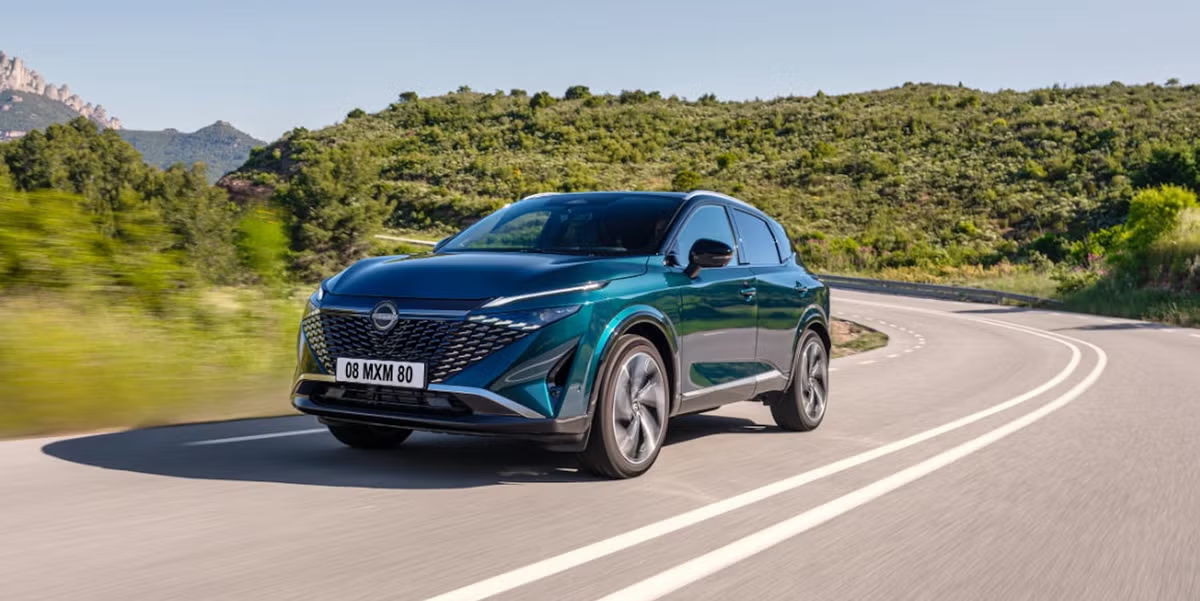
Nissan jumps on the hybrid bandwagon with two new Rogues, a plug-in hybrid coming early next year and the one you see here with series-hybrid power. We got to drive a European Qashqai crossover with e-Power that featured a series-hybrid drivetrain with a 202-hp electric motor powering the front wheels, a 2.1-kWh battery pack, and a turbocharged 1.5-liter three-cylinder gas engine.The version we get will get the Rogue name, too, and arrives in October 2026.
While most carmakers have had hybrids for years—most notably Toyota, which seems to hybridize dang-near everything it makes—apart from an Altima hybrid years ago, Nissan missed the hybrid-powered bandwagon, assuming the $7,500 federal tax credit would last forever and that the world was going to electric powertrains sooner rather than later. It chose poorly.
That will all be addressed, albeit late, starting next year.
In early 2026, we in the States will get, first, a Rogue plug-in hybrid with a combined gas-electric range of 420 miles, and then in October 2026 we’ll get a higher-tech series-hybrid version of the current Euro-market Qashqai crossover.
Related Story
Unless you live in Europe, or like hybrids that don’t power the wheels directly, you’ve probably never heard of the Nissan Qashqai. It’s a perfectly fine compact crossover with a fairly advanced hybrid drivetrain. We got a Qashqai from 2017 to 2022 but with a 2.0-liter gas engine, there was no hybrid offered.
Here’s a quick refresher on hybrids: They’re either series or parallel. Most hybrids we see now are parallel, that is, their gasoline engines power the vehicle directly and also produce electricity to power an on-board battery. In a series-hybrid model, the gasoline engine is used only to power a generator to make electricity for the battery—and from thence the wheels are driven only by electric motors.
The coming Nissan Rogue Hybrid will be one such series hybrid. (The Rogue plug-in hybrid coming in early 2026 is a parallel hybrid. Don’t think about that right now. We’ll get to that in the next article.)
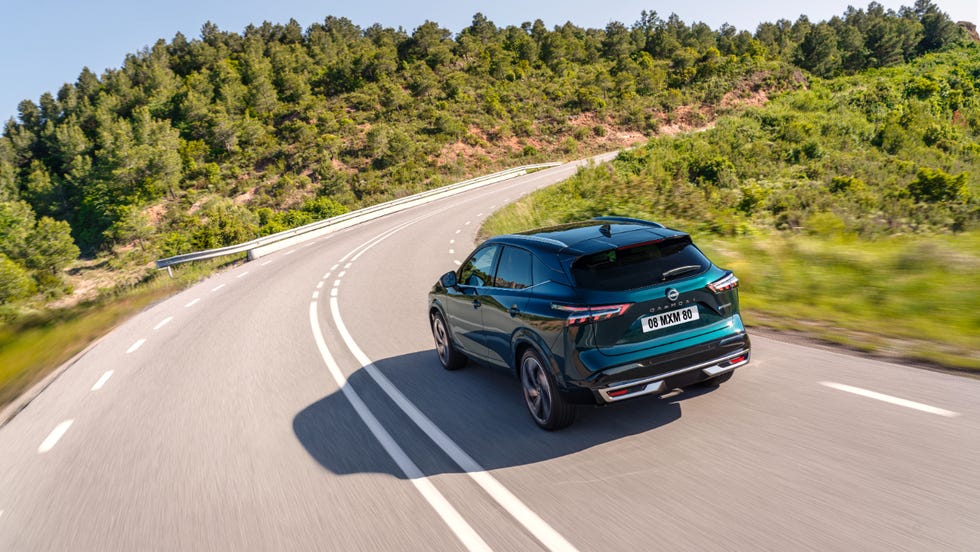 Nissan
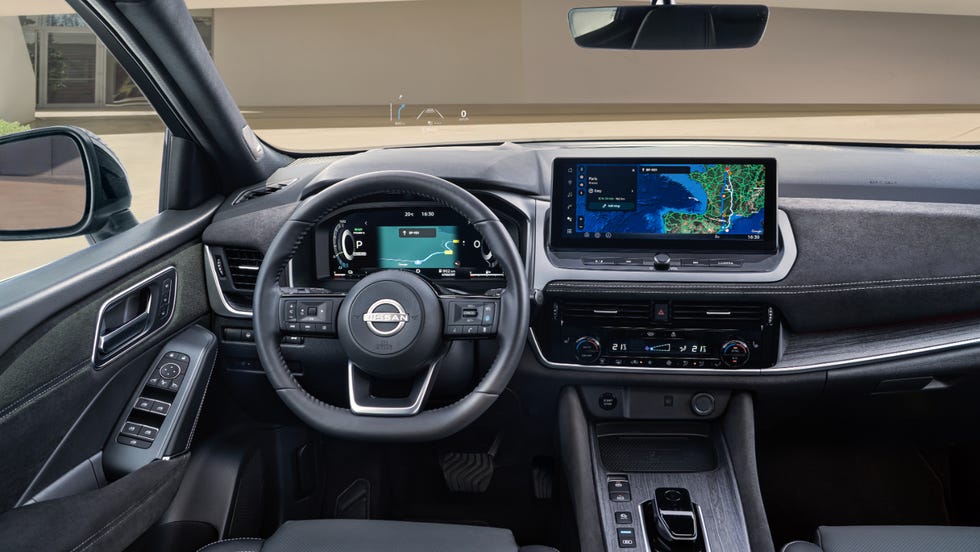
This is a Euro-spec Nissan Qashqai like the one we drove earlier this week in Tennessee.
The Nissan e-Power hybrid system in the Qashqai I drove has been around for many years, but only in Europe and Japan. The Rogue Hybrid with e-Power that we will get later next year will have this third generation of series hybrid e-Power, the best one yet.
A couple days ago outside Nashville, where Nissan’s North American headquarters are, I got to drive a European Qashqai with the e-Power system very similar to what we will get here next year.
What’s a Qashqai, you ask? It’s a compact crossover that’s been around since 2006 in Japan, Australia, and Europe. In 2021, for its third generation, the Qashqai got this e-Power option. Next year, we will get it as the Rogue Hybrid (sorry to be repetitive but it’s easy to get confused).
The Hybridization of the Industry
The Euro-Qashqai I drove had a 202-hp electric motor powering the front wheels (we will get AWD-only when this model comes to our shores). That motor draws electric power from a 2.1-kWh battery, which itself is fed electricity from a 1.5-liter turbocharged three-cylinder engine spinning a generator.
On my short drive, I was a bit surprised to find that the gas engine in the Euro-Qashqai revved higher as I stomped on the gas pedal. You may have thought these things simply spun at their most efficient rpm and never varied, as Series Hybrids do on train locomotives and large buses.
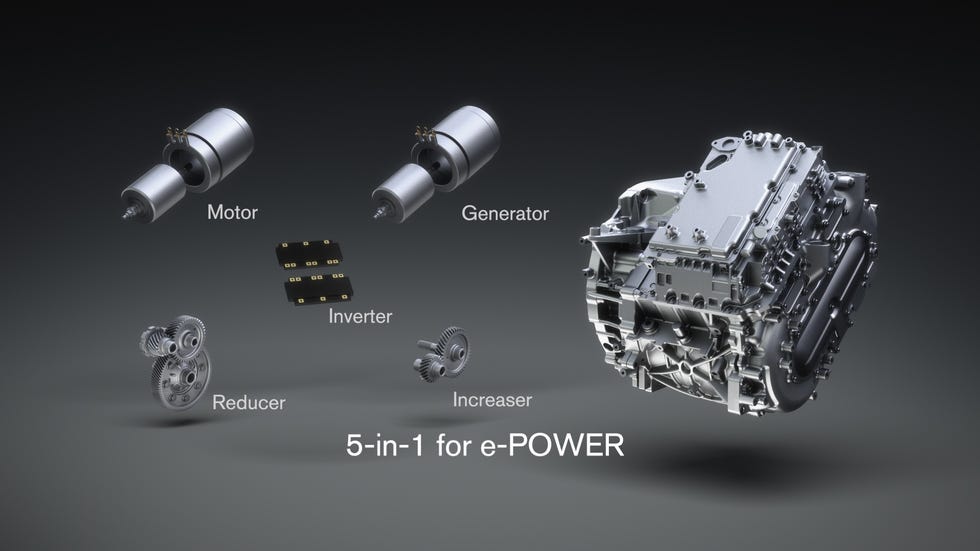 Nissan
Drivetrain parts that make up e-Power
You could hear the gas engine as it revved, but it wasn’t too loud given its small displacement and the turbo muffling the exhaust sound somewhat. Nissan says cabin noise is reduced by up to 5.6 dB compared to previous generation, “offering EV-like refinement.”
With what Nissan says is more stabilized in-cylinder combustion lifting thermal efficiency by 42%, this setup offered a quieter approach than parallel hybrids I’ve driven, but you can judge for yourself next year when your Nissan dealer starts offering test drives.
Related Story
The drivetrain offers a little over 52 mpg on the European WLTP cycle, or what could be from 39 to 41 mpg on our EPA routes. Nissan quotes a range of over 620 miles in the Euro-spec, front-drive Qashqai on a full tank. We’ll get less than that here.
Nissan says its new e-Power features a newly-developed 5-in-1 modular powertrain unit that integrates an electric motor, generator, inverter, reducer, and increaser into a compact and lighter package. Overall, the improvements raise power by 15 hp to that maximum output of 202 hp.
 Nissan
Qashqai controls include a power diagram showing where the energy is flowing.
“This new, third generation e-Power system redefines Nissan’s hybrid technology providing smooth and responsive driving in all conditions,” said Eiichi Akashi, chief technology officer and executive officer, Nissan Motor Corporation. “We’ve embedded close to a decade of learnings to ensure the system is more efficient, more refined and more competitive.”
The Nissan version will be complemented by an Infiniti, which is currently being called the LM-SUV, but may be called the QX50 when it hits the market.
Hybrid and plug-in hybrid SUVs are growing in market share, particularly in the subcompact segment where the Rogue sits. With the Rogue being Nissan’s biggest-selling vehicle, it only makes sense to offer a hybrid or two. Finally.

Mark Vaughn grew up in a Ford family and spent many hours holding a trouble light over a straight-six miraculously fed by a single-barrel carburetor while his father cursed the Blue Oval, all its products and everyone who ever worked there. This was his introduction to objective automotive criticism. He started writing for City News Service in Los Angeles, then moved to Europe and became editor of a car magazine called, creatively, Auto. He decided Auto should cover Formula 1, sports prototypes and touring cars—no one stopped him! From there he interviewed with Autoweek at the 1989 Frankfurt motor show and has been with us ever since.