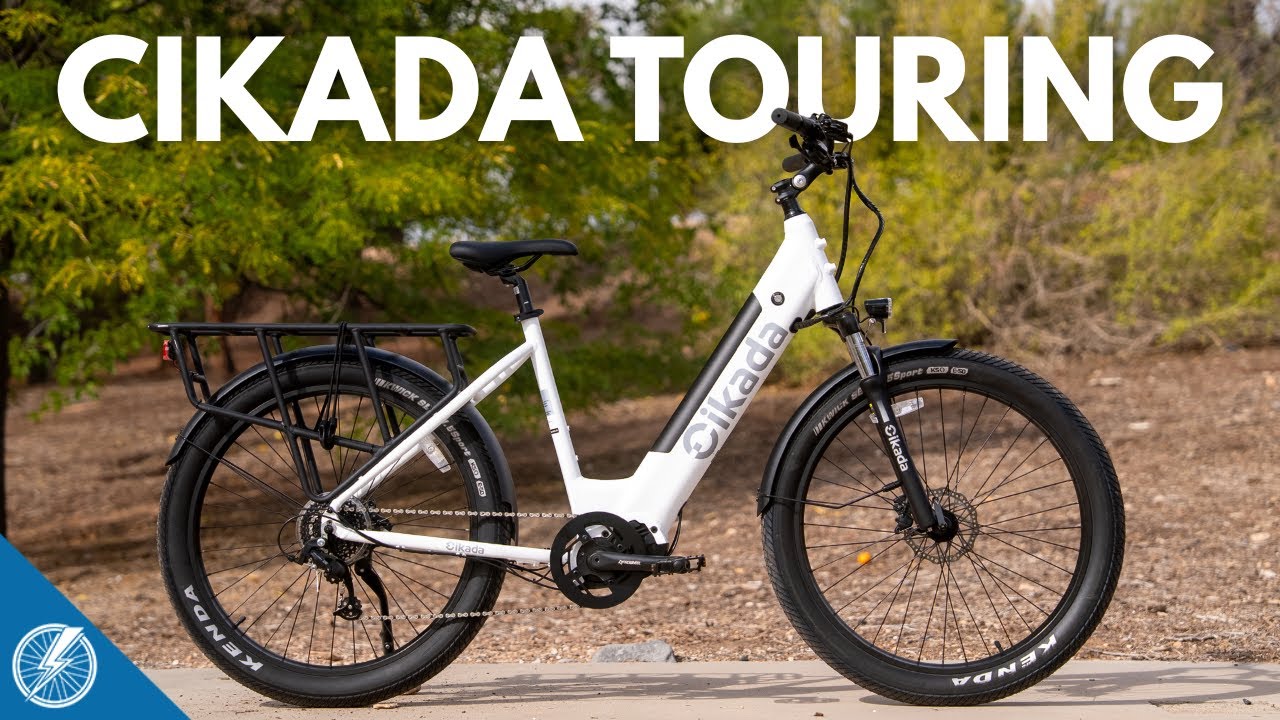
Cikada Touring E-Bike Review | In It For The Long Haul?
This is the Cicada Touring, a mid drive eBike that just might do it all. It’s part commuter, part cargo hauler, and part adventure bike that’s built for serious distance. We even pushed it past its advertised range, and the results surprised us. [Music] [Music] The Cicada Touring’s mid drive motor, cargo ready rack, and high-capacity battery make for an uncommon blend. At least on paper, this bike is built for weekday commutes, grocery runs, and long weekend rides. But is it truly as versatile as it seems to be? That’s what we’re here to answer today. I’m John with Electric Bike Report, and if you’re new here, thanks for tuning in. We specialize in data-driven ebike reviews and real world testing. So, if you’re shopping for an ebike, make sure you’re subscribed. And if our testing helps you choose your next ride, please consider using the affiliate link down in the description to help support our channel. But now, one thing about most ebikes is that they tend to be pretty specialized. They’re often designed to do one or two things extremely well, sometimes at the cost of versatility. For example, a full suspension EMTB handles rocky terrain beautifully, but isn’t exactly efficient on pavement. Folding ebikes are compact and convenient, but usually trade away some comfort and control. The Cicada Touring sits in a unique middle ground between a long range commuter and a cargo ebike. It’s not limited to one purpose. So instead, it aims to handle a little bit of everything, including getting you to work or school, running errands, and providing long-distance recreation. At its core is a 350 W Buffong M410 mid drive motor, producing up to 90 new meters of torque. It has plenty of power for hills and hauling while keeping the ride smooth and natural. Thanks to its torque sensor, the motor responds to how hard you pedal, giving you more power when you dig in and backing off when you relax. If you’re used to riding a non-electric bike, it feels intuitive, engaging, and a whole lot more fun. The Touring is powered by a 720watth battery pack built with LG cells. The battery is removable, lockable, and certified to meet UL 2271 standards. Cicada claims up to 75 mi of range, and as you’ll see later, we actually went well beyond that in our range test, so stick around for those details. Functionally, this bike is more than just a commuter. Its extended rear rack can carry up to 77 lb, pushing it into moderate cargo territory. With a total payload of 309 lb, this bike is ready to haul groceries, a child seat, or gear for a full day of cruising and exploring. Comfort is another area this bike puts a big focus on. The Touring includes a Zoom suspension fork with 60 mm of travel, a leather saddle, and a set of ergonomically curved 680 mm handlebars with Vevel anti-slip rubber grips. The bike can feel sporty or relaxed thanks to its adjustable stem. And it comes in two frame sizes, making it easy to find a comfortable fit. The Touring’s handling also impressed us. The 27 1/2x 2.8 8 in Kenda tires give great stability and traction while keeping the ride nimble. The bike felt planted at speed but responsive in corners, making it ideal for both city streets and open paths. Other key features include star union hydraulic disc brakes with two piston calipers, 160 mm rotors, and a parking brake feature, as well as an 8-speed microshift drivetrain operated by a trigger style shifter on the right handlebar. The bike also includes full coverage plastic fenders, integrated LED lights, a sturdy kickstand, and a right-hand twist throttle for when you just want to cruise. The bike itself is certified to meet UL2849 standards. And on the Cicada website, it has just this single white paint job, but some of the marketing materials we were sent show black as well, so it’s possible that that’ll be available in the future. All in all though, the Cicada Touring feels comfortable, adaptable, and practical with performance that exceeded our expectations in more than one area. But no ebike is perfect. And in our testing, we did find a few small areas that could be improved. So stick around because up next, we’re going to dive into the data from our standardized tests to show exactly how this bike performed on the road and how it compares to similar ebikes we’ve tested. All right, we are here for a speed test on the Cicada Touring eBike. Starting things off as usual with no pedal assist. And uh the bike feels pretty comfortable here with uh no power. We’re going kind of between 10 and 10 1/2 mph by the bike’s display uh just on leg power alone. So, let’s go ahead and kick things up into PAS1. All right. So, I’m sure that you can hear the motor there uh picked on right away. And you know, still feels pretty natural while pedaling, but uh you know, pedaling did get a bit easier. And then, of course, we are getting a noticeable jump in speed up to uh kind of between 12 and 12. So, a good couple miles per hour of difference. All right, let’s go up to PA2. And again just uh you know gradual ramping up in power there. Not a huge difference. Uh again still delivers power very responsively and naturally feels a lot like riding a regular bike but we are again picking up in speed. So uh looks like another you know maybe around mile and a half to 2 mph jump kind of between 13 and 12 and 14. Yeah. Let’s get around this bend till we take a final reading. A little bit of a downward grade here. So, let’s level that back off again. And all right, I guess uh yeah, another 2 m per hour jump up to between 14 and 14 12. Let’s go ahead and go up to PAS3. All right, another smooth ramping up. Shifting up again. And I’m definitely noticing, you know, uh, a bigger difference here in the ease of pedaling, um, or at least the amount of, you know, return for my effort. So, it does still feel pretty natural, though. So, we’re got up up to around 17 mph. Again, pretty comfortably. Between 17 and 12, maybe. So, you know, predictable increases here. Pretty steady. Let’s go ahead and go up to PAS4. All right. Again, noticing, you know, a lot more power here. Shifting up again. Still feels pretty natural to pedal, but again, just even more return for my efforts. We’re up to kind of right around 19 miles per hour. Yeah, just maybe just under. And then All right, let’s finish things off in PAS5. We’ll see if we can hit that 20 m per hour limits now. All right, I’m gonna shift up. It doesn’t really feel like we’re we’re getting additional power here. So, it seems like this might be the ceiling. Maybe a little bit early. Uh, yeah, kind of topping off right around 19 then. I’m just feeling like resistance as I push into the pedals a little harder. So, all right. Well, I guess that’ll be our uh speed test for the Cicada Touring. All right, we’re back for a throttle acceleration test on the Cicada Touring. So, I’m going to start here in kind of a middle gear and then we’re going to see how long it takes to get up to 20 mph. Let’s go ahead and start in 3 2 1 go. All right, nice gradual start. I’m going to go ahead and shift and one more time up to 18. 18.4 18 12. I’m going to shift up one more time. See if we can get going any faster. Yeah, there we go. Uh, well, all right. It looks like 18.7 is about it. Let’s call that the uh speed test. Let’s go ahead back to the studio and chat a little bit more. As you saw, I rode the Cicada Touring for our speed test on a flat paved section of our local shared use trail, starting in PAS0 with just leg power and stepping up through each of the bikes five assist levels. Now, since the Touring is limited to class 2 speeds, it tops out at 20 mph with either pedal assist or throttle. So, starting with no assist, I averaged 10.2 miles per hour under my own power. In PAS1, my speed climbed to 12.2. Then 14.1 in PAS2. PAS3 delivered a bit of a boost up to 17.1 mph. PAS4 brought me to 18.8. And finally, PAS 5 topped out right around 19 mph. Each increase in assist level felt generally smooth and predictable, though there was a distinct jump in power between PAS 2 and 3 that made the bike feel a bit livelier. I wasn’t quite able to hit a full 20 m hour, but I’m fine with the conservative ceiling, especially on a bike built to carry cargo or a child passenger. When using throttle only acceleration started gently before steadily ramping up to that same roughly 19 mile per hour limit, I noticed that my selected pedal assist level influenced throttle acceleration with PAS1 feeling gentle and easygoing and PAS-5 giving the most punch. But as you saw, it was still very steady and approachable. Overall, the Cicada Touring showed strong performance in this test with well- balanced assist levels, smooth acceleration, and a natural feeling mid drive response that made the ride both controlled and engaging. [Music] Our next stop is the range test, where we measured how far the Cicada Touring could go on a single charge in both its highest and lowest assist levels. As I mentioned earlier in the review, this bike is built for distance, and it definitely lived up to that claim. Between its efficient 350 watt mid drive motor and its relatively large 720watth battery, the Touring proved capable of some seriously long rides. In our testing, we rode the bike until the fully charged battery was completely drained. First in PAS5 for the minimum range and then again in PAS1 for the maximum. Without carrying any added cargo weight, our test riders reached 35.3 mi in PAS5 and an incredible 121.8 mi in PAS1. To put that in perspective, similar commuter style ebikes we’ve tested averaged about 34 miles in their high assist tests and 68 miles in their low assist runs. That means the Touring was roughly average at high power, but nearly doubled the category average in PAS1, giving us one of the longest low assist results we’ve ever recorded. Looking at energy efficiency, you can check our written review for the actual numbers, but I’ll keep it digestible here and say that the Touring was noticeably more efficient on average than its competitors in its lowest setting, though a bit hungrier for power in its highest. We attribute the bike’s strong performance to two main factors. The natural efficiency of its mid drive motor and the relatively high-capacity 720watth battery. Together, they give the Touring a serious advantage over many hub driven commuter bikes and some with mid drives, too. If we could make one improvement, we’d ask for a faster charger. The included 2 amp unit takes around 7 1/2 hours to recharge a drained battery, while a 3 amp charger would cut that down to about 5 hours. But overall, the Cicada Touring absolutely lived up to its name. It’s built for distance, making it an excellent choice for long commutes, weekend adventures, or multi-day touring rides. [Music] Next up is our hill test where we evaluate how the Cicada Touring performs when climbing a steep halfmile stretch we call the Devil’s Backbone. It’s a tough one with an average 8% grade and 217 ft of elevation gain. This hill really separates the strong climbers from the rest. We performed this test twice, once using throttle only and again with the rider pedaling in the bike’s highest assist level. Let’s watch both through the eyes of our test rider, Justin, and then I’ll analyze his results once we get back here. Okay, we are out here on the Cicada Touring at the Devil’s Backbone doing the throttle test. Now, with the mid drive, that’s a little bit more challenging on this hill test for mid drives for obvious reasons. I do also have to get the right gearing. So, I’m in third gear. We’re going to see if this makes it. Um, I’m not sure it will. 10.1 miles per hour, 9.0. No. 7.9 7.7. I’m going to downshift really quick. Do I have to turn the pedals just to downshift? 6.1 6.0. I’m going to downshift again. So, I’m in second gear. So, trying to give it the best shot possible. Now, note when I am turning the pedals, I’m not adding anything to the motor. I’m simply turning the crank. Um, so it so I the chain will actually move properly and not mess up the cassette. So we bottomed out about 6 miles per hour. We’re at 8.5 8.9. So definitely did better when I shifted down to second gear. It’s going to struggle a little bit through here as you know I’m limiting it by being in second gear. That’s okay. We want to make it up the hill. We’ll see. 9.6. I’m going to downshift as low as I can here. So this is first gear. 6.9 mph. My expectation is it doesn’t quite make it to the stop sign. If it does though, I’ll be pretty happy. Um, you know, mid drive is multiplying what I’m putting in it. I’m not putting anything. So, it’s that’s a big that’s a big challenge there. Um, it’s kind of wanting to hold right about that 7 mph, though. 6.9 is kind of where we bottomed out. I’m not going to need a break. I’m going to try to maintain as much speed as I can through this section here and see if we can make it to the lamp post and farther. So, we’re at 9 miles an hour here. 8.7 [Music] 8.3. It’s doing a little better than I thought it would once I shifted down to first gear. So, we’re going to cross right at 8.1 miles per hour and basically see if this is kind of that little engine that could that just keeps trucking along. Um, motor noise, I do hear it a little bit more. I know this one’s a little bit louder than average. I’ll let you listen here. [Music] So, yeah, we’ve been going about 7 6.9 miles per hour. This is one of the steeper sections right here. So, we’re down to 5.7, but it is I want to knock on wood. It is pushing through um better than I expected. I honestly I did not think this was going to make it up. Um they definitely have not overpowered this bike. It’s more natural um as kind of you’d probably want on more of a cruiser style commuter. Um, so I think we’re going to make it. We’re at 9.1 miles per hour. You can hear that motor pick up as our as the RPMs increase on that motor. Kind of cruising at 9.2. Obviously, this is not going to be one of the better times, but it is getting up so far. I don’t want to jinx it. Um, there down to 7.8, 7.5. Kind of feels like that bottom through the hill was about 6.9. We’ll see what this did, but it made it. So, great job there as we finished at 7.6 mph. All right, we are back out on the Cicada Touring bike now doing the pedal test at the Devil’s Backbone and PS5. We’re hit about 17 miles per hour. Can’t quite tell what gear I’m in. I’m in a higher gear. I’m going to downshift once here. 16.0. 15.0. Down shift one more time. There we go. 13.7 mph. I’m going to kind of bottom about 12.8 miles per hour here. I think I’m going to keep this same gear. Then I downshifted twice, but it’s feeling pretty good there. Got to about 15 and a half before this next next steep section. I’m going to downshift one more time. So 13.2 12.6 12.4 and it’s going to bottom out right at 11.8. I’m going to downshift one more time before this turn. and see what it gets to before this lamp post. So, I’m at 11.9. Let me shift up one more. We’re going to cross this checkpoint. We’re at 12.6 mph. Um, now, as far as the engagement goes, feels natural. Um, feels more like a lighter weight city commuting type bike. cruiser. Not overly powerful, but good engagement. I’m having to pedal a little bit more than I’d say average. So, definitely more than a soft pedal, but not as hard as a mid drive. Um, motors making a little bit of noise. I’ll let you listen to it. [Music] So, I’d say it’s a little louder than normal and the frequency is a little higher pitched. So, I’m assuming you you’ll be able to hear this. But, did make it to the top and we’ll see what it gets as we cross right at 11.9 mph. On throttle power alone, the Touring completed the climb in 2 minutes and 42 seconds with an average speed of 11.2 mph. When pedaling in PIS-5, our test rider made it to the top in 2 minutes and 17 seconds at an average speed of 13.2 mph. Now, those numbers are a bit slower than the averages from many other commuter style ebikes we’ve tested, but there is more to the story. Our comparison group includes a lot of rear hub motorbikes, which typically climb faster because they can apply all their power directly to the rear wheel. The Cicada’s 350 watt mid drive motor, on the other hand, delivers power through the drivetrain, giving it a more natural, responsive feel, even if it’s not quite as quick on paper. In comparison to other commuters with mid drives that finished the pedal test in 2 minutes and 18 seconds, the Touring came in right around average. At our secondary test location, Pilot Hill, I personally found the Touring’s throttle to be steady, but reserved. It didn’t quite bound to the top of the hill, but it did pull consistently all the way up. When pedaling in PAS5, the climb felt active, but manageable, so I reached the top with only light effort and barely heavier breathing. With a load of cargo, riders may need to assist the throttle with some pedaling, depending on the hills and how much weight they’re carrying. But considering that many mid drive commuters don’t include throttles at all, I see the Touring’s throttle as a bonus feature. When pedaling, the bike handled every climb we threw at it with ease, flattening hills in a way that felt smooth and controlled. [Music] Next up is our brake test, where Griffin, who is 6’1 and about 230 lb, brings each bike up to 20 mph before applying the brakes and coming to a complete controlled stop. We record the distance from the point where the brakes are applied and then take the average of three runs to keep things consistent. The Cicada Touring came to a stop in an average of 29 ft and 5 in. For context, similar commuter style ebikes we’ve tested average 22 ft and 1 in. So, the Touring’s result was noticeably longer, roughly 7 ft beyond that benchmark. This bike uses a Star Union hydraulic disc brake system with two piston calipers and 160 mm rotors front and rear. In my personal testing, I found the brakes to be generally effective and predictable, though the longer stopping distance was apparent, especially on downhill stretches. The bike never felt unsafe, but the data does suggest that there’s room for improvement. Considering the Touring’s ability to haul moderate cargo or a child passenger, we’d like to see Cicada upgrade to larger and potentially thicker rotors for stronger braking and better heat dissipation. That said, credit where it’s due. Cicada included locking parking brakes, which add real stability and safety when loading or unloading the rear rack. It’s a thoughtful touch that sets this bike apart from similar bikes with standard kickstands instead of the dual leg center stands often found on dedicated cargo bikes. [Music] All right, let’s talk about ride quality here on the Cicada Touring eBike. So, of course, this is a pretty interesting hybrid ebike that blends commuter and cargo styles. You know, it very much leans into the uh commuter design that we would expect, but then it has that extended cargo rack that just makes it very utilitarian for a whole bunch of different purposes. Uh there are two frame sizes for this bike that are recommended for riders from 5’2 up to 6’4. Now we are on the larger of the two right now and I’m 5’11 which puts me pretty much smack in the middle of the recommended height range for this version of the bike. And uh yeah, I mean I’d say that it feels great for for my proportions and size. Um I’ve got really nice leg extension. There’s a long seat post here. Uh, I didn’t grab a measurement from that, but I will so we can talk about that when we get back to the studio. But then, of course, up front you have an adjustable stem that allows you to change the handlebar height and reach and also adjust the riding position. So, you know, when I first hopped on this bike and the stem was set, you know, lower, uh, the riding position was a bit sportier, but I raised the handlebars just to match my preferences. This is a nice comfortable, happy spot for me. And, uh, yeah, feels great overall. I also really like the ergonomic curved handlebars here and uh just this bike handles really well. So, a lot a lot of good going on with this bike for sure. Now, we’ve got uh just a front suspension here. That’s a Zoom fork uh with preload adjustment and uh let’s see, there’s 60 mm of travel on that. So, you know, plenty for smoothing out bumps on paved surfaces. There’s no rear suspension, but you know, to make up for that, uh, the tires really do a lot of shock absorption. So, those are 27 1/2 by 2.8. Uh, so very wide for this style of bike. And, you know, that adds a lot of riding stability. And, you know, you really notice that when you’re going into corners and then it also uh, you know, just absorbs a lot of those bumps. can lower the tire pressure a bit for uh better traction and and shock absorption, but uh even with you know standard pressure here, I’m feeling really good. So then we also have the 350 watt mid drive that I’m sure you can hear right now. Um so you know I would say that I normally am not bothered a whole lot by motor noise but it is definitely uh noticeable here. So that is a consideration if that you know matters to you. But, uh, as far as power delivery goes, as we’ve talked about in the speed test section, and it feels really good. Um, very natural in the low power levels. And then as you bump up to higher levels, you get just a lot more return for the amount of effort that you put in. And of course, you have five assist levels to choose from. So, I’m just going to bump up to PAS5. And you can see, you know, we are picking up in speed very quickly. And, you know, haven’t really changed my pedal effort. So, uh, yeah, definitely effective and feels nice and natural and responsive. So, uh, anyway, that pretty much wraps things up. Oh, yeah, I did want to point out that I have the Cicada app pulled up here. Um, I’ll do a quick run through of that at the end of the ride quality section here. Uh, and then I did want to just point out the fact that this bike does have a throttle. So, you know, a lot of mid drive ebikes do not include throttles. Uh, so, you know, it’s just a nice feature to have. helps you get started and you can take advantage of the gearing with the drivetrain if you, you know, want to let the motor do all the work when it comes to hills. So, uh, yeah, pretty nice feature to have. But in any case, let’s bounce back to the studio for a little bit and I’ll talk to you again shortly. As you could hopefully gather from that ride footage, the Cicada Touring impressed me with its comfort, handling, and its overall feel on the road. To touch back on sizing, the two frame sizes are a medium that fits riders from 5’2 to 5’9, while the large that I tested is intended for those between 5’5 and 6’4. The seat post offers around 4 1/2 in of height adjustment, which was plenty for my height of 5’11, and there was some additional room for taller riders, too. The touring step through frame design has a 17 1/2 in standover height that also made getting on and off the bike super easy, which I always appreciate. The bike saddle definitely leans more toward the performance side of things. It’s slim and a little bit firm, but that’s really a matter of personal preference. I’d probably swap it for something slightly cushier for longer rides, but you might opt to keep it depending on your weight and proportions. I did really appreciate the adjustable stem and the ability to set a relatively upright and relaxed riding position that kept a lot of pressure off my wrists. Now, as I mentioned earlier, the Touring’s 350W Buffong mid drive is a standout feature. As I’ve mentioned, it feels natural, responsive, and it gives the ride a very connected feel. That said, there are a couple of quirks worth noting. As you might have heard, the motor is noticeably louder than average, and it has a bit of overrun, meaning that it continues to deliver power for a moment after you stop pedaling. It’s not a safety issue, and many bid drives have this to some degree, but it is something to be aware of, especially when you’re carrying cargo. In terms of accessories, Cicada plans to expand the Touring’s utility with cargo baskets, a front rack, and even tire pressure monitors that sync with the brand’s mobile app, and all of those will be available for purchase separately. The rack is also compatible with Tulie’s Yep. 2 Maxi Child Seat, adding even more versatility to an already capable touring platform. I found the bike’s user interface both simple and functional with a small black and white display on the left handlebar that shows speed, battery level, and assist mode. I’d personally love to see a color screen and a percentage-based battery readout, but those details are also available through the Cicada app. Let’s head back out on the bike so I can walk you through that app and then we’ll come back and summarize all of our findings. All right, let’s go ahead and uh walk and talk you guys through the Cicada app here. So, I’m screen recording. We can pull that up so you can see what I am looking at here. But uh this main panel here is just sort of your your ride data. You can record rides manually, but I noticed that it does seem to work automatically as well. Uh when I first connected this yesterday and went out for a spin, it was automatically tracking as I was as I was going there. Um now, interesting thing, if I can figure out how to do it, but you can when you first open up the app anyway, customize the layout here. There’s different modules that you can kind of swap out there. Uh I’m not really sure how to get back to that, but it is possible again when you at least pull that up. Um and then you saw here that we do have the uh GPS that you can, you know, zoom in and out of and then go back to your uh location there. Now, we have uh a couple indicators here. This is the pedal assist level. So, interestingly on the bike it’s PA 1 through five, but then here we have uh eco tour, sport, sport plus, and boost. So, uh still five assist levels that do the same thing. And then, of course, we have our battery uh percentage here, which is really nice because the display on the bike only has uh the five bars here. So, this gives you a little bit more granular granular breakdown of your charge level. Um, but then yeah, if you go up here into the uh hamburger settings menu thing here, we’ve got activity. So, this is uh you know, as you save rides and record those, it’ll track all of the data from that. Um, so I’ve only tracked one, although I’ve been out here quite a few times on the bike. Um, but you can see that, you know, yeah, we did uh get up to about 6 miles today. And then if you know, if you hit this, it would show you all of your ride data. Um, so pretty cool there if you are into tracking your stuff. But then the service menu here is is good. Um, so this bike can be set up with tire pressure sensors. Uh, so if you if you get those and equip them to the bike, then you can pair them with this and then keep track of your tire pressure just through the app here, which is uh a very useful and pretty rare feature, honestly. So uh, that’s very cool. It also keeps track of some battery health stuff, which is nice. You’ve got we’ve gone through eight charge cycles here during our testing. Uh, and then there’s some service logs here just in case you run into any issues. Uh, so let’s go ahead and look at that. Okay, it says contact your retailer. Not really sure what that’s about, but um, yeah, anyway, you can mark those as red. But then if we go up here to settings, a couple useful things here. Uh, so just, you know, kind of your basic profile information. Um, interestingly, it does seem to pick up your weight automatically. I did not enter my weight, but it has that figured out pretty closely, which is, uh, which is interesting. But then down here, uh, let’s see, we have passcodes. So, there’s a security pin on startup with the display. So, you can set that up here. You can set up your tire sensor thing there. You can find service centers. And then here is where you can uh decide whether you want metric or imperial units or then with the battery readout if you want that in percentage, which of course is what we have. And then you can also break that down by like estimated range uh in time or distance. So, uh, pretty interesting there. I think that’s kind of the the most useful, but in any case, uh, pretty simple app, you know, but effective and, uh, gives you gives you some useful features here. But, let’s go ahead and keep the review moving and, uh, I’ll talk to you again soon. Before we completely wrap things up, let’s take a quick look at the pros and cons of the Cicada Touring. Starting with the positives, the Touring feels both powerful and natural to pedal thanks to its 350 watt mid drive that delivers up to 90 new meters of torque. It’s ready to work, too, with an extended cargo rack that can carry up to 77 lbs, making it far more utilitarian than your average commuter ebike. This bike is also well equipped for long rides. As we discussed in our range test segment, we actually exceeded Cicada’s advertised range, which says a lot about the bike’s overall efficiency. Comfort and adaptability were major highlights as well. The two frame sizes, adjustable stem, and ergonomic handlebar setup make it easy to find a relaxed and natural fit. Handling was another strong point. The 27 1/2x 2.8 in tend to tires offered a great balance of stability and agility. And with optional accessories like a front rack, cargo baskets, and even child seat compatibility, this bike’s functionality can grow with your needs. I also love that its mid drive motor includes a throttle that’s rare and super handy for getting up to speed or tackling steep hills. As for the downsides, we’d like to see upgraded brakes to match its hauling potential. And while its motor performed beautifully, the Buffong mid drive was louder than expected. [Music] The Touring is the first ebike from Cicada that we’ve reviewed here at Electric Bike Report, and it made a strong first impression. Based on its specs and its design, we expected a capable all-around performer, and in practice, that’s exactly what we found. As our range test results showed, the Touring is built for distance, but it’s equally practical for day-to-day use. Whether you’re commuting, running errands, or just heading out for a weekend adventure, this bike fits right in. We appreciated its intuitive programming, approachable power levels, and the natural responsive feel of its pedal assist. Its climbing ability was solid, too. The 350 watt mid drive had no trouble flattening hills. And it definitely has plenty of power for moving cargo or a passenger. As we’ve discussed, our main critiques came down to two things, the brake system and the motor noise. But otherwise, the Touring is comfortable, efficient, and user-friendly, making it a great fit for riders seeking a reliable do-it-all ebike for daily travel, errands, exercise, leisure, sightseeing, and beyond. If you want to take a closer look, you can find links to our written review and to Cicada’s website in the description below. As a reminder, using our affiliate link helps support our work. And as always, don’t forget to like, subscribe, and share this video with anyone you think would appreciate it. Feel free to leave us any questions you have in the comments section and let us know how you’d take advantage of the Touring’s 100mile potential range. But thanks for taking a ride with me today. Again, I’m John with Electric Bike Report and this is the Cicada Touring. [Music]
👉 Read our full written review and see test data here: https://electricbikereport.com/cikada-touring-review/
👉 Check current pricing and availability: https://ebrdeals.com/CikadaTouring
The Cikada Touring e-bike is built for distance, comfort, and utility — and it might just be one of the most versatile mid-drives we’ve tested. In this full review, we cover real-world range, hill climbing, speed, braking, and overall ride quality.
With a 350W Bafang mid-drive, 720Wh battery, and up to 100+ miles of potential range, the Touring is ready for commuting, errands, and long adventures alike.
📊 Specs & Highlights:
• 350W mid-drive motor (90Nm torque)
• 720Wh LG battery, up to 75-mile claimed range
• Extended rear rack (77 lb capacity)
• Star Union hydraulic disc brakes
• Cikada App with ride tracking & maintenance alerts
#ebike #electricbikereview #CikadaTouring #ElectricBikeReport #middrive
00:00 – Intro
00:45 – Overview
04:42 – Speed Test
10:22 – Range Test
12:20 – Hill Test
20:29 – Brake Test
21:57 – Ride Quality
27:59 – App Walkthrough
31:30 – Pros & Cons
32:52 – Conclusion