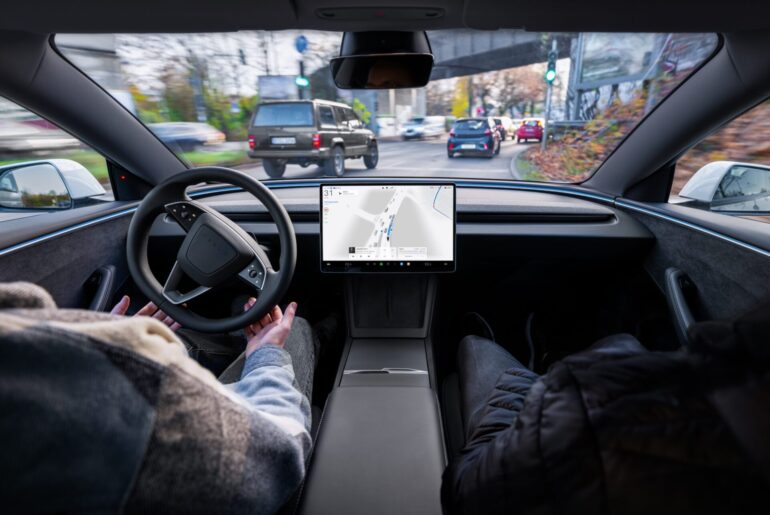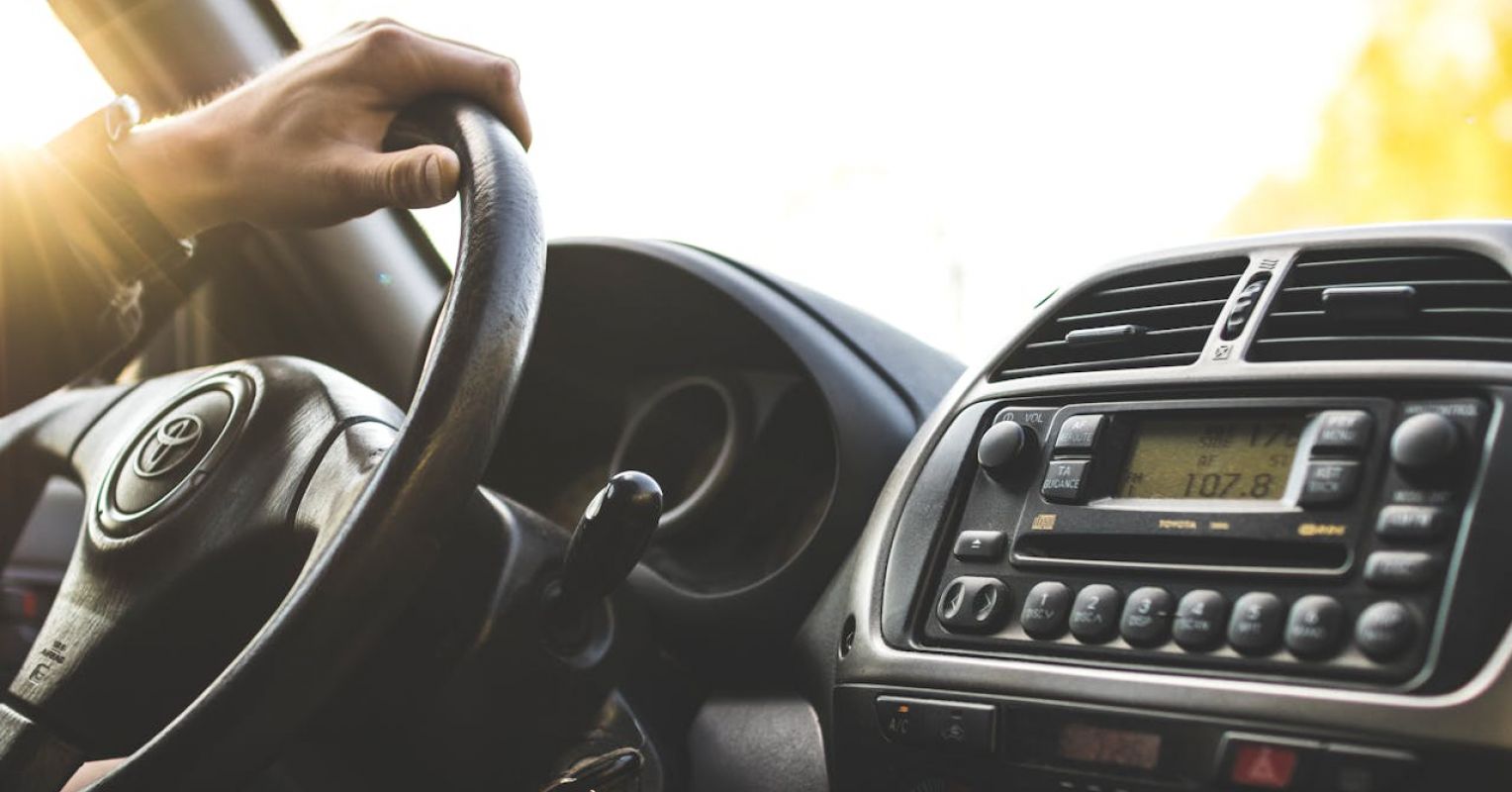
We say we like driving—but do we? The last time you were in a Lyft, did you really wish you could’ve taken over for the driver? What about in your friend’s car when she was driving? I don’t think so. If you could nap, work, meditate, or watch Netflix instead, would you still want to grip the wheel and be fully responsible for the trip’s safety and directions?
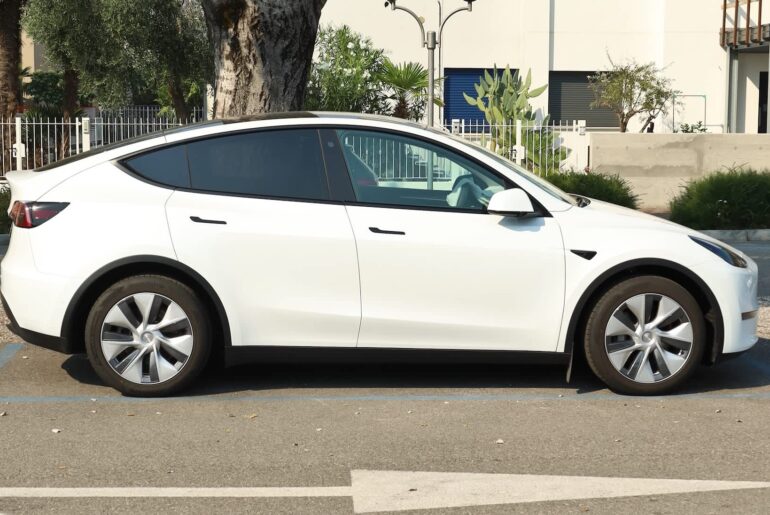
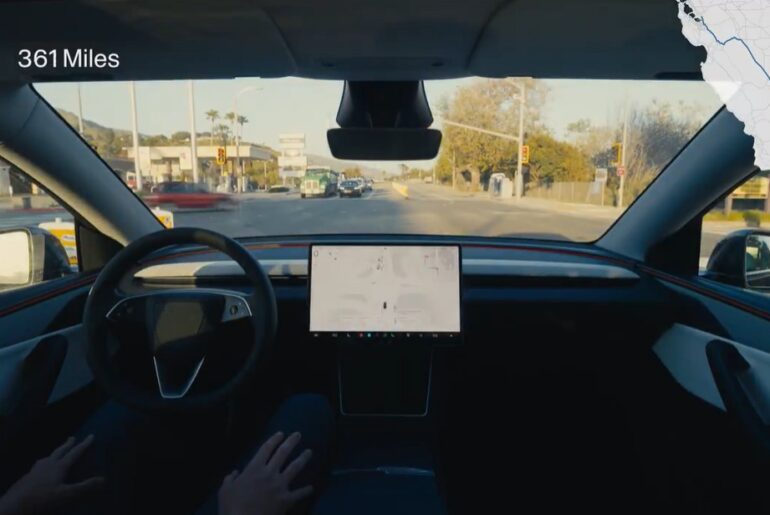
We’re also alarmingly bad at driving. According to the National Safety Council (2024), almost 44,000 people die every year in the U.S. from auto accidents (most of which, approximately 94%, are caused by human driver error). AVs can hopefully help prevent these. But, AVs must be proven as much safer than humans to achieve mass adoption. Now it finally feels to me like we’re getting there faster than we know. I wouldn’t have been so strongly compelled to write this post if I wasn’t continuously mind-blown by how good self-driving has become. I drive a 2019 Tesla; although I’m not using its newest hardware or software (hardware 4 is out and I’m on 3; software 14 is out and I’m on 12). Currently, Waymos are even more advanced, common, and scaled than AV-Teslas.
Most I talk to about this don’t seem to grok how seismic this transport transformation can be in the next 20 years. I think our resistance and/or apprehension to AVs (automated, or self-driving vehicles) reveals more about human psychology than about technology. Why is never driving again such a surprisingly uncomfortable thought? Understanding helps us see how fear shapes our relationship with technology and change (or in this case, technological disruption) itself. The research I present below suggests our attachment to driving has more to do with fear of change than real enjoyment. After all, elevators used to be human-operated and before automated calculators, calculations used to be done by humans.
As AVs evolve progressively quickly (as technologists would say, “slowly, then all at once”), we’re increasingly forced to confront a deeper human tension that almost all new tech underscores: our craving for control versus our desire for ease. As stated, many people say they prefer to drive and/or at least want the option to drive. But as automation made in-car time useful/enjoyable (i.e., the car is morphing into a comfy lounge), I think many would unknowingly prefer to not drive (use the trip to relax, work, connect with family/friends, watch video, etc). And I see loss of control and/or trust being a key psychological barrier. Do the data agree?
Literature Review
Haboucha, Ishaq, and Shiftan (2017) evaluated user preferences regarding autonomous vehicles. The TL;DR: 44% chose regular, non-AVs over AVs. This suggests we are hesitant to accept a preference we haven’t experienced. Even if AVs were completely free, only 75% of individuals in the study were willing to use them. To me, this implies the reluctance is not just a financial concern, but a deeper issue of comfort, trust, or preference for traditional control.
Likewise, Correia, Van Arem, and Van Wee (2019) found that when automation enables comfortable, productive, or leisure activities in-vehicle, people’s value of travel time drops substantially, i.e., travelers are willing to “give up” active driving if they can use the time productively or relax. Kolarova and others (2019) also found that the value people place on saving time decreases by 41% when they use an AV compared to a conventional car, although this reduction was found only for commuting trips (e.g., going to work).
Othman and colleagues (2021) summarized decades of research showing that trust, perceived safety, and loss of control are primary barriers to AV adoption, even when people appreciate potential benefits like productivity or relaxation. Naiseh and others (2024) found that trust and perceived risk predict willingness to ride without a human driver. This means that people who report low desire to “take over” also report higher intention to use AVs and to engage in non-driving activities. According to Walker and colleagues (2023), the aforesaid points above may hinge on AV tech progressively proving its widespread safety.
Accordingly, my growing conviction is that we think we want to drive, but our reluctance around self-driving cars is mostly about trust, risk perception, and fear of losing control, not actual enjoyment of driving, as we’d think on the surface. Tapia and colleagues (2024) agree: they found that people think they want control, but after riding in a simulated AV: anxiety decreased, positive emotions increased, trust increased, and thus people began preferring not having to drive. Related, another study, Huang (2023), found that people overestimate their desire to drive and underestimate how much they value free time in the car.
There is even more empirical evidence: Kenesei and colleagues (2025) found that “liking to drive” had minimal influence on willingness to use AVs. Trust and perceived risk were thus the core predictors of AV acceptance. Fear of losing control explained resistance more than preference for driving. To me, this is evidence that driving preference is not what people think it is. Similarly, Robinson-Tay and Peng (2024) showed people who think they like driving are often expressing fear of uncertainty. Knowledge and familiarity directly reduce fear and increase intent to use AVs; trust seemed to beget acceptance. Thus, our AV resistance seems emotional, not practical.
Conclusion
Aforementioned empirical research seems to consistently suggest that we tend to express wanting to keep the option to drive (from fear of losing control), but that this begins to shift as we understand that increasingly safe, comfortable automation can allow in-car activities (effectively gifting us time we thought was dead prior). Thus for most (likely excluding those who drive as a profession, sport, or hobby) we’d likely prefer to relax, work, or watch video instead of actively driving. Similarly, I think many of us didn’t know that we wanted video streaming until Netflix came along, or the Internet in our pocket until iPhone came along. Transportation, I believe, is the next industry poised for massive disruption. To me, we just don’t seem to know how badly we want (and need) it.
Even as 2025 ends, I believe that if you try an AV-Tesla, Waymo, Zoox, Baidu, or other competent AVs, you’ll quickly be as mind-blown as me. Most don’t know how much more relaxing (and safer) it is to rest in the car seat, observing the AV drive itself instead of being constantly focused on lane-changing, directions, or accelerating and braking, etc. This seems to be how tech succeeds; we become entrenched in our ways, underestimate the likelihood of disruption, and most importantly: its creators and engineers intuit what we need and want before and better than we think and know for ourselves. This principle can also explain why YouTube and Instagram algorithms seem to know that the content we will like before we do.
AVs are well-poised to drastically increase road safety, and restore the estimated 240 hours yearly we each spend commuting (U.S. Census Bureau, 2024). It can be a double-win. As AVs become increasingly and reliably safe, the game changes entirely abruptly, and exponentially.
So, do you really want to drive? Perhaps it depends on how safely you believe you’ll get to your destination in an AV. You may just be one AV-Tesla or Waymo ride away from a total mindset shift. Transformational tech gives us what we didn’t know we wanted (and needed).

![Tesla's entry-level Model 3 sedan [SCREEN CAPTURE]](https://www.evshift.com/wp-content/uploads/2026/01/1768620872_0fecd24b-2e4f-40e4-acb9-19e23f494e3f-770x499.jpg "Tesla’s Standard Model 3 sedan priced in 30 million won range after gov’t subsidies")