Ride quality encompasses many aspects of a bike, including its sizing and fit, comfort level, motor engagement, user interface, etc. The Jupiter Defiant’s ride quality was good overall, though these individual elements are worth exploring and explaining in more detail.
Though Jupiter does not advertise a recommended height range for the bike, our contact advised us that it is designed to fit riders from 5’ 0” to 6’ 2”. At 5’ 11”, this places me near the top end of its range, which makes sense based on its adjustability range.
The Defiant offers a moderate 8” of saddle height adjustment in its seatpost length and a generous 5.5” of handlebar height adjustment via its telescoping stem. I set the seatpost relatively high and the handlebars roughly in the middle of its height range to balance comfort and steering control—handling typically feels more sensitive with taller handlebars.
Thanks to the bike’s cadence sensor, maximizing leg extension isn’t necessary; even though I had a noticeable bend at the knee, I felt no strain since I kept only light pressure on the pedals.
I found the Defiant comfortable due to its dual-spring saddle, slightly curved, ergonomic handlebars, and rubber grips. The grips, while entry level, were supportive. The plush saddle was a standout for our entire team of testers, as it helped to smooth bumps and absorb vibrations while feeling soft and supportive.
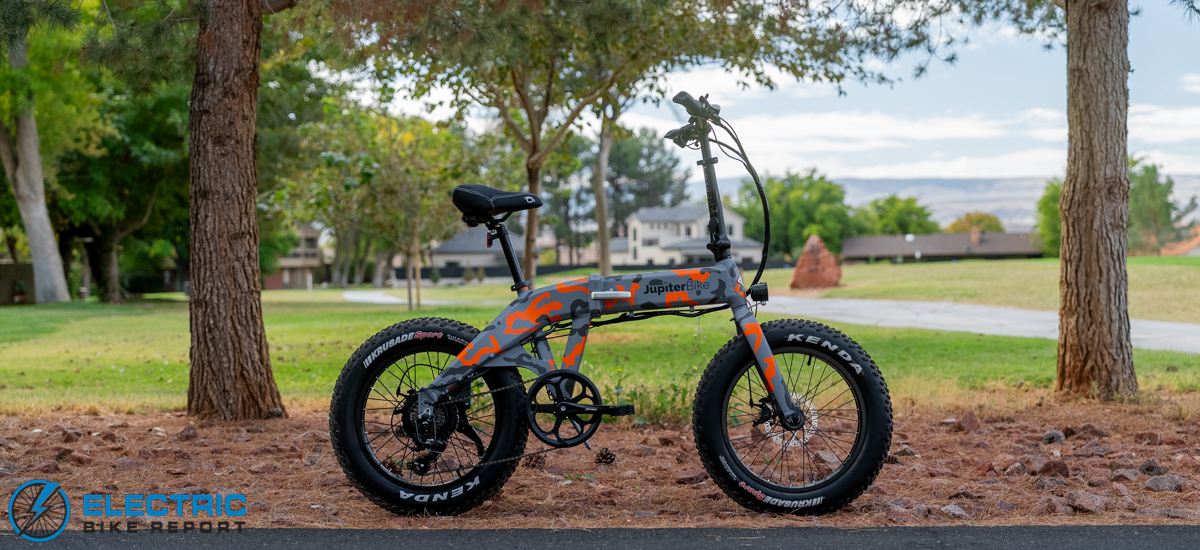
With its aluminum frame and fork, the Defiant has no suspension, so the bike’s seat and 20×4” knobby tires are essential for ride comfort. In addition to the aforementioned saddle, the bike’s tires can be used with relatively low pressure to add cushioning and increase traction; I found the bike stable and well-suited for light off-roading.
The Defiant’s handling was both crisp and quick; its 20” wheels make it highly maneuverable while its rigid fork ensures a stable and predictable feel while cornering. Riders with relatively large feet may need to be mindful of their foot placement when pedaling; with US men’s size 12 shoes, I found my heel striking the bike’s kickstand or the cable guides on its chain stay if I wasn’t careful.
As referenced in previous sections, the motor is powerful and engages quickly. The Defiant’s five speeds, as dictated by its PAS, allow users of different experience and comfort levels to find a suitable pace, though personally, I wouldn’t mind seeing the same limits applied to the throttle for easier speed control.
Its operation is relatively simple, with an entry-level 7-speed drivetrain operated by an over-the-bar thumb shifter on the right handlebar next to a half-twist throttle, a basic black-and-white display, and a small button pad on the left handlebar. This quality makes the bike a solid choice for new riders seeking their first e-bike or riders who haven’t been on a bike in years.
In terms of features and accessories, the bike includes fenders and an integrated 4-LED headlight, though we also hoped to see an integrated tail light with brake light functionality. To expand the bike’s utility and comfort, it can also be equipped with a handful of optional accessories, including a cargo rack, a suspension seatpost, side mirrors, and more.
In terms of folding, the Defiant features a common design that includes a hinged frame, folding pedals, and a telescoping/collapsible stem. The central hinge on our test bike was somewhat stiff on arrival, but worked well after we added some lubricant. We found the folded dimensions Jupiter advertises to be generally accurate; our bike measured roughly 38.5”L x 21”W x 27”H.
All in all, the Defiant is generally comfortable, uncomplicated, and easy to use. While it has some areas with room for improvement, its overall ride quality is a solid foundation to build on.