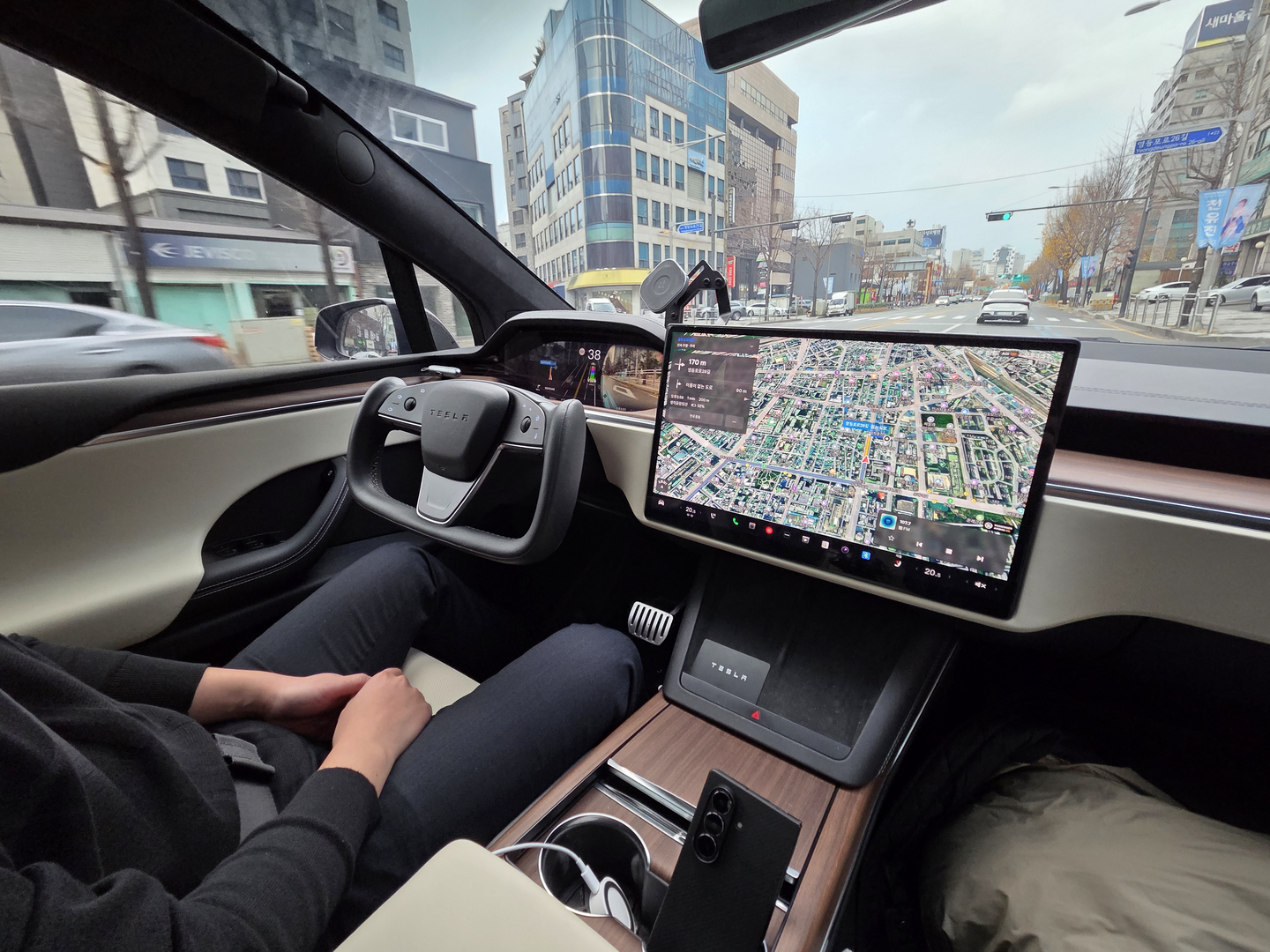
![A Tesla Model X vehicle is seen driving in downtown Seoul with the Full Self-Driving system enabled on Nov. 26. The system operates without the driver having to hold the steering wheel or press the accelerator or brake. [KIM HYO-SEONG]](https://www.evshift.com/wp-content/uploads/2025/11/a3fdf4ff-9094-4159-8352-d23b8c49a811.jpg)
A Tesla Model X vehicle is seen driving in downtown Seoul with the Full Self-Driving system enabled on Nov. 26. The system operates without the driver having to hold the steering wheel or press the accelerator or brake. [KIM HYO-SEONG]
A driver testing Tesla’s newly released Full Self-Driving (FSD) in Korea reported a smooth performance through dense urban traffic but would still be legally responsible for any accident.
“It feels like I’m riding in a premium taxi, and I don’t have to move a finger,” said 32-year-old Yang Jae-hyung, describing his experience with Tesla’s supervised FSD software during an interview with the JoongAng Ilbo in Yangcheon District, western Seoul, on Thursday.
Yang, the owner of a Tesla Model X, installed the newly released FSD update on Sunday, the same day that it became available in Korea. Over the following five days, he tested the system for more than 12 hours, including on a 44-kilometer (27-mile) round trip from Cheongnyangni to Mok-dong, which involved navigating Seoul’s congested inner beltway.
“The system handled stop-and-go traffic and constant lane changes without any incidents,” Yang said. “It felt like I had a private chauffeur.”
A JoongAng Ilbo reporter joined Yang for a ride through the Yangcheon and Yeongdeungpo areas to observe the FSD system in action. The initial concern was about the system’s ability to avoid scrapes or collisions. But after nearly an hour of driving, those worries proved to be largely unfounded.
Activating the FSD system was simple: While at a complete stop in a parking lot, Yang tapped “Self-Driving” on the vehicle’s center screen, and the system immediately took control.
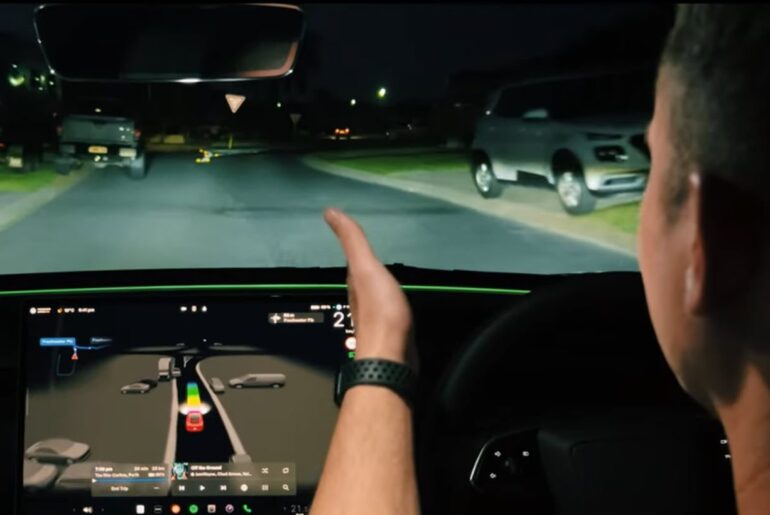
![The center display of a Tesla Model X vehicle on Full Self-Driving mode [KIM HYO-SEONG]](https://www.evshift.com/wp-content/uploads/2025/11/c932f99a-2a88-4c98-8007-ae405d9c86e5.jpg)
The center display of a Tesla Model X vehicle on Full Self-Driving mode [KIM HYO-SEONG]
The first test was merging into a busy road. The Tesla X paused at the exit and waited until it sensed an opening in traffic.
Once on the road, the system steered through a mix of straightaways and turns, never requiring human intervention. It adjusted its speed automatically and accelerated and braked seamlessly.
One of the most impressive moments came when the car mistakenly entered a left-turn-only lane instead of the middle or right lanes needed to go straight. With the center lane blocked by traffic, the expectation was that the vehicle would take a detour. But as soon as there was an opening, the Tesla swiftly reentered the middle lane and continued straight.
When the Tesla was abruptly cut off by a taxi, it gradually slowed down, allowed the other vehicle to pass, then gently picked up speed again. Unlike many other semiautonomous systems, the FSD did not force the Tesla to suddenly brake, jolting passengers.
![A Tesla Model X vehicle parks itself inside an underground parking lot while in Full Self-Driving mode. [KIM HYO-SEONG]](https://www.evshift.com/wp-content/uploads/2025/11/f62d5818-fd36-432f-98bb-7a15e6cfce3d.jpg)
A Tesla Model X vehicle parks itself inside an underground parking lot while in Full Self-Driving mode. [KIM HYO-SEONG]
The vehicle followed Korea’s traffic laws well. When a yellow light came on at an intersection, the car stopped smoothly without attempting to rush through. At right turns, the car waited when pedestrian signals were active and slowed when bicycles or people approached from the side.
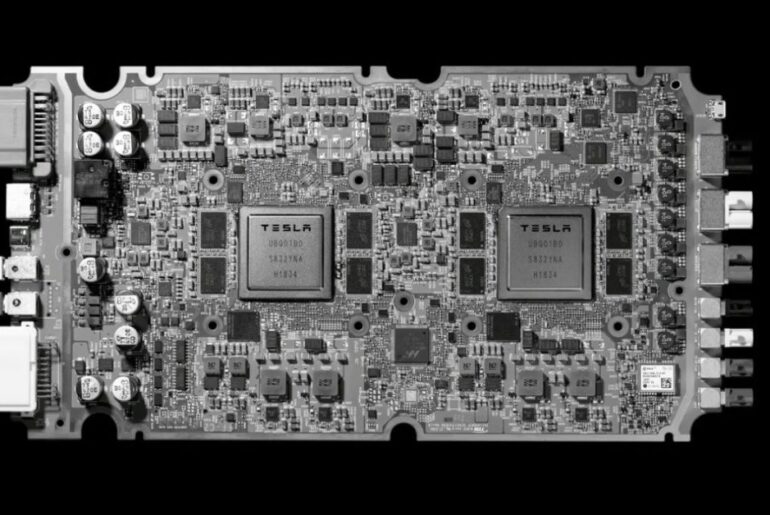
Tesla’s FSD works through eight exterior cameras and a neural network system. The system recognizes lane markings, vehicles, pedestrians, traffic signs and signals, and it reconstructs the driving environment in 3-D to determine optimal steering and driving actions.
However, the system still has flaws. In underground parking garages, where GPS signals are unreliable, the FSD struggles to differentiate between entrances and exits. In the parking lot, the vehicle was able to begin searching for a way out, but it circled the lot and even went up and down the same levels a few times. Although the system knows how to avoid “do not enter” zones, it struggles to find a clear exit.
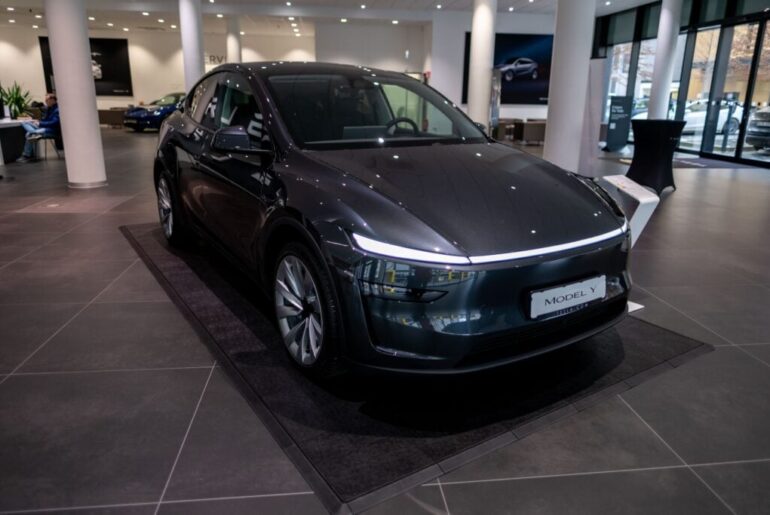
![A Tesla Model X vehicle equipped with the latest supervised Full Self-Driving system [KIM HYO-SEONG]](https://www.evshift.com/wp-content/uploads/2025/11/fbc4f28d-27d7-4d96-9704-3608577ba6c3.jpg)
A Tesla Model X vehicle equipped with the latest supervised Full Self-Driving system [KIM HYO-SEONG]
Under current Korean law, the driver remains fully responsible for any accidents as the FSD is classified as a Level 2 autonomous driving technology. This means the human driver is in charge, and the system is merely an assistant.
While the system doesn’t require hands on the wheel at all times, interior cameras monitor eye movement and will issue warnings if the driver is not watching the road. Though no alarms sound as long as the driver is attentive, the Road Traffic Act, which mandates precise operation of a vehicle’s controls, may still require drivers to keep their hands on the wheel.
This article was originally written in Korean and translated by a bilingual reporter with the help of generative AI tools. It was then edited by a native English-speaking editor. All AI-assisted translations are reviewed and refined by our newsroom.
BY KIM HYO-SEONG [[email protected]]