25 Years Old, As Efficient As Electric Cars NOW But No One Wanted it – Honda Insight Mk1 (1999)
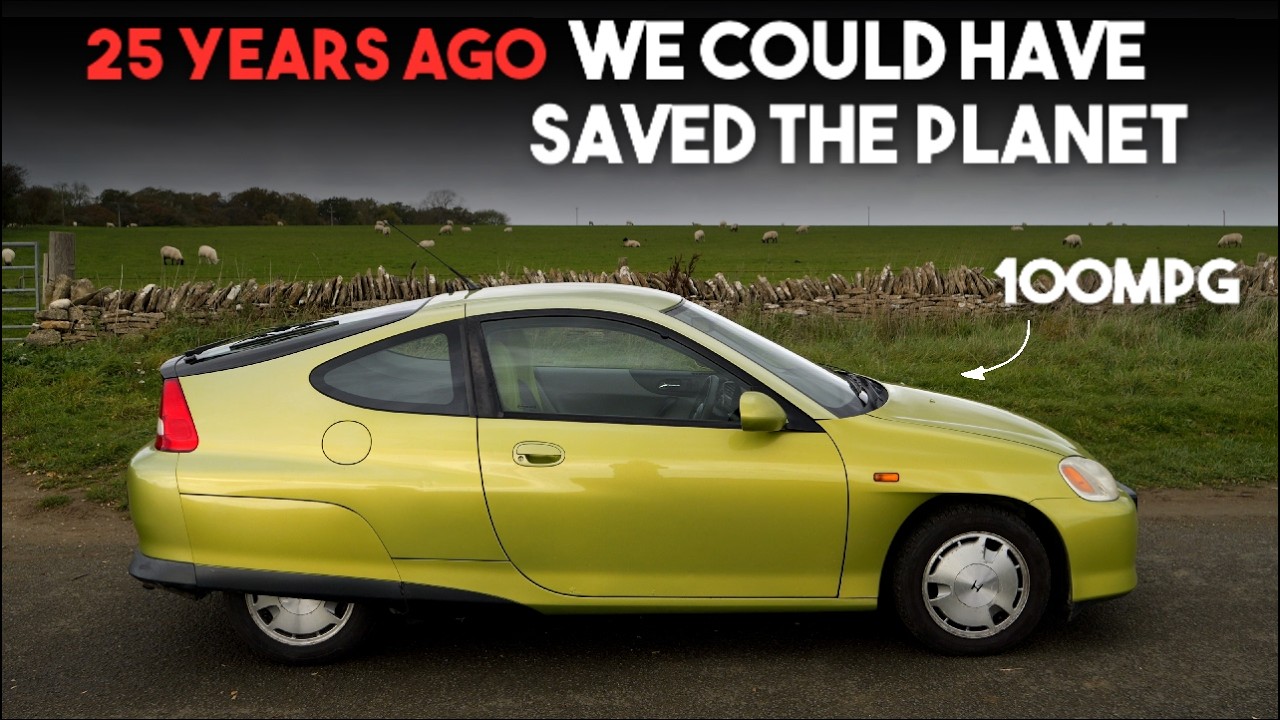
You’re looking at a car that could do over 100 miles to the gallon. And that was in 1999. 25 years later, and you’ve got electric cars that can do barely more than this in range equivalent terms. It borrowed technology from the NSX supercar and was four times more efficient than the average cars that were around then. Just think, if we’d all been driving these, we could have been reducing emissions by 75% over the 2000s. Instead, today we have some electric cars that struggle to get a range of 250 mi, whereas this little teardrop miracle can do 700 m on a tank. The Honda Insight was the most intelligent car that nobody wanted. Let’s find out why and also what it can teach us about the way that we should be making cars today. Before everybody had started talking about range anxiety and charging networks, Honda had already built the answer. A car so light, so slippery, so cleverly engineered that it makes most modern hybrids look like they’re dragging an anchor. But efficiency doesn’t sell posters. And that’s one reason why this space age masterpiece never stood a chance. The inside looks the way it does because every line is there to cheat the air. The rear track is even 5 cm narrower than the front to give it room for those spats covering the rear wheels like something from a pre-war streamliner. The result, a coefficient of drag of just 0.25. The last generation Insight, which was made up until 2022, only managed 0.28. Progress apparently isn’t what it used to be. It’s a shape that seems odd now. But it was never about fashion. It was about physics. And it wasn’t just about the shape either. Underneath the paint is a proper piece of engineering theater. It has an aluminium space frame chassis clad with aluminium panels and it was built in the same Suzuka factory as the NSX supercar. It was 50% lighter than the Civic that was made at the same time. While the structure was still 40% stiffer, even the wheels and brake calipers were made from aluminium and the tires were so skinny you could almost mistake them for bicycle rubber. It was a relentless pursuit of lightness, something that Colin Chapman would have nodded at approvingly. And coincidentally, this is only 50 kilos heavier than the very first sparse lightweight Lotus Elise, whilst being a much more complete and well-finished car and having all the hybrid tech. The engine is a 1 L 12 valve 3cylinder producing 67 horsepower. Not exactly thrilling, but remember it’s paired to an electric motor with 10 kW, which is mounted directly to the crankshaft. Together, they made a combined 76 horsepower, but it actually behaves like a much bigger engine because most of the torque is available from just 1500 RPM. Now, it’s bizarre that they didn’t go for a diesel engine. Apparently, the reason for that is that they’re not very popular in the Japanese and the US market. During acceleration, the electric motor helped the engine. While braking, it was the reverse. It was like a generator helping to recharge the batteries. Now, it sounds quite normal now, but you got to remember this was actually built in 1999. At that point, this was just witchcraft. No plug, no charging cable, no nonsense. This was hybrid technology before hybrid got complicated. Step inside and it feels like a prop from the Matrix. The digital dash glows with LEDs. The tachometer sweeps like something from a spaceship. And the two seats are located in a narrow cockpit-like cabin. But look behind you and there are no seats, just a small boot and 35 kilos of batteries. It’s part eco- car, part concept, and part supercar. I have heard though that they don’t exactly drive like supercars either. We’ll find out the truth about it now. But also want to go into detail about why it was such a commercial failure despite everything I’ve told you so far. I mean, getting in here, it’s like remarkable just how absolutely normal it is. Um, probably help if I got the keys. There we go. Um, but yeah, everything looks pretty much normal. Now, when you switch on the instruments, that’s when you see that this is something a little bit different because especially if you go back to the time this was made, it looks very futuristic. And still now, I really like the characters and the colors that they’ve got on there, that orange with the green, um, the two dials, but the way it’s been reorganized. Really like it. Now, straight away, you’re barely pulling off and the car comes up with a little up down arrow telling you to change up. So, the moment you get close to 2,000 revs, you’ve got to change gear. There’s something a little bit different about this car. This little box of goubbins here, that’s something that Rick, the owner, had put on it, which allows him to bypass the car’s brain, so he can decide when to have it regenerating, when not to. He’s a consuate hyper mileer which most people who own these would be because essentially that’s a lot of the appeal behind it is that side of it. Um but I’m not going to use that today. I’m going to use the car pretty much as standard again. It’s telling me to change up. So it really doesn’t like the engine being revved at all. We are going to do um you know taking it through the gears and seeing what it’s like. Um, but it’s uh it’s almost pointless on this car. But I have heard again, you know, the engine it’s just a one liter. It’s not even turbocharged. There’s not a lot of power there. Um, but it feels really flexible even though it’s at such low revs. So, it’s at the moment around sort of 1,800 revs, but when you put your foot down, you know, it does respond instantly. And that’s all that sort of lovely electric torque. Now, I know some of you probably don’t like electric cars, and um I don’t dislike them. I think there’s a place for them. But what is quite addictive about them is just that instant response that an electric motor can give you. Now, one thing I am noticing straight away is that the ride, whilst maybe not uncomfortable, is pretty unsettled. The front of the car in particular, I think, is bobbing around a little bit. And I was expecting that because it’s almost as if they spent all their money on the drivetrain and then didn’t really try that hard with the chassis itself. So this car has McFersonen struts at the front and then a torsion beam at the rear which isn’t exactly advanced. You can understand why they spent so much money on everything else. Plus it’s just not a car that would have been driven hard. But that’s exactly what we’re going to do now because I am curious about the way it goes. Um, most people say that it’s not the best driving thing in the world. Now, there’s a couple of cars which are just coming past, but we’ll still be able to get a quick run through the gears cuz this isn’t that fast. Well, look, it goes up to 60 quickly enough. And the engine for a three-cylinder especially, it’s really, really smooth. There’s very little vibration coming through. And I think that the assist from the battery, it makes it feel brisk. Um, it’s not going to, you know, take your hair off, but it’s it’s it’s fine. We have a bit a few cars in front of us. So, I’m just going to pull over, give them some room because I want to just take it through this twisty section a little bit briskly just to see how how it feels. It’s interesting because at idle actually is where it feels least happy. At just under 1,000 RPM, it’s got a little bit of um I don’t know imbalance to it that you can feel through the car. I would call it roughness. It’s just as if those cylinders aren’t quite balancing themselves out. Soon as you pick up the revs, though, it smooths out really nicely. Now, one of the things that I do like about it is that the steering is quite precise. And obviously being a light car, it is quite agile. Um, these tires as well, they were designed to be used with um super high pressures or higher than normal anyway. So, they’re narrow, they’re high pressure, they’re hard tires, and grip isn’t really its strongest point, but it is quite acceptable. Having read the reviews, um, I was expecting the handling to be notably worse. Now, on the tighter Sbend here, I think that the under steer is going to become even more pronounced, but it is nice and agile. doesn’t seem to lean particularly actually either. You know what? It’s not as bad as people say. It’s okay. Um well, the engine warning light has come on after those corners. So, um I’m not going to be taking it hard through the gears again. It does seem to be running pretty much fine, but um just as a precaution, I’m going to in terms of the engine itself anyway, I’m going to drive it a little bit more gently. It really handled those corners quite well, though. I think that the main thing, which I would agree with road testers of the time, is that the suspension itself isn’t the best thing. So, the way it rides is the biggest issue. And again, it’s not terrible, but it’s just not, you know, it’s just not very refined. little bitsy, but it’s still quite good fun. You know, for a car which isn’t, you know, isn’t designed to be driven at all hard, it’s okay. Now, right now, it’s reading an average of uh 90 m to the gallon. When he drove here today, Rick managed to get 94 MPG, and that was on these sort of stop and start little roads like that. He regularly gets over a 100 miles to the gallon on runs from where he lives, I think it’s Bristol where he is, to London. So, these really were able to get incredible efficiency for 25 years ago. Does make you wonder what they could have achieved a if they used a diesel engine and then with 25 years of progress. It’s bizarre to think that the modern insight uh in some ways was actually less efficient than this. That’s because they went to sort of a four-seater configuration, I think, is the main thing. And it just became a bigger, heavier car. As you’re driving, it’s quite addictive to see the charging and assist style there, which shows every time you sort of put your foot down, it goes into assist. When you let off, and especially when you break, it goes into charging. It gives you the battery level next to it as well. Now, thankfully, I’ve just popped back to see Rick, and that engine light is absolutely nothing to be worried about. He said when he first collected the car, within a mile of leaving the dealer, the light came on and he thought it was all sorts of issues. It just comes on periodically and with his little box of tricks there, he was able to get that sort of removed. Today, I have probably ruined his average. The way I’ve been driving it and with the runs through the gears, it’s already down to 84.4 miles to the gallon. So, why was it a failure? Well, Honda initially hoped to sell about 6,500 a year. So, quite modest targets in any case. But in actual fact, in 7 years, they only managed to sell 16,000 of them. So, commercially, we can’t argue it was a flop. Why was that, though? I think the first thing is that it was expensive. So, at £17,000, it was the same price as a 3 series compact. Another problem was that it looked odd. Now, I quite like the way this looks today, but I think most people thought that they were just odd, bizarrel looking things. Couple that with a lack of practicality. Having only two seats makes it quite difficult to justify this as a daily proposition. And the last thing was the lack of faith in the residuals. So, if you’re going to pay a lot for a car, you want to make sure at least that you’re not going to lose loads of money when you come to sell it. Because it was such a modern space age thing, people were very worried uh about, you know, how reliable it was going to be. They didn’t really need to be because in actual fact, these things never tend to go wrong. Ironically, it seems that the same people who said they wanted greener cars didn’t actually want to drive one. And it’s hard not to feel a little bit sorry for the little Honda today, because 25 years later, you’ve got SUVs with fake exhaust tips pretending to be eco and some electric cars that struggle to do more than 250 mi. Meanwhile, this little aluminium teardrop could go 700 m between tanks. It wasn’t the future that we chose, but maybe it should have been. Only 250 were ever brought to the UK, so it’s an extremely rare car, very hard to get hold of. Honda really found it hard to ship them at the time. But if you want to buy one now, I’ve got good news and bad news. The bad news is there’s not many of them about. But for me anyway, for some inexplicable reason, they’re not that much in demand. So the two that are on the market at the moment, they’re only £4,000, which considering the prices that a lot of cars fetch nowadays, seems to me to be an absolute bargain. Now, as as a car to drive, it’s perfectly pleasant. I wouldn’t say you’d buy it because of the way it drives. It’s more for what it represents. If you’re interested in cars, if you’re interested in clever solutions and to the lengths that they went to make this such an efficient car, that is what makes it a really appealing prospect. Now, if you enjoyed this, you will really like the story of another very, very clever car, the Audi A2. Another 100 miles to the gallon car, which was a complete flop. Check that video out. Thank you and see you for the next one.
The Honda Insight Was a 100MPG NSX Supercar..
The Petrol Car as Efficient as Modern EVs — That Nobody Bought – Honda Insight Mk1
The 25-Year-Old Petrol Car as Efficient as EVs Today – Honda Insight Mk1
Tayna Car Batteries are fantastic and supply all my car batteries! Use the code NUMBER27YT for a further 5% off! – https://www.tayna.co.uk
I use the RODE Wireless Go (Gen 3) for sound, you can find it here: https://brandstore.rode.com/number27YT
Support NR27 And Get:
1. Members Previews For Videos 2. Priority Replies To Comments 3. Members Only Post and Updates on My Project Cars
https://www.youtube.com/channel/UCErr8b5Sc1owxI31N6WZmIA/join