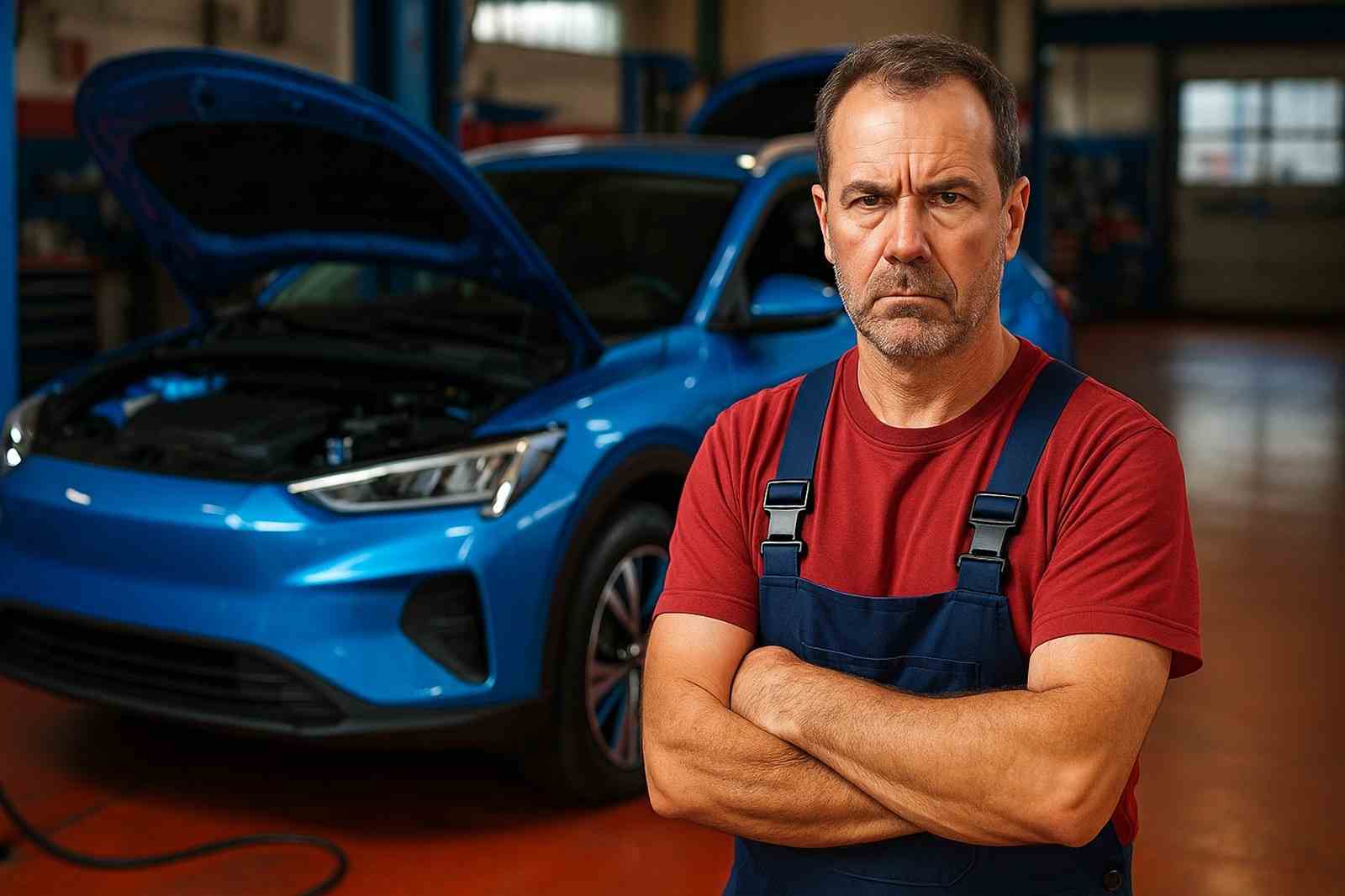
The mechanic details why he considers electric vehicles a risky bet, citing reduced range, a fragile charging network, frequent breakdowns, and expensive repairs which, according to him, reveal limitations still ignored by many consumers.
The debate about the role of electric cars has returned to the center of conversations in workshops and digital platforms. The recent participation of mechanic Kike Ferrer on Adrián G. Martín’s channel brought arguments that sparked a strong reaction among enthusiasts and professionals.
The blunt way in which he described electric vehicles as “a farce for fools” opened the door for an analysis of technological limitations, infrastructure gaps, and the difficulties faced by repair shops that deal with them daily.
The impact of his statements exposed sensitive points in a sector undergoing profound transformation and still seeking clear answers about its evolution.
— ARTICLE CONTINUES BELOW —
The mechanic’s perspective and trust in Asian manufacturers.
During the interview, Ferrer explained that his opinion is based on his own workshop’s routine. He highlighted that vehicles of Japanese, South Korean, or Chinese origin continue to lead in reliability and ease of maintenance.
According to him, these are the models that least often come in for repairs and represent the current benchmark in durability. His statement summarizes a perception built up over the years and which, for him, remains valid despite changes in the market.
The direct assessment of the reliability of Asian vehicles contrasts with the discourse surrounding electric vehicles. Ferrer stated that their technological and environmental virtues lose strength when faced with the challenges of everyday use. For him, the problem lies not only in the vehicles themselves, but in the conditions surrounding them. This distinction was central to his argument.
Limited infrastructure and a theory that is difficult to support.
Ferrer explained that, for electric vehicles to be accepted as a fully viable option, a network of charging stations as practical as current gas stations would be necessary.
In his view, only a system capable of rapid recharging, with reduced cost and wide availability, would allow drivers to adopt the technology safely. Until this infrastructure is consolidated, he considers electric vehicles a risky choice.
The situation in Spain was cited as an example. Although there is rapid expansion, the number of fast chargers in operation remains lower than announced.
Furthermore, not all operate as expected. Technical failures, lower-than-promised power output, and unexpected delays continue to generate dissatisfaction. These points reinforce the criticism leveled at the “fool’s theory,” an expression the mechanic used to highlight the difficulties in fully defending the current proposal for electric vehicles.
Network expansion and charging habits
The discussion about infrastructure took on another layer when Ferrer mentioned that many drivers need to travel long distances to ensure they can recharge. He linked this reality to actual range, explaining that, on some routes, the lack of suitable charging points increases the total distance traveled just to keep the vehicle running.
The source material also presents the view that the grid is growing rapidly, driven by private operators and energy companies.
In parallel, the habit of recharging at home or at work reduces the need to travel to public stations and offers more convenience than traditional models. This contrast shows how the discussion about infrastructure remains complex and multifaceted.
Challenges faced by workshops in the face of modernization.
Another point Ferrer commented on was the difference between the work of a conventional workshop and servicing electric cars. In his low-cost establishment, recognized as the best in Spain for several years, he says he offers accessible and transparent services. The comparison with what he calls the “black box” of electric cars summarizes his concern: modules, sensitive electronic systems, batteries that are difficult to replace, and high-cost repairs. For him, this highlights the need to adapt to a new reality.
This opinion coincides with warnings from experts in the automotive aftermarket sector. Most workshops still lack the equipment, training, or clientele necessary to dedicate resources to servicing electrical vehicles. The transformation is happening, but at a slow pace. Small businesses, with few employees, avoid investing without certainty of return.
Reduced maintenance and the impact on after-sales service.
The source material also highlights that electric vehicles have fewer moving parts and eliminate the need for items subject to wear and tear, such as clutches, belts, turbochargers, or engine lubricants.
This means less need for maintenance and fewer visits to repair shops throughout the vehicle’s lifespan. This feature reduces costs and changes the dynamics of after-sales service.
Despite this, doubts persist regarding more extensive repairs. Although they function well in the first few years, situations requiring complex interventions or battery replacement can make it difficult to find qualified workshops, in addition to high costs. This uncertainty weighs on potential buyers, especially as the technical and structural landscape is still evolving.
Warranties, battery durability, and industry advancements.
To alleviate concerns, manufacturers typically offer eight- to ten-year warranties for batteries. Practical studies reveal moderate degradation after long journeys, generally between 5% and 10% after 150.000 km.
The development of LFP batteries and new, more stable chemical compositions has further reduced the risks of overheating and accelerated wear. These advances reinforce confidence in the continued electrification process.
The strength of Asia and the role of hydrogen.
The source material also addresses the evolution of the Asian market. Ferrer stated that Japan, South Korea, and China have surpassed Europe in quality and reliability. According to him, these brands offer durability and technological innovation that drive the global adoption of electric vehicles. The combination of efficiency, safety, and reduced environmental impact has solidified Asia as a benchmark.
At the same time, he points out that challenges remain. Battery degradation and their high replacement cost still affect perceptions about vehicle longevity. Even so, he considers electric mobility inevitable and positive because it reduces emissions and encourages sustainable technologies.
Ferrer also mentioned hydrogen as a promising alternative. According to him, it is essentially another form of electrification. Although the focus remains on conventional electric vehicles, he believes that hydrogen will have a place in technological advancement, especially in regions that are already leading the transition to new forms of mobility.