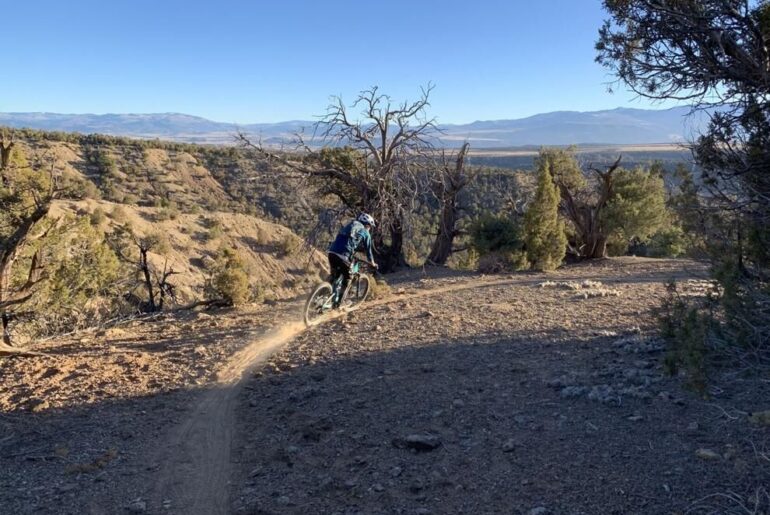

Biking on bike trail. Photo By Metro Creative Service
EVESHAM—The Evesham Township Council, in an eventful Nov. 12 meeting, gave provisional approval to measures that could significantly change both the rules for those utilizing the Black Run Preserve and other open-space recreational retreats, and the zoning classification of a privately owned 778-acre “watershed” tract that is adjacent to the preserve in anticipation of the municipality possibly acquiring it to add to the protected habitat at its southern end, which area nature lovers have expressed ardent hopes it might do.
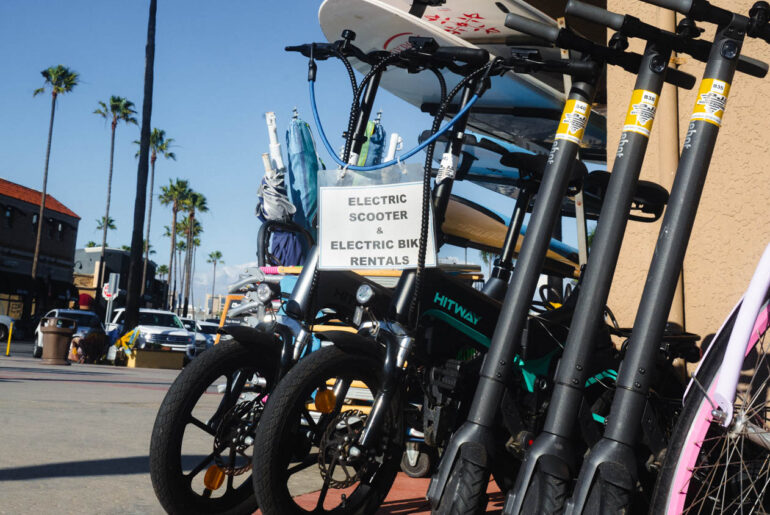
Council’s unanimous vote to introduce an ordinance that would designate all trails within the township for “non-motorized traffic only” came about following a warning at the previous council meeting from John Volpa, the preserve’s founder, about the new types of dangers to trail users posed by two classes of E-bikes—that is, bicycles equipped with electric motors and rechargeable batteries.
The members also unanimously endorsed a resolution directing the township Planning Board to “take into consideration” what the New Jersey Pinelands Commission had done in October by adopting the proposed Comprehensive Management Plan amendments as published in the June 16, 2025, New Jersey Register, which changed the preserve’s neighboring tract’s designation from “Rural Development” to that of a “Forest” area.
The resolution’s passage corresponds not only with the actions of the Pinelands Commission, whose Policy and Implementation Committee voted on Oct. 31 to commit $3 million dollars from the Pinelands Conservation Fund to assist with the purchase, as noted by Heidi Yeh, policy director of the Pinelands Preservation Alliance in addressing the council, but a Nov. 12 resolution approved by the Burlington County Commissioners to authorize a cost-sharing partnership with the township and the nonprofit foundation to preserve the tract, known as the Samost property.
“Changing the zoning now will not jeopardize the ongoing Green Acres appraisal or reduce the compensation due to the landowner,” maintained Yeh, noting that rezoning the locale would thus represent “a clear win for conservation” that “would strengthen local environmental protections and ensure that if for any reason the preservation deal falls through, the land remains safeguarded from inappropriate or intensified development in the future.”
It would also be both “prudent and forward-looking,” she contended, in protecting the township’s environmental resources while “preserving flexibility for Green Acres to complete its negotiations at fair market value, helping not only “in the acquisition process but also in the shared responsibility of stewarding this remarkable landscape, ensuring its continued value for passive recreation, scientific study, and environmental education.”
The proposed ban on the use of motorized vehicles on nature trails, as explained by Township Manager and former Police Chief Walt Miller, is specifically intended to keep E-bikes off the trails running through Black Run Preserve, having been separated from a more comprehensive piece of legislation planned for next year that would include regulating the operation of such conveyances in the township, and put on a fast track due to the kind of safety concerns raised by Volpa.
“It will add some value to the environment down there in usage, protection of the trails themselves from damage, and potentially prevent injury to people who are out walking and not expecting a fast-moving electric bike to come up almost soundless behind them,” Miller said, adding, “So that is why we didn’t want to wait on this.”
Councilman Joseph Fisicaro, Jr., in voicing support for the proposed ordinance, noted that in addition to the points made by Miller, it would have the purpose of “protecting those also on the bikes, because they are the ones who can get seriously injured,” and who are apt to be “kids that are in middle school and high school.”
While operators of that age might respond that “they are taking away all our fun stuff,” noted Fisicaro, who teaches social studies at Cherokee High School, “the reality is we are doing something because we want to save you, and this is one of those things.” He then brought up the difficulty that would be involved in responding to an accident that might occur on one of those trails, maintaining that “if someone gets seriously hurt and we can’t get there in time, that is a tragedy waiting to happen.”
“I really hope that in time this gets expanded with protections from state law so that our neighborhoods will have that same protection,” added Fisicaro, who said he was grateful that the township had worked so quickly in introducing the ban and expressed his appreciation to Volpa for having gotten “the conversation started.”
Also offering praise for the proposed ordinance were Councilwoman Heather Cooper, who pointed out that it was formulated in a manner to maximize the police department’s ability to enforce it, and Mayor Jaclyn “Jackie” Veasy, who thanked Volpa “for bringing it up at our last meeting” and causing the township to expedite the matter in order to protect those using the Black Run Preserve.
Volpa then came back to address the council, thanking them in turn for their support both in passing the resolution to rezone the Samost property as a step toward acquiring it and “doing everything you can to move this project forward” and for introducing the proposed prohibition on motorized vehicles in the preserve following his cautionary remarks at the previous meeting, quipping, “Wow, you guys are fast!”
(Volpa, it should be noted, wasn’t the only one to broach the subject on the perils posed by E-bikes, which was also addressed in a public comment forum by resident Gary Warga.)
On another preservation-related matter, Miller announced that the site of the 19th Century African-American settlement and burial ground in what was once known as the Milford section of the township, has now been made a part of the New Jersey Black Heritage Trail, one of more than 50 such “significant Black history sites” to be approved for historical markers by the State Historical Commission, with one such monument designated to eventually be erected there.
Accompanying the approval, the township manager said, were three grants “for us to do some work out there,” including cleaning up some of the underbrush and smaller trees at the site, leaving the mature ones in place, and fencing off the burial ground.
“We are very grateful to have gotten these grants,” he said, both “to restore and preserve the site and bring respect to the people who are buried there, which is probably the most important aspect of this entire process.”
Regarding the latter, he said, “We did locate a list of some of the people who are buried there,” although exactly where specific individuals may be interred on the property isn’t certain, but whatever information on the enclave is known will be made available at the township website.
According to Miller, the hamlet was “a discreet community that was established by the 1820s by a free and fugitive black population that settled in a secluded area with support from members of the Evans family,” who were noted abolitionists. By 1850, he said, it had grown to about 64 residents, and included a school, a store, a sawmill and grist mill, and was for a time a stop on the Underground Railroad for fugitive slaves.
While the settlement eventually “dissolved” around the early 1900s, he said, the burial ground, which is estimated to contain about 90 gravesites, remained in use for several more decades for the interment of indigent people of color from the surrounding area.