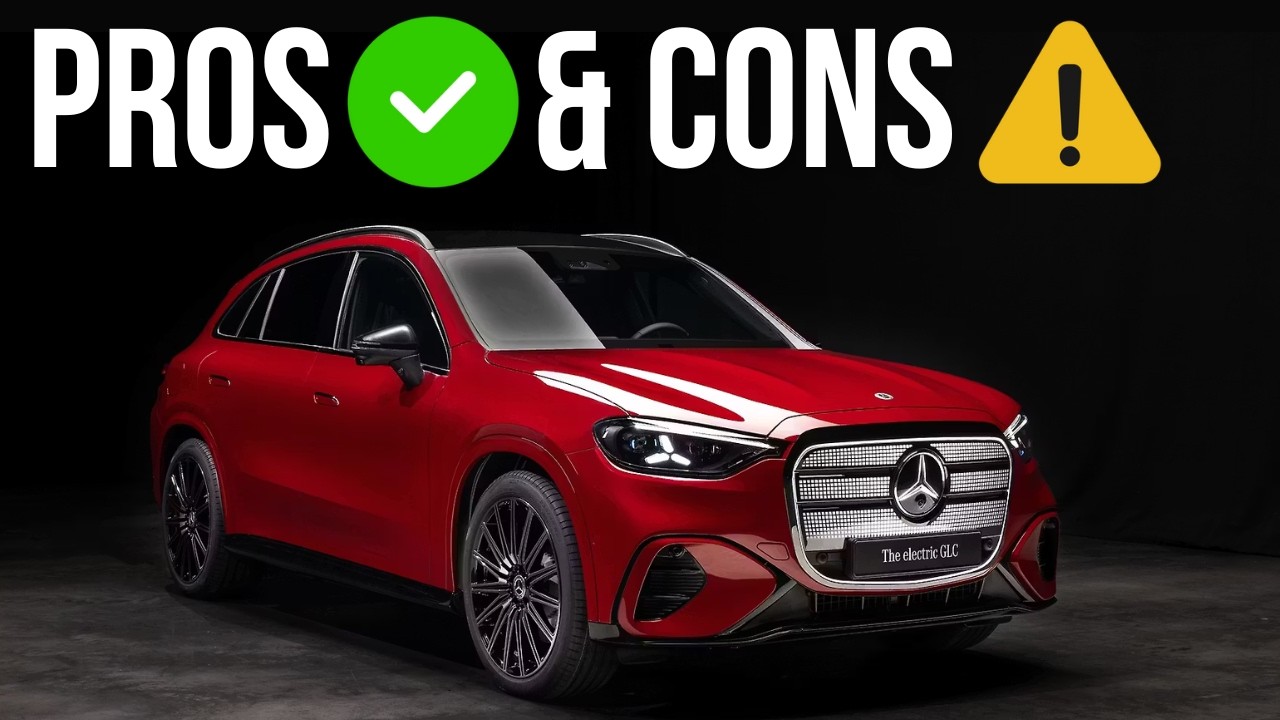
5 Pros & Cons of the 2026 Mercedes GLC EV | Luxury Electric SUV Review
The 2026 Mercedes GLC EV isn’t just another electric crossover. It’s Mercedes next major step in redefining its core lineup for an all-electric future. Built on the brand new MB.EA electric architecture, the GLC EV promises major upgrades in battery efficiency, improved thermal management, smoother dual motor performance, and that signature Mercedes quietness everyone loves. Early benchmarks suggest stronger realworld range, quicker charging, and a driving feel that blends luxury comfort with a clean electric punch. Inside the cabin is a tech showcase with the latest MBUX interface, massive displays, AIdriven driver assistance, ambient lighting that reacts to your mood, and a level of refinement that tries to remind you why the GLC is Mercedes global bestseller. But, and this is where things get interesting, even a flagship EV from Mercedes isn’t flawless. With all the new tech, battery upgrades, premium pricing, and evolving competition, the 2026 GLC EV comes with strengths you’ll love and weaknesses you shouldn’t ignore. So, today, we’re breaking down the five biggest pros and the five biggest cons of the 2026 Mercedes GLC EV. the performance, the design, the tech, the practicality, and the realworld ownership experience that doesn’t always show up on the spec sheet. If you’re thinking about upgrading to a premium electric SUV in 2026, this is the breakdown that’ll help you decide whether the GLC EV deserves a spot at the top of your list. This is Parth and you are watching Motor Nation. Before we jump into today’s video, here’s something every true car enthusiast will love. Our official website, motornationgroup.com. It’s your go-to destination for everything automotive. From the latest car launches, and industry news to detailed reviews, performance breakdowns, comparisons, buyer guides, and even insights into future tech shaping the next generation of vehicles. Join the Motor Nation community where passion meets performance and the drive never stops. Now, let’s get into the video starting with the first major advantage of the 2026 Mercedes GLC EV. And honestly, one of the biggest reasons people are excited about this SUV, its longd distanceance capability. Mercedes has equipped the new GLC EV with a large 94 kWh NMC battery pack with around 90 to 92 kwatt hours available for actual use. This isn’t just a big battery for the sake of numbers. It’s paired with Mercedes latest cell chemistry, improved cooling channels, and a tighter module layout, which together deliver better thermal efficiency, and higher performance consistency, even during long drives or fast charging sessions. Because of this, the GLC EV achieves some truly impressive range figures. On a European WLTP cycle, Mercedes claims up to 713 kilometers of range for the all-wheel drive model. Even the base rearw wheelel drive version is expected to cross 650 km, putting it far ahead of many rivals in the midsize luxury EV class. For comparison, most competitors like the BMW iX3, Audi Q4 Ron, and Lexus RZ sit in the 450 to 550 km bracket. So, the GLC EV comfortably offers an advantage of 150 to 200 km depending on the configuration. In the US, where the EPA standards are tougher, early industry estimates suggest a realworld range of 310 to 340 mi. Again, depending on wheel size and whether the buyer chooses single or dual motor, a big factor behind this efficiency is Mercedes aerodynamic tuning with an expected drag coefficient of around 0.26 to 0.27 along with a smart heat pump system that helps maintain efficiency in colder conditions. And the benefit of this big battery shows up not only in range but also in daily usability. With higher voltage stability during highway cruising, better charge retention at lower states of charge, and lower long-term degradation, the GLC EV feels like a proper long-d distanceance luxury EV bill for people who drive a lot, not just those who want a premium badge. Now, let’s move on to the second major reason to consider the 2026 Mercedes GLC EV. Its ultra fast charging capability, which is genuinely one of the strongest technical highlights of this SUV. Mercedes didn’t just upgrade the battery. They rebuilt the entire electrical backbone of the GLC EV around an 800vt architecture. This is the same class of system used in high performance EVs like the TYON and the Ionic 5, and it opens the door to dramatically higher charging speeds and better thermal stability during fast charging. With this platform, the GLC EV can pull up to around 320 to 330 kW from a compatible DC fast charger. To put that into perspective, many mainstream EVs still top out near 150 to 200 kW, meaning the GLC EV can charge nearly 60 to 70% faster under the right conditions. According to Mercedes internal testing, the SUV can jump from 10% to 80% in roughly 24 minutes, which is genuinely impressive given that it’s powering a 94 kWh battery pack. a fairly large battery for a midsize premium SUV. Those numbers translate to realworld benefits. If you’re on a long trip, a quick 10-minute stop can add around 300 km, about 185 to 190 mi of WLT paraded driving range. For many drivers, that’s enough for an entire day of commuting or for comfortably covering the distance between two major cities in a single burst. It genuinely changes how range anxiety feels because the SUV doesn’t force you into long inconvenient charging sessions. On the AC side, Mercedes offers an onboard charger of up to 11 kW or 22 kW depending on the configuration, making overnight home charging faster and more convenient as well. With a 22 kW wall box, you can refill the entire battery in roughly 5 hours, which is excellent for such a large pack. All of these systems working together mean this isn’t just another EV with good numbers on paper. It’s one of the most practical long-d distanceance electric SUVs you can buy. From faster weekend getaways to effortless interstate road trips, the 2026 GLC EV is built for drivers who want zero compromise when it comes to charging convenience. Moving on to the third big advantage of the 2026 Mercedes GLC EV, and this one is all about performance. Mercedes isn’t treating this as just another electric family SUV. They’re offering it with powertrains that genuinely elevated into a more premium performance leaning category. At launch, the GLCEV is expected to come in two major variants. The first is a single motor rearwheel drive setup tuned for smooth, efficient everyday driving. Output numbers vary depending on early manufacturer details, but estimates place it anywhere from 270 to 370 horsepower, which already puts it well above what most base luxury EV SUVs offer today. Even in this entry configuration, the GLC EV promises quick throttle response, quiet acceleration, and the kind of instant torque delivery that makes city driving feel effortless. But the real excitement comes from the dual motor all-wheel drive version, which pushes things to a far higher level. This variant is expected to produce up to around 490 horsepower, giving the GLC EV the kind of muscle that rivals some AMG gasoline SUVs. With two motors working together, one on each axle, the SUV delivers strong traction in all weather conditions, instant torque from standstill, and a far more dynamic feel when you want to push it. What makes this setup even more interesting is the engineering underneath. Mercedes is reportedly equipping the rear axle of the AWD version with a two-speed transmission, something you usually only see on ultra high performance EVs. This allows the car to stay in a short aggressive ratio for maximum acceleration off the line and then shift into a longer ratio for high-speed efficiency and more relaxed highway cruising. The benefit is a smoother, more controlled power curve and potentially quicker zero to 100 km per hour times without sacrificing driving range at higher speeds. Combine all this with Mercedes latest motor cooling, battery thermal management, and traction control software, and the result is an EV that doesn’t just feel fast, it feels refined, predictable, and deliberately engineered. Whether you want a calm daily commuter or something that can confidently overtake on the highway with a single push of the pedal, the GLC EV’s powertrain lineup gives you options that feel genuinely next generation. [Music] Now, let’s move on to the fourth big highlight of the 2026 Mercedes GLC EV. And this is where Mercedes truly flexes its luxury DNA. Step inside the cabin and you immediately feel like you’ve entered a digital lounge rather than just another midsize SUV. The star of the show is the optional 39.1 in MBUX hyperscreen. Stretching almost the entire width of the dashboard in a single sweeping glass panel. It blends the driver display, central infotainment, and passenger screen into one continuous surface, giving the GLC EV a futuristic spaceship-like feel that very few rivals can match. But the technology isn’t just for looks, it’s intelligent. The 2026 model runs on the allnew MBOS software platform, one of Mercedes biggest tech upgrades in years. It uses advanced AI and multi-agent intelligence co-developed with partners like Microsoft and Google. Meaning the system learns your habits, predicts your needs, and delivers far more natural voice interactions. Whether you’re setting the climate, navigating through traffic, or adjusting driving modes, everything feels faster, smarter, and more intuitive. Comfort takes a big step forward, too, thanks to the GLC EV’s longer wheelbase compared to the gasoline GLC. This opens up noticeably more rear seat leg room, and a flat EV floor makes the cabin feel wider and more spacious, especially for the middle passenger. Add in optional ambient lighting with hundreds of color combinations, high-grade trim materials, and Mercedes signature attention to detail, and the cabin easily sits at the top of the luxury EV class. The overall feeling is clear. This isn’t just an electric upgrade. It’s a complete evolution of the GLC’s interior experience, blending cuttingedge digital tech with a signature luxury that Mercedes buyers expect. And finally, let’s move on to the fifth major advantage of the 2026 Mercedes GLC EV, its sheer practicality. For all its luxury and tech, this SUV still remembers that people need space, versatility, and everyday usability. And Mercedes delivers that in a big way. Open the rear hatch, and you’re greeted with 570 L of cargo space behind the second row. One of the most generous volumes in the electric luxury SUV class. Fold the seats flat and that expands to a massive 1,739 L, giving you enough room for luggage, sports gear, road trip essentials, or even small furniture runs. But what really sets it apart is the added 128 L franc, which is rare in this segment. It’s the perfect spot for charging cables, backpacks, or wet gear you don’t want inside the cabin. Turning the GLC EV into a genuinely multi-sto vehicle. And here’s a surprise. The utility doesn’t stop at cargo with the optional towing package. The GLC EV can pull up to 2,400 kg or about 5,291 lb. That’s serious capability for an electric SUV this size. And it puts the Mercedes ahead of many competitors who sacrifice towing capacity for range. To make it all easier to handle, Mercedes also offers rear axle steering, shrinking the turning circle and making tight city maneuvers feel effortless. Paired with adaptive air suspension, the GLC EV stays comfortable on the highway, planted in corners, and smooth over rough roads, giving it the perfect blend of premium ride quality and realworld versatility. In short, this isn’t just a stylish, high-tech EV. It’s a genuinely practical luxury SUV designed to handle everyday life with confidence. Now, let’s dive into the first major con, and honestly, it’s a big one for anyone considering an electric SUV. The real world range is still a giant question mark. Yes, Mercedes advertises an eye-catching 713 km WLTP figure for the all-wheel drive GLC. On paper, that makes it look like one of the longest range EVs in its class, rivaling even Tesla’s top offerings. But here’s the catch. WLTP numbers have always been far more optimistic than realworld driving, especially when a vehicle moves from European test cycles to the much tougher EPA standards used in the US. Typically, WLTP figures drop anywhere from 18% to 30% once converted to an EPA rating. And for heavier, boxier SUVs, especially ones with large wheels and powerful dual motor setups, the reduction can be even larger. That means the GLC EVs claimed 713 km could realistically land somewhere around 370 to 420 mi EPA or potentially lower if the model tested is the dual motor performance variant. And that’s where the uncertainty becomes a problem. Mercedes still hasn’t officially confirmed the EPA rated numbers, which means early buyers are essentially going in blind until the independent tests roll in highway cycles, cold weather results, towing behavior, and high-speed range. Nobody truly knows how far this SUV will go in the real world. Even small factors like wheel size, climate control use, winter temperatures, and aggressive driving can shave off 10 to 25% of range on modern EVs. And since the GLC EV is marketed as a premium long-d distanceance tour, lack of concrete EPA numbers creates hesitation for buyers who rely heavily on predictable longrange performance. So, while the theoretical range is impressive, the actual range remains improving. And that gap between claim and reality is something that buyers should treat very carefully. Moving on to the second con, and this one is more about the real world than the car itself. Charging infrastructure limitations. The 2026 GLC EV is built with cuttingedge hardware. an 800volt system capable of pulling in massive charging speeds, theoretically up to 320 to 330 kW. On paper, that means blisteringly quick topups with Mercedes claiming 10% to 80% in about 24 minutes and as much as 303 km, roughly 188 mi added in just 10 minutes under ideal WLTP conditions. But here’s the reality check. Most public DC fast chargers, especially across the US and even parts of Europe, still run on 400vt architecture, and that means the GLC EV can’t always unleash its full charging potential. Sure, Mercedes does include a DC toDC converter, so the SUV can still charge efficiently at these lower voltage stations, but the speed will only be as fast as the charger allows, not what the car is capable of. And the bigger issue, true 300 plus KW chargers are still limited. They exist, but they aren’t everywhere. In many regions, you’ll still find 50 kW, 150 kW, or 200 kW chargers dominating the network. So, unless you’re in a city or corridor with newer high power infrastructure, you may not experience the ultra fast charging times Mercedes promotes. This doesn’t make the GLC EV a bad long-d distanceance EV. Far from it. But it does mean owners may need to plan around the realities of today’s charging landscape, not tomorrow’s. Because until the grid catches up, the SUV’s blazing fast 800V charging will remain a feature that shines best on paper and at only a handful of stations in the real world. Now, for the third con, owning a high-capacity battery isn’t free. And for the 2026 GLC EV, that could come with some real trade-offs. With a 94 kWh pack powering things, Mercedes is packing in serious energy, but that energy costs money. Media estimates suggest that the base price for this EV could start well north of $60,000 in Europe or around $65,000 or more in the US once taxes, destination charges, and local EV incentives are figured in. That puts the GLC EV firmly in the premium luxury EV SUV category. Not an entry-level electric crossover by any stretch. And then there’s the weight. A battery that big doesn’t come without mass and all that extra weight affects more than just your bank account. The added kilos influence how the vehicle handles in tight corners, how much energy it consumes in stop start city driving, and how much stress you’re putting on suspension components. Even with Mercedes clever battery cooling and management systems, heavier mass can reduce efficiency during everyday driving, especially in urban or suburban settings where acceleration and regeneration are constant. On top of that, more battery mass could mean higher long-term service costs. Replacement modules, future repairs, or warranty work may cost more. While modern EV batteries are built to last, the financial risk of degradation over time is still something to consider for a large pack like this. So, yes, that 94 kWh battery is part of what makes the GLC EV so capable, but it’s also a double-edged sword. You’re paying more upfront, carrying more weight, and potentially increasing the long-term cost of ownership. Another major concern surrounding the 2026 Mercedes GLC EV is the uncertainty tied to its production and overall market rollout. Over the past year, multiple industry reports have suggested that Mercedes-Benz is scaling back or restructuring its EV manufacturing strategy in the US. Some sources point to reduced output at EQ facilities, while others hint at shifting priorities toward plug-in hybrids and nextG architectures. And whenever a brand reshuffles its manufacturing footprint, it introduces real risks for buyers. From potential supply shortages to fluctuating pricing as demand and production try to balance out. And beyond manufacturing, the GLC EV itself rides on Mercedes brand new MB E8 Electra platform. Their next major step in EV architecture. Being first in line on a fresh platform is exciting, but also comes with first generation challenges. Early adopters could be dealing with anything from software instability, unexpected bugs in the advanced driver assistance systems or charging communication glitches to the more practical concerns like inconsistent service coverage for EVP specific components across North America and Europe. It’s not that Mercedes is inexperienced, far from it. But new platforms always face teething issues, firmware bugs that need OTAA fixes, thermal management tuning, fast charging handshake problems with certain networks, or drivetrain calibration that evolves over the first year of ownership. And with Mercedes adjusting its global EV strategy, some regions may see delayed deliveries, tighter allocations, or slightly higher pricing depending on how production stabilizes over the next 12 to 18 months. So, while the GLC EV promises cutting edge tech and a fresh chapter for Mercedes electric lineup, buyers should be aware that being first also means living through the growing pains of a new platform and a shifting EV production roadmap. One more drawback that buyers should keep in mind is how the GLC EV sufficiency can shift dramatically once you step outside ideal test conditions. That impressive WLTP range is achieved under controlled scenarios, but in everyday driving, especially in dense city traffic or colder climates, the big 94 kWh battery and high output motors can become a double-edged sword. In stopand go urban driving, the vehicle’s weight works against it. With a battery pack this large, the GLCEV is expected to tip well over two tons, meaning every acceleration cycle consumes more energy than lighter EV rivals. Yes, regenerative braking helps, but repeated low-speed cycles still tend to eat into efficiency quicker than you might expect, especially if you’re using heating ADAS systems or running the full digital suite inside the cabin. Cold weather introduces another layer of inefficiency. Lithium ion chemistry naturally loses performance at low temperatures. The motor and battery need additional power for thermal management, cabin heating, and maintaining optimal pack temperature. Realistically, winter driving could shave 15 to 30% off range depending on conditions and driving style. So, while the 2026 GLC EV shines on paper, in real life, in cities, in winter, or when fully loaded with luxury features, its efficiency can vary more than expected, making that headline range figure a best case scenario rather than an everyday reality. So, after looking at all the pros and cons, the 2026 Mercedes GLC EV clearly stands out as one of the most advanced electric SUVs in its segment. It combines a massive long range 94 kWh battery, ultraast 800vt charging, powerful performance options, and that signature Mercedes luxury that feels a step above most competitors. Add to that the impressive cargo space, a usable frunk, real towing capability, and the latest MB.OS tech, and the GLC EV shapes up to be a seriously compelling premium EV. But like every first generation product, it comes with its trade-offs. The real world range is still an unknown. charging infrastructures in many regions won’t let you use the full 330 kW potential and a large battery adds weight and cost. Plus, being based on Mercedes new EV architecture, early adopters may see the usual firstear teething issues or market uncertainties. Overall, the 2026 GLC EV is a strong statement from Mercedes. Modern, capable, luxurious, and packed with cuttingedge tech. If you want a premium EV SUV with long-d distanceance capability and first class comfort, this should definitely be on your short list. But make sure you understand how your local charging conditions, climate, and driving style may affect the ownership experience. Thank you for watching today’s deep dive into the 2026 Mercedes GLC EV. If you enjoyed the breakdown and want more detailed car reviews, comparisons, and upcoming EV insights, make sure to hit that like button and subscribe to Motor Nation. Drop your thoughts in the comments. Would you consider the GLC EV or does another EV SUV catch your eye? This is Motor Nation bringing you the latest from the automotive world. I’ll see you in the next video. Until then, drive safe and stay charged.
5 Pros & Cons of the 2026 Mercedes GLC EV | Luxury Electric SUV Review
Thinking of buying the 2026 Mercedes GLC EV? In this video, we break down the 5 biggest advantages and 5 key drawbacks that every potential owner should know — from range and charging to design, performance, and usability.
What we cover:
✔️ Standout range and high-capacity battery
✔️ Ultra-fast charging with 800V architecture
✔️ Spacious and premium interior with extended rear legroom
✔️ Futuristic 39.1-inch MBUX Hyperscreen & AI features
✔️ Powerful AWD option with strong performance
❌ Real-world range may be lower than WLTP claims
❌ Charging infrastructure might still be limited
❌ Very high starting price and running costs
❌ Large touchscreen can be overwhelming / distracting
❌ Weight and size reduce agility compared to smaller EVs
Timeline:
00:00 – Introduction
01:53 – New Reveal
02:26 – Pro #1
04:58 – Pro #2
07:31 – Pro #3
10:10 – Pro #4
12:19 – Pro #5
14:35 – Con #1
16:52 – Con #2
18:57 – Con #3
20:54 – Con #4
23:04 – Con #5
24:46 – Conclusion
👉 Watch till the end for our verdict on whether the 2026 GLC EV is worth the investment — especially compared to other luxury EVs like the BMW iX3, Audi Q6, and Mercedes EQC.
👍 Like, Comment & Subscribe for more EV reviews, 2026 model breakdowns, and luxury SUV guides.
#MercedesGLC #GLCEV #2026EV #LuxuryEV #ElectricSUV #CarReview #MercedesReview #MotorNation #EVComparison #2026mercedesglcev #2026mercedes #2026glc #2026glcev #motornation
————————————————————————————————–
Heroism by MaxKoMusic | https://maxkomusic.com/
Music promoted by https://www.chosic.com/free-music/all/
Creative Commons Attribution-ShareAlike 3.0 Unported
https://creativecommons.org/licenses/by-sa/3.0/deed.en_US
Bliss by Luke Bergs | https://soundcloud.com/bergscloud/
Creative Commons – Attribution-ShareAlike 3.0 Unported
https://creativecommons.org/licenses/by-sa/3.0/
Music promoted by https://www.chosic.com/free-music/all/
Take It Easy by Luke Bergs | https://soundcloud.com/bergscloud/
Music promoted by https://www.chosic.com/free-music/all/
Creative Commons – Attribution-ShareAlike 3.0 Unported
https://creativecommons.org/licenses/by-sa/3.0/
Sound Effect by whoisbenjamin from Pixabay
Sound Effect by Modestas123123 from Pixabay
Sound Effect by Matthew Vakalyuk from Pixabay