DARTMOUTH — When it comes to the wide range of small, engine-propelled or assisted vehicles like electric bikes and scooters that have risen in popularity over recent years, Dartmouth officials want to raise public awareness of what is and isn’t OK.
That was the conclusion of a discussion on the topic between Dartmouth Police Chief Brian Levesque and the Select Board at their Nov. 17 meeting, where Levesque shared that enforcing laws around those vehicles can be challenging for police.
According to Levesque, knowing which laws apply to which vehicles can get “a little bit complicated out there.”
“They’re in all different categories, and even the [Registry of Motor Vehicles] is trying to still decide on some,” he said.
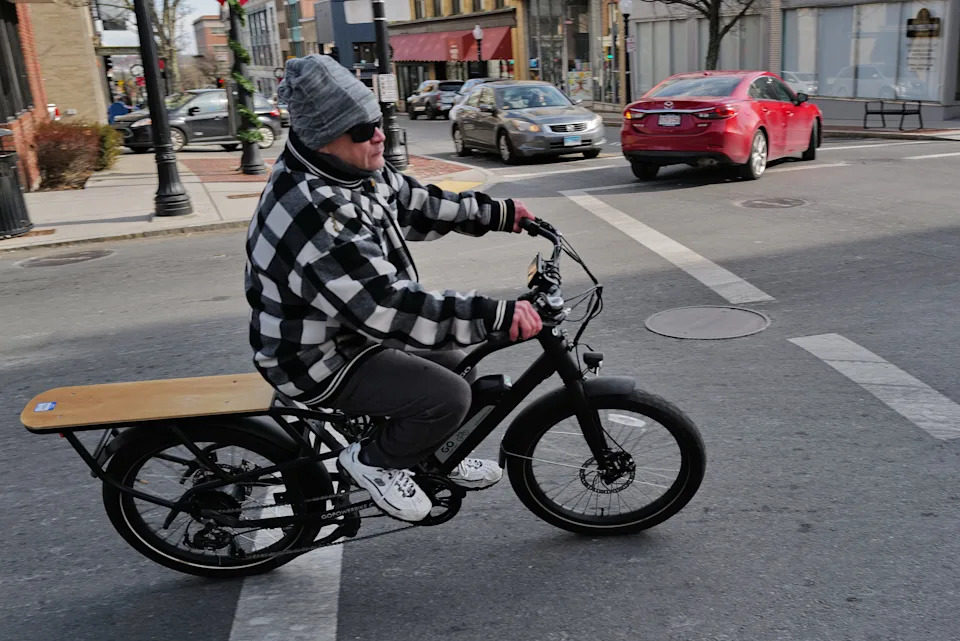
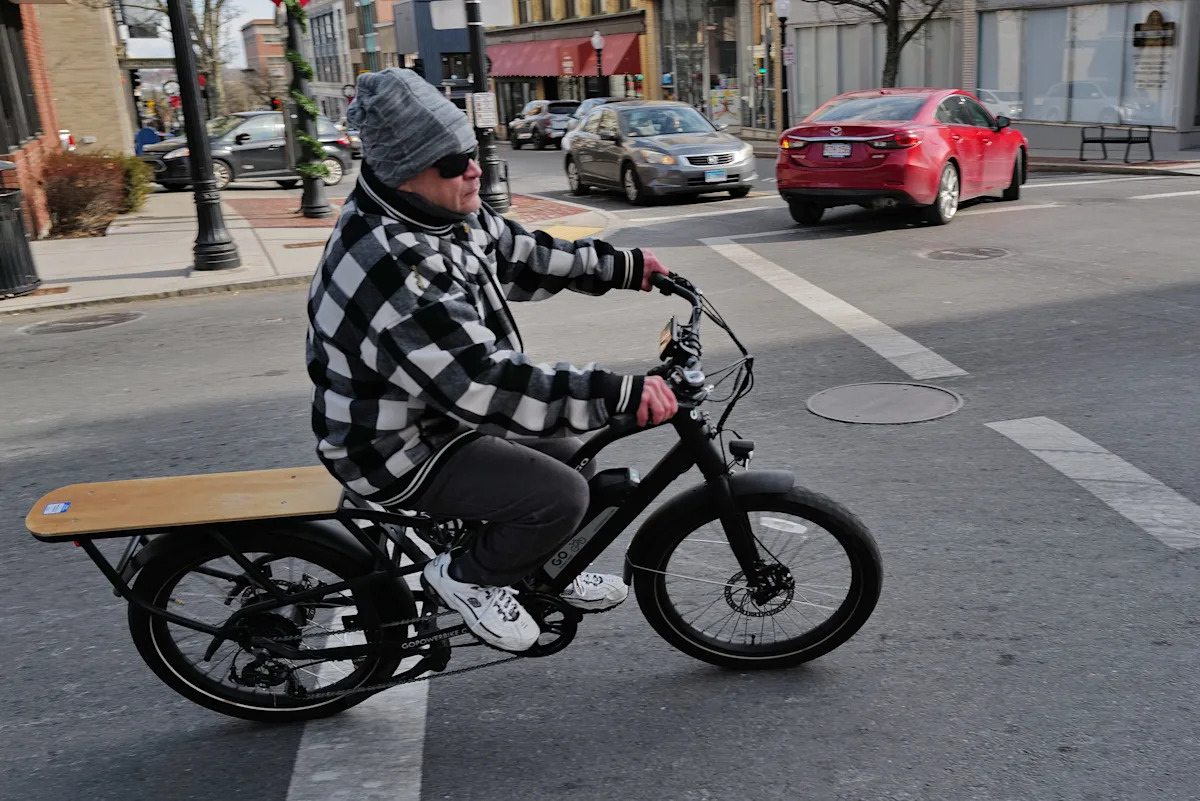
In this file photo, a man is seen riding an e-bike rides onto Union Street in downtown New Bedford. Dartmouth officials say they want to boost public awareness when it comes to the rules on e-bikes, motorized bikes and other small vehicles of the like.
Aside from vehicles categorized as scooters, Levesque said “there’s two recognized classes of electric bikes and then there’s like almost a third class that doesn’t fall within the other two that they’re still working on.
“We’ve actually got different charts we have to use to consult when we stop these vehicles to figure out, what they are what category they fall into and then what the requirements are on them.”
More on e-bikes: What are e-bikes and can you ride them on the road? Here’s what riders say you need to know
E-bike rules are tricky to enforce, because chasing is difficult
Knowing what’s what when it comes to “all the different little vehicles” isn’t the only challenge, according to Levesque.
“We do have a problem … with these different vehicles not commonly stopping for us,” Levesque said. “Frequently they flee, and there’s not a lot we’re going to do with that at this time. We don’t have any great way of stopping them and we don’t want to see them get into an accident and get hurt or hurt someone else while they’re trying to get away for a helmet violation or something of that sort.”
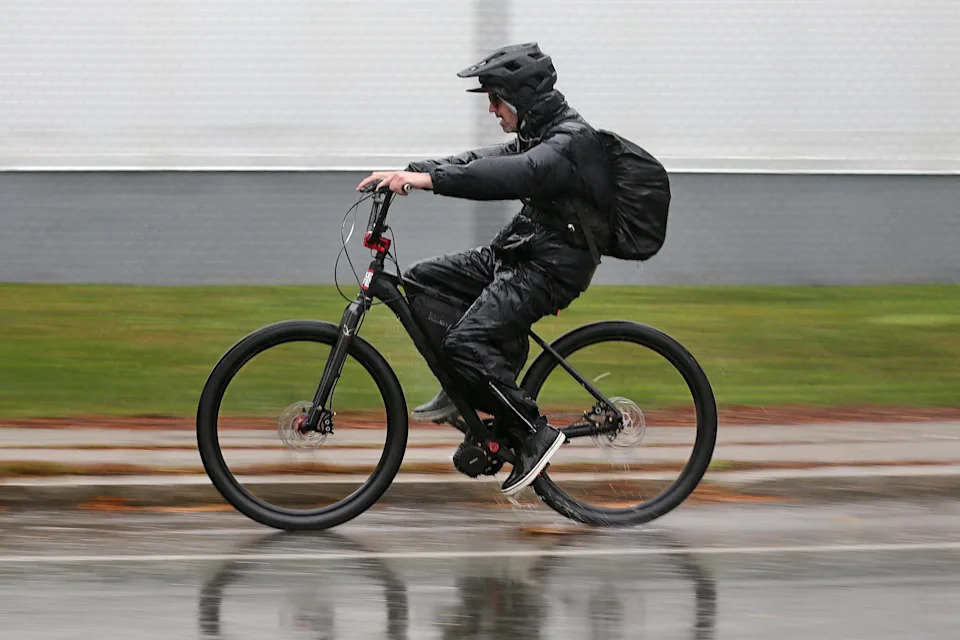
A man rides his e-bike down JFK Memorial Highway in New Bedford on a rainy morning.
‘We can save one reckless kid’
Ideas for increasing public awareness of the rules for the vehicles included having police hand out educational materials when making stops, posting materials at Dartmouth schools, and setting up an informational page online.
“And I know that’s not an ultimate solution but on the other hand nobody knows what the rules are,” said Select Board member David Tatelbaum. “We can save one reckless kid … by doing something that we’re not doing.”
What are the different classes of e-bikes?
According to a guide made available online from the town of Natick, Massachusetts General Law defines an electric bicycle or “e-bike” as a “bicycle or tricycle equipped with fully operable pedals and an electric motor of 750 watts or less.”
“Class 1” e-bikes are those that are “equipped with a motor that provides assistance only when the rider is pedaling and that ceases to provide assistance when the bicycle reaches the speed of 20 miles per hour.”

Members of the Fall River Police Department’s NEET team mounted on e-bikes ride in to the unveiling of the city’s new e-bikes at the Quequechan River Rail Trail on Tuesday, Sept. 30, 2025.
Read the latest: Voters kill $288M Old Colony Voc-Tech school building project. What happens now?
“Class 2” e-bikes are “equipped with a motor that may be used exclusively to propel the bicycle and that is not capable of providing assistance when the bicycle reaches the speed of 20 miles per hour.”
Neither e-bike class requires a license or registration to operate, the guide says.
Understanding ‘motorized bikes’/mopeds
Unlike e-bikes, “motorized bikes” or mopeds do require a valid driver’s license or permit and registration, and all riders must wear helmets.
“Massachusetts General Law defines motorized bikes, or mopeds, as ‘a pedal bicycle which has a helper motor, or a non-pedal bicycle which has a motor, with a cylinder capacity not exceeding 50 cubic centimeters, an automatic transmission, and which is capable of a maximum speed of no more than 30 miles per hour,’” the guide reads.
Understanding ‘motorized scooters’
“Motorized scooters,” according to the guide, are defined in state law as “any 2-wheeled tandem or 3-wheeled device, that has handlebars, designed to be stood or sat upon by the operator, powered by an electric or gas-powered motor that is capable of propelling the device with or without human propulsion.”
Like with motorized bikes/mopeds, motorized scooter riders must have a license or permit, and riders must wear helmets.
Grab a bite: New Bedford Chipotle project advances, opening slated for spring 2026
Do you know these rules?
A look at some key sections of Mass. General Law reveals the following about how state law applies to some of the vehicles-types discussed by Dartmouth officials.
“Bicyclists riding together shall not ride more than 2 abreast but, on a roadway with more than 1 lane in the direction of travel, bicyclists shall ride within a single lane.” (Applies to all “bicycles” as per M.G.L. Title XIV, Chapter 85, Section 11B.)
“A motorized bicycle shall not be operated upon any way, as defined in section one within the commonwealth by any person under sixteen years of age, nor at a speed in excess of twenty-five miles per hour.” (M.G.L. Title XIV, Chapter 90, Section 1B)
“Any person 16 years of age or younger operating a bicycle or being carried as a passenger on a bicycle on a public way, bicycle path or on any other public right-of-way shall wear a helmet.” (Applies to all “bicycles,” including e-bikes, as per M.G.L. Title XIV, Chapter 85, Section 11B.)
Watch the meeting
To watch the Nov. 17 Dartmouth Select Board meeting online, visit www.youtube.com/@DartmouthCommunityMedia
This article originally appeared on Standard-Times: Dartmouth officials say awareness needed on e-bikes, mopeds, scooters