 9 min read
Electric bikes have changed cycling. Over the last decade, e-bike technology has revolutionized how far and fast we ride our bikes, and opened roads, bike paths, and trails to many more riders.
However, it’s not only commuters and city riders getting in on the e-bike fun; electric mountain bikes enable riders to access terrain they never thought possible. E-MTBs allow older cyclists to continue mountain biking and new riders to conquer long climbs. Long-range batteries and torque make these bikes extremely capable. Plus, they’re simply a blast to ride. If you haven’t tried one out, you really must—riding an electric mountain bike puts a grin on the face of even the biggest technophobes among us.
Electric mountain bikes enable you to ride off-road trails farther and faster. And their small-but-mighty motors help make tough climbs actually enjoyable. Thanks to modern geometry, solid components, and ever-improving motors and batteries, E-MTBs are as fun to ride as any traditional mountain bike.
However, electric mountain bikes are far more than standard mountain bikes with electric motors slapped on the frame. The best E-MTBs are purpose-built for stability, range, and real trail performance. Look for a powerful motor, long-lasting battery (or range extender), capable suspension, and a price that works for you.
Note: The electric mountain bikes featured in this story have been ridden and evaluated by Bicycling’s editors and test team. These E-MTBs are designed—and intended—for use off-road on technical singletrack and trails. For improved performance and lower weight, these bikes use mid-drive motors (versus less expensive E-MTBs equipped with heavier and less reliable hub-drive motors).
For a wide assortment of lower-priced electric bikes—including some with knobby mountain bike tires—check out our Electric Bike Buyer’s Guide story.
Five Great E-MTBs to Buy Right NowFull Suspension E-MTB Reviews
Best Full Suspension Deal
Salsa Notch 160 Cues 10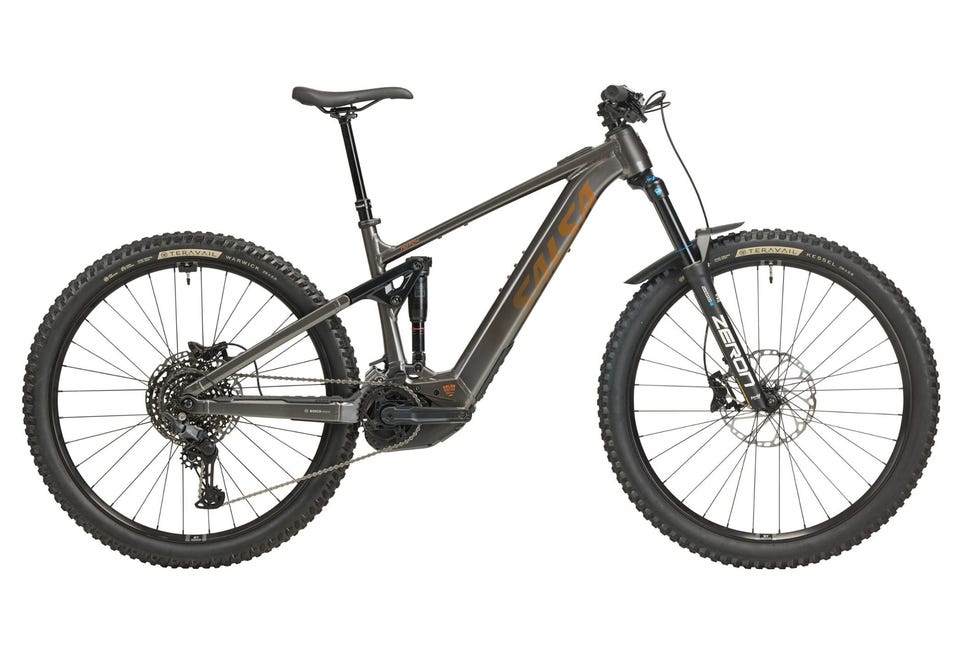 Features at a GlanceWeight57.25 lb.Travel160mm (f & r)Battery500WhTorque85Nm
Priced less than many hardtail electric mountain bikes, Salsa’s Notch 160 is packed with value. At the heart of this dual 29-inch wheeled trail bike is Bosch’s Performance Line CX motor with 85 Newton-meters of torque powered by a 500-Watt-hour battery. While it has less torque and a smaller capacity battery than higher-priced competitors, it’s more than enough for some serious fun in the woods and on singletrack.
The Notch 160 uses a Split Pivot suspension system designed by Dave Weagle (the mastermind behind the dw-link suspension system used by Pivot) for a balance of performance and pedalability. A 10-speed Shimano Cues drivetrain with four-piston Shimano brakes, a dropper post, and WTB tubeless rims round out the component selection on this feature-packed full suspension E-MTB.
Best Carbon Deal
Cannondale Moterra SL 2 
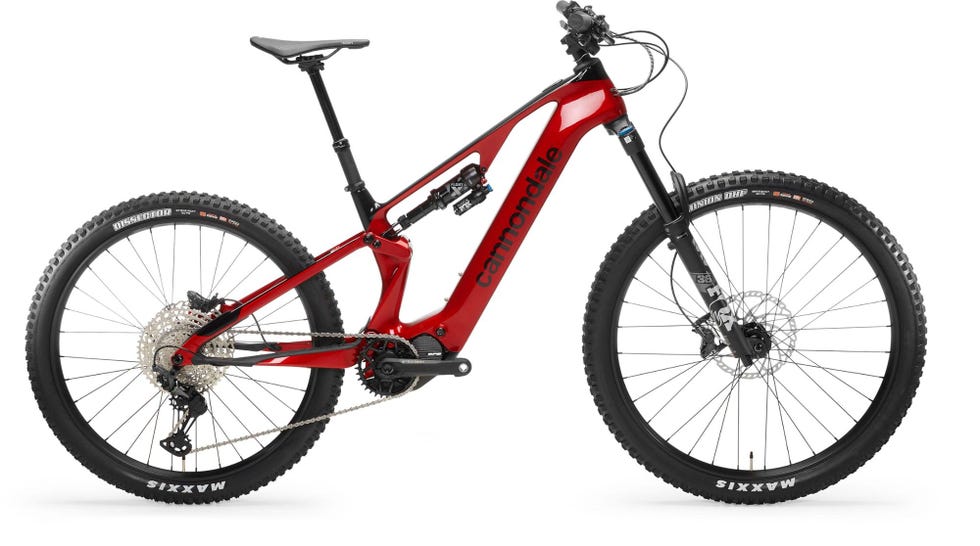 Key SpecsWeight46 lb.Travel160mm (f), 150mm (r)Battery601WhTorque85Nm
Cannondale’s Moterra SL 2 sits perfectly between trail and enduro capability, with a few clever tricks: adjustable headset cups provide 1.2 degrees of head-angle adjustment, and if you’d rather run 29-inch wheels front and rear instead of the stock 27.5-inch rear, reverse the Flip Chip and you’re set.
Senior Test Editor Matt Phillips describes the Moterra SL as being “a unique blend of a full-power e-bike’s power with the weight of an SL category bike.” He continued, “It’s much poppier than the typical full-power e-bike,” and that it has “great geometry and solid suspension too”. Since the Moterra SL is a lighter-weight and easier-handling e-MTB, it’s especially suited for lighter riders. Phillips noted that his wife “typically finds full-power e-bikes cumbersome and not enjoyable to ride, but she really likes the Moterra SL.”
Tip: Can’t pick between the Moterra SL and Moterra LT? Read this story to help you decide.
The real standout part is the bike’s Shimano EP801 motor. Delivering 85 Nm of torque and paired with a 601 Wh battery, it helps make the SL2 impressively light for the category. Suspension comes from a two-position Fox Float X Performance Elite shock and a 160mm travel Fox Performance 36 fork. A 170mm dropper post (150mm on size S) gets the saddle out of the way for steep descents, and the build smartly mixes Shimano XT and Deore components for value and performance.
If you buy the Moterra SL through rei.com, you can have it shipped to your nearest REI location for professional assembly with in-store or curbside pickup. You also get one year of free adjustments—or two years if you’re an REI Co-op member.
With its satin black paint and all-black parts, the 29-inch wheeled Cannondale Moterra 4 has a subdued appearance. However, it makes up for its lack of flash with proven and dependable components and features. (Cannondale also offers the Moterra 4 in orange if you want bright and poppy.) At the heart of the Moterra is a trusty Bosch Performance Line CX motor bolted to a 150mm-travel aluminum full-suspension frame, and inside the Moterra’s stout downtube is a 600Wh Bosch Powertube battery.
While many high-end full suspension E-MTBs routinely cost more than $10,000, Cannondale keeps the Moterra 4 to a (somewhat) more reasonable $5,500 through smart component choices. Examples of this include the excellent Shimano Cues drivetrain and a 160mm travel SR Suntour Xeron air-sprung fork with 36mm stanchions. Additionally, the Cannondale equips the Moterra 4 with a long-travel dropper seatpost, tubeless wheels, and Tektro disc brakes (with 203mm rotors).
The Moterra 4 might be a little heavier and have less range than pricier full suspension electric mountain bikes, but it packs a lot of punch for its price.
Best Overall E-MTB
Turbo Levo 4 Expert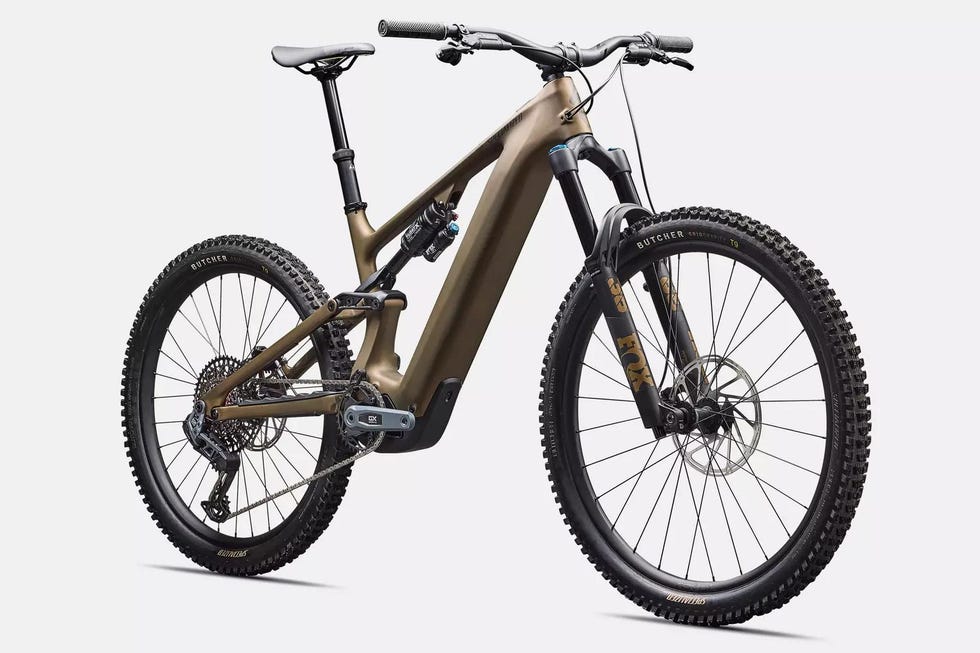 Features at a GlanceWeight53.8 lb.Travel160mm (F)/150mm (R)Battery840WhTorque101Nm
“I’ve never considered an e-bike a replacement for a traditional bike—until now,” said Matt Phillips in his review of the excellent S-Works Turbo Levo 4. He went on to state that the bike “has me rethinking that position.” The latest version of Specialized’s flagship e-MTB is refined, quiet, fun to ride, and refreshingly free of the common annoyances that plague many e-bikes.
Several standout features set the S-Works Turbo Levo 4 apart from the crowded E-MTB segment: a powerful motor delivering 111Nm of torque, a larger 840Wh battery, and the ability to toggle the pedal-assist cutoff between Class 2 (20mph) and Class 3 (28mph). That extra speed might sound excessive, but it’s a welcome boost when you’re riding to or between trails.
Though the S-Works Levo 4 is less expensive than its predecessor, it’s still eye-wateringly pricey. For better value—relatively speaking—we recommend the Turbo Levo 4 Expert. It offers the same carbon frame, battery, and motor as the pricier model, though with slightly less torque. Suspension is handled by a 160mm Fox 38 Performance Elite GRIPX2 fork and a Fox Float X Performance Elite shock, while shifting comes courtesy of a SRAM GX AXS drivetrain.
If you’re after the latest—and arguably greatest—electric bike currently available, the Turbo Levo 4 should be at the top of your list.
Yeti arrived a little later to the electric mountain bike party than many other popular bike brands. However, the brand’s E-MTB offerings have, thus far, been nothing short of brilliant.
The Colorado-based company’s latest E-MTB is a prime example of this excellence. Drawing on the experience of reigning Enduro World Champion, Connecticut’s Richie Rude, Yeti pairs its Sixfinity full suspension system with Bosch’s 85Nm Performance Line CX drive unit for excellent on-trail performance and traction. (For boosted performance and adrenaline, go with the LTe T4 and its 100Nm CX-R motor.)
Rounding out the C4 model’s component list is the cable-actuated SRAM E90 Transmission drivetrain and super-powerful SRAM Maven brakes. Suspension duties are handled by a 170mm travel Fox Performance 38 up front and a Fox Performance Float X at the rear.
And if the bright mango paint scheme isn’t your thing, Yeti also offers the LTe in raw carbon or the brand’s signature color, turquoise.
Hardtail Electric Mountain Bike Reviews
The Aventon Ramblas is a category-defining bike that impressed me during trail testing. Its trail-forward components include a 1×12 SRAM Eagle drivetrain that can handle most climbs, powerful four-piston SRAM brakes, a solidly stiff 35mm stanchion RockShox fork, a useful dropper seatpost, and cushy 2.4-inch wide tires. These are unmatched by any other hardtail E-MTB, especially given its price.
As I expressed in my full Ramblas review, hardtails are the gateway into the sport for many mountain bike riders because they’re simple, sturdy, and affordable. Yet, the Ramblas has few true competitors for comparatively priced, trail-ready electric hardtails. And once more people see and ride the Ramblas, I hope more brands follow Aventon’s lead with sharp-priced, trail-capable hardtail E-MTB.
Big, burly full-suspension mountain bikes aren’t for everyone. For many riders, they’re overkill—adding cost and complexity without delivering benefits that match their needs. That’s why we’re excited to see more brands investing in high-quality hardtail electric mountain bikes. Hardtail E-MTBs give you pedal assist for about the same price as full-suspension non-electric mountain bikes
The Grand Canyon:ON’s bike handling leans toward the agile, XC-focused end of the spectrum. Its 68-degree head angle is on the steeper side, which translates to tighter, more precise steering—especially noticeable at low speeds. If you ride trails with plenty of tight, twisty sections, you’ll appreciate that. It also keeps the bike lively and engaging on cinder paths and non-technical flow trails.
With excellent pedal assist and sharp handling, the Grand Canyon:ON is well-suited to riders who want a versatile hardtail without the bulk of a full-suspension bike. It’s equally at home on smoother, climb-heavy trails in the Rockies or West Coast as it is weaving through the tight, technical singletrack common in the Mid-Atlantic and New England.
Best Kid’s Hardtail E-MTB
Woom Up 5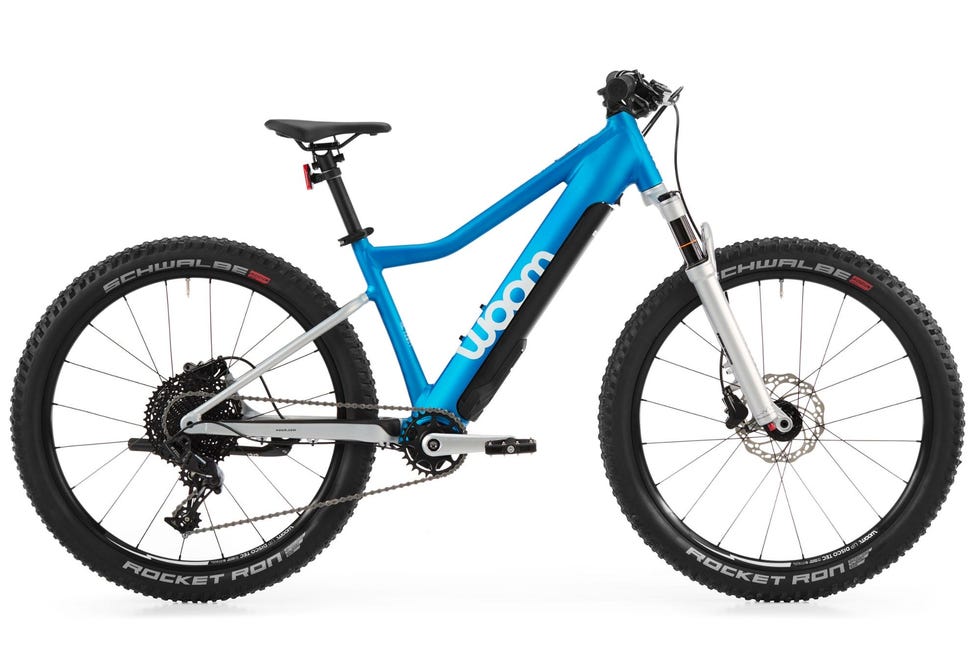 Features at a GlanceWeight35.3 lb.Battery150WhTravel80mmTorque58Nm
Why should adults have all of the fun? Woom’s answer to this question is the Up 5, a kid-centric, trail-worthy electric mountain bike. The Up enables kids to ride longer and keep up with older siblings—and probably drop their parents on climbs.
Powered by a lightweight Fazua motor, the Up 5 is speed-limited to 15.5 mph; its torque maxes at 58 Nm. This allows kids to have some fun and ride longer, but prevents them from getting in over their heads. Designed for kids 7 to 9 years old, the Up 5 uses 24-inch wheels, an 80mm travel air-sprung fork, hydraulic disc brakes with kid-friendly levers, and short 130mm cranks. A 26” wheel version—the Up 6—for riders 10 and older is also available.
Co-op Cycles is REI’s in-house bicycle brand. Exclusively sold at the outdoor retailer’s website and 170-plus store locations, the DRT 1.1 is equipped with a dependable Bosch Performance Line mid-drive motor (with pedal assistance up to 20mph) and an internally-mounted 500Wh battery.
The 53.7-pound DRT rolls on tubeless-compatible 27.5-inch wheels with 2.6-inch-wide Maxxis Rekon tires for off-road capability. The bike’s 100mm-travel SR Suntour fork with thru axle isn’t glamorous, but it works; Shimano hydraulic brakes and a 9-speed MicroShift drivetrain round out the key parts. The only notable component missing is a dropper seatpost; it would enhance the DRT’s trail capability and help riders feel more confident on challenging terrain.
While the DRT 1.1’s price is higher than some consumer-direct competitors, REI’s assembly and service are a big plus for many riders (plus, REI often runs sales on bikes and gear). If you’re looking for a bike to explore trails and use around town, this is a solid and dependably-equipped pick.
Best Dual Use E-MTB
Trek Marlin+ 6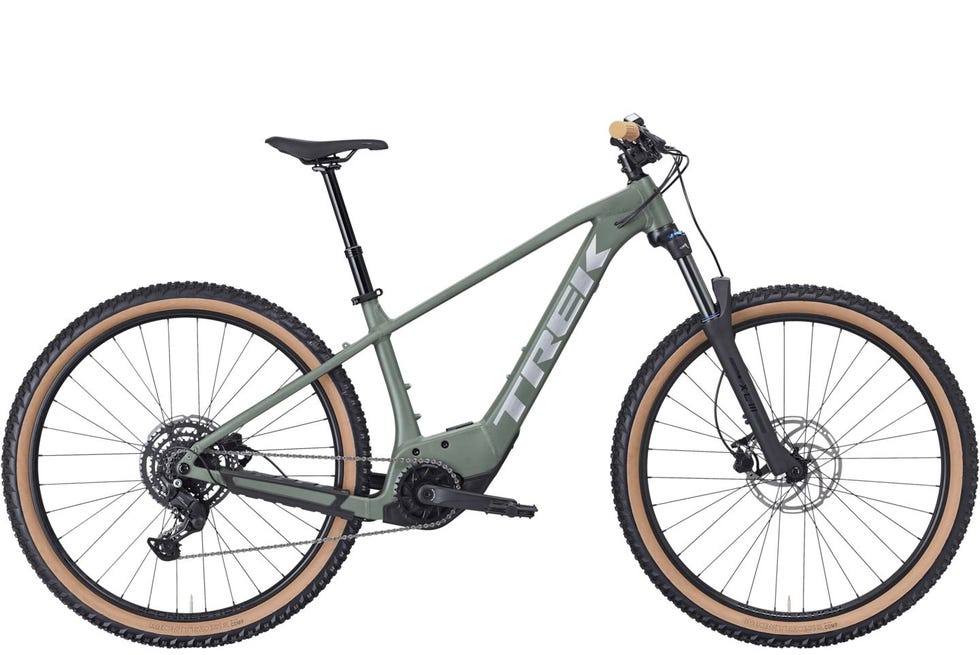 Features at a GlanceWeight50.5 lb.Travel120mmBattery400WhTorque50Nm
The Marlin+ 6 is an excellent entry point into electric mountain bikes. It’s also a great choice for riders needing an e-bike for dirt trails, around town, and commuting. Its sturdy aluminum frame houses Bosch’s refined Active Line Plus motor, paired with a Shimano Cues 9-speed drivetrain. While not as refined for off-road use as higher-end models, the SR Suntour XCM34 fork features an air spring and lockout and gets the job done without much fuss.
This bike gets Trek’s Smart Wheel Size treatment, which ensures balanced handling across all sizes—XS and S models come with 27.5-inch wheels and 100mm forks. Practical additions (like mounts for racks, fenders, and a kickstand) make it a solid choice for commuters as well.
At $3,200, the Marlin+ 6 is far from cheap, but it’s among the more affordable E-MTBs on this list. With dependable components and thoughtful design, it’s a great first electric mountain bike—it blends everyday practicality and trail usage.
How We Selected These Bikes
Bicycling has been reviewing bikes and gear for over 50 years, and our recommendations are grounded in decades of real-world experience. Our test team includes Deputy Editor Tara Seplavy, Senior Test Editor Matt Phillips, Test Editor Dan Chabonov, Senior Reviews Editor Bobby Lea, and Senior Photographer Trevor Raab—collectively bringing 75-plus years of ride-testing insight to every product we evaluate.
For this guide to electric mountain bikes, Matt and Tara led the charge, drawing from their deep category expertise and the team’s hands-on testing across a wide range of terrain and conditions.
These picks reflect what we’ve learned through thousands of miles of testing: which E-MTBs deliver the right mix of ride quality, trail capability, and pedal-assist performance. Whether you’re climbing faster, riding farther, or just having more fun, these are the best electric mountain bikes you can buy right now.
What to Consider in an E-MTB
When you’re shopping for an electronic mountain bike, you’ll want to factor in not only the motor’s power and features, but also the bike’s basic capabilities.

Travel
Since electronic mountain bikes are heavier than non-motorized bikes, you’ll want to consider a bike with more suspension travel than you have on your non-motorized bike. The longer your travel, the more cushion you’ll get when you encounter obstacles.
Most full suspension E-MTBs are in the 150- to 160mm travel range, which offers a nice balance of increased comfort and improved control for first-time buyers.
Motor Options
In addition to choosing the right kind of bike, you’ll also need to decide which pedal-assist motor option is right for you. There are three electric-assist classes in the United States. Class 1 motors kick in only when you pedal and stop helping you at 20 mph. Class 2 also offers pedal assist up to 20 mph, but these bikes can also have a throttle-powered mode that allows users to engage the motor without pedaling. Class 3 is pedal-assist like Class 1, but will help you until you hit 28 mph.
Class 1: 20 MPH max assist speed; throttle is not standard equipment
Class 2: 20 MPH max assist speed; throttle comes standard equipment
Class 3: 28 MPH max assist speed; throttle is not standard equipment
Other countries classify e-bikes differently, and many countries do not allow e-bikes to assist riders beyond 20 miles per hour.
Most performance-oriented electric mountain bikes are Class 1. Electric mountain bikes generally feature one of two types of motors: mid-drive motors, which are contained in the frame at the bottom of the bike between the pedals; and rear hub motors, which are built into the rear wheel.
Bikes with rear hub motors are generally less expensive but are also less powerful. A mid-drive motor will almost always offer more power. Because the extra weight on a mid-mount bike is centered in the bike and lower to the ground, these bikes are generally easier to handle than bikes with hub motors. Mid-mount bikes do tend to be more expensive, but all of our favorite bikes feature this type of motor.
Battery Life, Range, Maintenance, and Safety
On top of the motor, you’ll want to consider the battery size and range. More is always better for performance, but a battery with a longer range will also weigh more and cost more.
As a bike’s weight increases, it requires more effort from the rider to handle. This is especially an important consideration for smaller riders; extra weight can also become a bigger challenge at faster speeds, when you need to ride the bike more aggressively.
A lighter bike will offer better handling, but if you sacrifice too much battery capacity to cut weight, you may find yourself pedaling home with no assist if you take a wrong turn.
Like all e-bikes, E-MTBs can be pedaled as a normal bike if the battery dies, so you’ll still be able to get home, but it will require extra effort and possibly more time.
While we can confidently say a larger battery provides more range, it is difficult to accurately estimate any e-bike’s exact range. Many factors impact an e-bike’s range: How much boost you’re using (most power systems offer three or four settings), how much you weigh, the terrain you’re riding, how much climbing you’re doing, the air temperature, rolling resistance from the tires, and even how clean and lubricated the drivetrain is.
Don’t take any brand’s word on its range claims. Start conservatively as you test your bike’s range. The more you ride, the better you’ll understand how far your batteries can carry you in different conditions. If your bike’s main battery isn’t cutting it, some models let you add an external range booster or swap the internal battery for a fresh one. Be warned: These accessories can be expensive!
Like all batteries, e-bike batteries do lose capacity every time they’re charged and discharged. Unfortunately, that means that the more you ride, the sooner you’ll need to replace your battery. Even so, an e-bike battery should give you years of reliable riding.
Follow your bike’s manufacturer’s recommendations for storage, but most batteries will last longer if stored with about a 40-percent charge (but don’t forget to plug your bike in about six hours before riding, to make sure you start your ride with a full charge).
Batteries should also be stored at room temperature whenever possible and not left outside or in an unheated garage in freezing temperatures. Some bike brands, including Specialized, have a setting that will prevent the battery from charging fully. This feature is designed to extend the battery’s life, but you may want to disable the feature if the rides you regularly take use your battery’s full capacity.
If, after a few years, your battery loses enough capacity that you want to replace it, be sure to contact your bike’s manufacturer or local dealer and purchase a certified replacement battery through the brand or its dealer.
Don’t be tempted by cheaper options available online from third-party brands. These third-party batteries are generally not certified by bike brands and may void your bike’s warranty. More importantly, third-party replacement batteries often do not have important safety features, and, as a result, these batteries have been identified as the cause of several serious fires.
There is currently legislation pending at the state and federal level that will bar the sale of non-certified batteries in the U.S., but they are still available as of this writing.
Drivetrains
While a handful of bicycle drivetrain manufacturers exist, almost every e-mountain bike will have either a Shimano or SRAM drivetrain. Both are reputable manufacturers that offer reliable shifting and a wide-ranging gear set. Some drivetrains feature electronic shifting. Such drivetrains offer quick and precise shifting, but they will add cost.
The added power of an e-bike puts more strain on a bike’s drivetrain. You can expect to replace your chain more frequently, but you can get more life out of your components if you back off the pedals when shifting, and ease the chain between gears instead of mashing the shifter and the pedal at the same time.
Brakes
Given the increased weight of an electronic mountain bike, you’ll want to make sure yours is equipped with hydraulic disc brakes, as most are. These brakes offer lots of stopping power and modulation, which ensures you’ll remain in control regardless of your bike’s weight, or how fast you go.
Several brands offer hydraulic disc brakes, though again, Shimano and SRAM usually lead the way. For additional power, look for bikes featuring four-piston brakes.
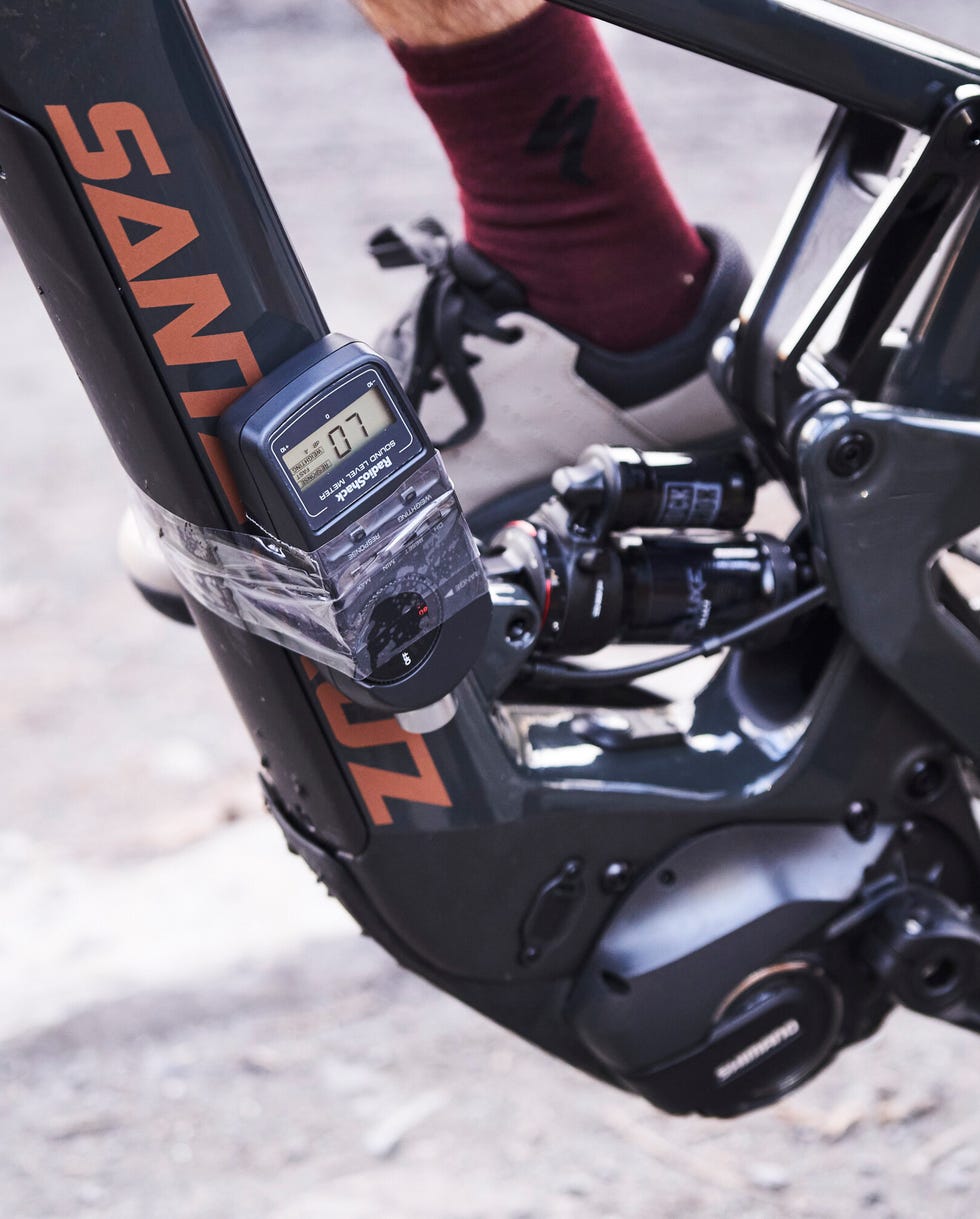 Trevor Raab
Testing motor sound levels on the latest e-bikes on real trail rides.
 Trevor Raab
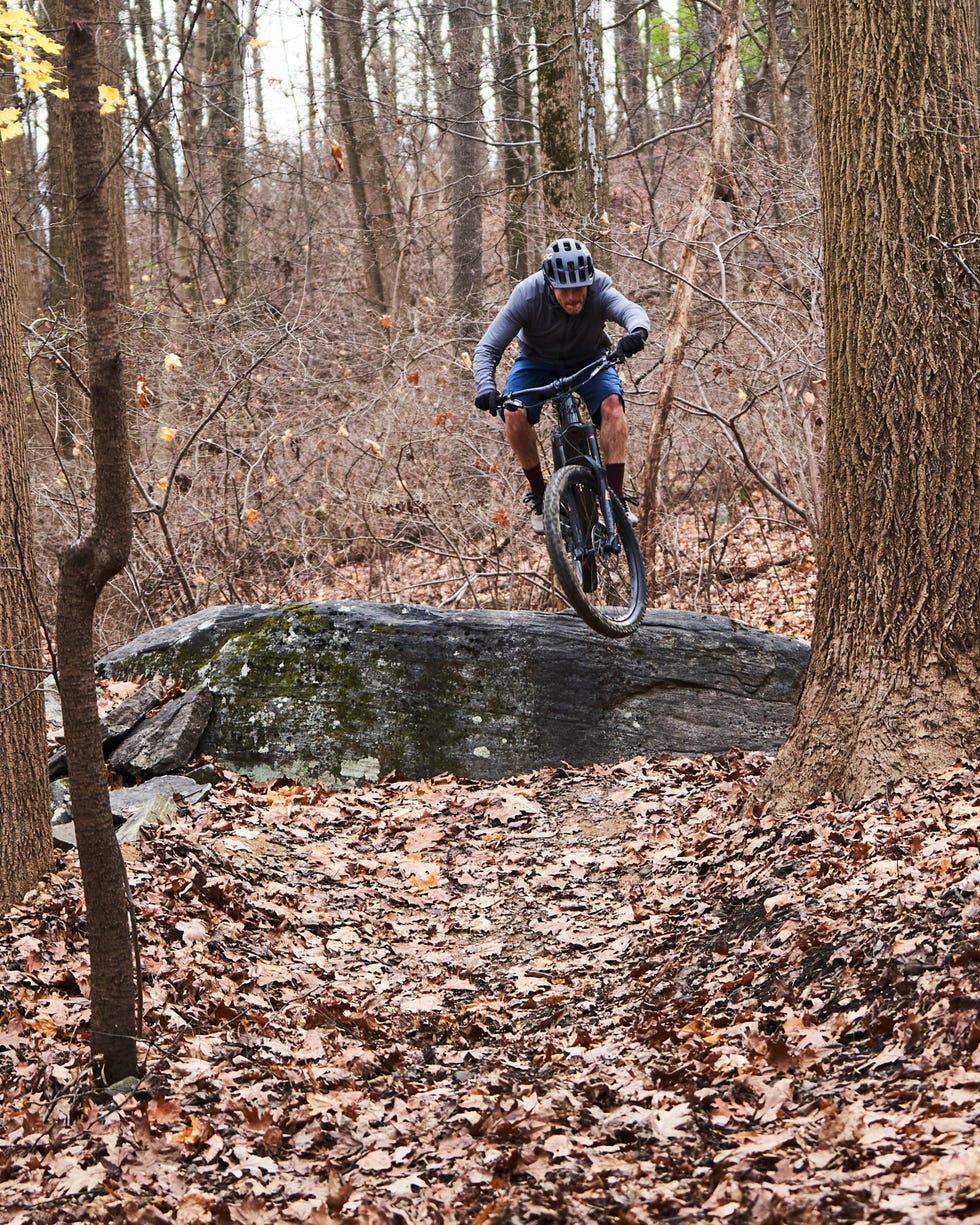
Testing the suspension and handling of the latest e-mountain bikes.
Exclusive Video Programs

How to Ride Faster
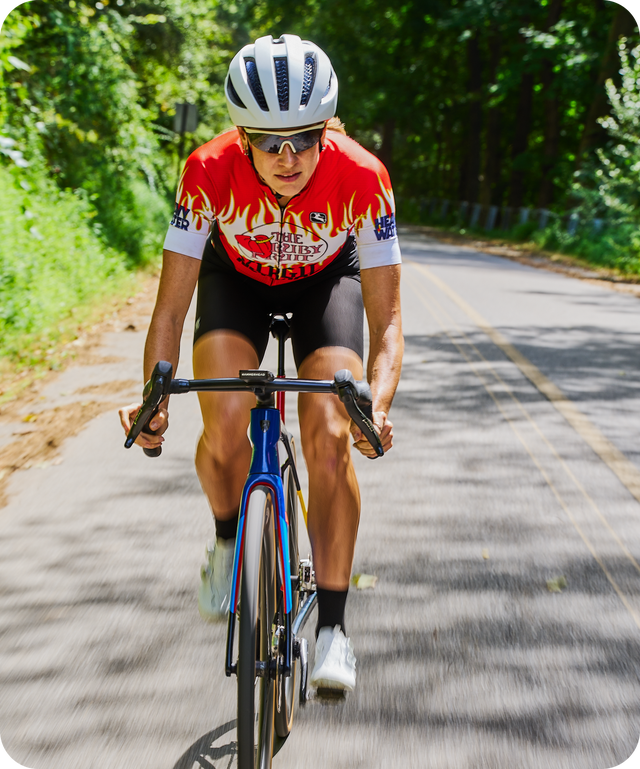
This holistic program covers all the tips and tricks needed to improve your riding technique, master cadence, stack speed and endurance workouts, build strength off the bike, and fine‑tune gear in order to achieve the speed gains you dream about.
Master the Century

Watch as host Alison Tetrick takes you through everything you need to know to ride your first (or fastest) century. Along with other cycling experts, she explains how to find the best gear, build endurance, fuel your body during the ride, and much more.
Ride Strong at 50+
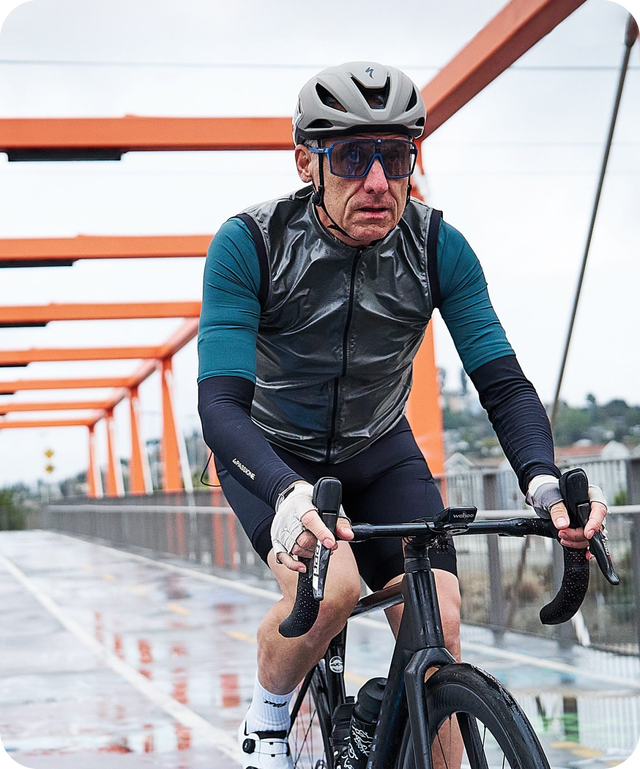
Cycling is the best way to stay fit as you age. With the help of host Peter Abraham and other experts, you’ll learn everything you need to get started and stay riding into your golden years, including choosing a bike, finding a plan, and optimizing recovery.
Perfect Your Bike Fit
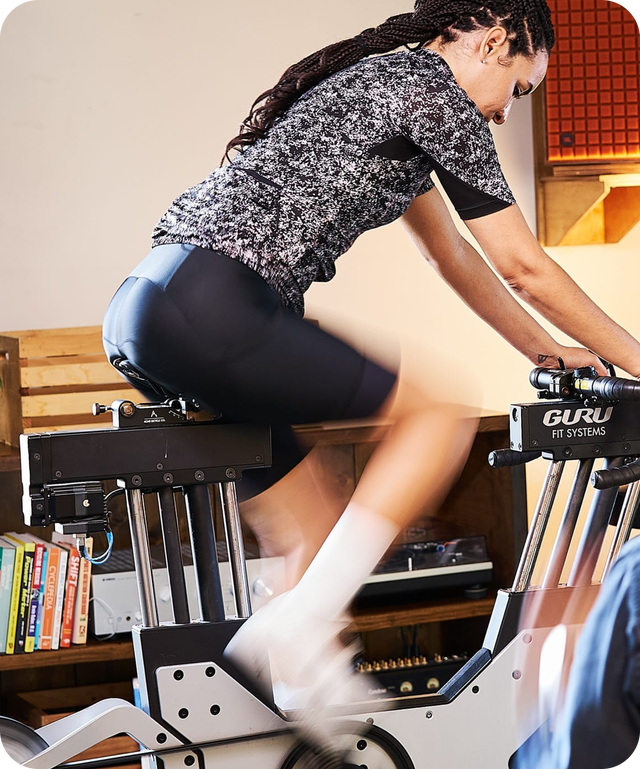
Whether you’re constantly feeling aches or you want to maximize your performance gains, you need the right bike fit. With this guide, host Jenna Foley and certified bike fitter Jonathan Blyer walk you through the process and offer up DIY tips.

As Deputy Editor, Tara Seplavy leads Bicycling’s product test team; after having previously led product development and sourcing for multiple bike brands, run World Championship winning mountain bike teams, wrenched at renowned bicycle shops in Brooklyn, raced everything from criteriums to downhill, and ridden bikes on six different continents (landing herself in hospital emergency rooms in four countries and counting). Based in Easton, Pennsylvania, Tara spends tons of time on the road and trail testing products. A familiar face at cyclocross races, crits, and bike parks in the Mid Atlantic and New England, on weekends she can often be found racing for the New York City-based CRCA/KruisCX team. When not riding a bike, or talking about them, Tara listens to a lot of ska, punk, and emo music, and consumes too much social media.

Bobby is part of the Bicycling Test Team and brings with him over a decade of professional racing experience, including 3 Olympic Team berths. Prior to joining Bicycling, he raced professionally on the road and track for over ten years and dabbled in cyclo-cross and cross-country mountain bike racing as a junior. His resume includes a bronze medal at the 2015 Track Cycling World Championships, three trips to the Olympic Games, Pan American titles, and dozens of National titles. In his spare time between testing bikes and continuing to race at a regional level, he can be found enjoying the quieter side of life and cheap beer on the farm he shares with his wife and their 2 dogs, 3 cats, and 14 chickens.

A gear editor for his entire career, Matt’s journey to becoming a leading cycling tech journalist started in 1995, and he’s been at it ever since; likely riding more cycling equipment than anyone on the planet along the way. Previous to his time with Bicycling, Matt worked in bike shops as a service manager, mechanic, and sales person. Based in Durango, Colorado, he enjoys riding and testing any and all kinds of bikes, so you’re just as likely to see him on a road bike dressed in Lycra at a Tuesday night worlds ride as you are to find him dressed in a full face helmet and pads riding a bike park on an enduro bike. He doesn’t race often, but he’s game for anything; having entered road races, criteriums, trials competitions, dual slalom, downhill races, enduros, stage races, short track, time trials, and gran fondos. Next up on his to-do list: a multi day bikepacking trip, and an e-bike race.