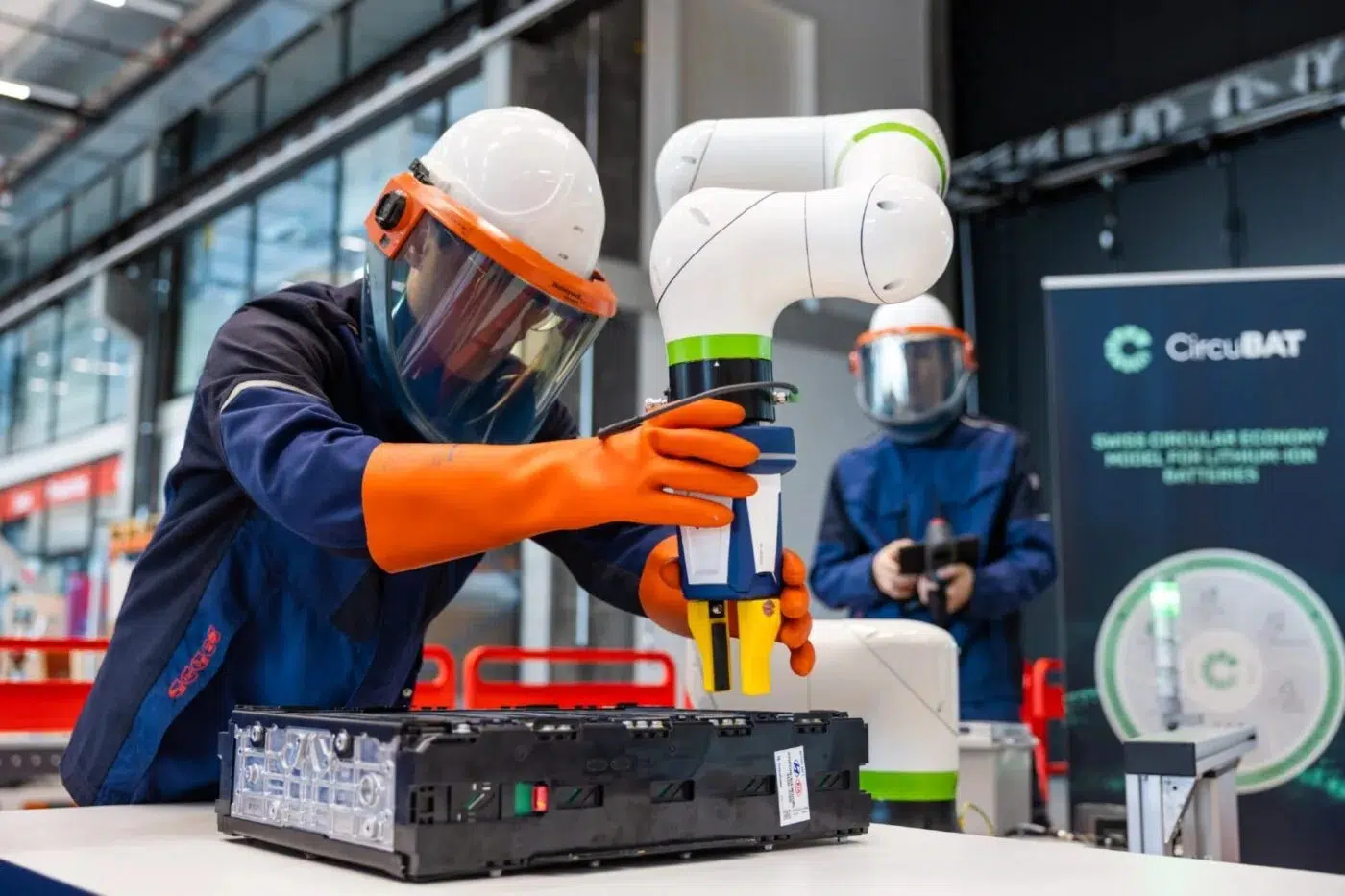
A robotic recycling system developed in Switzerland aims to transform waste management of electric car batteries. By automating their disassembly and classification, it facilitates their reuse in new environments.
This innovation, the result of four years of work by a consortium led by the Bern University of Applied Sciences, represents a key advancement towards the circular economy in electric mobility.
The CircuBAT Project: International Collaboration
The project, named CircuBAT, brought together seven research institutions and 24 companies to tackle one of the biggest challenges of the energy transition: the efficient and safe recycling of lithium-ion batteries used in electric vehicles.
The robotic system, installed at the Swiss Battery Technology Center (SBTC) in Biel/Bienne, automates the disassembly and classification process, which until now required a lot of labor and posed safety risks. Thanks to the precision of robotics, the system separates battery modules and recovers valuable materials with minimal human intervention.
Benefits of Automation
Automation reduces occupational risks, increases efficiency, and improves the quality of recovered materials. According to researchers, the amount of electric car battery waste could increase from 500,000 tons in 2019 to eight million tons in 2040, highlighting the urgency for scalable and sustainable solutions.
The new system allows for the recovery of high-quality raw materials, reducing the need to extract new resources and contributing to the reduction of hazardous waste.
 The CircuBAT project boosts the circular economy and material reuse in sustainable mobility.
Second Life for Batteries
One of the most notable aspects of the project is the possibility of giving a second life to batteries removed from electric vehicles. The Swiss consortium has developed a Battery Expert System capable of analyzing the aging of thousands of cells, identifying which ones can be repaired or reused.
In this way, many batteries that are no longer suitable for automotive use can become stationary energy storage systems, useful as backup for buildings or renewable energy grids.
Additional Technical Innovations
In addition to automation and reuse, the CircuBAT project introduced technical improvements such as:
New electrode coatings, which reduce energy consumption and production costs.
Integration of secondary materials in the manufacture of new batteries.
A Swiss circular economy model for lithium batteries, which will allow estimating future volumes available for the second-life market.
These innovations reinforce the circular economy model and decrease dependence on newly extracted raw materials.
Presentation at CircuBAT2025
The project’s results were presented at the CircuBAT2025 conference, on November 13 and 14 at the BERNEXPO Foyer. The event brings together experts from science, politics, and society to discuss the impact of these solutions on the energy transition and sustainable mobility.
With the implementation of systems like the one developed in Switzerland, the industry is moving towards a closed battery cycle, where globally distributed recycling stations could ensure the efficient reuse of key components for the electric mobility of the future.
The CircuBAT project demonstrates that technological innovation and international collaboration are essential to face the challenges of the energy transition, ensuring a more sustainable and resilient future.