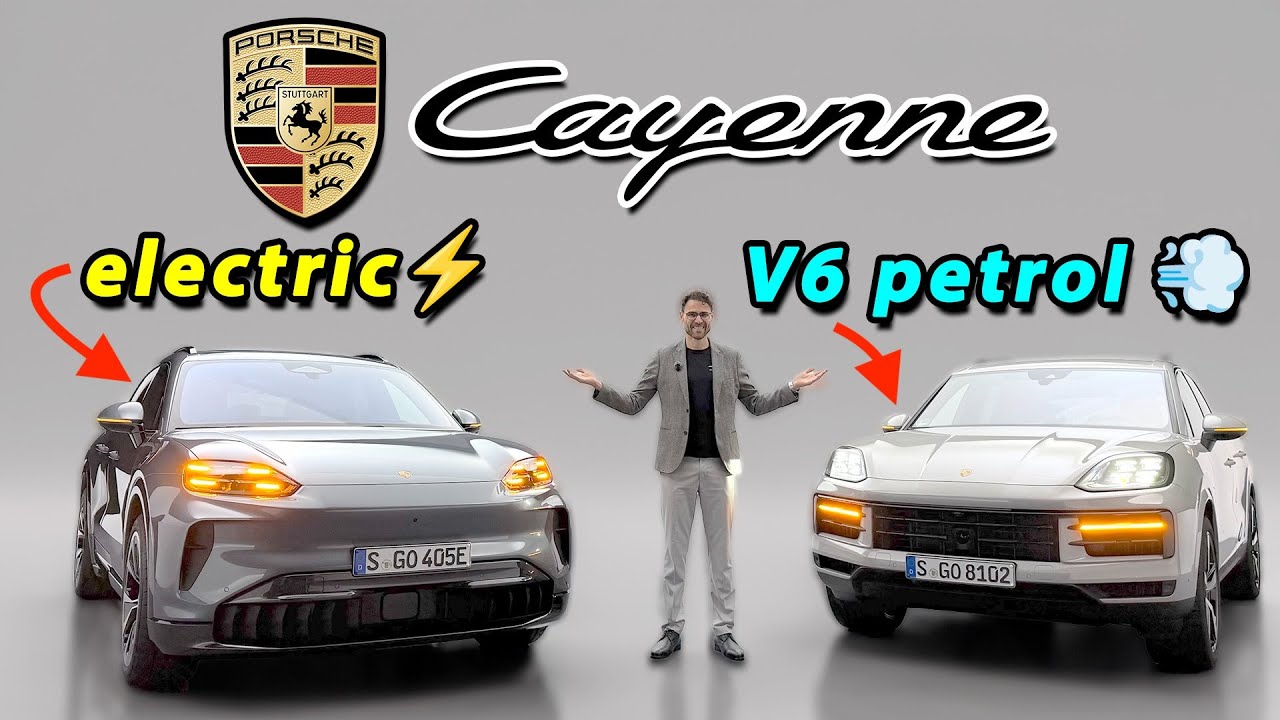
Porsche Cayenne V6 vs EV comparison REVIEW – petrol vs electric who will prevail?
The super exciting internal Cayenne
comparison, the all-new Porsche Cayenne electric versus the, so far and still,
existing Porsche Cayenne combustion engine, this one here, the base model V6,
against the base model electric. What are the differences in exterior and
interior and their technology? And you also tell us in the comments,
which one is your favorite, just from the initial reaction. And then after you’ve watched the whole
review, then tell me again if you would stick with this or with this version. This will be super exciting here with
Thomas Autogefühl in 4K, full screen, full length. Let’s go, starting with the all-new one,
the electric, which is more streamlined, so to speak, aerodynamically optimized,
CD value at 0.25. Whereas here with the combustion engine
model, we were at 0.35, so massive difference. CD value, of course, when it’s higher,
it’s worse in this case. But you can also see it just visually,
the classic Cayenne SUV ICE model here, like really high, big stance on the road,
typical, very strong SUV styling in chalk gray here, by the way, from the color. Lamp logic is kind of the same. You get Matrix LED optional. HD Matrix LED and the same also for the
electric model, which is now, you can see, lower, better for the aerodynamics. Not that strong from the stance. This typical Porsche four-dot design also,
like they have in all the other electric models, like in the Macan and in the
Taycan, for example. Yeah, and of course, a huge difference is
always then that in the front, you have the frunk and not the combustion
engine hood. We’ll also take a look at that. Very, very soon. So we already had discussions with Lea. Lea says like initially she likes the
electric front better. I am sometimes a little bit more
conservative as for design decisions. So I like the combustion engine from the
front design a little bit more because it has like this strong SUV sense. But maybe I’ll get used to the electric
version as well. But there are so many more technology
differences to come. Here with the EV version, you can either
swipe on the hood to open it or you can also press the key up here. And just one click. And it directly opens. There is no additional lock necessary. And you have 90 liters here of additional
front space. So you can very well use it not only for a
charging cable, but for even more things. Then, of course, closing it again on the
Porsche crest. There we go. Just want to be gentle. Gentle. And then with the combustion engine,
of course, we have the engine under the hood. Here we have the 3-liter V6 biturbo. With… Just over 350 horsepower. All-wheel drive, of course, as for all
Cayennes with the combustion engine. There we go. Large engine cover. And the acceleration figure here is 6
seconds 0 to 100 kilometers an hour. This one already has more than 400
horsepower. It always depends on the horsepower output
if you count in the launch control mode or in the constant horsepower output. In this one here, 4.8 seconds 0 to 100
kilometers an hour. So the electric version is already a
little bit quicker. Big illuminated Porsche lettering for the
rear of the electric version here. This all-new one. Light strip going all the way through. Horizontal stress indeed. And considering it’s very aerodynamic in
the front, this one looks actually a little bit more rectangular, I would say,
if we compare it to the combustion engine very soon. But let’s first focus on the side profile
and the differences there. Here, the electric version, you can see a
little bit lower. And once again, not that much of a classic
super upright SUV form. But still, you see Cayenne a little bit. Painted wheel arches here also. Vanadium Gray is the vehicle paint. Then you have a darker gray here for the
painted wheel arches. They are always painted, by the way. 22-inch wheels. You would start from 20-inch wheels. And we soon also have the comparing wheels
with the combustion engine model. The length here with the electric one is
4.99 meters. Or 196 inches. And also, frameless doors. This is a special thing, definitely. And now to the differences with the
combustion engine model. So this one here is, in the length,
6 centimeters or 2 inches shorter. However, the wheelbase difference is even
larger. So this one here, 13 centimeters or 5
inches shorter wheelbase. Or longer than with the electric version. Here we also have the optional 22-inch
wheels, by the way. In the nice retro style. I really love that styling. And the Chalk Gray color here. The same body color and also in the wheel
arches. And you can see this more classic upright
styling. Also a little bit higher. You can imagine that it’s not so good
against the wind, basically. But it conveys more classic SUV feeling,
so to speak. Yeah, and the wheelbase is the main
difference. And also that here the doors, they are
with frame. So this is, yeah, one of the main
differences. And both are… or will be available as the classic SUV
form, as we have it here. And also as the Coupé, the SUV Coupé. It’s there for the combustion engine
model. And will also come for the all-electric
model. And for the rear, since the facelift,
we also have this light strip that goes all the way through. So that’s more or less the same. Only that the Porsche lettering is not
illuminated. And the funny thing is that although the
electric version looks a little bit more roundish in the front, in the rear, the combustion engine looks a little bit more round,
egg-shaped, so to speak. And of course, the exhaust tips. Here in this case, the optional sports
exhaust. And on the technology side, they both
offer air suspension. And also rear axle steering. However, the electric version comes
standard with the air suspension. Whereas it’s an option with the combustion
engine model. And we’re soon also going to talk about
the prices. So it is the case that with the electric
one, you already have a little bit more tech already included from the base
version. Whereas range, charging and so on is of
course not the thing with the combustion engine. It is of course for the electric one. Battery at 108 kilowatt hours net. WLTP figures around 640 kilometers. We have to see what it is in the realistic
range. I would suppose maybe like 130,
140 kilometers an hour on the Autobahn. Maybe towards 500 kilometers, 300 miles. We’ll test it for you very soon. And recharging here. This is the electric charging flap. It actually goes here on the inside then. There we go. AC 11 or later 22 kilowatt charging. And DC charging is actually a 400 kilowatt
peak. And we have already tested it. And we could score less than 15 minutes
from 10 to 80 percent state of charge. And ours has even 8 to 80 percent in 14
minutes. 40 or something it was. So that’s a very impressive charging from
this 800-volt architecture. Now to the interior of the electric
version. First, completely new cockpit. Digital instruments. Curved optional passenger screen here. Also, really wide black panel behind it. In the base version, it would be a
completely black panel without the passenger display. And of course, the most obvious thing and
the difference, the central screen here. The curved way. So this is a new thing to experience. Especially when you have a menu like
this. And some say that they might feel a little
bit dizzy when looking at that. Here, for example, also at the map. You really — you know — look at my finger. And then you have this lower overlay there
here. So you have this mode selection, for
example, which also affects the ambient lighting. But you can also swipe away this lower
thing. And then you have the full view here. At this curved display. And the advantage is that the things in
the lower part are actually nearer to your finger. Also than here. You can also open and close the charging flaps
from here. Select the air suspension settings. A cool visualization. And the software is, you know, more
up-to-date. The hardware behind it is also way quicker
than with the combustion engine model. Yet at the same time, you still have the classic climate unit
with clicking sound. Metal knurling here. Volume jog also metal knurled and manual. So I really appreciate still to have that. I’m maybe not the biggest fan of this
curved screen. I don’t need to have it. But it also doesn’t disturb me that much. Let’s take it that way. Speed chime deactivation is in the upper
left corner, by the way. Very important for this EU chime law. Steering wheel is not too different. Classic Porsche. Also with real controls here. Turning knob also, then for the drive mode selection for
example. And the digital instruments. I have the speed right there in the center
where I need it. Here of course. And with the electric gauges. Big difference also with the middle
console. But quickly just to the headroom. Here with 1.89 meters (6’2”). Enough headroom left. This also with the real panoramic roof. I can actually really open that as well. And seating position. Seats. They’re not uncomfortable. And in the comfort seat, you can also get the animal-free interior, with a Pepita retro fabric, which looks quite cool. It’s even a little bit softer from the
seating surface. And then you also get the Racetex
microfiber steering wheel. So that would be my tip. First of all, go for the comfort seat. And then also for this Pepita retro
fabric. Middle console in here is a big
difference. Here you have this armrest. Slick. Then this one, you can already see there, it will slide away. Like this. And then this front part, also with a nice metal knurling, you slide open to the front. And then front. So the first cool thing is there you have
a new inductive charging pad. And if I put my smartphone there,
this is magnetic. And it automatically locks. So it stays in a good position that it
definitely charges inductively. And if you hear that, automatically the
ventilation is starting. It’s quite powerful. You don’t see the ventilation hole, but it’s there. You can hear it actually. Two USB-C chargers as well. And then there has been a lot of
discussion about these adaptive cup holders with fabric inserts. Interestingly, that they’re a little bit
adaptive. And they’re either in this lower position, or you can put them out basically, turn them around, and then put them here in this higher
position. There we go. Then they are a little better accessible. Higher. It always depends on if you put bottles in
there or coffee cups. This is more the coffee cup position,
so to speak. Some say that they are too low down there. And it’s not that practical. So, yeah. What’s your take? Definitely what’s the case is it’s a very
modern cockpit. Yet, at the same time, I’m happy we still
have the classic physical interface. And now the combustion engine model here. The Cayenne V6. Different interior. Maybe a little more old-school. The steering wheel is more or less the
same. You know, with the controls and so on. So, not much difference there. Instruments. Yeah, they’re a little bit wider with the
electric version maybe. But you see the speed there. That’s also not the biggest difference. Let’s take it that way. Here, more horizontal stress from this
screen. You don’t have the curved screen. And honestly, I maybe get along better
with that — with the straight one. But you can see that the software is way
slower. So, that’s much quicker with the new
version. Optional here again, also the passenger
screen. I like this classic grab handle here on
the middle part. And we also have the clicking sounds here. However, I gotta say now when I compare
it, that the new version is a little bit more ergonomic in how you reach the
things. Also, even the climate unit because it’s
more placed like here. Also, then where you place your phone is
like really deeply hidden in the top part there. It’s not much space. So, that’s maybe also a downside. Then here, the cup holders. To me, a little bit better with the
adaptive cup holder setup here. Well, the other one has the fabric
adaptive cup holders. Here, they’re a little bit more upright. However, you have to think here that in
the American version, this one here is locked. But in the European version, when you put
your arm here, sometimes it can happen that this one slides forward while
braking. You know, when, for example, you have two
arms here — one here, one here — and then you brake, and it could slide
forward. We had it sometimes in the Cayenne. So, with the lock in the American version,
it’s better. More space underneath here. A little bit more classic layout. So, you see that they haven’t, like,
you know, thrown the old things completely away. Like also the Sport Chrono Package and so
on. But the new one is a little bit more
modern. And I gotta say, it has pros and cons. I’m maybe not the biggest fan of the
curved screen, but it makes a huge difference when the software is way
quicker and also when the things are a little bit better oriented in the
ergonomic sense, gotta say that. And here, well, this one is the one
without the panoramic roof. So, it’s not the one-to-one comparison,
but also enough headroom here, of course. And the seating position is pretty much
the same from the seat, also the sport seat here. However, you still sit higher here. This is a more classic, higher SUV seating
position. Now, the rear of the electric version. First of all, here, windows — dual
laminations — available front and rear. You can see here, this is also the lowest
position of the rear window. And I can also show you here, what you can
also get is this electric sunshade for the rear. It’s pretty cool. A luxury option. Interesting how they also put this Lea
styling color here on the inside of the door here. No felt covering at the inside of the door
either. Some rubber pocket in the very back part. We also have electric seats here for the
rear. Front and back here, for example. And also, the inclination of the seat can
be changed. This is also how you can get to this cargo
position, for example. And the most important thing here is,
of course, legroom and headroom. And what’s the comparison to the
combustion engine? So we have a longer wheelbase here,
as you can see. Ample legroom, although I’m sitting as
a tall adult in the front. And this version with the panoramic
roof, still has some headroom left here with
1.89 meters (6’2”) to the ceiling right here. Yeah, and then once again, the electric
shade here. And yeah, it’s an upright seating position,
if I like, like this. Once again, here with the inclination
change, or more backward. Pretty stiff from the bolstering,
if you have the animal-skin surfaces and this single-seat setup here for the
seats. Let’s see how it’s in comparison to the
combustion engine. Now, the combustion engine in the rear. Yeah, not the frameless doors we have
here. Everything wrapped tightly. This is actually a better covering at the
inside of the door. I gotta say that. Then, seat control. You can also move them forward and
backward manually here, though. And the main difference is, of course,
now I want to see — the legroom is also good. So, no problem as for that. However, I gotta say, there’s a little bit
more legroom in the electric version, but it would not be the main game changer
to me. So not everything of the wheelbase somehow
translates into rear legroom. This is also still fine, also from the
headroom. So the comfort is, I’d say, more or less
the same — not the most crucial difference. And let’s check out the trunk. 708 liters in the cargo
position here for the Cayenne Electric. You can see here this top cover. You can move it forward or backward like this. Underneath, you have some more space,
also made for a charging cable, but you can also use the trunk. And the interesting thing is — cargo
position. What does it mean? It means that these seats here are in
the upright position, and you can also put them a little bit more forward. So this is what you could maximally do. Wow. That’s like… So you can see then the difference between
all the way back and all the way forward. But how does it look in the
combustion engine? And now something extraordinary here — the combustion engine model from the trunk,
or the boot. 770 liters in the cargo
position. So also, if you put the inclination all the
way upright. And here, I also put the bench forward and
the inclination upright. But the interesting thing is that width is
a little bit more than a meter, or about 40 inches with both. And also the length is about a meter, or
40 inches, with both. The main difference is, however —
and I still kind of wonder — this one has 10 liters less of capacity on paper,
but still, the height is better here. So this is where the electric version
ends — about 70 centimeters, or 28 inches. And this one is more than 30 inches, or
around 77 centimeters. So this is the height difference
between the electric and the combustion. And so if you need more height
in the trunk, then this is better. However, somehow, due to the form,
you don’t lose much in the electric version in terms of liter figures. Yeah, that’s a curious thing. What about the price as well? It’s actually fairly simple — and fairly
simply expensive. Because both versions here, in their base
models — the V6 Cayenne combustion engine and the Cayenne Electric — start right over 100,000
euros. And just a couple of thousand euros’
difference. You know… It depends also on the market,
but it’s more or less the same. We have to see how it is in the leasing
rates, of course, and also as for the residual values. And also, if you spec these vehicles,
you can easily add some 50,000 euros, for example, to this one. As it stands here right now — about 155,000
euros. But you can also easily add a lot of
extras to the Electric version, of course. However, some more base equipment is
already included there. And if you now think about what you get as
base equipment and also how quick the acceleration is, then you could say maybe
the Electric is a better price-performance ratio. However, as past experience shows,
the residual values so far have been better with the combustion engine models.
So, as I said, we have to see about all the leasing rates and so on in the
different markets. As for the exterior design, I have to say
I like the combustion engine model a little bit more from the front. However, I think the rear of the Electric
one is a little bit cooler. Definitely the SUV-building style here. This classic one — more upright,
stronger stance. And there you can see the aerodynamic
focus of the Electric vehicle. The interior — you know, on the one hand,
some things are similar. A little bit more legroom here with the
Electric version. Of course, the all-new cockpit with this
curved screen there. It looks more modern, definitely. What I find quite cool: that with the new one, you have the
all-animal-free interior — at least one offering. Only one offering there, sadly. But at least you have it now with the
Electric one. So that’s a good step forward. And the trunk — I think both are still well
usable. Since we have already driven both, I mean, they both drive fantastically,
definitely. But when driving the Electric one,
you have to say — if you don’t think about the combustion engine sound — I gotta say that the Electric one maybe even
drives a little bit better. Even a little bit sportier, you know,
in how it handles. And that was, to me, a very astonishing
thing to feel. And yeah, the Electric one has more
performance boost. At the end of the day, it’s also about
personal preference and about, I think, mostly the charging infrastructure. If you already have that — because the
range with that large battery will also be somewhat fine. And this also recharges extremely quickly. So there’s not so much difference
anymore between charging at the electric charging station and just refueling fuel at
the gas station. So, very interesting to see all the
similarities, but also the differences. The question is — which one would you go
for? Which one would I go for? I’m a little bit — yeah — not a hundred
percent, you know, decided yet. Maybe the thing is really that I like this
one so much more from the front side. But then again, this one here with the
possible animal-free layout is very convincing. And, for example, also the taxation in
Germany would be a big benefit here if I would go for the Electric one. So actually, I would save a lot of
money if I picked the Electric version. And although I’m quite a fan of the
combustion engine model still, which will still be sold in all markets as
well — maybe some markets where they only offer
Electric ones because they have, you know, crazy taxation on combustion engines
or something — but all the main markets, let’s take it that way. I think although I’m still leaning a
little bit emotionally toward the combustion engine model, after all, with the animal-free interior
and the taxation benefits I have, I would probably lean to try out the
Electric one. So that’s my verdict here for today. What’s yours? Tell me in the comments which one you
like better. And also check out more Cayenne content
here now on Autogefühl.
This is our in-depth comparison review Porsche Cayenne V6 ICE vs Porsche Cayenne Electric. We’re taking a look at Exterior, Interior and technology.
00:00 Porsche Cayenne EV vs ICE
02:16 Frunk for the electric
02:44 V6 Biturbo comparison
03:26 Rear and side comparison
05:58 Technology
06:21 Battery and charging EV
07:20 Interior electric
11:17 Interior V6 petrol
13:43 Rear EV version
15:05 Rear ICE version
15:50 Trunk / boot comparison
17:34 Price
18:47 Which one would I take?
Data & facts:
Porsche Cayenne (Turbo) Electric
SUV or Coupe
Matrix LED, optional HD
Length 4,99 m 196”
EV vs ICE: Length difference 6 cm 2“ longer, but even 13 cm 5“ wheelbase difference
Standard air suspension
Optional Rear-axle steering up to 5° below 100 km/h 60 mph, reducing turning circle by a meter to 11,6 m
Optional Porsche Active Ride suspension for Turbo
Optional PCCB for Turbo
Towing 3,5 t
cW 0,25 (Cayenne ICE 0,35)
108 kWh battery net (113 kWh gross)
800V charging
11 kW or later 22 kW AC charging
11 kW inductive charging optional, efficiency up to 90 %
400 kW DC charging
10-80 % in less than 16 Min
Our test result: 8-80 % in under 15 Min
600 kW recuperation, 97 % of all braking actions are done with recuperation
WLTP 640 km (620 km Turbo), real-world range probably around 500 km / 300 miles on motorway with decent speed
Cayenne Electric:
325 kw 442 hp and 835 Nm in launch control maximum power, normal power 408 hp
0-100 km/h 4,8 s (EV base 1,2 s faster than ICE base)
Vmax 230 km/h 140 mph
Cayenne Turbo Eletric:
850 kW 1.156 hp and 1500 Nm in launch control maximum power, boost mode button +176 hp for 10 s, normal power 857 hp
0-100 km/h 2,5 s, 0-200 km/h in 7,4 s
Vmax 260 km/h 160 mph
Usually rear motor is used, when needed also the front motor
Turbo also with rear torque vectoring
14,25“ digital instruments
Curved „Flow“ display infotainment – Largest display ever in a Porsche
Optional 15“ (14,9“) passenger display
HUD with augmented reality
Comfort seats with optional vibration massage and cooling
Optional sports seats
Surface heating on middle console and inside of the doors
Animal free Pepita retro fabric/Race-Tex mix interior available for comfort seat, then also microfiber Race tex steering wheel
Optional panoramic roof that can be opened and dimmed
Boot 550 l without cargo, 780 l in cargo position – 1.590 l
Price entry model 105.200 Euro (3.700 Euro more than base model)
Turbo 165.500 Euro
Porsche wireless charging:
Up to 11 kW
Efficiency up to 90 %
Active cooling
Charging pad 50 kg and 1,17 m 46“ long
Car lowers automatically when it parks over the pad
Motion sensor shuts down the plate when living beings or metal is being detected
Price 2.000 Euro vehicle, 5.000 Euro for the inductive plate, plus electrician
Porsche Cayenne V6 (ICE)
Matrix LED optional HD
Length 4,93 m 194”
20“ wheels
Optional air suspension and rear-axle steering
3,0 l V6 biturbo 353 hp
0-100 kmh 6 s
0-200 kmh 24 s
12,6“ instruments
12,3“ infotainment
10,9“ passenger optional
770 l trunk in cargo
Price from 101.500 Euro, fully specced 155.000 Euro
#porsche #porschecayenne
►Subscribe here: https://www.youtube.com/user/autogefuehl?sub_confirmation=1
►Autogefühl Deutsch (German): https://youtube.com/@AutogefuehlDeutsch?sub_confirmation=1
►Also subscribe to our YouTube shorts channel: https://www.youtube.com/@thomasautogefuhl?sub_confirmation=1
►Follow us on Facebook / Instagram / TikTok @autogefuehl
►Sustainability in the automotive industry documentary: https://youtu.be/-8gNXlRGngA?si=bCdeJZORRHNcVmV2
Transparency note: Autogefühl videos are independent and free from editorial influence on opinion and rating. Since there can be sponsored messages or product integration from partners, which are clearly and transparently pointed out, for legal reasons the videos are marked with the YouTube standard info message that a video contains advertising or product placements.
WATCH OUT FOR SPAM/FAKE ACCOUNTS. Across YouTube/Whatsapp/Telegram etc., you’ll find fake accounts taking the identity of original channels or people claiming to work on the behalf of original channels, they sometimes even use the same profile pic, similar names and include a telephone number in the name or their comments, trying to get you to message them on Whatsapp or Telegram. DO NOT MESSAGE THEM, they are trying to get your personal details, bank accounts etc. and in the end, they will ask for money or they will misuse your bank account. They promise you giveaways, prices, payment etc. Do not fall for these cheap tricks and PLEASE HELP everyone and MARK THEIR MESSAGES and their whole accounts/channels as Spam and/or report their telephone numbers/Whatsapp to the police. We from Autogefuehl will never ask for your bank details. Check out our original channel marked with the verified badge.