
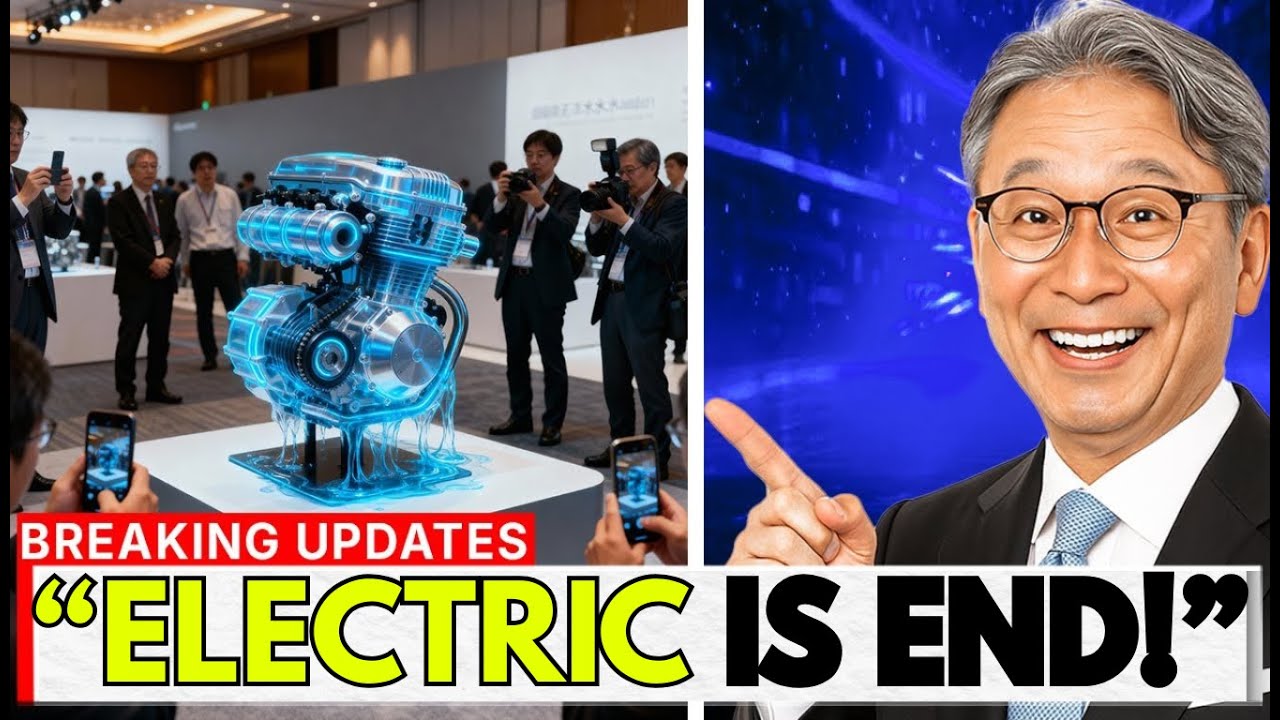
Honda CEO Says NEW Water Engine Will END Electric Motorcycles!
Honda just walked onto the global stage and dropped a bomb the electric motorcycle world didn’t see coming. Their CEO confirmed a new water assisted combustion platform. And he said it with the confidence of a man who believes this tech can end the EV push. The industry’s been ramming down our throats. This isn’t some magical water powered bike. It’s a mechanical system built to challenge batterdriven machines where they’re weakest. And if Honda’s right, electric motorcycles might not be the future everyone promised you. Stick with me because by the end of this video, you’ll know exactly what this means for your next bike, your wallet, and the road ahead. The CEO bombshell. The announcement caught the entire industry offg guard because it arrived without warning or rumor. During a late afternoon briefing streamed from Honda’s main development center, the company’s chief executive stepped into view and delivered a statement that immediately rewrote expectations for the next decade of motorcycle engineering. He revealed the existence of a new power platform called the V3R900E compressor water engine presented not as an experiment or concept but as an active program aimed at production. There was no hesitation in his tone. No corporate language meant to soften the edges. He said plainly that this engine was built to outperform the electric motorcycles dominating today’s headlines and planning boards. The reaction inside the room shifted fast. Reporters stopped typing mid-sentence because they were not expecting anything close to this kind of development. Some watched the executive closely, trying to determine whether the statement was symbolic or literal. Others exchanged quiet glances because the implications were enormous. With a single announcement, Honda had stepped away from the beaten path and pointed toward a direction nobody else seemed prepared to take. This was not a pledge for future battery research or a promise of expanded charging strategy. It was something different, something bolder, and something designed to change long-term expectations. When a company of Honda’s size makes such a claim in front of the entire world, the motorcycle industry has no choice but to listen, even if the message lands like a shockwave. But right after the announcement settled, a new question rose to the surface. What exactly is a water engine? What water engine really means? The phrase water engine created immediate confusion because it sounded like something pulled from rumor boards or science fiction channels rather than a real engineering project. As the briefing continued, it became clear that Honda was choosing its language carefully, but the public still reacted with uncertainty. People wanted to understand whether the term meant water as an active fuel, a catalyst, or an integrated part of a broader combustion cycle. Without context, the announcement opened the door to wild assumptions and seasoned writers do not take well to vague terminology. This is why clarity matters. The moment someone hears the words water engine, their mind might jump to impossible scenarios involving liquid filled tanks and magical reactions. Others might think it refers to steam era designs or fringe experiments without practical value. Honda’s use of the phrase demanded explanation because the motorcycle world has been around long enough to recognize when a new term risks being misunderstood. When large companies speak in unfamiliar ways, riders naturally question whether marketing departments are steering the message. Yet, despite the confusion, the statement was intentional. Honda wanted the public to understand that the core concept revolves around a controlled system that relies on water in a structured, industrially viable role. It is neither fantasy nor an internet myth, but a deliberate engineering path chosen for long-term development. The label may sound unusual, but the intent behind it is grounded in practical science, not imagination. Still, the timing of the announcement made many wonder why Honda chose this moment to reveal such a direction. If you want straight answers without the corporate filter, make sure you like this video, subscribe to the channel, and share your thoughts below. Your perspective keeps conversations like this honest, and it helps push out the truth riders deserve to hear. The one EV weakness that opened the door. The moment Honda revealed its new engine direction, many analysts noticed something familiar behind the timing. For years, discussions around electric motorcycles have celebrated clean operation and impressive engineering. Yet, a deeper issue has consistently followed the technology. The challenge is not the motors, the controllers, or the electronics. It is the long complicated chain of rare metal extraction required for large-scale battery production. Why Honda is rejecting the EV stampede? Honda’s decision to pursue a different path did not emerge from a moment of impulse. Inside large engineering firms, major shifts happen only when leadership believes the current direction no longer represents the future they want to build. For years, nearly every major manufacturer has been racing toward full electrification. following government policies, investor expectations, and competing corporate narratives. But Honda’s leadership appears to see something deeper, something rooted in long-term identity rather than short-term trends. The company’s decision suggests a belief that motorcycles should retain a form of mechanical character, even as new forms of clean technology evolve. Not every rider wants a silent machine governed by battery limits and software schedules. Some believe the essence of motorcycleycling involves a power source with personality, rhythm, and a sense of mechanical depth. By announcing the V3 R900 Ecompressor water engine, Honda signaled its intention to preserve that philosophy while still aiming for future ready efficiency. There is also an internal strategic layer. Companies rarely choose unconventional routes unless they see an opportunity others have missed. Honda may be responding to market signals hidden beneath surface level enthusiasm for electrification. Long-term engineers understand that innovation does not always follow the mainstream path. And Honda’s choice reflects a desire to protect a legacy centered on engineered motion rather than battery dependency. This move is not rebellion for its own sake. It is a purposeful step toward a future defined on Honda’s terms. And the next step is understanding how this new engine actually works behind the scenes.
Honda CEO Says NEW Water Engine Will END Electric Motorcycles!
Honda just walked onto the global stage and dropped a bomb the electric motorcycle world didn’t see coming. Their CEO confirmed a new water-assisted combustion platform and he said it with the confidence of a man who believes this tech can end the EV push the industry’s been ramming down our throats. This isn’t some magical “water-powered bike.” It’s a mechanical system built to challenge battery-driven machines where they’re weakest. And if Honda’s right, electric motorcycles might not be the future everyone promised you.
Stick with me, because by the end of this video, you’ll know exactly what this means for your next bike, your wallet, and the road ahead…