
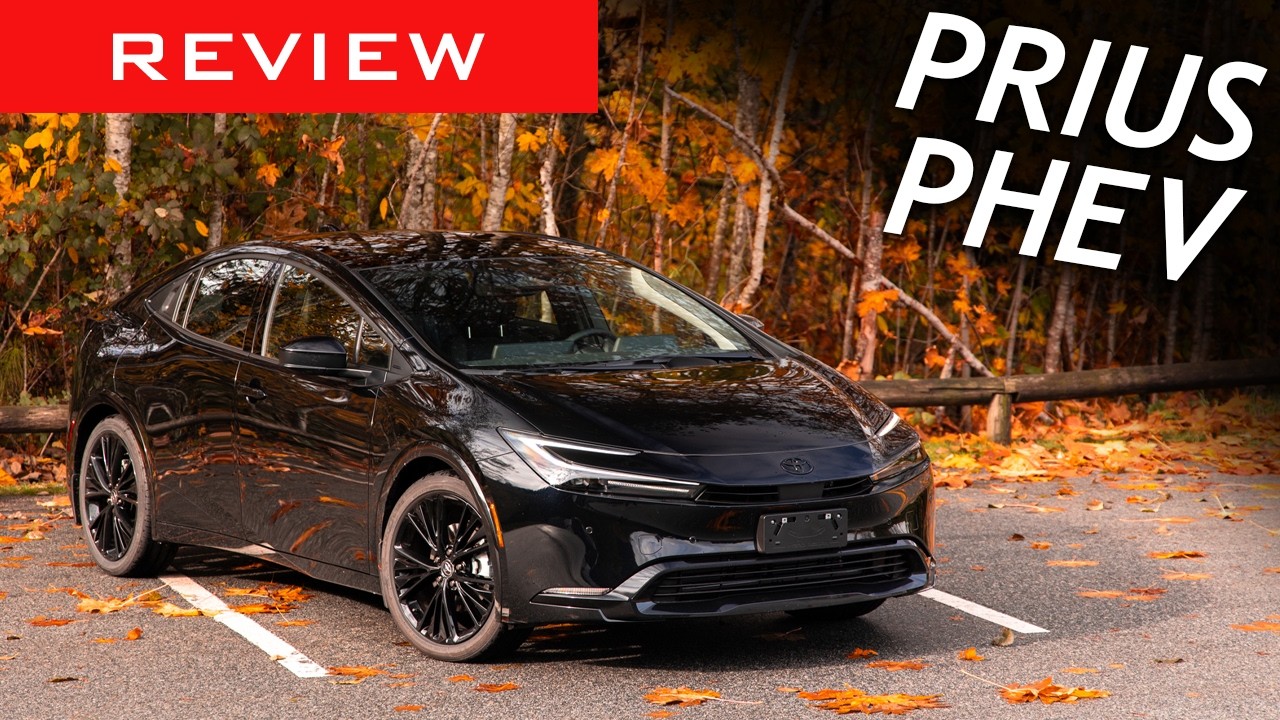
2026 Toyota Prius PHEV Review in 4K / The plug-in hybrid that won’t quit
There are quite a few plug-in
hybrid vehicles out on the market, but most of them
are crossover SUVs. If you want a car PHEV, then the
2026 Toyota Prius is your only option, unless you go
for the luxury brands. But cars like the Honda Clarity and the original Honda Ionic plug-in
hybrid are gone. So how is it that the Toyota Prius survived
where the others have disappeared? Let’s go for a drive and find out. So the first thing you should
know about this version of the Prius is that
it’s no longer called the Prime. It’s now just called
the Prius PHEV. I guess for people that are
coming into Toyota, don’t really know what Prime
means, whereas PHEV, everybody knows what it means.
Under the hood is a 2-liter naturally aspirated four-cylinder engine which is aided by a few
electric motors. Total output is 220 horsepower.
As for the torque, Toyota doesn’t really like to
say how much torque the overall system produces, but
the engine torque is 139 pound-feet. This is more
than enough power in everyday city or highway
driving. Sure, it’s not going to make the Prius
PHEV blisteringly fast because zero to 100 kilometers
an hour takes just under seven seconds, but it
doesn’t feel like as though it’s struggling to go
up a hill or merge onto a highway or just set off
from a stop. Being a PHEV, you can’t switch between hybrid driving and full electric driving.
In hybrid driving, it’s just like every other Toyota
hybrid vehicle. The engine provides power in
conjunction with the electric motors to get you up
to speed. Then once you are up to speed and you
let off the throttle just a little bit, the engine
shuts off and the electric motors keep you at
that speed for brief periods. If you switch it
to EV mode, then the engine will never turn on
even if you go full throttle, but the electric
motor does feel like as though it has enough power
to again get you up to speed from a stop or merge
onto a highway. Of course, because the engine
isn’t running, the acceleration won’t be as fast as when the engine is also helping,
but again, even so, it’s more than enough power.
When you are in that EV mode, you’ll have up to 72
kilometers of driving range, at least for the base
SE trim. The higher XSE trim only has about 64
kilometers of driving range, at least that’s what
it’s rated for, and I think it’s probably because
of the bigger wheels and tires. During my time with this XSE Nightshade Edition, I managed to
get about 70 kilometers of driving range just using electricity,
and that is with climate control running.
Of course, for you, it might be different. It all
depends on climate control usage, your driving
style, whether you go up a lot of hills or not,
so there are quite a few number of factors. As for
the fuel economy, if you decide to drive it
in the hybrid mode or leave it with a completely
depleted battery, then you’ll be getting about
4.6 liters per 100 kilometers in a city and
5 liters per 100 kilometers on a highway. Again,
that’s for this XSE trim. The SE trim is slightly
better. However, because it is a plug-in hybrid,
the actual fuel economy really depends on how
often you can plug it in. For example, right now
I’m averaging 2.7 liters per 100 kilometers, and
I’ve driven this car for about 300 kilometers. The
pre-SPH EV doesn’t have a one-pedal mode. However,
you can switch the gear selector into B, and
then you’ll get a strong regen braking mode. You
can also put the gear selector in B while the car
is in the hybrid mode. However, from what I’ve
noticed, the engine doesn’t really turn off quite
as often as if you would just leave it in regular
D. Recharging the 13.6 kilowatt hour battery
takes approximately 4 hours from a level 2 charger
and about 11 hours from a regular wall socket.
As for the driving dynamics, the Prius was never
designed to be a fun car on a twisty road.
But with that being said, this new generation
Prius handles quite well around corners. Steering
is sharp, and the car doesn’t give you the feeling
that it’s going through a corner at 45 degrees. There are definitely more fun to drive mainstream
cars out there, but this Toyota Prius is surprising
and a huge improvement compared to the
previous generation. Unlike the regular hybrid Prius, this PHEV
version does not have all-wheel drive. It’s front-wheel drive only. The ride of the 2026 Toyota Prius
PHEV is not too bad. Most bumps are well absorbed by the suspension
but when you drive on rougher roads, it does get a little bit jarring. For me, these seats are plenty comfortable.
They have just enough support and I didn’t feel any back pain
on longer commutes to and from work. As for cabin noises, obviously
when the engine is not running, you don’t hear
any engine noises, but when the engine is running,
it gets very buzzy every time that you
put your foot down. The rest of the time, it’s
mostly tire noise that you hear and it can get
a little bit loud, especially on highways. In
the front, taller adults like me at 6 foot 4
have enough space. Legroom is more than plentiful
and headroom is good so long as the seat is lowered.
Unfortunately, this new generation Prius
has a lower roofline than the previous one which
does impede on the interior headroom. In the back
seats, this lack of head space is much more noticeable,
but at least legroom is decent with my knees
gently brushing up against the back of the
front seat behind my tall driving position. The
trunk accommodates 575 liters of space. That is
a significant drop compared to the previous generation’s 776 liters. There is some small item
storage underneath the trunk floor and the rear
seats can fold down 6040. It does not have a spare
wheel and instead it does use a tire repair kit. The 2026 Toyota Prius PHEV starts at
$40,050 Canadian for the SE trim. The XSE starts at $44,785
Canadian with the top spec XSE premium costing
$48,535 Canadian. The one that I drove was the XSE with the Nightshade package which cost an
additional $895 Canadian. The 2026 Prius is packed with
more technology than ever before. The usual
features are still present like heated front and rear seats, heated steering wheel, automatic
climate control, wireless phone charging pad,
keyless entry with push button start, power driver
seat with memory, and so on. But it now has a lot of extra convenience features such as
ventilated front seats, a dual pane sunroof, surround
view cameras, a large infotainment touch screen,
a power liftgate, and parking assist. But one
of the most polarizing changes to the interior of the
Prius is the driver instrumentation cluster. It’s
positioned far away from the steering wheel and
closer to the bottom of the windshield. This allows
the display to be closer to the driver’s field
of vision when looking ahead. However, the big problem
is that no matter how you adjust the steering wheel,
it either blocks a portion of the display or
the steering wheel is touching your legs. Worse yet,
if you’re the type that likes to hold the steering
wheel at the 12 position, your hand will
completely block the driver instrumentation screen.
The rest of the interior however is a nice
update over the last generation. The climate
controls are still physical, the touchscreen is
large but not over the top, and there’s even
a strip of ambient lighting incorporated into the
dash. My only gripe is with the piano black plastic
that surrounds the center console controls
and the cup holders. As you know, this material attracts dust, scratches, fingerprints, and so on.
So it’s not going to look great after a long period
of time. Visibility around the car is good. Blind
zones are not too big and the view out the back
is decent. A rear camera mirror is available
but only on the XSE premium trim. In the end,
this is no longer your parents Prius anymore.
It actually looks like something that you would
want to own. It’s also the most powerful Prius
to date but without sacrificing fuel economy and
it’s available with convenience features that one
would want in a city car. So why is it one of
the last car PHEVs that’s available on the market,
at least for mainstream cars? Well firstly, it’s a
Toyota so it’s going to last a very long time. But
I suspect the biggest reason is because other
auto manufacturers are placing their bets on
EVs whereas Toyota is placing all of their money
on hybrids. But either way, this is the best
that survived out of the ones that were available
in the past. And if you would like to know
more about this 2026 Toyota Prius PHEV, I
have a more detailed written review of it over on
my website. You can find that link in the video
description or click on the pop-up banner right up
here. And as always, I will see you in the next car, truck, or most likely it’ll be an SUV
next time. Anyway, thank you for watching. I hope you enjoyed
the video and see you in the next one.
There are a number of plug-in hybrid SUVs. But there are very car PHEVs, unless you move up to the luxury brands. The Honda Clarity and original Hyundai Ioniq are gone. The 2026 Toyota Prius PHEV is the only one left. So, why did it survive where the others have failed?
The Toyota Prius is no longer called the Prime. This version is now referred to as the PHEV. I guess new customers to Toyota don’t know what Prime means?!
Anyway, under the hood is the same 2.0L naturally aspirated 4-cylinder engine as the standard hybrid version of the Prius. But in the PHEV version, it is aided by a more powerful electric motor to provide a combined output of 220 hp (164 kW). Toyota doesn’t say the combined torque but the engine torque is 139 lb-ft (188 Nm).
The 2026 Toyota Prius PHEV has a 13.6 kWh battery pack which allows it to drive for up to 72 km (45 Miles) while using only electricity. The top spec XSE trim has a slightly lower estimated range of 64 km (40 Miles) which I can only assume is because of the larger wheels. I managed to squeeze 70 km (43 Miles) out of a full charge with climate control running at all times and an observed efficiency of 18.5 kWh/100km (3.36 Miles/kWh).
If you drive the 2026 Prius PHEV with a depleted battery or in the HEV mode, then it is rated to return up to 4.4 L/100km (53.4 MPG) in a city and 4.6 L/100km (51.1 MPG) on a highway. These numbers are slightly higher for the XSE trim. While in this hybrid mode, I averaged around 4.3 L/100km (54.7 MPG). With constant charging, my overall fuel economy figure for the week with the car was 2.7 L/100km (87.1 MPG).
The 2026 Toyota Prius PHEV starts at $40,050 CAD ($33,775 USD) for the SE trim. The XSE starts at $44,785 CAD ($37,025 USD) with the XSE Premium costing $48,535 CAD ($40,470 USD). The one I got to drive was the XSE with the Nightshade package which cost an additional $895 CAD ($770 USD).
—–
➡️➡️ 𝗗𝗲𝘁𝗮𝗶𝗹𝗲𝗱 𝗧𝗼𝘆𝗼𝘁𝗮 𝗣𝗿𝗶𝘂𝘀 𝗣𝗛𝗘𝗩 𝗥𝗲𝘃𝗶𝗲𝘄: https://mgreviews.com/review-2026-toyota-prius-phev/
👉👉 𝗦𝘂𝗯𝘀𝗰𝗿𝗶𝗯𝗲: https://www.youtube.com/c/MGReviewsBlog
—–
𝗩𝗶𝗱𝗲𝗼 𝗻𝗮𝘃𝗶𝗴𝗮𝘁𝗶𝗼𝗻
0:00 Intro – Don’t Forget to Subscribe 🙂
1:18 Performance – How does the Prius PHEV drive?
5:14 Comfort – How spacious is the Toyota Prius?
6:45 Odds and Ends – How much does the Prius PHEV cost?
8:53 Conclusion – Why is it the last of its kind?
—–
#Toyota #Prius #PHEV