November 21, 2025
By Karan Singh
For the past decade, Tesla’s strategy has been defined by a simple, brutal, first-principles logic. If a critical component’s supply chain is a bottleneck, you must build the machine that builds the machine.
We’ve seen this tactic with them previously, with batteries at Giga Nevada, cells at the Kato Road facility at Fremont, and now the new Texas Lithium Refinery, which is coming soon. At the 2025 Shareholder Meeting, Elon Musk confirmed that Tesla has identified its next great bottleneck, and it may be the most challenging one yet: manufacturing computer chips.
AI5 and xAI
With the advent of the AI5 chip, Tesla’s demand for compute is now effectively infinite. This “monster” chip is a generational leap over AI4, driven by staggering, purpose-built specs:
This chip isn’t just for vehicles; it’s the central unit required to power millions of Optimus robots eventually. Since Tesla dropped Dojo, the same chip will also power supercomputer clusters in large AI data centers around the world. Elon also mentioned that Tesla is looking to spend 10’s of billions on AI compute alone, just to be able to train Optimus.
xAI recently announced that it’s building a huge 500 MW data center in Saudi Arabia, which may also include Tesla AI chips, furthering the need for more chips.
Tesla is working towards mass production of AI5 in 2027, with early samples expected to arrive for early testing in Tesla’s engineering labs sometime in 2026.
Faced with this increasing demand for AI chips, Tesla has now concluded that it cannot remain beholden to external chip fabricators. Now, Tesla is now thinking about another one of their vertical integration pivots: building a massive facility dubbed the TeraFab.
The Foundry Bottleneck
Tesla’s current AI hardware plan is already ambitious. The AI5 chip is slated for production at state-of-the-art facilities run by two of the world’s largest chip fabs, TSMC in Taiwan and Arizona, and Samsung in Korea and Texas.
In any normal context, securing capacity at four separate fabs from these two giants would be a massive supply chain victory. But for Tesla, it’s still not nearly enough capacity. Elon admitted that this four-fab plan is still not nearly enough for AI chip production to keep up with demand.
According to Elon, Tesla’s largest challenge right now isn’t battery minerals or cell production lines; it is a fundamental lack of AI chip manufacturing capacity.
Intel Joining the Party?
With its primary partners maxed out and availability from other manufacturers limited, Tesla is being forced to find a short-term bridge to survive the coming compute drought. With that said, Tesla is looking for even more partners in the short term, and one of the few fabs that hasn’t been tapped already is Intel.
Intel’s resurgent foundry services, based in the US, represent the only other viable large-scale partner capable of handling Tesla’s advanced designs.
This potential partnership, adding Intel to the TSMC-Samsung lineup, would create a more resilient, US-centric supply chain.
Tesla TeraFab
If the problem is a lack of chip fabs, Tesla’s ultimate solution is simple. Build its own.
Elon Musk floated the idea of a Tesla TeraFab, a gigantic chip fab dedicated entirely to Tesla’s AI hardware. This, he suggested, could be the only answer to Tesla’s massive AI chip demand.
This is the Giga Factory logic applied to silicon. It is an idea of such staggering capital cost and technical complexity that few companies would even dare to voice it. As Nvidia’s CEO Jensen Huang, a man who knows this industry better than anyone, warned, building a foundry from scratch is an extremely hard challenge.
But Tesla’s plan is not just to build a fab; it’s to build a monster. The vision laid out includes 10 separate modules on-site, each capable of producing 100,000 chips per month, all to be located in the United States. This would be, in effect, the largest and most advanced AI chip factory on Earth, dedicated to a single customer.
Decentralized Supercomputer
This vertical integration isn’t just about securing the FSD and Optimus roadmaps. It’s about powering the new, compute-hungry business models that AI5 will unlock.
If data centers and vehicles share the same AI-optimized hardware, then Tesla can use its entire parked fleet as a decentralized, distributed AI supercomputer. To do that, every single vehicle must be equipped with an AI5 chip.
TeraFab may be the only logical path to a future of millions of Optimus robots and a fleet of distributed AI-inference vehicles if Tesla isn’t able to secure fabrication deals elsewhere.
Tesla has looked at the global supply chain, found it lacking, and has decided, once again, that the only way to build the future is to build it itself.
Ordering a New Tesla?
Use our referral code and get 3 months free of FSD or $1,000 off your new Tesla.
November 20, 2025
By Karan Singh
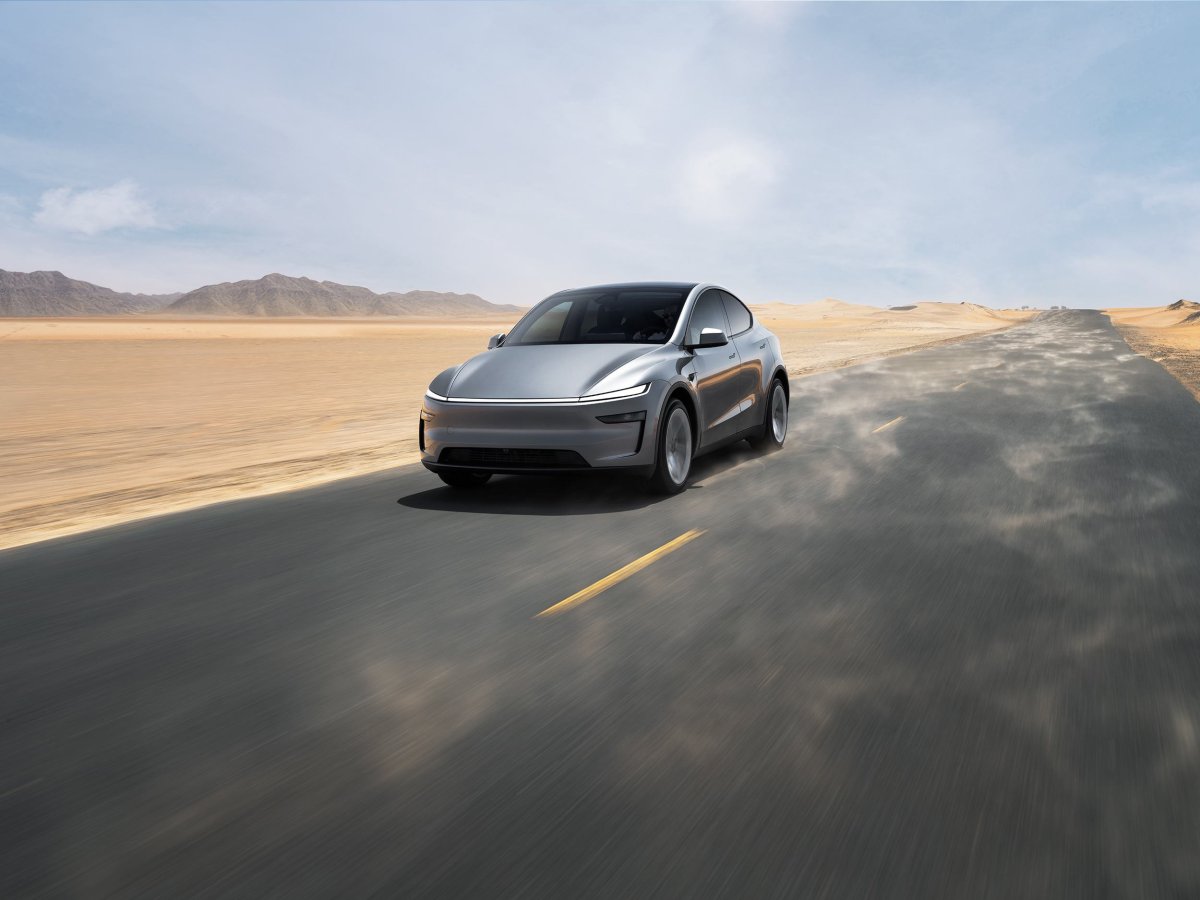
Tesla has officially received approval from the Arizona Department of Transportation (AZDOT) to launch its commercial Robotaxi service, marking the third US state to greenlight the ride-hailing platform.
Tesla previously submitted requests for Robotaxi permits for autonomous vehicle testing and operation with and without a safety driver in June 2025.
According to a status update from AZDOT received by Sawyer Merritt, Tesla applied for a Transportation Network Permit on November 13, 2025, and met all the requirements just four days later. The permit became active on November 17, granting Tesla the legal authority to operate a paid ride-hailing network similar to Uber or Waymo.
Arizona was one of Tesla’s six upcoming areas of expansion shared at the 2025 shareholder meeting.
Statewide Access
The most critical detail of this approval is actually in its scope. Unlike in California, where permits are often battlegrounds fought on a city-by-city basis, such as San Francisco vs Los Angeles, the Arizona TNC permit is statewide.
This means that Tesla is not legally restricted to a specific geofence like downtown Phoenix. The company has regulatory clearance to operate Robotaxi services across the entire state, opening the door for future inter-city autonomous routes that haven’t been done before.
Paid Rides Now Legal
While Tesla has been testing on Arizona roads for some time, with Robotaxi Engineering Vehicles and Mules spotted in Tempe, Arizona, the TNC permit is the specific business license required to charge passengers for rides.
This approval formally transitions Tesla’s Arizona operations from a “Research and Development” phase to a “Commercial Services” phase. Phoenix will likely become the third staging ground for Tesla’s expansion of the Robotaxi Service, joining Austin, Texas, and the Bay Area in California.
Next Steps
With the regulatory paperwork signed and the Robotaxi App now open to all North American users, Tesla can theoretically flip the switch on Arizona operations immediately. The state has long been a haven for autonomous vehicle testing among competitors due to its favorable weather and light regulations, making it a prime candidate for Tesla to deploy one of its Robotaxi fleets. We’ll have to keep an eye on whether Tesla includes safety monitors and whether they’re in the driver’s seat or just along for the ride.
November 20, 2025
By Not a Tesla App Staff
Most users have now received Tesla update 2025.38, although some users on FSD v14 are still waiting to receive some of the latest features.
While update 2025.38 brought some nice features to AMD Ryzen vehicles, such as 3D buildings, Tron Mode, and an improved Dashcam Viewer, among other features, it also included seven undocumented changes, including a beautiful new charging visualization.
Check out all the undocumented features of Tesla’s 2025.38 update below.
Santa Mode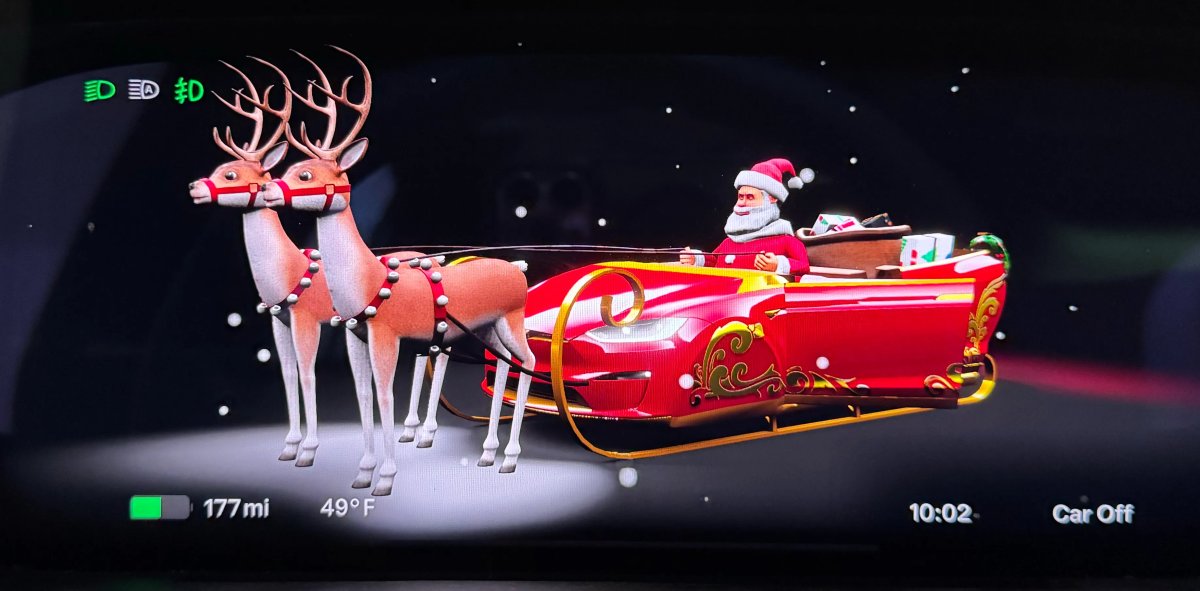
Tesla has added Santa Mode to 2026 Model S and Model X vehicles. These cars use the Unreal Engine and did not include Santa Mode until this update.
Santa Mode was noticeably absent from the Toybox, and when users tried to enable the feature through voice commands, the system would say that Santa Mode is not available and will be enabled in a future update.
New FSD Guide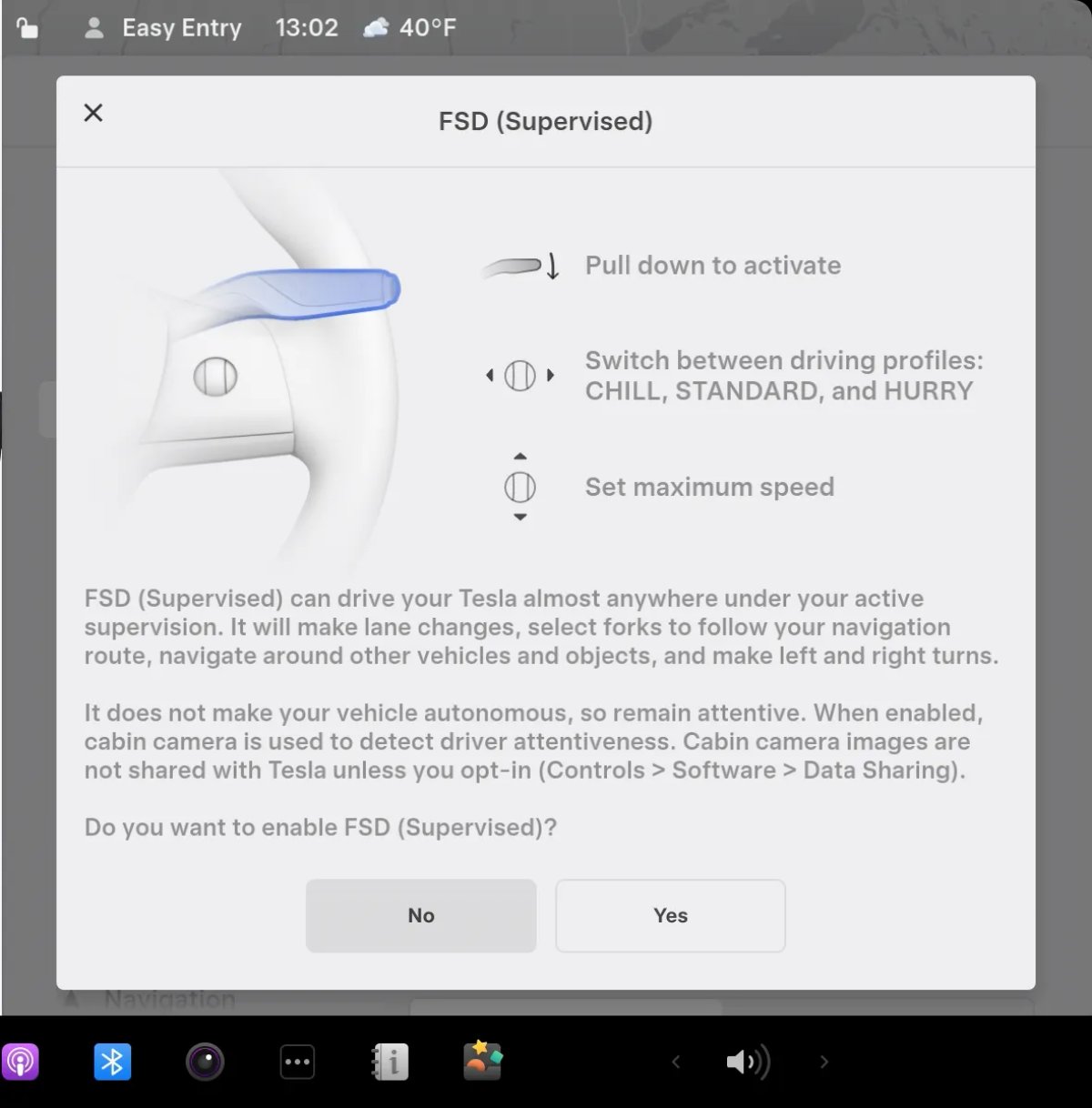
When a user activates FSD from the Controls > Autopilot menu, Tesla will now present a one-screen guide that introduces the user to FSD.
The guide includes the same disclaimer as previous updates and now also includes an image of the steering wheel controls for FSD, letting the user know how to switch FSD Profiles and set the maximum speed (for FSD V13 and below).
The image used is specific to the vehicle and will either include steering wheel buttons or stalks, depending on the model.
More Charging Information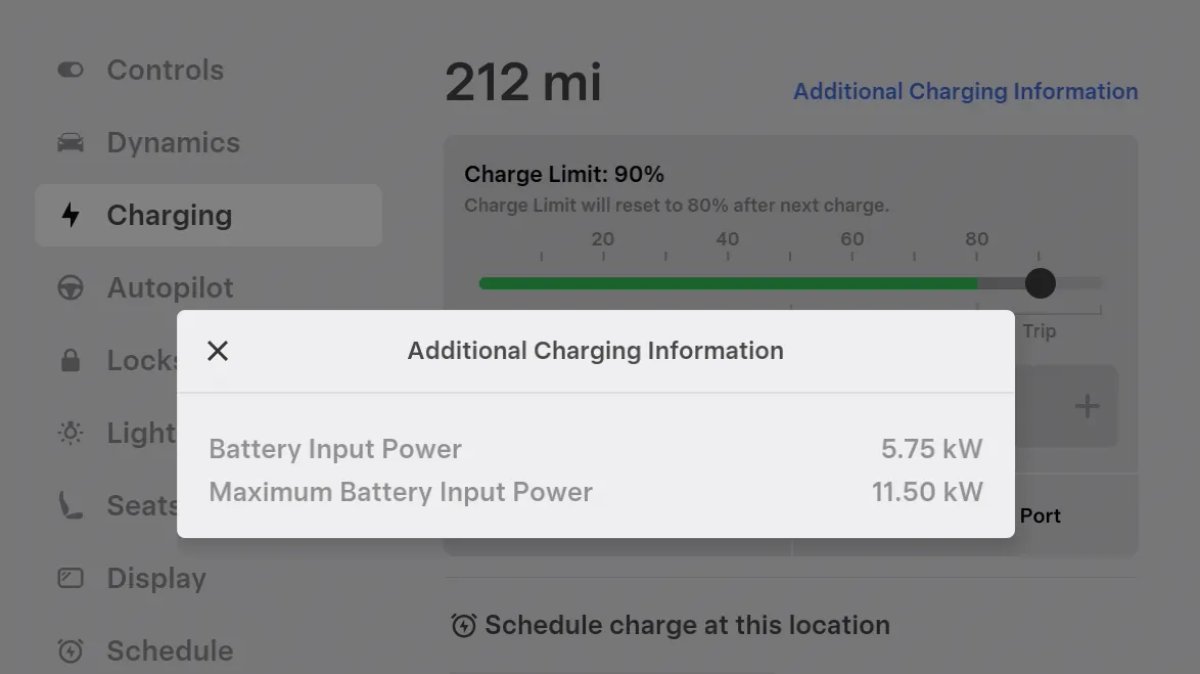
While a vehicle is charging, Tesla now includes a link for ‘Additional Charging Information’ in the Controls > Charging section. If the vehicle is charging, the link will appear in blue in the top-right corner.
Tapping the link displays a pop-up containing additional information, such as the maximum and current battery input power.
Maximum Battery Input Power is the total power the charger can deliver.
Battery Input Power is the amount of energy that is being actively put into the vehicle’s battery. The battery input power may be less than the maximum charger capability for several reasons, including a high vehicle charge level. The vehicle will also draw power directly from the charger rather than draining the battery if it needs to run the HVAC system, screen, or other components. This reduces battery wear by using energy from the battery, only to have to re-add it.
Keep Accessory Power On App Control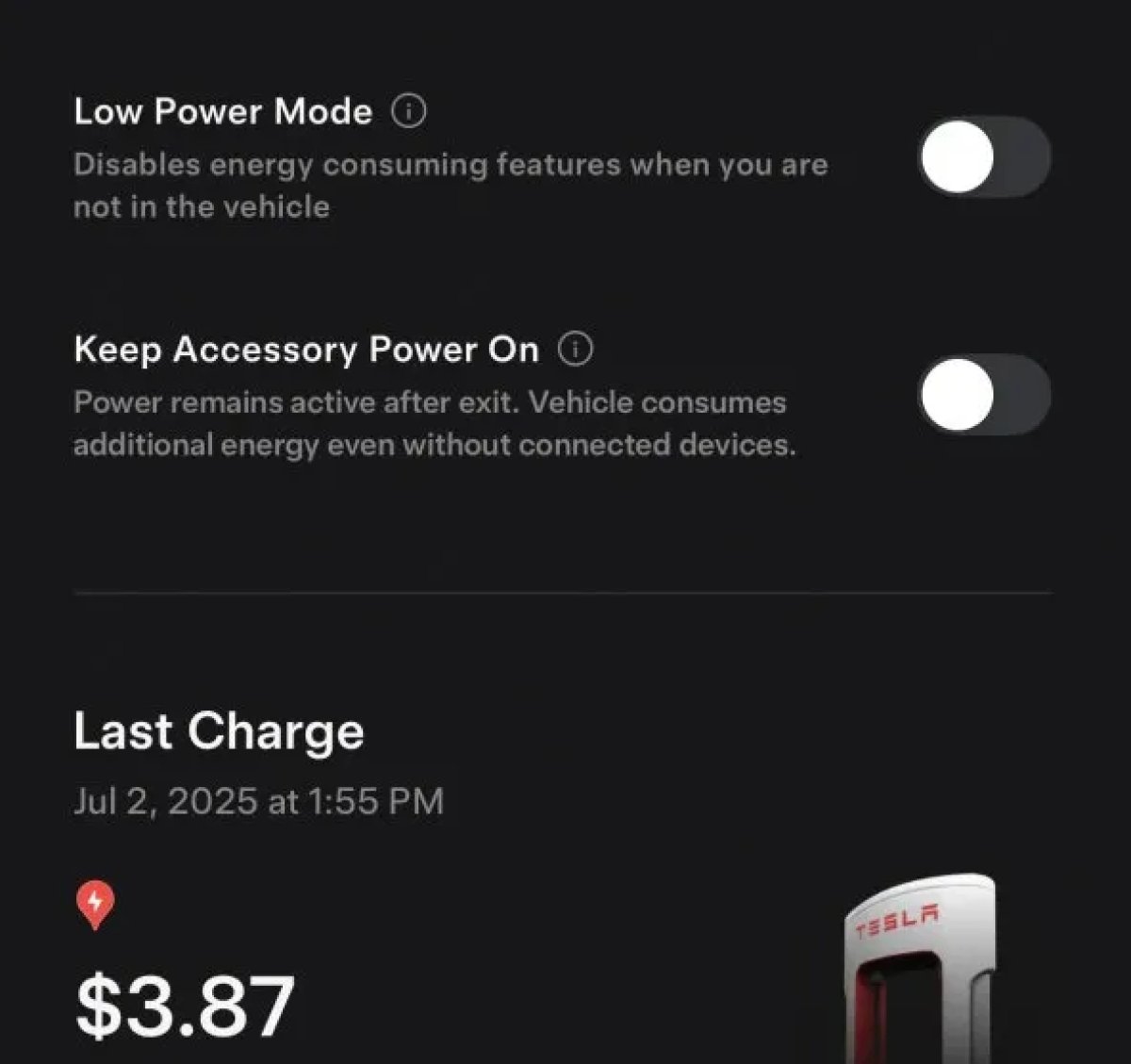
The 2025.38 vehicle update adds support for the ‘Keep Accessory Power On’ option in the latest Tesla app. This option is part of the latest Tesla app update, which adds the new Charging menu that consolidates most charging options under a single menu.
It also adds a button for Low Power Mode, instead of just being under Quick Actions.
Buy Parts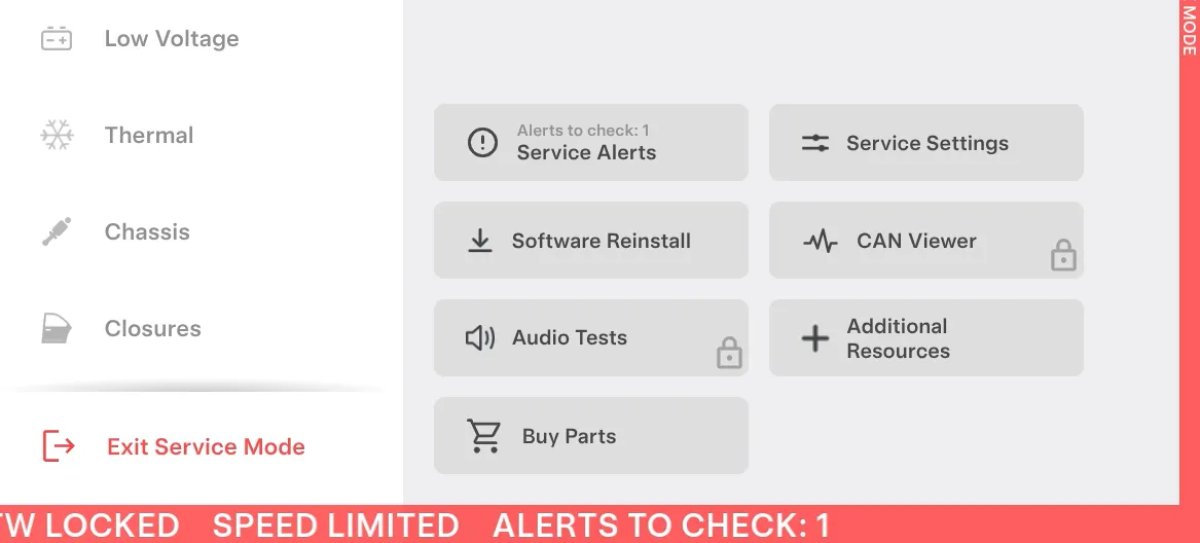
Tesla has added a Buy Parts button to Tesla’s Service Mode. Tapping the button displays a QR code that takes users to Tesla’s service site, where owners can buy parts directly from Tesla.
Parts can be shipped directly to the customer or to the nearest service center.
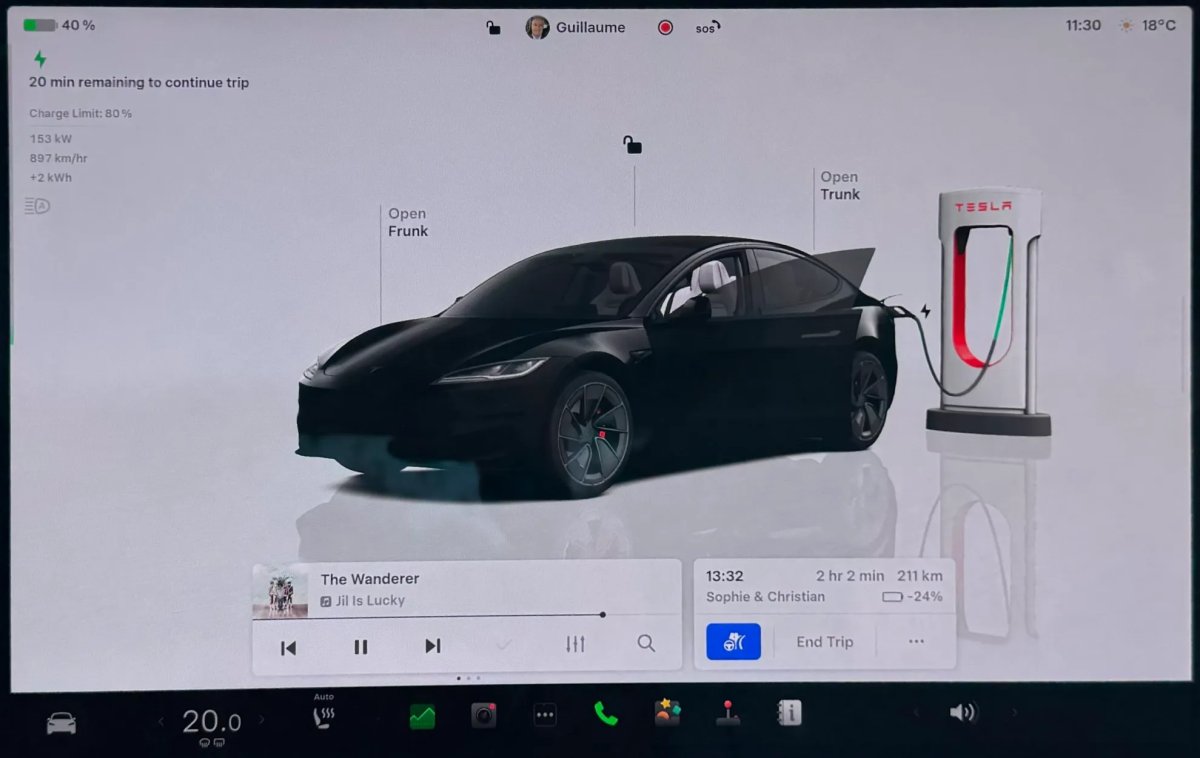
Charger Visualization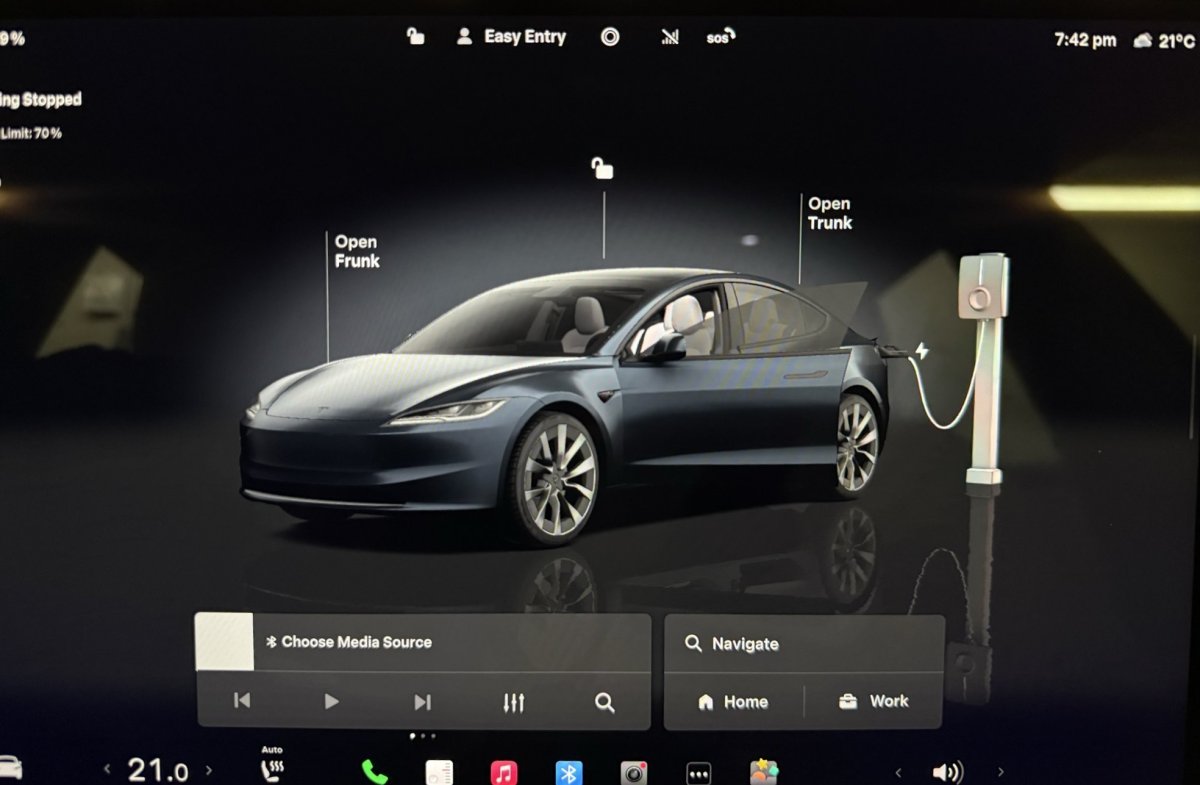
Tesla has added a visualization of a charger when the vehicle is parked and plugged in. In this photo, the owner is using a non-Tesla charger, so a generic charger is displayed. Tesla will presumably display a mobile charger, Wall Connector, or Supercharger if those are plugged into the vehicle.
Service Mode Improvements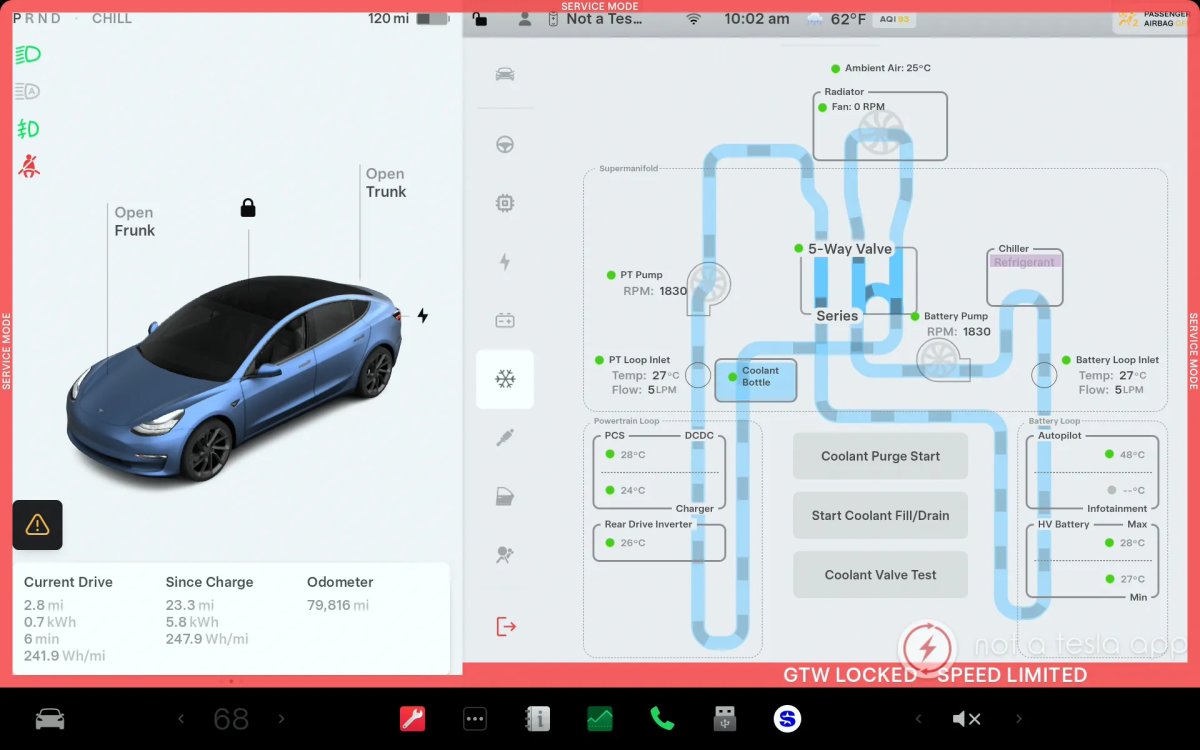 New Trunk Panel
A new Trunk panel with an overview of the liftgate status, latch status, and calibration status for the trunk is now available. The panel also provides additional information, such as the request source, set liftgate height, and hands-free settings.
Models: ModelS (2021+), Model 3, Model X (2021+), Model Y
New Front Trunk Panel
A new Front Trunk (or frunk) panel with an overview of the liftgate status, latch status, and calibration status for the front trunk is now available. The panel also provides additional information, such as the request source, set liftgate height, and hands-free settings.
Models: Cybertruck
Cameras Panel Update – Mismatched Firmware Detection
In the Cameras panel, detection for when Driver Assistance System (DAS) Hardware 4 (HW4) cameras have mismatched firmware versions has been added.
If a DAS HW4 camera with mismatched firmware is detected, touch the Update Camera button to initiate a camera firmware update.
Models: ModelS (2021+), Model 3, Model X (2021+), Model Y, Cybertruck
Brakes Panel Update – ESP Stiffness Test Routine Changes
In the Electronic Stability Program (ESP) replacement panel, the routine TEST-BRAKE_CORNER_STIFFNESS-TEST has been replaced with TEST_BRAKE_X_STIFFNESS-TEST-SERVICE.
Models: Model 3(2017-2023), Model Y (2020-2024)
Next Update
Most vehicles have already received Tesla update 2025.38, however, there’s still a group of 5-10% of the fleet that is on 2025.32 due to having FSD v14. These vehicles are on update 2025.32.8.16 and waiting for the next wave to bring them up to FSD v14.1.7 and the 2025.38 branch.
If you haven’t seen the undocumented features of FSD v14, that’s also worth checking out.
Installed on 33.2% of fleet
Last updated: Nov 21, 1:05 pm UTC
Tesla has already started rolling out update 2025.44 with some small improvements until the holiday update drops next month.