
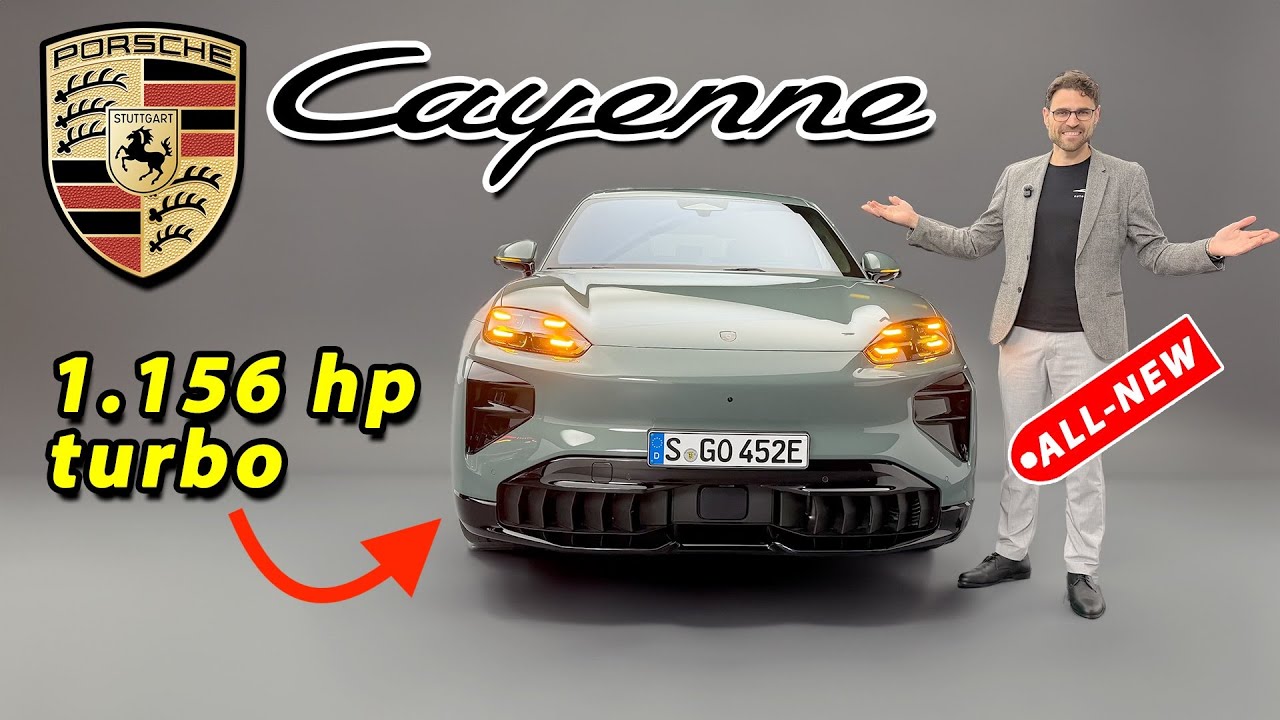
all-new Porsche Cayenne Turbo vs base – the final full REVEAL of the 2026 Cayenne electric!
This is now the final presentation of the
new Porsche Cayenne. What can you expect from the Turbo and
from the base version? And what about electric and the combustion
engine model? What’s the strategy there? Everything you need to know right now. Exterior, interior, and technology details. With Thomas on Autogefühl in 4K,
full screen, full length. Let’s go! Starting here with the top model,
the Cayenne Electric Turbo. This one here in Mystic Green. Very interesting color, for sure. The Turbo gets a little bit more sporty. Lower spoiler here, also with these large
air intakes. And you might wonder — why does the
electric Cayenne need so much air intake? Well, there is still cooling needed. This one here, over 1,150 hp in
the launch control mode. So, it always depends on which figure you
are looking at, actually. But still, like, the base power output
is still over 850 hp, even if you’re not in the launch control. Matrix LED or HD Matrix LED are also
available for the Cayenne Electric. And then, one major difference is,
of course, when you press this button. Or, alternatively, you can also swipe here. There we go. Then the hood is also opening, and you
have a frunk — 90 liters. Not only for a charging cable,
but even more space. And then, of course, close it properly
again, pushing the Porsche crest, the most stable one. I think it’s actually easier just to use
this button here, because yeah… That always opens in an easier fashion. And you can also open it while you’re
getting out of the vehicle and so on. So yeah, that would be, to me,
the most preferable option, actually. We already have the rear here with the
base Cayenne version. You can see here, the light strip goes all
the way through. Porsche lettering also illuminated. Looks pretty cool. And a horizontal stress also here, with
these design elements. We’ll soon also go
and take a look at how the Turbo is differing
then here from the… rear. But tell me in the comments what you think
about the design of this all-new Cayenne. And yes, it’s the all-new Cayenne. It is the electric one. At the same time, the combustion engine
will run parallel. It will remain with the so-far model that
was recently facelifted. And in a separate, different video,
we will also shed more light on this… difference between the electric and the
combustion engine model. Wheels from 21 to 22-inch. These are the 22-inch wheels here. In this case then, for the Turbo Spires
design. And here, you can also get the PCCB —
the Porsche Ceramic Composite Brake — for the best braking performance, without
any fading effects. So, theoretically, also racetrack-proof. The length here is 4.99 meters, or
196 inches. That’s about 6 centimeters, or 2 inches,
longer than the combustion engine. And even 13 centimeters, or 5 inches,
difference in the wheelbase. So the electric version — longer
wheelbase. You can see here, on the one hand,
typical Cayenne silhouette… But then again, a little bit lower,
more aerodynamically optimized. 0.25 is the Cd value. That’s better than the Mercedes GLC EQ. A little bit worse than the BMW iX3,
the new one. However, this one here is at 0.245… So, you know, they had to round it up. So it’s kind of like between —
oh, we’re very good in the Cd value. And there will also be the Coupé version. And we can expect, usually, the Coupé
versions have an even better Cd value. So, like the combustion engine —
SUV body style and Coupé body style. Here, by the way, painted wheel arches. Black then, in this case, for the Turbo
version. And we can also take a look at the base
Cayenne. Differences here… Well, we also have painted wheel arches. We don’t have the Mystic Green color. Here, there’s a Vanadium Grey. Also, pretty cool. And where the Turbo just has the different
logo on the side, there’s just a blank. You know, there’s no special logo there. Also, 22-inch wheels here. The large ones, as an
option, in a different styling. And I think both work very well. Here, the base model — it looks a little
bit less dramatic in the lower part. I even have to say, you know, this more
elegant styling is pleasing me a little… bit more with the base version here. Or what do you think? We can, however, say
that just on the visual part, there’s maybe
less difference… between the base model and the top-end
sports model with the electric version… than there is, maybe, with the combustion
engine version. Or what do you think? Technology-wise, air suspension is always
standard. If you have here the Turbo version, then
you can also get this Porsche Active… Ride — this hydraulic control for each
individual wheel. That would be another option for this one. And also, for both, an option that you
have rear-axle steering for a better… turning circle. Here, the Turbo in the rear — a little bit different in the lower
graphic. And this one also has these aero flaps
that then go out here. It’s always a spectacular effect. We already, you know, tried it once with
the prototype model and did some… acceleration with it. What the… Yeah, that was 50 to 100 in like… I can’t… What the hell?! So now we’re here at 90 km/h. Let’s go. 150. 170. 200. Crazy. 220. 250. What the… What?! What?! And another interesting thing that moves
is here. This is a rear wing, and it’s adaptive,
both for the normal and the Turbo version. So at really, really high speeds,
it deploys. You can also manually do that from the
infotainment system for show-off purposes. What about battery and charging? First of all, this is here the charging
flap — electrically. It goes in like this, and then AC charging
is here on the passenger side. And you might wonder — what about DC
charging? Yes, it’s of course available. We just have to go around, because I want
to show you that AC charging is standard… on both sides. That’s a pretty cool thing, because you
never know where the charging station is. And then here, you have the… Ah! Now the other side was closing first. And now this one is opening. I could hear it on the other side. Pretty cool. Then here, AC charging — 11 or later,
also 22 kW possible. Then DC charging, up to 400 kW. And we already could do a charging test
for you. And we could really score. It was 8 to 80 percent in 14 minutes,
like 40 seconds. So, pretty amazing. So you can always be sure that when the
charging station is, you know… powered enough, you can reach under 15
minutes — 10 to 80 percent state of charge. That’s pretty amazing from this 800-volt
architecture. 400-volt charging is, of course,
also possible. Right, Mercedes? Yeah, at Mercedes, they make it an option
now. But all other manufacturers, they put it,
of course, as standard — as it should be, actually. You can also close the flap again
from the interior. So you’re pretty much flexible as for
that. And another special
thing for the electric Cayenne is that you
can have an inductive… charging pad. It costs 5,000 euros, plus 2,000 euros for
the receiver in the vehicle. You can also order it directly from works. This one works up to 11 kW —
this inductive charging. You put this plate, then you, yeah, when
you charge at home, would be another… alternative, right? Well, you know, it’s very interesting. And what could be a potential range for
this one here? WLTP — the official driving cycle —
640 km. For the Turbo, a little bit less,
like 620. So, because of the, like, more power
output and so on. Realistically, at the motorway,
I would suppose when you drive like 130… 140, maybe like 500 km —
300 miles of realistic higher-speed range. But, of course, we really have to test
that for you. The efficiency effects, as for the Cd
value, are very promising. So, we got to see how it will end up in,
like, concise real-world driving range. We’ll, of course, test that for you as
soon as possible. And now, power figures. Once again, with launch control —
1,150 hp, a little bit more than that. With launch control for the Cayenne Turbo,
they really have this base power… which is here already more than 850 hp. Then you have the boost button in the
steering wheel — plus 176 hp. And then, the maximum power output is
always during the launch control. And the acceleration figure is here: 0 to 100 km/h (62 mph) — 2.5 seconds. And to 200 km/h (125 mph) — 7.4 seconds. This is insane. This is supercar dimension. This one here is the most powerful works
Porsche that has ever been built. And it’s the electric one. Very interesting. Remember — 2.5 acceleration figure here. With the base Cayenne, it is 4.8 seconds. For a base version,
this is still very interesting and amazing,
because the base… Cayenne combustion engine would be 1.2
seconds slower in comparison to the base… Cayenne Electric version. Yeah, very interesting. We could already take a spin for you,
as we’ve shown to you. And I can already say — it drives
extremely well. It drives very sporty, very crisp,
very direct. And so you don’t have to say that you have
less fun driving the electric version… or so. But even more interesting is, of course,
what are the differences in the interior? Now to the interior. This is the key fob. Frunk, trunk — open, close. Turbonite color for the
Turbo at the key fob. And then the doors. What’s interesting at
first — frameless doors. You know that the new combustion-engine
Cayenne has frames around. So this is more sports-car-like. Also, by the way, like this
insulation here — laminated windows. And this one also equipped optionally with
the soft close. Of course, you don’t have to do it. I’m always not a fan of it, honestly. I like that we have classic door handles. That’s pretty cool. But sometimes, with the soft close,
yeah, you get some more… resistance when opening the door, maybe. But here, it’s actually — yeah,
sometimes maybe. But sometimes you feel it, sometimes not. But also slamming — still a good sound. So, although we have the frameless doors,
we still have a good door-closing sound. Then, interior here. As we know from Porsche —
horizontal stress, wrapped around. This is the Turbo interior here. Different stylings are available. Here, hard-pack at the inside of the doors. This is worse than with the
combustion-engine model, I gotta say. Just a rubber insert in the lower part. I would expect some soft materials here —
especially at that price. Turbo entry badging. And also, nice floor mats here,
with the segmentations. Why not? And Turbonite pressed
also on the steering wheel. Real buttons and jogs here on
the steering wheel for volume. And the drive mode selector. This is the boost button here —
for 176 hp extra for 10 seconds. The digital instruments are now more
stretched and even more curved as for that. Then, this is here the sport seat. There’s a comfort seat and a sport seat. Visually, they’re not
the biggest difference. Now, let’s also see if we can feel any
difference in the seating comfort then. And this — animal skin. There is now, however,
for the first time, a completely animal-free
interior available. Then, you would have the Pepita fabric. That’s retro fabric on the middle part. And a Racetex microfiber steering wheel. And I would, of course, go for the
animal-friendly solution. At least, they offer one
solution in here now. Still, they have to, you know,
develop it further — maybe offer… something more like BMW
is doing, like a high-grade leatherette, because
it would look the same. And then here — 1.89 m. 6’2″. Still some headroom left. You sit maybe a little bit lower than in
the combustion-engine Cayenne. I would take it that way. But still, you have an SUV-feeling,
like a driving position. Yeah, and I now have to remember this
sport seat driving position. You have more shoulder enclosure here. Yeah, let’s soon see
and hop over to the base model if there’s any
difference in comfort. And now here, first
of all, the cockpit of the base Cayenne — and
also the comfort seats. They also have some shoulder support. I would say the sport seats have a little
bit more shoulder support here. I mean, but the form itself is not too
different. I feel that, yeah, maybe they are a little
bit stiffer from the material. It’s both animal skin, though. Yeah, I think it will also make a
difference when you have the Pepita… fabric, which is connected
to the comfort seat. This one will have more dampening from the
seat cushion. But yeah, I think it’s tough to see the
difference in seating — and also in the… visual part as for that. Yeah, maybe you have to see when we drive
the vehicle. The cockpit is, of
course, very interesting. Here, we also have
some color accentuations. Yeah, Lea would probably prefer this one. But of course, you
can pick different colors. The main aspect everyone is talking about
is this curved screen here. There we go. It’s also standard like this. And you see here this curve in there. And you either have
this lower control element, which you can
remove or put up again. Then you have this split in there. And very interesting
is, for example, also when you are in this deep
menu — and then here. And some say, ah, maybe get a
little bit dizzy by that, looking at that. And I can understand that. I’m not the biggest fan,
as in — yeah, I need that. But I can understand that they want to do
something new. Here, for example,
when you have the map view, and at the same
time you see the map… and then you have this
overlay in the lower part. And ergonomically,
it’s actually quite good, because you can
rest your hand on here. You can control the
volume with a manual jog, and also still a
manual climate unit… with clicking sound. I really love that. That’s cool. And it’s actually easier to reach here
than in the combustion-engine model. So, as for the ergonomics, this interior
is actually better. Also, the whole system — the
whole software — is so much quicker than in the outgoing
combustion-engine model. Again, they will run parallel. But you do have advantages here. Passenger screen. I don’t need one. It would either be high-gloss black
background here… Or then, if you want one, you have a very
wide passenger screen here. Digital instruments. You can also see it from this perspective
right here. And yeah, good ergonomics also for the
steering wheel. You can directly control the driving modes
and so on. And another main difference now in the new
version is this huge new middle console. So, this should be softer for your elbow,
because when you’re like here… you even hit this edge here. This is really hard. So, it’s not comfortable for your elbow. You slide this one backward… slide this one forward. And then, what’s pretty cool is this
inductive charging pad in the front — because it really fixes the smartphone
with the magnetic holder. And then it charges, and the ventilation
directly starts. So, it doesn’t overheat that easily. Two USB-C chargers there as well. And then, there was also a big discussion
about these new cup holders. You remember, maybe,
in the combustion-engine, they’re more open like here. Here, they go deep in there. And then they have
some fabric-adaptive parts, which make it, of
course, more silent… that bottles don’t, like, blub-blub-blub
around. That’s cool. And you either have this lower setting, or
you turn it up, turn it around, and then… put it in the higher setting. Maybe for coffee-cup holders — coffee cups
that are easier accessible. Or if you say, I don’t need that at all,
I don’t drink… I mean, water. You can also have this totally open area. This would be another alternative. So, yeah. Tell me what you think. Two more USB-C chargers right there. But I really gotta say, I was first a
friend of the combustion-engine interior… but the more and more I get used to this
one, I’m more a friend of this one. Yet again, I do not
need the curved screen — but it wouldn’t annoy me that much. I think it’s cool that it’s super quick. And also that I still… when I have my classic
climate control here, with clicking sounds and metal
knurling — then I’m happy. And it’s the most important thing to me. I think then it’s actually more annoying
that it’s too hard here for your elbow. Especially here, because
your elbow lands here — maybe even here, in this hard plastic part. I think this is something major they
would have to fix first. Or what do you think? Yeah. Here, by the way, again,
the headroom is fine. Panoramic roof. Also very interesting. You can open it completely. This is still very rare
now in the EV segment. And then you still
have this electric shade, which does nothing
really for how much sun… is coming in for the
heat — but visually, yes. You can have it clear. You can have it more like this. You can also have like a step in between,
and so on. Yeah. It’s interesting to have that. And also maybe not really needed. But to me — cool that you
can still reopen that one. And the driver POV, once again,
here with the volume jog. Favorite button here. You can set that for the
speed chime warning. But the speed chime warning can also be
deactivated here on the top-left part… in the infotainment system. That’s cool. And here, once again, a look at the
digital instruments. And you can also adjust
what you want to see, actually — also in the middle part. And also this famous Porsche
“five-gauge” view, for example. Best greetings, of course, also from Lea. Yeah. Color-wise, it’s her interior. But she would also pick the animal-free
one, she said. Then here, in the passenger display — well, this is now like a handy use. Because there you can select more
functionalities here on this top screen. And this, I would always
call the show-off effect… because it doesn’t make any sense. It just looks good when you have it
in this split-view mode, so to speak. And back to the Turbo
with the interior here. All the way — everything in black. Some contrast stitching, yes. But yeah, you can have
it darker, more subtle, or more colorful —
however you like it. These sport seats, by the way,
if I test them again now — they’re also pretty stiff. But indeed, the biggest difference
is here — the shoulder support. That’s like the main difference indeed. And then here, from the cockpit, you
can see that when you have fewer color… accentuations, everything has more of a
black transition, so to speak. So which one would you prefer? Tell me in the comments. And you have the Cayenne
badging here as well. Other Turbo-specific
elements on the armrest — here, for example, embossed on the armrest, and also here at the seat — for example,
the “Turbo” lettering. Yeah, but I have to say, I mean,
here with the curved screen — when everything is black, I
like it more colorful, actually. Maybe it doesn’t have to be the Lea color — that’s for her, especially. I would… maybe have to check the configurator price
for some other different colors. But this one is then a lot of black. And especially also when you have the
Turbonite accentuations, like on the steering wheel — everything is darker,
you know, even further. Then, the rear seats — by the way,
these frameless doors are also with this laminated glass in the rear. And then, yeah, this hard-pack
here once again at the rear inside, and the rubber pad at the back part,
so to speak. So not ideal at the inside of the doors. And what’s also cool is that you can have
these electric shades for the rear. That’s a pretty cool thing. By the way, here, if you lower this one
all the way down, then we go up till here. And you can see more here from this
laminated glass. I guess that would be an option. We’ll have to see that when the price list
and the configurator exist, and so on. Then here, electric
seats are standard, as I heard, and they go pretty
much all the way forward. And also the inclination. This goes way forward indeed. Wow. And then look at that inclination here. With the steepest inclination —
that’s also how the official trunk
cargo figure is measured. Of course, you can go back again. So, it’s a nice luxury feature. Oh, it doesn’t move simultaneously. So this — then all the way back again. And also back in the length. ISOFIX here at the outer parts each. And there we go. And this is a single-seat design. However, the middle part is also approved,
so to speak, from registration. But whoa. Yeah. Pretty stiff. It works headroom-wise and space-wise
for five tall adults, yes. And you have to especially
see here, you know, that this one doesn’t hit you
from below, so to speak. And here, you have more wheelbase
in the electric version — meaning you also have
some more legroom in the electric version compared to
the combustion-engine one. Maybe not the largest difference,
but maybe like this much or something. And then headroom also works here. So, good space. Again, the surface is pretty stiff. I would expect a little bit more softness
from the fabric surface in that case. But still, you have
enough space — and also a pretty cool climate unit
here, with clicking sounds. So, the climate unit is really classic —
also for the fan speed. Even seat cooling and seat heating
simultaneously for the rear seats. Two USB-C chargers. And then we can fold down this here. Cup holders are not
adaptive here in the rear. I think this also looks like it’s shared
with Audi, I would expect. But the highlights are… I think I complained about that
in the prototype vehicle. But yeah, this is a
little bit loud, you know, considering everything
else goes so smooth here. Now, the trunk — or the boot —
of the Cayenne Electric here. 780 liters in the cargo position. What does it mean? I’ll soon show that to you. First of all, here, this cover also has
this rail here at the side. This one also fits underneath — no problem. The width here — similar to
the combustion-engine model. About 1.40 meters, or 55 inches. Also, the length — about 1.40 meters, 55 inches. So, that’s not the main difference. But I checked the
combustion-engine one before — and here, you do lose some height. We’re at about 70
centimeters, or 28 inches. The combustion-engine
version would be a little higher. Still, liter-wise, you
don’t lose anything — you even gain 10 liters, strangely enough. And then here underneath — some more space. But the charging cable could
also be stored in the front. Now, what else is interesting? “Cargo position” would be when
you put this one more upright. And here on the left side,
you can see — I put this one not only more upright,
but also moved it forward. So, this is the difference —
the maximum cargo position you can have without
directly folding the seats. Yeah. And on the other side, then — let’s
say the minimum cargo position. And now, the very
cool thing is: we can fold down the seats
electrically from the rear. That’s a very practical feature. And then, we can also
measure the final length here. And yeah, this is around 1
meter 85, or about 73 inches. Also interesting here, by the
way — in the back, when I remove the top cover, I can also
store it practically underneath. So, I have to squeeze
it in a little bit like this, and then it’s all the way
stored away — full setup. So, as I said — while the new
electric version is available, the combustion-engine model
is not on this new platform. It basically stays as
it is, with the recent facelift, and will still
be available in parallel. Maybe with the exception
of some markets that are almost pure EV now
— like Norway, perhaps. Not sure if it’s still
available there, but in all major markets, both
will run side by side. The question is — which one would you take? Soon, when you watch this video here
at the initial premiere, the second video will come — where we compare the electric
with the combustion-engine Cayenne. Or, if you watch
this video later, that comparison might already
be online on our channel. It’s also very interesting
— I can promise you. So, pricing: the base
model starts right above €100,000 — like the base
combustion-engine one. And the Turbo — €165,000,
also comparable, so to speak. And you can easily add another 40 or 50k
in extra equipment. So, price-wise, combustion engine versus
electric will not be the major difference. Taxation will, of course, be a major
difference — but also residual value. If we, for example, compare ICE
Porsche models to the electric vehicles — it’ll be very interesting to see
how this story develops further on. I have to say — from the exterior looks, in
the front, I still have to get used to it. I really like it from the rear. Inside, I personally don’t
need the curved screen. However, the software is very, very fast —
super quick reactions. And also the ergonomic
layout of the classic climate buttons and
controls — I really like that. So, I have to say, I was
kind of skeptical before, and maybe I was thinking, “Hmm,
is it really a step forward?” But the more time I
spend with it — drive it, explore the interior
features — the more I like it. At first, I was leaning
toward the combustion engine. Now, I’m actually leaning more toward
the electric one — especially since it’s also available with the animal-free
interior, which I think is pretty cool. So this has been a very interesting journey
for me as well, definitely. And soon, we’ll keep you
updated with an extensive driving review of the
final version right here. Tell me — what do you think
of the new Cayenne Electric? Everything about the exterior,
interior, and technology. And now, we’ve got even more
Cayenne content coming up for you.
This is our in-depth review of the Porsche Cayenne Turbo electric vs Porsche Cayenne electric (base model) 2026. We’re taking a look at Exterior, Interior and technology.
00:00 Final all-new Porsche Cayenne
02:00 Acceleration test Turbo
01:12 Frunk
01:52 Base vs Turbo
04:38 Suspension and technology
05:00 Launch Control Turbo
05:59 Battery and charging
08:14 Acceleration figures
09:43 Interior quality Turbo
12:27 Cockpit base with curved screen
17:23 Driver POV
18:13 Turbo Cockpit
19:28 Rear seats
21:57 Trunk / boot
23:36 Price
#Porsche #PorscheCayenne
Data & facts:
Porsche Cayenne (Turbo) Electric
SUV or Coupe
Matrix LED, optional HD
Length 4,99 m 196”
EV vs ICE: Length difference 6 cm 2“ longer, but even 13 cm 5“ wheelbase difference
Standard air suspension
Optional Rear-axle steering up to 5° below 100 km/h 60 mph, reducing turning circle by a meter to 11,6 m
Optional Porsche Active Ride suspension for Turbo
Optional PCCB for Turbo
Towing 3,5 t
cW 0,25 (Cayenne ICE 0,35)
108 kWh battery net (113 kWh gross)
800V charging
11 kW or later 22 kW AC charging
11 kW inductive charging optional, efficiency up to 90 %
400 kW DC charging
10-80 % in less than 16 Min
Our test result: 8-80 % in under 15 Min
600 kW recuperation, 97 % of all braking actions are done with recuperation
WLTP 640 km (620 km Turbo), real-world range probably around 500 km / 300 miles on motorway with decent speed
Cayenne Electric:
325 kw 442 hp and 835 Nm in launch control maximum power, normal power 408 hp
0-100 km/h 4,8 s (EV base 1,2 s faster than ICE base)
Vmax 230 km/h 140 mph
Cayenne Turbo Eletric:
850 kW 1.156 hp and 1500 Nm in launch control maximum power, boost mode button +176 hp for 10 s, normal power 857 hp
0-100 km/h 2,5 s, 0-200 km/h in 7,4 s
Vmax 260 km/h 160 mph
Usually rear motor is used, when needed also the front motor
Turbo also with rear torque vectoring
14,25“ digital instruments
Curved „Flow“ display infotainment – Largest display ever in a Porsche
Optional 15“ (14,9“) passenger display
HUD with augmented reality
Comfort seats with optional vibration massage and cooling
Optional sports seats
Surface heating on middle console and inside of the doors
Animal free Pepita retro fabric/Race-Tex mix interior available for comfort seat, then also microfiber Race tex steering wheel
Optional panoramic roof that can be opened and dimmed
Boot 550 l without cargo, 780 l in cargo position – 1.590 l
Price entry model 105.200 Euro (3.700 Euro more than base model)
Turbo 165.500 Euro
Porsche wireless charging:
Up to 11 kW
Efficiency up to 90 %
Active cooling
Charging pad 50 kg and 1,17 m 46“ long
Car lowers automatically when it parks over the pad
Motion sensor shuts down the plate when living beings or metal is being detected
Price 2.000 Euro vehicle, 5.000 Euro for the inductive plate, plus electrician
►Subscribe here: https://www.youtube.com/user/autogefuehl?sub_confirmation=1
►Autogefühl Deutsch (German): https://youtube.com/@AutogefuehlDeutsch?sub_confirmation=1
►Also subscribe to our YouTube shorts channel: https://www.youtube.com/@thomasautogefuhl?sub_confirmation=1
►Follow us on Facebook / Instagram / TikTok @autogefuehl
►Sustainability in the automotive industry documentary: https://youtu.be/-8gNXlRGngA?si=bCdeJZORRHNcVmV2
Transparency note: Autogefühl videos are independent and free from editorial influence on opinion and rating. Since there can be sponsored messages or product integration from partners, which are clearly and transparently pointed out, for legal reasons the videos are marked with the YouTube standard info message that a video contains advertising or product placements.
WATCH OUT FOR SPAM/FAKE ACCOUNTS. Across YouTube/Whatsapp/Telegram etc., you’ll find fake accounts taking the identity of original channels or people claiming to work on the behalf of original channels, they sometimes even use the same profile pic, similar names and include a telephone number in the name or their comments, trying to get you to message them on Whatsapp or Telegram. DO NOT MESSAGE THEM, they are trying to get your personal details, bank accounts etc. and in the end, they will ask for money or they will misuse your bank account. They promise you giveaways, prices, payment etc. Do not fall for these cheap tricks and PLEASE HELP everyone and MARK THEIR MESSAGES and their whole accounts/channels as Spam and/or report their telephone numbers/Whatsapp to the police. We from Autogefuehl will never ask for your bank details. Check out our original channel marked with the verified badge.
We do have other official channels, so you can identify them and also subscribe if you like e.g. in your native language. French & Arabic are translated using Dubly.AI. Try it for free here: https://go.dubly.ai/autogefuehl