
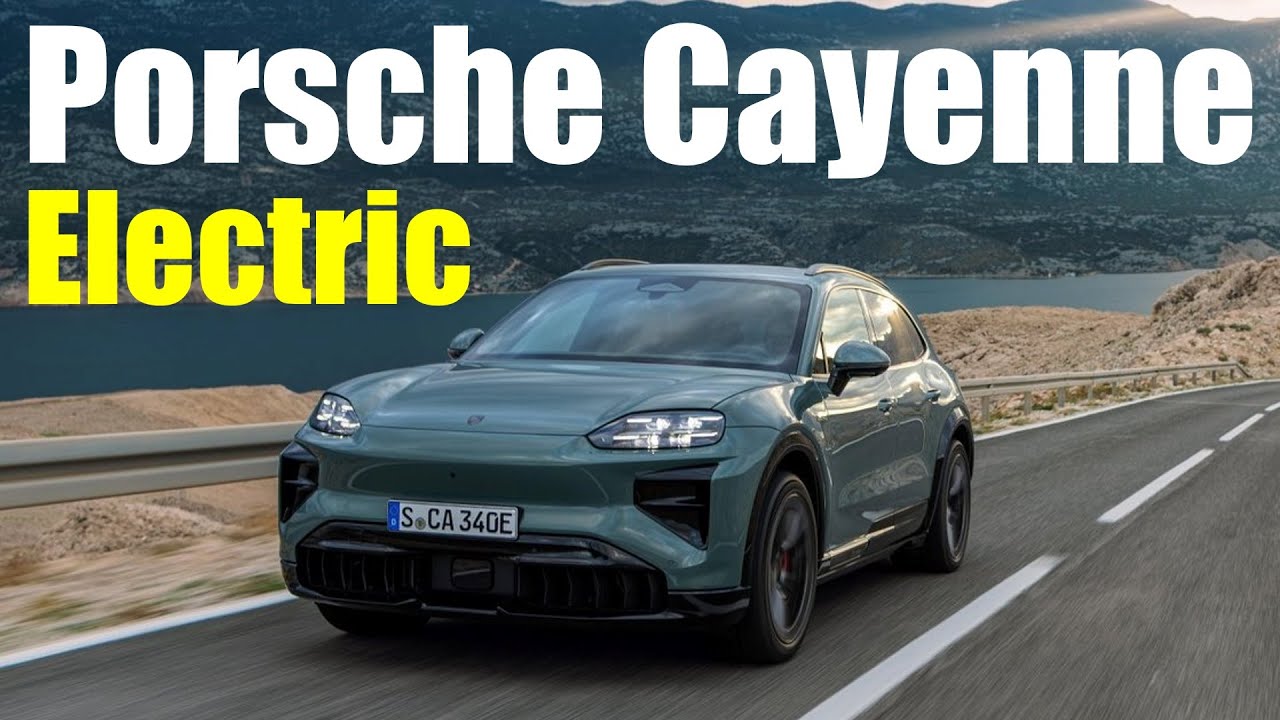
Porsche Cayenne Electric – Just Another Electric SUV?
[Music] Today we have to take a closer look at the new Porsche Cayenne electric. Yes, it is another electric SUV, but this one is special as it’s one of the new generation of positive news from Germany. And that’s because you can see that Porsche really wanted to do it right. So, let’s start. In the past 10 years, German car makers didn’t always produce convincing electric cars. Very often they just brought something electric on the market to lower their fleet emissions. The cars had lower range than the competition, many technical issues and very high prices which resulted in a massive devaluation. Additionally, they didn’t give the customer what was possible with an electric car and only the bare minimum. So customers had less space, less seats, and from a manufacturer’s perspective, ideally no towing capacity because that’s cheaper to develop. Although electric drivetrains are ideal for towing heavy loads, only Tesla pushed the industry and showed what was possible. And in the meantime, Chinese manufacturers overtook established Western car brands. So now it’s time to catch up. Let’s start with the battery. A high voltage battery consists of modules, and you want to have as less as possible because each module needs a connector, and every connector creates losses and is a potential reliability risk. In the TYAN, Porsche used 32 modules. In the new Cayenne, they only have six. So, there are less losses and they use the space in the battery case more efficiently. The car uses an 800 volt architecture, which allows smaller, lighter cables and more performance. It can still be charged with 400 volt by splitting the battery into two parts. It has 113 kW hours and a weight of 700 kg. Yes, that is a heavy battery, but that’s 6.2 kg per kilowatt hour, which is not bad for a road car. So, you have around the same battery weight like on previous electric cars, but 15% more capacity. The key area for constant electric performance is cooling. And here, Porsche uses a system with cooling plates on top and bottom of the modules. This was something we criticized on the new Ferrari electric car because they only cooled it from below. So with cooling cells from both sides, you can cool and heat the battery much more efficiently, which allows for constant high power and also faster warming up. You can simply control the cells thermally much better, which also helps with battery life. In addition to that, the battery is a structural member, which means the rest of the structure can be lighter, which was another thing we criticized at the Ferrari with its massive frame. Also, the electric motors are a highlight. Porsche is using permanent magnet synchronous motors at front and rear because of their efficiency. The rear motor is being produced at Porsche in Sufhausen. It has a direct oil cooling which is built on their formula E experience. So the oil can reach hot motor parts directly instead of a water coat further away. This allows for a much more compact motor and recuperation of up to 600 kilowatt. So you basically never need the mechanical brakes. But of course, you can get ceramic ones. The rear motor has a double oil pump for the oil cooling on one side and thicker gearbox oil on the other side. It has a oil water heat exchanger to connect the oil cooling to the water cooling system of the car. Oil changes are not necessary during the car’s lifetime. These drivetrain details allow the Cayenne to accelerate in under 3 seconds from 0 to 100 km/h and a top speed of 250 km/h where manufacturers limited top speed in the past to save development costs. More important for daily users is the range of more than 600 kilometers in the WLTP cycle which is similar to the latest Chinese electric cars which reach more than 700 in the Chinese city cycle. In the WLTP, they should be on the same level. And in terms of charging, Porsche claims up to 400 kilowatt, which is below the more than 500 kilowatt of Chinese competitors, but Porsche claims to keep a constant charging power, which would result in a similar charging time. Also here, they caught up. Another charging innovation is for wireless charging pad on the ground. It was discussed for electric cars more than 10 years ago already, but wasn’t introduced due to weight, costs, and the risk of damage from below. Porsche now brings it in the new Cayenne, and it’s their unique selling point. And instead of denying the customer decent towing capacity, Porsche goes allin and offers three and a half tons. Additionally, Porsche offers all-wheel steering, an active suspension without anti-roll bars, and a new design. Also, the rear seats offer more comfort now, and the trunk is as big as you would expect it from a Cayenne. Prices start at €15,200, which is on the same level as the current V6 entry model, but the performance you get here with the entry electric car is more similar to the V8 GTS or S hybrid version, which are much more expensive. So all in all we can say that we have a similar case here like the new BMW iix3. Porsche concentrated on creating a really good electric car with oil cooled PSM motors, a structural double cooled battery, 800 volt technology and performance similar to the latest Chinese electric cars. And all that for a price level which sits at the same level as the current entry Cayenne and below current Cayenne with the same performance. And another important point is unlike the Macan, the Cayenne combustion version will stay in production for now while selling the electric Cayenne. So Porsche is not killing another Qashq. We now just have to hope that the Carriad software issues didn’t also end up in this car. Check out my other video to learn all about this. So what do you think about the new Porsche Cayenne Electric? Let me know in the comments below and see you at the next one.
Let’s take a closer look at the new Porsche Cayenne Electric!
Is it really just another electric SUV?
How did Porsche try to catch up with the competition?
And did they suceed?
Let me know your thoughts below and check out my other videos for more!
WIND TUNNEL for your desk:
https://fun-tech-lab.com/?ref=bsport_aero
Discount Code: bsport_aero
DIY Detailing Shop:
Welcome to DiyDetailing.eu, proud distributor of DIY Detail and C6 Ceramics!
MOON DISC Shop:
https://shop.hansen-styling-parts.de/PKW-SUV/Radzierblenden-Mooncaps-Felgen-Weisswandringe/?affiliateCode=2606HSPMC
Check out my new Engine Design course:
https://www.udemy.com/course/engine-design-v16/?referralCode=0D3612EA48312471C429
Join this channel to get access to perks:
https://www.youtube.com/channel/UCUuqOFALCJhxv-Jm0EHx9kg/join
If you are interested in how to design complex F1 aero parts, check out this course:
https://www.udemy.com/course/f1-aero-design-bodywork/?referralCode=6375DE6DCBA9FC3163E9
Check out my eBay Shop for customized aero parts:
https://www.ebay.de/usr/buchan_motorsport_320
Twitter:
Tweets by B_sport320
Instagram:
https://www.instagram.com/b_sport320/
#porsche #porschecayenne #electric #ev #suvichar
Pictures:
www.auto-motor-sport.de
www.porsche.com
www.volkswagen.de
www.audi.de
Porsche AG
BMW AG