
What It Takes To Build A Nissan – Ep 4
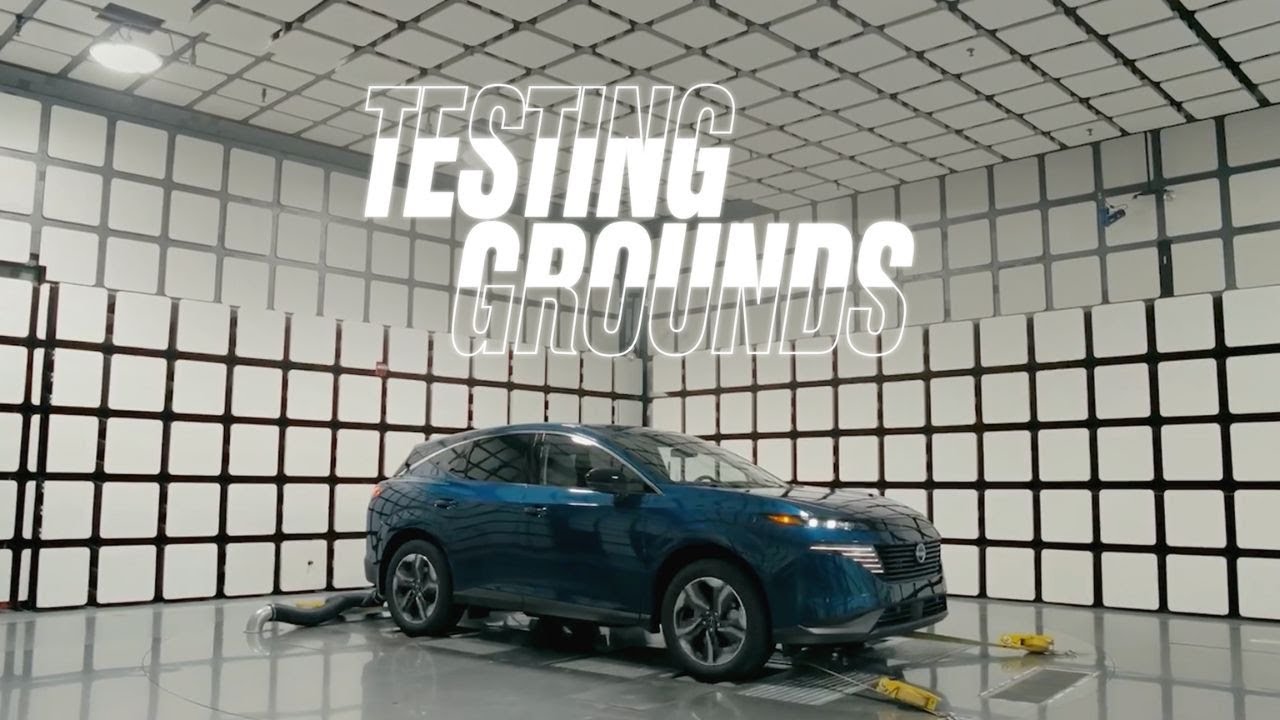
[Music] We don’t see sound, so it’s easier to forget about. But when there’s too much or not enough, it’s all you can think about. My name is Michelle K and on this episode of what it takes to build a Nissan, we are at Nissan’s technical center in the Motor City, Detroit, Michigan. And we’ll be exploring the unseen, influential, life forming world of sound. We are going to meet engineers dedicated to keeping unwanted sounds out and making our desired sounds enter our brains at the highest quality possible. We want to deliver perfection to the customer, translating to zero squeaks and rattles. So, what is this roof? Uh, we call this the environmental chamber. It heats the car up to as high as 110° F and then cool it down to as low as -40° F. Oh my gosh. So it’s instantly hot. Instantly. It is intense. Wo. Parts behave differently at different temperatures. So these temperatures present different normal noises a car might produce. We subject the vehicle to virtually anything it can experience out in the field. And we also, so to speak, shake the out of it. We can simulate tens of thousands of miles of usage. Oh. Oh my gosh. Okay. So, while this is happening, what are you looking and listening for? Well, we’re going over a really rough road surface. We’re looking for noises. We don’t want to hear any. Do you hear anything? I am hearing something. Try that. You actually use a stethoscope. We do when we need to. [Music] Oh my gosh, you found it. The Morano is such a quiet car, we actually had to plant something in there for you to be able to hear any noise. Old cars were loud by default. Since the very beginning of the creation of the car, scientists and engineers have been working on ways to make the car quieter. A room completely sound treated to eliminate echoes. And so started a centurylong mission to hush the ride for drivers. and everyone nearby. So, Baroo, what is this room? This room is called a Hemiianoid chamber, and we use it for testing acoustic performance of cars. Oh, wow. This is so cool. As soon as we walked in here, it felt like a vacuum sucked out all of the sound. Yes, it’s so quiet in here. So, what is the engineering purpose of this room? To test a vehicle sound package. Every material we put in this car. Carpets, the dash insulator, the roof headliner, the the door panels, the luggage compartment of the car, it’s layered with sound deadening materials or sound absorbing materials. So, we test how efficient those are. And then we also test how the car will behave when in the presence of all the sources of noise around the car while you’re driving it and how quiet the interior will be for the occupant. Explain to me how you simulate the exterior noise on the inside of the car. We use the principle of acoustic reciprocity. So we put the speaker inside the car. So it’s in here. It’s in here. This is not like any other speaker I’ve ever seen. This is crazy. Connor, could you please turn on the volume velocity source? Now you want to hear it. Okay. So, this is what we’re trying to measure. The volume inside and the volume at any microphone outside the car. And the bigger the difference, the better the sound packaging. That was a pretty big difference. Yes, it is. That’s amazing. [Music] By the 1960s, home hi-fi systems were just taking off. And cars, they were getting serious sound upgrades, too. And to this day, Nissan has been partnering with the very best in the audio business to deliver exhilarating, immersive sound you can feel. Patrick, I didn’t scare you. I’m Michelle. Nice to meet Patrick. Nice to meet you. Welcome to the audio lab. This is where all the fun happens. We understand that the vehicle is one of the top places where people listen to their music. So, we want to make sure it’s the best it can possibly be. The one of the ways we do that is we have a six microphone array. So, these six microphones collect sound waves at different frequencies. Provide a more complete picture. More complete picture. Yeah. Exactly. Binaural head. There’s two microphones in there and that captures everything you need to know about the audio scene. So, you got to make sure that’s all correct to get the most realistic sound in the vehicle. Oh, it feels like a real ear. That is so strange. Yes. But I guess it’s the type of precision you want for the collection of this data. For sure. The shape of the ear, the shape of the head, all that plays into what you hear. Okay, let’s go listen to the Morano. There’ll be a point where all of a sudden everything will just kind of pop. It just pulls you in. Everything sounds very detailed and it’s like, wow. and it gives you the the goosebumps, stuff like that as well. Okay, we’re on to something. We’re on to something. And that’s what we’re looking for. Now that we’ve gotten to know each other a little bit, I get the sense that you’re the kind of person that likes to really jam out in the car. For sure. Yeah. The car is like un unlike any other place you can listen to audio. It’s very intimate. It pulls you in. Bass is so fun to listen to. It’s amazing. So, let’s turn it up and enjoy. Okay. Heat. Heat. [Music] [Music]
We can’t see sound — but when there’s too much…or not enough, it’s all you can think about. Join us and @MichelleKhare in seeing how Murano became a masterclass of quality in sound.
Subscribe to the Nissan USA YouTube channel:
https://www.youtube.com/user/nissanusa?sub_confirmation=1
Connect with us online:
Website – https://www.nissanusa.com
Facebook – https://www.facebook.com/NissanUSA
Twitter: https://www.twitter.com/NissanUSA
Instagram: https://www.instagram.com/NissanUSA
Pinterest – https://www.pinterest.com/NissanUSA