EVs – Per Mile Tax – Why 2028?
You may have seen in the UK news last week that a per mile tax is going to be introduced for plug-in vehicles. If introduced, the tax would take effect from 2028. But why 2028? If like me, you wondered why that particular year, then stay with me. I’ve done some estimation and I think I understand that decision and I’ll share what I found today. Hello everyone. I’m Andrew and today I want to share with you some estimations I’ve created. Estimations that I think explain why this new tax would start from 2028. When I first saw the news, and I should say a big thanks to Dawn for sending it to me, I wondered if the introduction of this new tax might be a bit premature. It’s not a surprise that a tax of this nature would be introduced. Of course, after all, fuel duty is very high in the UK and thus an important source of tax revenue for the government. But what went through my mind was more about when it should be introduced. At the moment, we’re busy trying to get the transition to EVs done to encourage people to try an EV when otherwise they might not consider doing so. Furthermore, the manufacturers are pushing back, constantly lobbying to hang on to the status quo, claiming that people don’t want EVs when in reality, some of them just don’t know what they want or haven’t changed their cars recently. Introducing an additional tax at this point might make the transition harder. It might give the manufacturers ammunition to use in their lobbying, allowing them to say that they’re not being supported in making this change happen despite the somewhat hurried introduction of the electric car grant earlier this year. That led me to investigate the shortfall in tax revenue from the introduction of EVs. How much money is the government missing out from at the moment and how does that change as the delivery of the ZEV mandate progresses? There are several figures we need to consider when measuring the transition to EVs. At least two percentage figures that can be used to gauge its progress, and they’re easy to mix up. The first, which I regularly discuss on the channel, is the percentage of new car registrations made up of EVs. That’s something we track through new car registration figures from the SMMT, the Society of Motor Manufacturers and Traders. That was 25.4% 4% for the month of October 2025 and is likely to be about 23% for the year of 2025 as a whole. That’s up from 19.6% in 2024. However, there is a second metric that matters. Indeed, it might matter more for the government, and that’s the percentage of EVs in the total car fleet. The percentage of all of the cars on the road. That percentage lags behind new car sales of course as cars have quite a long lifetime about 17 years on average in the UK. The total proportion of the UK fleet that is EVs is only going to be about 4.6% at the end of 2025. That’s not all that much yet, but it’s starting to grow pretty fast as we’ll see in a minute. And that’s a problem because of the tax revenue that is lost as a result of the current incentive mechanisms on EVs. There have been several tax breaks on the running costs of EVs over the years, two of which we’ll discuss today. Firstly, road tax, formerly called vehicle excise duty. Road tax on EVs has been free for many years, but started to be charged at £195 per car this April 2025. So this tax now generates some revenue. The second tax break for discussion today is fuel duty which we weren’t paying because in an EV we don’t use fuel. This is the loophole that the new per mile tax is intended to tackle. To understand how big a problem this was going to be, we need to do some estimation. Before I show you the figures, first a few simple caveats. Firstly, in order to keep things simple today, I’m going to ignore inflation. I will use 2025 figures for all of the amounts of money, both past and future. That makes the numbers a bit inaccurate and more so the wider out we go from the current year, but not enough to worry about in what we’ll find. Secondly, I’m also ignoring the difference between calendar year and tax year for the purposes of the estimates. That too clearly makes a bit of a difference for the purposes of tax. But again, I’ve chosen simplicity over accuracy here. As a result, the figures I show are estimates, not detailed predictions. To make it very clear what figures I am estimating, I have used the color red plus the font weight of bold for anyone who can’t see that color. If you want to understand in detail exactly how the figures were all obtained, more detail than I include here, then the sources of all of the information I used are in the description. Right, it’s time to see some numbers. This first sheet brings together some figures we can look up and need in the calculations. We can see here that there are two rates of fuel duty as a temporary reduction of 5 p per liter was introduced during the fuel crisis in 2022 and thus applies from April 2022 until March 2026. Fuel will be more expensive again after that. Next, what we need to do is understand the size of the EV fleet. We’ll use that as the other input for our calculations. Figures from 2010 to 2024 are based on the government’s own vehicle licensing figures, but the values from 2025 to 2035 are estimates using growth driven largely by the UK’s ZEV mandate. You’ll notice that I put the ZEV mandate percentages in column two, but then estimated a more realistic figure in column three that is used for estimation of new car sales. The difference represents the flexibilities allowed for in the ZEV mandate, which includes alternative ways for manufacturers to earn EV credits, something I covered in another video that I’ll link to from the description, as well as from the end screen of this one. The real mandate percentage gives us the number of new EVs that we can expect to be sold in each year. And I’ve created a simple formula to estimate the number of EVs that will reach end of life. either through failure or because of being written off in accidents. The previous year’s cumulative total plus the number of new cars less the number of cars scrapped in that year gives us a projection of the cumulative size of the EV fleet. I’ve shown that as a number but also as a percentage of the total fleet largely for interest. However, from that percentage, we start to get an understanding of the exponential growth that the ZEV mandate brings about. Until this year, EVs were a pretty small part of the total car fleet. But the proportion of cars on the road that are EVs starts to grow pretty quickly from here, exceeding 34% in 2035, just 10 years time. We can now use this estimate for the fleet size to calculate the tax deficit that EVs cause both from road tax, a deficit which has now all but stopped, and also from fuel duty, which is still an ongoing problem. It’s this table that helps answer our question, why introduce this new tax from 2028? Well, 2028 would be the first year in which the deficit from a single year would exceed 2 billion pounds. A graph of the deficit helps explain why the change was needed at all. The loss of revenue each year is now clearly visible as an exponential growth curve and gets out of hand pretty quickly as the overall EV fleet grows and fuel duty is lost from the ICE cars that reach end of life. The reintroduction of road tax called veed on the graph helped a bit but not much. Given the existing tax deficit that Chanter is struggling to manage this year, it’s not really a surprise that an additional tax on EVs was due. But the size of the deficit growth from reducing fuel duty explains when it needs to kick in. Here’s a table of the estimated revenue from the new per mile tax just from EVs. I should mention and the deficit that will still remain after the introduction of the change. Pause the video if you want to see the details of that. But here it is in graphical form to make it a bit easier to visualize. This shows the before and after for this one change in the same graph. Before the change, the line went significantly higher by 2035 and was also quite a lot steeper. The line after the change is still going up, but less quickly. But if that line is still going up, if there is still a deficit, does that simply mean more to come in the future? Well, of course, that’s a bit more complicated to predict, but probably yes. There are a couple of taxes not shown here, things that can affect the wider economy that we can’t see on the graphs. Firstly, we pay a bit of VAT on electricity. all electricity, including that used to charge our cars. Therefore, we already pay a bit of tax on the use of EVs, but only a bit in comparison to the huge amount we pay on liquid and gaseous fuels. Having said that, we pay 20% VAT on any public charging. So, that adds to the coffers, too, and a bit more than you might expect, but I’ll come back to that in a minute. We expect additional electrification in the future. For example, the electrification of heating and industry, but income from the VAT on that really only offsets the loss of VAT on natural gas in many instances. There’s not much gain there. However, I mentioned a few moments ago that the reduced rate of fuel duty is set to end in March next year. We haven’t taken that into consideration in our graphs. Here’s an updated table showing the effect on revenue from fuels and road tax. 1.8 billion pounds per year extra tax as a result of that change to fuel duty. Although this dwindles as the proportion of ICE cars in the fleet drops away. So if we add this as an extra change to our calculations with the new per mile tax, then things look a little rosier. There’s actually a small surplus in the tax revenue for a couple of years. those years from 2026 to 2028 where the deficit is a negative number but it starts rising again after that. In order to understand the future changes to tax, let’s change tax slightly and look at the taxes we pay per mile for each type of car. Let’s start with what we pay for ICE cars at the moment with and without the fuel duty reduction. This bit is just from fuel duty without VAT. What we’ve got here is the fuel economy of the car down the side and a couple of columns showing the fuel duty calculated per mile. Both with the fuel duty reduction we get this year and without it for 2026 onwards. We can see that for an efficient car at the bottom of the table, we pay 4 p per mile this year and 4.4 4 p per mile when the temporary fuel duty reduction is removed. Again, as the car gets less efficient as we go up the table, the cost per mile goes up. That’s because we get fewer miles out of each gallon. And for a car getting just 25 miles per gallon, the cost per mile is 9.6 p in 2025 and 10.5 p from April 2026. Next, we can calculate the VAT we pay on fuel in a similar table like this and then add the two together to give us a total for the tax on fuel for an ICE car, ranging from 5.7 p for an efficient car in 2025 to 14.7 p for an inefficient one in April 2026. Now, let’s look at the VAT from EV charging first when on the public network. Here I’ve put the price of charging across the top of the table showing some of the different figures we might find across the various networks we have. The second row shows the proportion of that per kilowatth price which is VAT. As before, there are then different rows for different efficiency and how the VAT splits per mile based on those efficiencies. As you can see, the price of public charging varies wildly, and as a result, so does the VAT we pay per mile. It ranges from just 1.2 p per mile in an efficient car if we can find super cheap charging. But most public charging is much more than that, and we can end up paying 7.4 P per mile just from VAT in an inefficient EV. This next table is the same again for public charging once more, but this time with the proposed per mile tax added. Now it ranges from 4.2 p to 10.4 p per mile as you’d expect. Those are not insignificant in terms of revenue for the government, but the home charging figures look very different. Very little before the per mile tax is added and still very small even after it. Let’s summarize all that lot considering how things look after the impending rise in fuel duty early next year. For an ICE car, we’re paying somewhere between 6.1 and 14.7 p per mile in tax. For an EV, even with the new per mile tax applied, all of the figures are lower. Most EV charging happens on the AC network where prices are lower, especially if you can charge at home. What’s more, because VAT is calculated from a percentage of the charging price, if charging prices were to fall, then so would revenue. That’s a risk for the government that they probably can’t afford to take. So from this table, we have to conclude that there will be more tax to come. The per mile tax will have to rise again at some point, probably in or around 2030. I’ve whipped through that section a bit. Hopefully, you managed to keep up. However, if you want to review the figures more slowly, then rewind to the appropriate moments in the video. You can always pause to see the tables in more detail. In summary, this tax isn’t really a surprise. I expected it to come a bit later. I thought the incentives might last a bit longer to help the transition along its way. However, when you see the deficits, you see how big the gaps in the finances get and how soon they become very large numbers, then the need for the change being introduced from 2028 becomes more obvious. If we were to take the additional income from next year’s fuel duty rise into account, then it might appear that we could delay the additional tax on EVs. However, the reality is that the money from that is already accounted for somewhere. It’s a small positive figure in amongst all of the negative ones that Rachel Ree is juggling at the moment. No, sadly not. This has to be done. It seems to me that the charge being introduced is reasonable. It’s less than it could be. Indeed, it’s less than it will need to be by 2030 or so. And the timing of its introduction does make sense. There is an alternative, of course, namely to put up fuel duty again in 2027 or 2028. However, that’s not going to be acceptable politically. That just upset too many drivers. This time, it’s us EV drivers in line for a new tax. With a smaller proportion of the electorate at this stage, fewer voters being affected by the change and it sets an important precedent for the future. I think it’s a fairly crude move politically. Get the tax in while it affects a small number of people and then tweak it as needed at a later date. Oh, and I should say that this new tax applies to plug-in hybrids, too, at least to some extent. I haven’t taken them into account when talking about future revenues, but that’s because I don’t see plug-in hybrids as the future. This tax might just be another nail in the coffin for them as it happens. They suffer the forthcoming rise in fuel duty and the per mile tax two years later. In my eyes, the hybrid is at best a transition drivetrain. Just a small step towards a bigger goal, one of electrification. It is after all called the electric transition. Anyway, that’s my thoughts. Now over to you. What do you think about this news? Were you expecting this tax? And if so, were you expecting it this soon? Let me know in the comments below. I’ll be very interested to see what you have to say about the proposal, whether you think it’s accurate and whether it’s proportionate. If you’ve liked this week’s video, then it will be a huge help to me if you click the thumbs up button, and I would love to have you as a subscriber of the channel if you want to see more from me. Thanks.
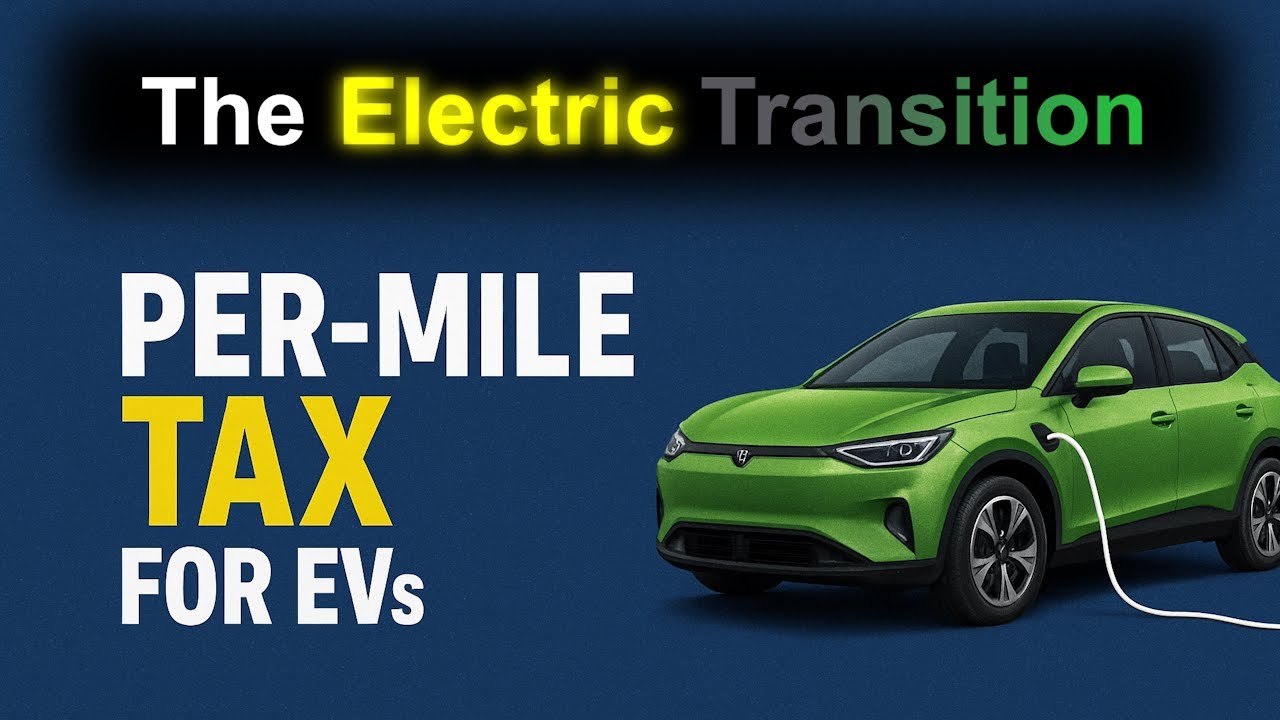
Join me as I discuss last week’s news that a per-mile tax is being considered for plug-in vehicles. If the tax is introduced, it will apply from 2028. But why 2028?
This is the latest in a series of videos sharing my knowledge and experience with electric cars. EVs have improved immensely over the last few years, and we are at a point where I think the majority of people can make the switch to electric.
00:00 – Introduction
00:27 – Why introduce a tax?
01:03 – The risk of early introduction
02:02 – Measuring the transition
04:19 – Caveats
05:21 – Two rates of fuel duty
05:49 – Fleet size estimates
07:40 – Current tax deficits
07:54 – Why 2028?
08:50 – Revenues after the change
09:28 – Can we expect further taxation?
11:27 – Comparing per mile taxes
11:37 – Fuel duty from ICE cars
12:34 – VAT from fuel sales
12:42 – Total ICE fuel taxes
12:56 – VAT on public EV charging
13:51 – EV taxes when public charging
14:10 – EV taxes when home charging
14:20 – Side by side comparison
14:42 – The risk of VAT income
15:04 – Conclusion: more to come
15:31 – Summary
17:16 – The sting in the tail
Videos mentioned in this one:
UK ZEV Mandate – Target Hit or Target Miss? – https://youtu.be/7Sv-vuk6cLk
EVs – The UK ZEV Mandate – https://youtu.be/FXbSOcDuf0o
Total registrations
https://www.gov.uk/government/statistical-data-sets/vehicle-licensing-statistics-data-tables#all-vehicles
Total EV Fleet Size By Year
https://www.gov.uk/government/statistical-data-sets/vehicle-licensing-statistics-data-tables#plug-in-vehicles
Average UK MPG (Car)
https://www.nimblefins.co.uk/cheap-car-insurance/average-mpg
UK Fuel Duty
The aim of my channel is to provide knowledge and plain speaking about the transition we all face. I hope you will join me for other videos on the move towards a renewable energy future. I will be covering plenty more about EVs, but will also be sharing my experiences as I look into energy generation and electric heating.