Jetour T2 IDM Full Review -How Efficient is it Really?
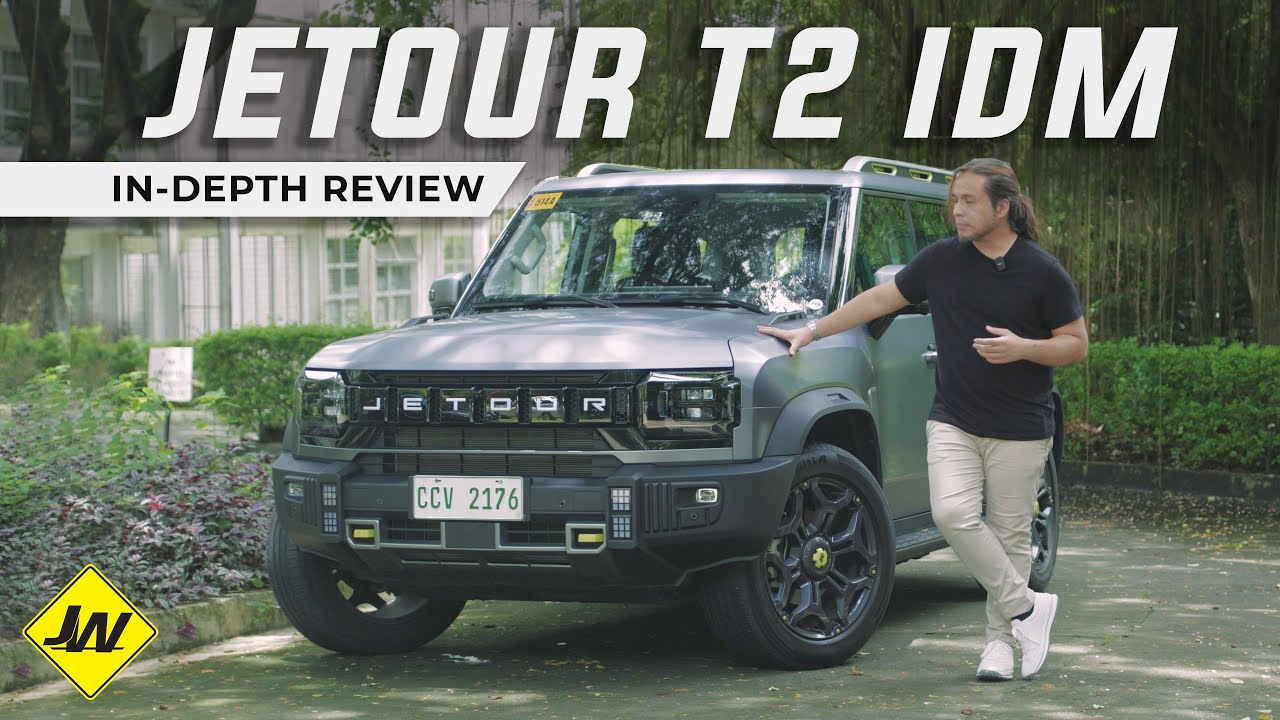
So, you want a massive and rugged SUV that can turn a lot of heads, but you also want it to be green, and you want good fuel economy. This is the T2 ID, and it might peak your interest. [Music] Is it worth your money? Let’s find out. Now, most hybrids and plug-in hybrids try to look sleek and futuristic. The T2 IDM goes in the opposite direction. It looks boxy. It looks upright. It almost looks like a military vehicle, but with a touch of class. It’s a seamless combination of modern and retro. You have these boxy looking uh panels over here, but you have these modern looking headlamps and this modern looking grill with the Jour logo on it. And as you’ll see later, this is loaded with tech. The proportions of the Jur T2 IDM are unlike most vehicles that you’ll see on the road. It is very wide. It is very boxy. It is wider than most PPVs. It is wider than the Everest, but it’s not quite as long. Now on the outside, the Jour T2 IDM looks almost identical to the regular IC JTOR T2. [Music] You get the same LED headlamps, the same chunky plastic bumper over here, the same 20-in wheels wrapped in 255 series GT tires. Of course, you get disc brakes on all four corners. This also gets independent suspension on all four corners. uh a McFersonen setup at the front and a multilink and a multilink setup at the back. Yeah. You also get these yellow accents on the wheels like you have yellow screws and that yellow center cap over there. You have these tie down points over here which make it look like a proper off-roader. Of course, the side mirrors are power folding. You also have cameras here for your 360 camera system. Functional roof rails up here with yellow accents. You have this plastic stepboard over here. It’s a very rugged and very mosh looking SUV. Now you can really appreciate how wide the T2 is from this angle. Um it all it’s almost pyramid shaped. It’s very very wide at the bottom and tapers towards the top. You get these huge vertical blacked out LED tail lamps over here. And you get the same rectangular LED pattern that you see on the headlights. Retro futuristic theme. The T2 IDM comes with a rear-mounted U spare tire. Now this is not a full size spare tire. You have your rear camera mounted on the spare tire cover over here. Also, in keeping up with the retro theme, you have these exposed fake hinges over here. From the outside, the T2 IDM looks almost identical to the to its IC counterpart. Now, one way of knowing that you’re looking at the T2 IDM is that the T2 IDM has this hatch over here, which can be difficult to open for some reason. Okay, you have to unlock the door first. Okay. Now, now the T2 IDM comes with a type 2 CCS2 charging port, which is the most common uh standard here in the Philippines. Now, unlike other PHVs like the C Lion 6, the T2 IDM comes with a DC charging port, so you can fast charge the battery. Charging through the DC charging port will take about half an hour from 30% to 80%. Now, when using AC charging, that goes up to about 4 6 to 8 hours uh from 30% to 100%. The T2 IDM comes with a pretty big 26.7 kWh battery, which is good for 139 km of EV range. So the battery is located on the flooring of the T2 IDM and that ensures that it doesn’t affect the cargo capacity and the cabin capacity of the T2 IDM. [Music] Okay. So while the regular T2 um IC and the T2 IDM look very identical on the outside, under the skin they are quite different. While the ICT2 comes with a 2 L turbocharged engine, the T2 IDM comes with a smaller 1.5 L 4-cylinder turbocharged gasoline engine. The Jour T2 IDM has a 1.5 L engine that puts out 154 horsepower and 220 Newton m of torque coupled to an electric motor that puts out 165 kW and 390 Newton m of torque. Now, Jutoroa Philippines didn’t give us the combined output, but according to online sources, the front-wheel drive T2 IDM puts out a combined 380 horsepower and 610 Newton m of torque. The door opens electronically. You have to press this button over here to open the door. And it takes about a second before it responds. So, if I press it now, that’s how long before it opens. Also like the T2 IDM, you got a lot of toys here, like you got these cup holders. You have these hooks over here for hanging your groceries. You have a bottle opener over here. Thanks to the floor mounted battery, the cargo space of the T2 IDM is exactly the same as its IC counterpart. It’s a square shaped space, which usually means more usable cargo volume. The rear door also has a soft close mechanism. Like the ICE T2, the T2 IDM also looks very nice on the inside. But before we talk about the interior, let’s first hear a word from our sponsor. Introducing the AutoSport mobility scooter, the world’s most innovative mobility scooter. It folds into a small suitcase size and it has wheels so you can move it around like a trolley. It separates into two parts. It has leather seats and grips, an illuminated LCD dashboard, enhanced lighting for extra visibility. [Music] You can install optional armrests. It’s perfect for seniors as it’s easy to lift and unfolds in seconds. It has a maximum speed of 10 kph. Shock absorbing flat free tires. High ground clearance. Advanced braking system. Be free to travel anywhere, land, sea, or air. [Music] It has 20 km of continuous driving range. Engineered with flare. Designed with passion for performance. Be active. Be free. Be yourself. Atalosport. Moving life. [Music] On the inside, the the retro futuristic theme continues. Like you have these exposed screws on the door cards, [Music] but you also have plenty of high-tech stuff. Uh you have this huge 15-in screen over here. You have Android Auto. You have Apple CarPlay. You also have a 360 camera system. Um, you have ambient lighting. [Music] Uh, yeah, it looks rugged, but it also looks premium. [Music] [Music] Almost everything here is covered in soft touch material. This is soft touch right here. This is leather wrapped. The entire door siding is covered in soft touch materials. This is soft right here. This is leather wrapped. This is leather wrapped. Even the grab handles are soft padded. You also have plenty of aluminum looking accents all over the car. The door opener is dampened as you can see. You have leather seats, both of which are power adjustable. You have seat ventilation. You have adjustable number support. The steering wheel is leather wrapped. It doesn’t just have a flat bottom. It also has a flat top. Yeah, you have a wireless phone charger over here. Um, you have multiple buttons here on the center console. You have your uh camera button here. You have your knob for selecting different drive modes. You have your AC button over here. You have this huge crystal shifter over here which feels really solid on the hands. Terms of storage, you have a decently sized glove box. You have a bit of storage here for your phone. You also have your USB ports over there. You have one USBC port, one USBA port. Um, actually you have four USB ports here. You have two on this side, two USBA ports, and two on this side, one USBA and one USBC. You have plenty of storage underneath the center armrest. And this also has an air con vent in here. So, this can double as a chiller for your drinks. Uh, you have two cup holders over here. This also looks almost identical to the interior of the of the IC T2 of uh except of course that we get additional pages here for your hybrid system. Okay, so let me show you around the settings of the car. This over here is your page for your hybrid settings. So here SOC settings or state of charge settings. That’s where you manage how much battery you want to conserve. Like right now we’re set to 50%. So, as long as the battery level is above 50%, it’s not going to prioritize uh conserving battery conserving battery power. Once you reach 50%, it’s going to try to maintain that battery power. So, the engine will turn on a lot a lot more often. So, you can also set the energy recovery level. You can set it to weak, middle, or strong. Um, you can also set it to HEV or EV modes. Basically, if you’re in EV mode, the car will use battery power until the battery gets to a certain level, and usually that’s about 20%. In HV mode, the car automatically decides when it’s going to use battery power alone, and when it’s going to turn on the engine. You have a full suite of ADAS features here, like you have adaptive cruise control, lane keeping assist, and you can turn all of them on or off if you don’t want them. Now, space here at the back is pretty adequate. I have a lot of knee room over here. Uh that’s about a sang dangal or uh 6 and 1/2 in. In terms of toys, you have two USB ports over here, one USBA and one USBC, two air convs. You get plenty of grab handles. You also have this foldable armrest with two cup holders. It is very nicely padded. You have a bit of storage over here. Your flooring is completely flat. You also have plenty of pockets here on both front seats. And you get a panoramic sunroof which extends all the way to the top of my head. If you’re coming from traditional diesel PPVs like the Fortuner, the T2 might feel like alien technology. It is so much more refined, so much more hightech, and so much more quiet. It’s also a lot quicker and the way it accelerates is different from most IC vehicles in the sense that the torque is instantaneous. There are no perceptible gear shifts and you don’t hear the corresponding engine noise, even when you’re in hybrid mode. By the way, the transition from HV to EV mode is almost imperceptible. You can barely tell that the engine is running. Now, testing the fuel economy of a plug-in hybrid can be tricky because it can be as low as zero. keep left if you keep the battery charged. So, this has a range of about 140 km and for that distance, your fuel consumption could be as low as zero. So, this is how we’re going to do our test. So, currently the battery is about 58% charged. We have about 80 km of range on the battery. So, we’re going to drive in EV mode, test the car’s energy consumption in full EV mode, and when the battery goes down to about 20%, it should automatically turn the engine on. and then we’ll test the fuel consumption of the car when the battery is fully depleted. The main advantage of PHVs over regular hybrids is that you can charge from an external source and therefore you’re not entirely dependent on the engine for charging and so you can use the vehicle as a pure EV if you want to. We’re going to drive the T2DMI from QC to Bali Bulakan. That’s about 40 km without using a single drop of fuel. We’ll check its energy consumption and how accurate the gauge is. Okay, we’re now at NX. We’re going to reset everything. Our current range is 76 km. Reset. I think tonight I wake up tired and terrified. Started feeling weak. You grind your teeth. Can’t hide your bloodshot eyes. talking in your sleep cuz we’re on a losing street. Oh, we’re in good company. Okay, so we’ve done about uh almost 15 km now. We still have a range of 59 km. So, the range estimate tends to be more or less accurate on the highway. Um we still have about 29 km to go before we get to our destination. bro. So far on the highway, it is it is very quiet. Of course, we’re only using the electric motor. Uh but there is minimal wind noise considering the fact that it’s a it’s shaped like a box and you have huge tires here. There is minimal wind noise and tire noise. And of course, there is no engine noise right now because the engine is off. Um it the suspension though tends to be wallowy. Um it is soft and the and the center of gravity of the car is pretty high. So it can feel a bit wowy when you’re suddenly shifting lanes. The car feels quite topheavy and that’s because it is it is a tall off-road style SUV. The Jour T2 comes with a full suite of advanced driver assist features. We get adaptive cruise control here. To turn it on, just press this button over here and press set. And now I’m not stepping on the gas. I’m not stepping on the brakes. The vehicle will automatically control my speed depending on the on the speed of traffic ahead of me. Now the adaptive cruise control of the T2 has a stop and go function. So it can go all the way down to zero if it has to. By the way, my right foot is not doing anything. If you can see, the vehicle is automatically driving itself right now. Now, it’s also supposed to have lane keeping assist, although I can’t seem to get it working on this particular vehicle. [Music] Okay, so we’re now near our destination. We have done about 32.8 km. Um, we still have a range of 38 km. Exit right and our average energy consumption is pretty high at 17.7 kwatt hours. Okay, so we’re now in Badiwag Bulakan. Uh we drove here from Quzon City. We traveled a distance of 43.1 km. We still have a range of 26 km. We traveled at an average speed of 71 km/h. Um our average energy consumption is pretty high at 18.9 kwatt hours per 100 km. Our fuel consumption is zero. We didn’t consume any fuel uh during this entire trip. On the way back, we will be consuming fuel because we only have uh 22% battery charge remaining. When it goes below 20%, the engine should automatically turn on if you still have fuel. Ah, we’re here. This is our destination. You have reached your destination. Going to a coffee place here in Bad Bulakan. I discovered this randomly while I was shopping for a piano and it’s pretty good here, man. Good ambiance, good coffee, good prices. Anyway, let’s study the data first before we have coffee. Okay, so the car will give you various information like like your average energy consumption here. Um, Yeah, we did 19 we did 18.9 kwatt hours per 100 19 km and that is a pretty high number. Um, but this but of course this is a pretty big car. It’s heavy. It’s also not very aerodynamic. And we were traveling we were cruising at about 80 90 kph sometimes even sometimes even at 100. We did 43.6 km 43.6 6 plus uh 25 km 68.6 km. So we are short by about um 7 km. So on the highway if you’re going to travel at about uh 80 90 km/h expect the actual range to be a bit lower than what’s displayed on the screen. But I’ve tested this in the city with in light traffic and it seems to be more or less accurate. I know sooner or later it will come. I’ve now had my coffee. We’re going to go we’re going to head back to Gason City. Uh we still have about 20% left on our battery charge. The engine should automatically turn on in a couple of minutes now. Look at my window to see what the universe has in store for me. People passing by and the street will be smiling at me. Okay, so we’ve done about 30.3 km. We’ve been driving in HV mode. We’re letting the car automatically manage the power consumption and so far we’re getting about 6.3 L per 100 km. We started the trip with the battery at 20% which is the state at which the engine turns on. This is the kind of fuel economy that you would expect if you don’t charge your battery and let it run down to uh the minimum level which is still pretty good. 6.3 L per 100 km on the highway at an average speed of 72 kph. Yeah. So, these are our stats right now. You can see um for the entire time the engine was running. It didn’t turn off even when I was even when I was coasting. And I don’t know if that’s because it’s trying to charge the battery faster. The battery is currently at 27%. So, we are we are above the minimum 20% level. But yeah, we’re letting the the car manage its its energy consumption. We can set this to EV right now if we wanted to, but yeah, we’re going to let the car decide on its own when it’s going to turn the engine off. And so far, it has not turned the engine off. It’s on the entire time. As you can see, when you’re in HDB mode, the engine will remain running when you’re at highway speeds. At least that’s how it was when it tested the vehicle with a battery below 30%. So, I got about 16 kPL, but if you average the two-way trip and I had zero consumption on the first half, that’s about 32 kPL both ways. Driving the T2 in full EV mode can cost significantly less than running a comparable diesel SUV, but only if you charge at home. Take the Ford Divers 4×2 for example. It does about 16 kPL on the highway at 58 pesos per liter. That’s 362 pesos per 100 km. If you drive the T2 IDM in EV mode on the highway, it would cost you 245 pesos per 100 km at 13 pesos per kilowatt hour. Now, it does support DC fast charging. But with most DC chargers costing about 35 pesos per kowatt hour, the cost advantage disappears. In fact, at those rates, running purely on electricity could actually cost more than running on diesel or gasoline, at least on the highway. Where plug-in hybrids really shine is in heavy city traffic. Electric motors are just more efficient in stopand go conditions. They don’t use energy when you’re adding at a stoplight. Unlike combustion engines that continue to burn fuel even when you’re at a dead stop. While the Everest might consume twice as much in heavy traffic, it does 8 kPL in moderate traffic and about 6 kPL in heavy traffic. The T2 in EV mode will consume roughly the same or even less depending on your driving habits and traffic conditions. The Jour T2 IDM sells for 2,488,000 pesos. That’s almost the same price as the regular IC2 Beyond. The IDM gives you better fuel economy and CO exemption, but you give up four-wheel drive capability. That said, the four-wheel drive system on the ICT2 is really more for soft roing. If you want to take on serious off-road trails, I would still recommend a proper 4×4 PPV or something more purpose-built. But if hardcore off-roading isn’t your thing, you just want a rugged look, then the IDM might float your boat. Now, 2.4 million pesos is on the expensive side compared to other 5-seater PHBs in the market. It’s not exactly fair to compare to the Cine 6 because they’re very different types of vehicles. But even if you ignore the styling and size differences, the T2 IDM is simply packing a lot more stuff. You get a more powerful engine, more EV range, you get DC fast charging, and you generally get a more premium execution. Anyway, I like the T2 IDM. And if I had this much to spend on an electrified vehicle, this would be one of my main contenders. I like how it feels on the road. I like its size, but mostly I like it because of how it looks. And I know that’s subjective and hard to quantify, but it’s a major consideration for a lot of buyers. In terms of tech and overall feel, the T2 IDM is head and shoulders above mainstream PBVS. Sure, you can argue that plenty of Chinese crossovers offer similar specs at a lower price, but very few of them look and feel like the Jur T2 IDM [Music]
The Jetour T2 IDM might be the most macho looking plug-in hybrid that you can buy for the price.
In this video, we take a closer look at the Jetour T2 iDM, a rugged-looking SUV that blends off-road styling with plug-in hybrid efficiency. Priced at ₱2,488,000, the T2 iDM sits in an interesting spot among today’s PHEVs: tougher than most crossovers, but more advanced and efficient than traditional diesel SUVs.
Is it a smart alternative to mainstream PPVs? How does it compare to other 5-seater PHEVs like the BYD Sealion 6? And more importantly—does the T2 iDM deliver the balanced mix of style, tech, and real-world usability that buyers are looking for?
We break down the performance, EV range, charging capabilities, interior features, ride quality, and everyday practicality to help you decide if the Jetour T2 iDM is worth your money.
Subscribe and click on the bell button:
https://www.youtube.com/user/jaywalkur?sub_confirmation=1
follow me on social media:
https://www.instagram.com/lord_jaywalker/
FB: https://www.facebook.com/The-jaywalkur-620303224810492/
Website: www.jaywalkur.com