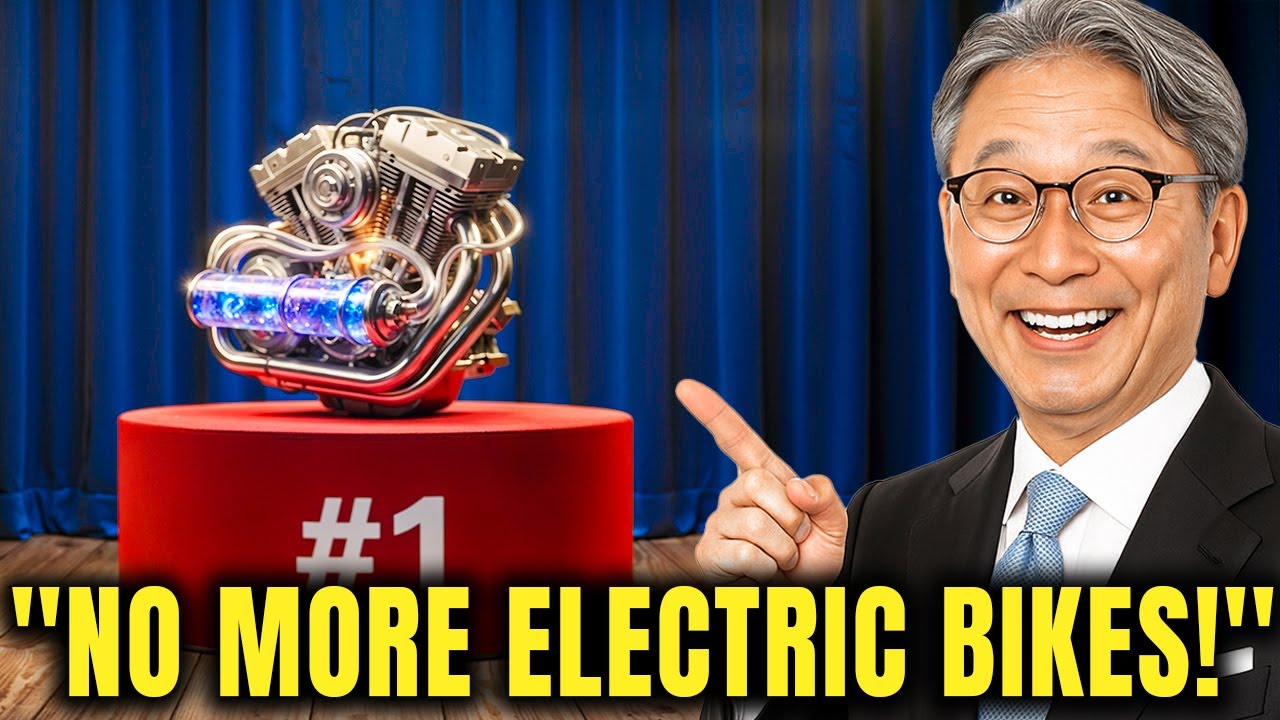
Honda CEO: This New Engine Will Shake the Entire Electric Motorcycle Industry!
Honda’s CEO just walked on stage and flipped
the script. No new EV, no fancy tech demo — just a quiet line that made every rival freeze.
“We’ve built an engine that ends compromise.” Nobody saw it coming. The whole industry’s trying
to figure out what Honda just unleashed — and why it could change everything we
thought we knew about power. Some call it rebellion. Some call it desperation.
But here’s the thing — if what insiders are whispering is true, the electric kings
might not be sleeping easy tonight. Stick around you’ll want to see why…
The Announcement That Broke Silence… No one expected Honda’s CEO to walk on stage and
throw a grenade into the electric revolution. For years, the industry chanted the same
gospel—batteries or bust. Then, in a calm Tokyo press room, Honda’s chief broke that silence with
nine words that turned every head in the business: “We have built an engine that ends compromise.”
The reveal wasn’t just another model or minor upgrade. It was the debut of a mechanical
comeback—the Seven Fifty Five cubic centimeter parallel-twin engine, a unit so efficient it
threatened to rewrite what “electric advantage” even means. The CEO called it “the most balanced
powerplant Honda has ever made,” but the subtext was louder: We don’t need cords to go clean.
Instantly, the internet exploded. News anchors called it defiance. EV investors called it
denial. But inside the motorcycle world, something stirred. Veteran riders who felt left
behind by the electric wave suddenly leaned forward. Could Honda really challenge the silence
of EVs with something stronger—and smarter? Behind that stage smile, Honda’s chief wasn’t
bluffing. This wasn’t nostalgia dressed as innovation. It was a declaration that performance
still matters, that the engine isn’t dead yet. But to understand how one announcement
rattled every rival, you have to see the battlefield Honda just walked into—and
the timing that made it lethal… Why It Matters Now…
Every manufacturer from Milwaukee to Munich was sprinting toward the same finish line—electric
dominance. Governments promised subsidies, investors demanded range, and headlines sold
the fantasy of a silent, zero-emission future. But beneath the surface, cracks were forming.
Charging stations lagged. Battery costs climbed. Riders complained that EVs felt like “riding
an app.” Then Honda’s CEO lit the fuse. By unveiling a combustion-based twin that could
match electric efficiency while running cleaner and cheaper, Honda did more than introduce an
engine—it challenged the narrative. At a time when others were chasing algorithms, Honda doubled down
on engineering. The Seven Fifty Five twin offered torque without delay, range without anxiety, and
power without guilt. Suddenly, the “inevitable” electric future didn’t look so certain.
Industry insiders called it “a direct hit to battery dogma.” Markets wobbled. Dealers flooded
forums with one question: If Honda can do this, what’s next for everyone else? Even environmental
analysts admitted hydrogen and hybrid combustion might not be dead after all.
It was a classic Honda move—arrive late, then dominate quietly. In one morning,
the company reclaimed the spotlight, not through hype, but by reminding everyone that
machines can evolve without erasing their soul. And if that sounded like rebellion, it was.
Because this wasn’t just business—it was personal, rooted in the legacy of a man who built an
empire from grease, grit, and defiance. If you’re enjoying this breakdown and want more
honest stories the mainstream skips, make sure to like this video and hit subscribe. Join the
conversation below—real riders, real opinions, no fluff. Your voice keeps this garage honest…
The Roots of Rebellion… Long before Honda became a global symbol of
reliability, it was one man in a small workshop hammering out piston rings by hand. Soichiro
Honda believed machines should serve people, not impress them. When Japan was rebuilding
after the war, he didn’t design luxury toys—he built cheap, tough engines so ordinary folks
could move again. In nineteen forty-six he strapped surplus generator motors onto bicycles
and birthed the first Honda two-wheeler. It was crude, noisy, and absolutely brilliant.
That spirit never really left the company. Every generation of Honda engineering carried a bit of
Soichiro’s stubbornness. When others chased flash, Honda chased reliability. When emissions rules
tightened in the nineteen seventies, they answered with the CVCC engine—a design so efficient it met
American standards without a catalytic converter. Later, the VTEC system proved small engines could
run like big ones if tuned right. Those weren’t gimmicks. They were the results of engineers who
loved combustion too much to give up on it. Today, Honda’s same spirit drives the Seven Fifty
Five twin—rebellion wrapped in refinement. While others abandon engines, Honda evolves them.
For lifelong riders, this isn’t strategy; it’s a homecoming. The brand that built
their trust now proves innovation still comes from turning wrenches, not coding
lines—a living reminder that progress and heritage can share the same heartbeat.
And that philosophy runs straight through the man now steering the ship—the CEO who’s betting
the company’s future on old-school power made new. Everything that keeps my rides running
smooth — gears and tools — you’ll find it all in the description.…
The CEO’s Playbook… When Honda’s current CEO took the stage,
he didn’t sound like a salesman. He sounded like an engineer. His message cut through the
buzzwords that fill most tech presentations. He spoke about torque curves, combustion
efficiency, and real-world usability. He called the Seven Fifty Five “a machine
built to outlast trends.” In an age where every headline screams about digital disruption,
that kind of statement feels almost rebellious. He laid out three promises: more usable torque
across the rev range, longer range per tank than any previous mid-size Honda, and drastically
reduced emissions—all without a battery pack. The design blends lightweight materials
with smart airflow systems that reuse exhaust heat for efficiency. The idea is
elegant: use better engineering instead of heavier batteries to save energy.
Honda’s CEO claimed the new twin costs less than half an electric drivetrain, promising
affordable pricing and easy upkeep. Its design even allows hybrid or hydrogen upgrades—one
platform, many futures. The crowd cheered, but riders stayed cautious. Prototypes impress under
lights; reality tests on the road. Whether it’s a true combustion comeback or nostalgic marketing,
only time—and torque—will reveal the truth. To find out, we crack open the heart of this
new twin and see what it’s really made of… Blueprint in Steel…
When Honda engineers lifted the cover off the new Seven Fifty Five cubic centimeter twin, they
weren’t unveiling a gadget—they were revealing a blueprint for the next decade of mechanical
evolution. At its core sits a Unicam design, the same philosophy that powered their off-road
champions but now refined for the street. In plain terms, Unicam means a single camshaft managing
both intake and exhaust valves. Fewer parts, less weight, and faster breathing under stress.
That design makes the engine compact and incredibly responsive. Twist the throttle and it
reacts immediately, not with hesitation, but with a surge that feels connected to your wrist.
The balance-shaft tuning keeps that response smooth without dulling the feel. Many electric
bikes accelerate like silent rockets—instant, efficient, and soulless. The Seven Fifty Five
doesn’t try to imitate that silence. Instead, it keeps a heartbeat. The engineers reworked
firing intervals to create a rhythmic pulse, something riders can sense through the bars
and seat. It’s not vibration for the sake of nostalgia; it’s feedback—a mechanical
language between machine and man. The Seven Fifty Five’s torque peaks early
and stays strong through the midrange, delivering instant pull in traffic or on the
highway. Throttle response favors real-world control over numbers, creating confidence
and connection. Once called too clinical, Honda has built an engine that breathes,
reacts, and finally feels alive again. And the genius doesn’t stop at performance—it’s
in how Honda plans to use this engine everywhere, from streetfighters to tourers…
Built for Every Frame… Honda’s Seven Fifty Five twin isn’t a one-off
experiment. It’s a foundation. The company has built an entire modular platform around it—one
engine, many lives. The same heart that drives the CB Seven Fifty Five Hornet also powers
the XL Seven Fifty Transalp, and insiders say hybrid prototypes are already testing
with the same architecture. That’s not just smart manufacturing—it’s mechanical strategy.
By designing a powerplant that can adapt across different frames and riding styles, Honda cuts
production cost while maintaining consistency. Mechanics worldwide will service the same core
design, and parts will travel easily between models. It’s efficiency without cutting corners.
For riders, that means familiarity. Whether you sit on a naked street machine or a mid-size
adventure tourer, the throttle response, fueling character, and reliability feel
the same. It’s like hearing a familiar song played through different speakers—distinct
in tone, but unmistakable in rhythm. Honda once revolutionized biking with modular
inline fours; now the Seven Fifty Five twin revives that legacy. Liquid-cooled and
fuel-injected, it meets global standards without losing punch. Mounted as a stressed frame member,
it saves weight and sharpens handling. Honda’s philosophy endures—simplicity, strength, and pure
rider control over software-driven gimmicks. Of course, no story about engineering
brilliance means much until you line it up against the current king of the
hill—the electric contenders… Numbers vs Voltage…
Electric motorcycles promise instant torque and zero emissions, but the real-world math tells
a messier story. Take Harley-Davidson’s LiveWire or Zero’s SR models. Both deliver impressive
acceleration but need hours on a charger and cost a fortune to replace batteries. Honda’s Seven
Fifty Five twin may not plug in, yet when you look closely at the numbers, it challenges the idea
that electric automatically equals better. The new twin produces torque in the high fifties
pound-feet range, landing right where mid-tier electrics sit. The difference lies in how it
delivers that power. Electrics spike instantly then fade as heat builds; this twin pulls steady,
holding muscle through the revs. On a dyno, that means consistent acceleration instead
of quick burnout and drop-off. Over a one-hundred-mile ride, it maintains usable
energy without temperature throttling. Electric bikes demand costly software updates,
cooling checks, and battery replacements. The Seven Fifty Five? Just oil, filters, and valve
care—maintenance any rider can handle. Over five years, upkeep costs are one-third of a premium
electric, and refueling takes five minutes, not forty-five. Delivering seventy miles per
gallon, it proves efficiency isn’t digital. Honda answered the EV challenge the old
way—with real engineering, not code. And behind that confidence lies a workforce
that still treats engine building as a craft, not a code line…
From Factory to Road… Inside Honda’s production plants in Japan and
Thailand, the hum isn’t digital—it’s mechanical. The Seven Fifty Five twin is being built in
facilities retooled to balance precision with human touch. These aren’t sterile robot halls
filled with whirring arms; they’re workshops where craftsmen still measure tolerances
by feel. A machine might do the rough work, but a person does the final check.
Each crankshaft is balanced manually, each cylinder honed to a standard that borders on
obsession. Engineers from the original Fireblade program were brought back as consultants, teaching
a new generation that precision is a discipline, not an algorithm. Workers describe the
project as “a return to the sound of tools.” It’s pride disguised as process.
In Thailand, Honda trains workers to master both combustion and hybrid systems, preserving
heritage while preparing for any future—gas, hydrogen, or electric. When the first Seven Fifty
Five twins fired up, the test bench echoed with a confident rumble, not a whine. Engineers
smiled, knowing that vibration meant balance and craft. Unlike tech brands chasing software,
Honda proved power is still forged, not coded—a reminder that real engineering has a heartbeat.
Paper specs mean nothing until rubber meets the road—and riders start talking…
The Dealer Buzz… The moment the first shipment of bikes powered by
Honda’s new Seven Fifty Five twin hit dealerships, the atmosphere changed. These weren’t showroom
queens gathering dust under fluorescent lights. Within days, most of the early allocations were
spoken for. The surprise wasn’t just the sales—it was who was buying. Many of the first customers
were older riders, men and women who had long sworn off “new tech” motorcycles, convinced
the modern market had lost its soul. When they threw a leg over this one, something clicked.
Dealership mechanics—those who have seen decades of engines come and go—were the first to notice
the difference. One veteran tech from Ohio said, “It’s the first bike in years that doesn’t feel
like it’s trying too hard to impress you. It just works, and it feels right.” That line
spread fast through forums and coffee shops. Riders described the throttle response
as “old-school smooth,” with power that arrives naturally instead of digitally delayed.
Reviewers echoed the sentiment, calling it “the most human-feeling Honda in a generation.”
Test rides sparked nostalgia. Riders said the Seven Fifty Five’s tone echoed early
nineties Shadows—pure and mechanical. After quiet electrics, the rhythm of shifting felt alive
again. Demand exploded; dealers begged for more, waiting lists grew, and skeptics turned curious.
This buzz wasn’t hype—it was torque, tone, and trust bringing riders back to belief.
But the excitement wasn’t only about sales or specs—it was about sound, feel, and the return
of something riders thought was gone forever… The Return of Sound and Soul…
Every rider remembers the first engine note that stuck in their chest. It’s that low, steady
rhythm that feels alive under you, the heartbeat that syncs with the road. In the age of electric
motorcycles, that sound has gone missing. The hum of a motor might be efficient, but it doesn’t
stir anything. Honda’s Seven Fifty Five twin brought that pulse back, and it’s making riders
emotional in ways no battery ever could. The new engine doesn’t roar—it resonates.
Its even firing order and tuned exhaust create a note that sits right between growl
and purr, steady but strong. Riders describe it as “the sound of breathing metal.” When
you idle at a stoplight, it doesn’t whisper; it waits, like it’s alive and ready to move. That
sensation isn’t just noise—it’s communication. Every vibration tells you how the bike feels,
what it wants, how it’s running. Electric bikes replaced that dialogue with silence. Honda
decided to bring the conversation back. Touring riders say the Seven Fifty Five’s rhythm
keeps them grounded—the engine feels alive, not artificial. One retiree said, “That sound
keeps me company.” Even younger riders raised on electrics agree. Viral clips echo the same line:
“Finally, a bike that sounds like a bike.” Honda didn’t chase noise; it restored soul.
Still, no matter how good a bike feels, riders eventually do the math—and the numbers
behind this one make it even more interesting… Wallet Math…
For all its emotion, the Seven Fifty Five twin is also practical to the
bone. Honda priced the bikes using it far below most electric competitors, making them accessible
to everyday riders instead of tech enthusiasts with deep pockets. The average price lands
thousands below comparable electrics, even before factoring in the long-term costs. That difference
alone caught the attention of retired riders who keep a close eye on what’s worth their dollar.
Ownership costs tell the bigger story. Electric motorcycles may boast about low fuel bills, but
battery maintenance and software updates add up. When an electric battery pack costs as much as
a used bike, the “savings” vanish fast. Honda’s twin avoids that trap. Regular oil changes,
filters, and occasional valve checks—that’s it. It’s service any home mechanic can handle with
basic tools and an afternoon. Over five years, that simplicity saves thousands.
Early reports show nearly seventy miles per gallon, delivering true freedom—no
charging waits, no plug hunts, just ride and refuel. Simpler systems cut insurance and
repair costs, saving both time and money. For older riders on fixed incomes, it’s the perfect
balance of thrill and thrift—proof that practical engineering can still make the heart race.
But as the bikes spread and the community grows, not everyone agrees on what this means
for the future of motorcycling. If this story hit home and you want more deep
dives into the truth behind the machines we ride, hit that subscribe button now. Stay tuned for
the next chapter—because the road ahead is about to get louder…
Culture Clash… The moment Honda’s announcement hit, the internet
divided. On one side were traditionalists cheering a return to real engineering—steel, pistons, and
soul. On the other side stood the progress crowd, arguing that anything not fully electric
was a step backward. Forums lit up with debates that felt less like brand
wars and more like cultural battles. Some called the Seven Fifty Five “a rebellion
against the inevitable.” Others called it “the only realistic path forward.” The truth sits
somewhere in between. For some riders, the appeal is emotional; for others, it’s practical. But one
thing unites both sides: everyone respects that Honda dared to make a real choice. They didn’t
follow the herd. They led with conviction. At rallies, debates became real conversations.
Electric riders shared charging data while others praised the new twin’s feel. It was
no longer about who’s right, but what kind of future fits. Some even wanted both—a quiet
weekday ride and a roaring weekend escape. The Seven Fifty Five reignited community and passion.
It reminded riders that motorcycles aren’t just transport—they’re emotion, craftsmanship,
and connection. As one reviewer said, “The Seven Fifty Five doesn’t just move you forward—it
brings you back.” Honda didn’t spark a trend; it rekindled belonging, proving that in a digital
world, real engines still speak the loudest. But this garage talk is turning into
boardroom panic around the world… Rivals Recalculate…
The shockwave from Honda’s Seven Fifty Five twin didn’t stop at their factory gates. Within weeks
of the announcement, the rest of the motorcycle world started shifting gears. Yamaha, Kawasaki,
and BMW all began quietly rethinking their next moves. None of them could afford to look slow,
not when Honda had just reminded the world that combustion still had fight left in it.
Yamaha was the first to blink. Leaks from a development meeting hinted that engineers were
testing a hybrid parallel twin using both gasoline and battery assist. The goal was to match Honda’s
torque delivery while maintaining zero-emission capabilities for city travel. It was a clever
hedge—half tradition, half transition. Kawasaki, never one to stay quiet, accelerated its hydrogen
engine program, announcing that it would have a working motorcycle prototype before two thousand
twenty-six. BMW, meanwhile, began reevaluating its full-electric lineup after disappointing
European sales, turning focus toward improving range without sacrificing mechanical feedback.
Suzuki revived shelved combustion projects, Triumph chased Honda’s torque, and Ducati
patented hybrid range extenders. Across Asia, automakers echoed Honda’s call for “sustainable
combustion.” What began as rebellion became leadership. The irony is clear—while rivals
rushed toward silence, Honda’s roar reignited a smarter race for balance, proving innovation
doesn’t whisper; sometimes, it growls. But as manufacturers scramble to
adapt, governments now face a new kind of pressure—their electric promises
are colliding with mechanical reality… Policy Whiplash…
For years, politicians painted a straight road to an all-electric
future. Dates were set, mandates were announced, and billions were poured into battery
infrastructure. Then Honda’s announcement landed, forcing a serious rethink. The idea of a cleaner
combustion engine that runs lean, efficient, and adaptable to hydrogen or biofuel suddenly
made those rigid timelines look premature. In Tokyo, energy officials quietly praised Honda’s
move. A leaked statement from Japan’s Ministry of Economy, Trade, and Industry said, “Innovation
in clean combustion will remain essential during transition decades.” That’s diplomatic code
for: we are not ready to go fully electric. In Brussels, European regulators who once dismissed
hybrids as stopgaps began drafting new exemptions for engines that achieve ultra-low emissions.
One policy analyst admitted, “Honda just gave us political cover to admit the truth—battery-only
mobility isn’t the full answer.” California’s two thousand thirty-five gas
ban still stands, but pressure is mounting. Lawmakers now consider hydrogen and ultra-clean
combustion as practical exceptions. Voters, weary of blackouts and charging costs,
want flexibility. Honda’s hybrid-ready twin arrived perfectly timed—offering
cleaner power without silence. In doing so, it handed politicians a steel-forged compromise
between progress, reliability, and reality. And while policymakers adjust their
speeches, something even more powerful is happening on the ground—people who build
engines are finally clocking in again… Workforce and Pride Restored…
Walk through Honda’s production lines in Japan, Thailand, or the United States today and you
can feel the shift. After years of fear that traditional engine jobs were vanishing,
the noise of production has returned. Machinists, tool operators, and
assembly workers are back in demand. For a generation of tradespeople raised
on engines, it feels like redemption. At one reopened facility in Tochigi, a
sixty-year-old technician who had once been reassigned to battery assembly said, “It
feels good to hold real tools again.” That sentiment echoes across Honda’s supply network.
Smaller vendors who machine pistons, bearings, and crankcases report renewed contracts. Local
economies that depend on skilled manufacturing are finally breathing again. It’s not nostalgia
driving this revival—it’s practicality. The new twin’s modular nature means fewer parts
to stock, but more precision required for each one. Every unit demands human
attention, not just robotic repetition. Young apprentices now study combustion and hybrid
systems side by side, hearing engines roar for the first time with grins that say it all. Across
factories once marked obsolete, machines hum again. Rivals retool, unions retrain, and pride
returns. Honda didn’t just launch an engine—it reignited purpose, uniting craftsmanship,
labor, and legacy under one roaring banner. And that brings us to the question that
matters most—not for companies or governments, but for riders themselves…
What It Really Means for Riders… For riders, this moment feels like a deep
breath after years of holding it. The world has been pushing toward a future that
sometimes forgot the people actually on the road. Honda’s Seven Fifty Five twin changed
that conversation. It reminded everyone—from executives to engineers—that motorcycles
are not just products; they’re experiences. And those experiences depend on choice.
Honda’s move ensures that riders still have one. In a time when electric options dominate
headlines, a mechanically honest, efficient engine offers balance. It gives riders a machine that
can cross continents without waiting on a charger, one that can be fixed in a small-town shop
instead of shipped back to a factory. It offers freedom that doesn’t depend on software
updates or cellular signals. For touring veterans, it’s proof that the open road still belongs
to those who ride, not just those who code. Honda’s new engine is more than innovation—it’s
continuity. It proves progress doesn’t mean erasing the past. Efficiency can come
from craftsmanship, not just circuitry. Around the world, riders and clubs now talk
about preserving the soul of motorcycling, not surrendering it. It’s cautious hope grounded
in realism. Combustion may not reign forever, but as long as engineers chase better, riders
will believe. Honda didn’t just build power; it built a bridge between heritage and tomorrow,
between pride and possibility. In the end, maybe real progress isn’t about silence at
all. Maybe it’s about keeping the roar alive. Maybe progress isn’t about
silence. Maybe it’s about choice. If this story hit you like it hit me,
drop a comment and tell me what you think: Is this Honda’s comeback… or their last stand?
Hit that like button if you still believe engines should have a heartbeat, and subscribe — because
the next chapter of this revolution is already warming up. And if you’re ready to ride into
the change yourself, scroll down after the video — my go-to gear and accessories are linked
below to keep your setup as sharp as this story.
🏆 Our FREE ”Ride More. Spend Less” EBOOK Is Finally Here. Get Yours Now 👉 https://www.garageheadsebook.com/home
Honda CEO: This New Engine Will Shake the Entire Electric Motorcycle Industry!
Honda’s CEO just walked on stage and flipped the script. No new EV, no fancy tech demo — just a quiet line that made every rival freeze. “We’ve built an engine that ends compromise.”
Nobody saw it coming. The whole industry’s trying to figure out what Honda just unleashed — and why it could change everything we thought we knew about power. Some call it rebellion. Some call it desperation.
But here’s the thing — if what insiders are whispering is true, the electric kings might not be sleeping easy tonight. Stick around you’ll want to see why…
🔴Can We Hit 100K Subs Before 2025 Ends?🫡 Subscribe Here And Don’t Miss Anything👉https://www.youtube.com/@MotorcycleheadsML
⬇️ Our Top Must-Have Tools & Products for Every Rider
🔧 Maintenance & Cleaning
Top products to keep your motorcycle in perfect shape:
– Waterproof motorcycle cover (Protects bike from rain) → https://amzn.to/43s2DS6
– White chain spray (Smooths chain performance) → https://amzn.to/43ujrIb
– Bike cleaner spray (Removes grime and mud) → https://amzn.to/43g93T9
– Chain cleaning + lube kit (Cleans and oils chain) → https://amzn.to/4jR4Vjr
– WD-40 contact spray (Cleans electrical components) → https://amzn.to/43fI7CU
– Durable MoS2 grease (Lubricates metal parts) → https://amzn.to/3SoIaHP
– Fuel system cleaner (Improves engine fuel flow) → https://amzn.to/4madreZ
– Microfiber wash mitt (Scratch-free surface cleaning) → https://amzn.to/3YIF0lA
– Waterless bike wash (Clean without water) → https://amzn.to/4kiwLFe
– Full cleaning & drying kit (Complete bike cleaning set) → https://amzn.to/43sAI4q
– 8-in-1 cleaning kit (Multi-brush detailing tools) → https://amzn.to/42Y1zp5
– Maintenance-free motorcycle battery → https://amzn.to/4k5lFDC
🛠️ Tools
Essential gear for your garage:
– Motorcycle stand set (Lifts bike for work) → https://amzn.to/4mfnQ9l
– Electric bike pump (Quick tire inflation) → https://amzn.to/43b4sl6
– Pro garage tool kit (Complete workshop tools) → https://amzn.to/3ZfL2KA
– OBD2 scanner (Reads fault codes fast) → https://amzn.to/4kceWHO
– 2-ton garage jack (Lift cars/motorcycles safely) → https://amzn.to/4jXhLge
– 3-ton low-profile jack (Heavy-duty low jack) → https://amzn.to/3GRWcz3
🧰 Accessories & Gear
Ride smarter, safer, and more comfortably:
– Ultralight hydration pack (Water on long rides) → https://amzn.to/4j7MwxL
– Alarm disc lock (Anti-theft brake lock) → https://amzn.to/43ujG63
– Motorcycle tank pad (Protects tank from scratches) → https://amzn.to/3ES2u17
– Vibration damper for phone (Protects electronics from shaking) → https://amzn.to/45cOb1F
– Motorcycle gloves (Essential riding protection) → https://amzn.to/3YKIQdZ
– Balaclava for riders (Cold-weather face shield) → https://amzn.to/3F8onJq
– Cruiser saddlebags (Extra bike storage) → https://amzn.to/3GVBOgA
– Waterproof crash bar bag (Storage on crash bars) → https://amzn.to/43gUtLh
– Kevlar riding jeans (Protective motorcycle pants) → https://amzn.to/4dqXfSH
– Ventilated motorcycle boots (Cool, protective footwear) → https://amzn.to/437B6Wd
– Wall mount helmet holder (Organize gear at home) → https://amzn.to/44CcsxT
– Universal phone holder (Holds phone while riding) → https://amzn.to/4k5lI2g
– Trail hydration backpack (Hydration for off-road rides) → https://amzn.to/4dgSnPO
– Helmet lock with cable (Anti-theft gear lock) → https://amzn.to/42Y2Oof
– Wall-mounted helmet rack (Display or store helmet) → https://amzn.to/43w6qha
💊 Health for Riders 50+
Support your health on and off the bike:
– Daily multivitamin (Essential daily nutrient boost) → https://amzn.to/4jZ1LdC
– Vitamin D3 + K2 (Supports bones and immunity) → https://amzn.to/3FdmgE8
– Calcium, magnesium & zinc (Bone and muscle health) → https://amzn.to/3S1bSlZ
– Vitamin B12 (Supports energy and nerves) → https://amzn.to/44wEYky
– Omega 3 fish oil (Heart and brain support) → https://amzn.to/3ZiqwJj
– Magnesium combo (Muscle recovery and relaxation) → https://amzn.to/3F5YkTm
– Advanced probiotics (Gut health and digestion) → https://amzn.to/43vEQkg
– CoQ10 supplement (Supports energy and heart) → https://amzn.to/43u7ceE
– Marine collagen (Improves skin and joints) → https://amzn.to/43sDI0G
– Milk thistle capsules (Liver detox and protection) → https://amzn.to/4jX8uVw
🔴Can We Hit 100K Subs Before 2025 Ends?
Subscribe Here And Don’t Miss 👉https://www.youtube.com/@MotorcycleheadsML
🤝 For collaborations please contact: snftmedia@gmail.com
📩For Copyright matters please contact: snftmedia@gmail.com