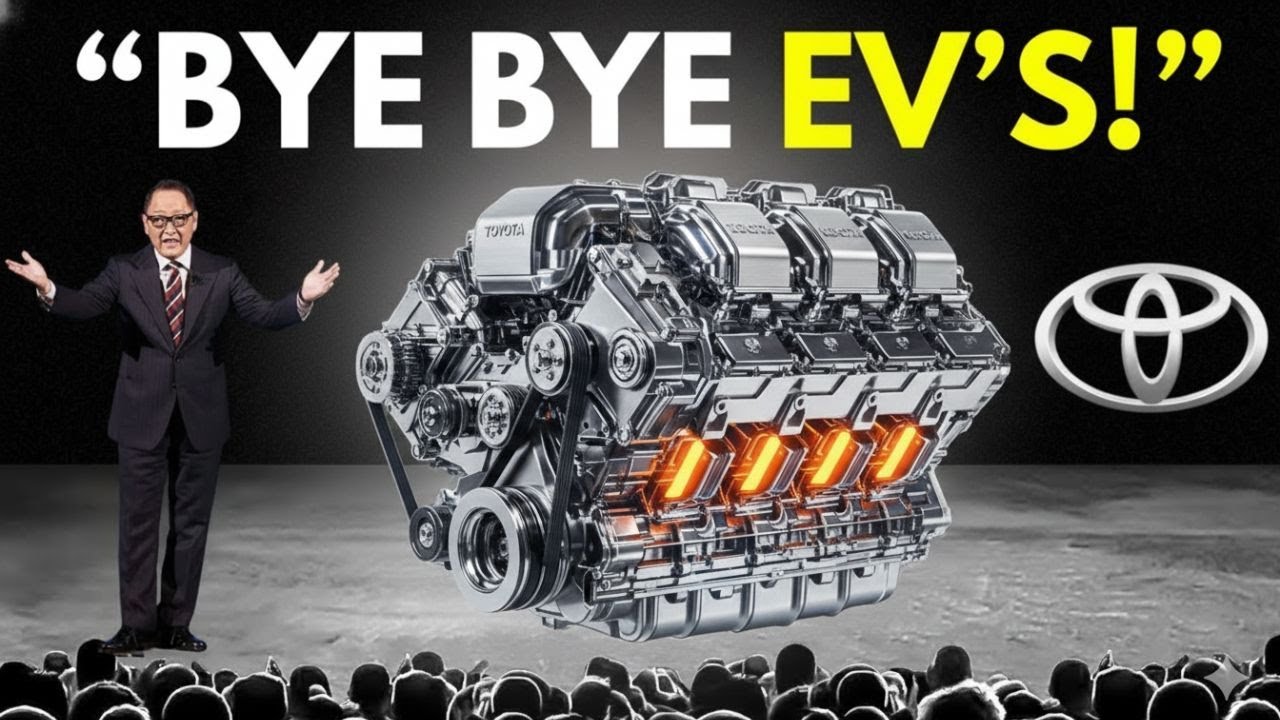
Toyota CEO: “This NEW Engine Will Destroy The Entire EV Industry!”
Even though many types of engines have existed for a long time, it is now more obvious that there are better methods to give our cars the power they need to move from one place to another. Toyota thinks that using hydrogen for power is the best path forward. The company also believes its new engines will make electric vehicles a thing of the past. Now, we should take a closer look at the progress of Toyota’s engines. We should also learn about the other reasons that help make Toyota a leading company in the car industry. So, how does Toyota make this happen? And is it possible for Toyota’s hydrogen-powered internal combustion engine to take the place of electric vehicles? Let us find the answers to these questions. Toyota is pursuing a multifaceted strategy to being carbon neutral and the Japanese automaker may find success with it. Toyota has been a pioneer in hybrid and plug-in hybrid automobiles since it introduced the groundbreaking Prius in 1997. These vehicles paved the way for the present electric vehicle boom. Despite its heritage, the Japanese company has been reluctant to embrace the allect electric trend headon. The controversy surrounding Toyota’s opposition to the switch to 100% electric is rather thought-provoking. The ban on gas-powered cars by 2035 has already been authorized by legislators in California, Australia, Canada, and the European Union. Automotive makers are under intense pressure to switch from gas to electric automobiles as efforts to reduce carbon emissions escalate. Toyota, meanwhile, publicly showed its disobedience by declining to ratify the QOP26 agreement, which calls for the use of electric vehicles only by 2040. The corporation has purposefully dragged its feet on the issue, arguing that the rush to fully electric vehicles has left many important considerations out. Akio Toyota, the former CEO of Toyota, received a lot of flack for taking an unpopular position. Jaguar, a British luxury automaker, said publicly that it would go entirely electric by 2025 back in February 2022. Cadillac and Volvo have also stated that they will only sell electric vehicles after 2030. Toyota is in the news for appearing uninterested in a market where many rivals, including Honda, Ford, Mercedes, Volkswagen, and General Motors, intend to phase out gasoline powered vehicles in favor of electric vehicles. Toyota has a reputation for being among the first to adopt new technologies, so taking this path surprised us. However, its justification is really compelling. Toyota worries that making the change over to all electric vehicles will not be feasible anytime soon. Akio Toyota said that EVs are just overhyped and that having too many of them could be dangerous. His opinion is that the high price of electric vehicles combined with the lack of a supporting infrastructure renders their widespread adoption impossible. However, all of it is now hidden from the public because electric vehicles only make up approximately 1% of the global auto fleet. If the number of electric vehicles rises, reality will begin to set in slowly, the biggest issue to deal with when electric vehicles flood the market will be the demand for electricity to meet the load demand that electric vehicles will provide. By 2030, the United States needs to expand power output by 40%. In other words, the current electricity supply chain needs to receive investments totaling around $100 billion. Even if some regions of Europe and Asia currently have sophisticated grids as a result of increased electric vehicle customer demand, it would still be far from enough if every car owner switched to electric. Akio Toyota has voiced reservations regarding electric cars, focusing instead on the necessity of hydrogen-powered technology in vehicles. He predicts that this new engine will destroy the entire EV market. Aside from the limited range of electric cars, he has also expressed concern over the environmental effects of battery production and disposal as well as the lack of infrastructure for charging. Indeed, Toyota’s arguments make a lot of sense. First, there is not enough power to support electric vehicles. Second, fossil fuels are the main source of electricity in the world. Therefore, increasing the number of electric vehicles will not decrease emissions. Rather, it will just change their source. His detractors may all be mistaken based on a Kio Toyota’s assertion that carbon, not combustion engines, is the enemy. From broad views, it appears that electric vehicle adoption is not uniform worldwide. While certain markets like those in Europe and China move more quickly than others, the United States is a lagard. Then there are markets that are far behind with little to no EV infrastructure like Africa. This disparity suggests that the globe is not yet prepared to forward the all electric vehicles objective collectively. Toyota believes that switching to all electric vehicles will leave a sizable number of its consumers completely in the dark. In 2021, Toyota sold more than 10.5 million units in more than 200 nations, making it the car maker with the greatest global market penetration. The business boasts a substantial market share across the board, particularly in underdeveloped nations with subpar charging infrastructure. By 2035, these areas will not be able to build the infrastructure necessary to support electric vehicles. So, electric vehicles are also highly pricey. Right now, electric vehicles are currently somewhat less expensive because of government subsidies intended to encourage people to purchase them. But honestly, it is unclear how long governments will maintain these incentives, particularly once mass production starts. Without financial incentives, many buyers would not be eager to spend a fortune on an electric vehicle. The corporation thinks that switching to a mixed engine is more practical than going entirely electric. They refer to it as a balanced approach, suggesting hybrid vehicles. Toyota is actively pursuing the development of hydrogen-powered vehicles and because of this, the materials used to make lithium batteries are difficult to produce. In reality, a lot of individuals believe that there would be a shortage of lithium and battery grade nickel, which will make it difficult to create the lithium batteries used in electric vehicles if hydrogen-powered engines are designed to their fullest capacity. This could prevent a significant delay in the transition to electric vehicles. One of the main issues with electric vehicles, automobiles, and trucks in particular, is sound. Nothing compares to the thrill of depressing the gas pedal on an old classic muscle car such as a 1970 Chevrolet Chevel SS with a large block 454 or a 1969 Ford Mustang with a 428 Cobra jet. When an automobile is about to launch, you may hear the sound of the carburetors opening as the fuel pours into the chain, feel the power flow through your chest, and experience a complete burst of adrenaline. Electric vehicles cannot provide it, but the hydrogen-powered vehicle can because it operates in a similar manner. You know, nearly every corner in the country is home to a tiny local repair business. But as electric vehicles gain in popularity among customers, you might not have that option any longer. Sure, you might be able to repair their electric engine by going online and watching a few YouTube videos, but it’s well strongly advised that you take it to a certified mechanic who is experienced with the most recent technology. Now, the amazing thing about hydrogen-powered engines is that they are purely mechanical and are quite similar to fuelpowered engines. That implies that the little neighborhood shops you feel safe bringing your cars to will be able to fix them. So, you know, there are some real drawbacks to hydrogen. It’s highly combustible, tough to handle and store, and when you burn it, it actually produces nitrous oxide. Now, Toyota’s approach to carbon neutrality is, well, a lot more diverse. They’re considering multiple technologies to reach zero emissions, while honestly, just about every other automaker seems to be betting everything on electric vehicles. This kind of thinking is starting to look pretty prophetic, especially now that European countries are scrambling to cut energy use because of the conflict in Ukraine and its impact on energy supplies. In fact, Switzerland has gone even further advising electric vehicle owners to save driving for emergencies or, you know, just grocery runs. And believe it or not, this policy could even become law. There is a path forward, sure, for hydrogen-powered cars, but it might end up blocked by the dominance of electric vehicles. Hydrogen fuel cell electric vehicles use some pretty advanced technology that honestly has a lot of promise. They also offer several advantages over traditional electric vehicles, like greater range and much faster charging or refueling. Still, for hydrogen-powered cars to really take off, we’re going to need a bunch of technological breakthroughs. Right now, producing hydrogen is expensive, and well, it actually takes a lot of fossil fuels. There’s also a real shortage of infrastructure, especially when it comes to hydrogen refueling stations. But maybe most importantly, the popularity of non-hydrogen electric vehicles could be holding hydrogen fuel cell cars back. People need a compelling reason to give up their Teslas, right? So, unless that happens, hydrogen-powered cars might just stay on the sidelines. The thing is, hydrogen fuel cell technology isn’t actually new. It was first developed back in the late 1960s to provide electricity for NASA’s man space missions. Since then, it’s been improved, and today, it can even power a regular car instead of a standard internal combustion engine. A typical hydrogen fuel stack is made up of an electrolyte.
Toyota CEO: “This NEW Engine Will Destroy The Entire EV Industry!”
While the rest of the auto industry rushes toward an all-electric future, Toyota took a different path that challenges everything we’ve been told about electric vehicles. Toyota engineers believes that EVs are not the only solution to a sustainable future and came up with an engine that has left the EV market in complete shock. But why is Toyota resisting the EV trend when so many other automakers are fully committed? Does Toyota know something the rest of the industry doesn’t? Join us as we expose the shocking details of Toyota’s strategy.