
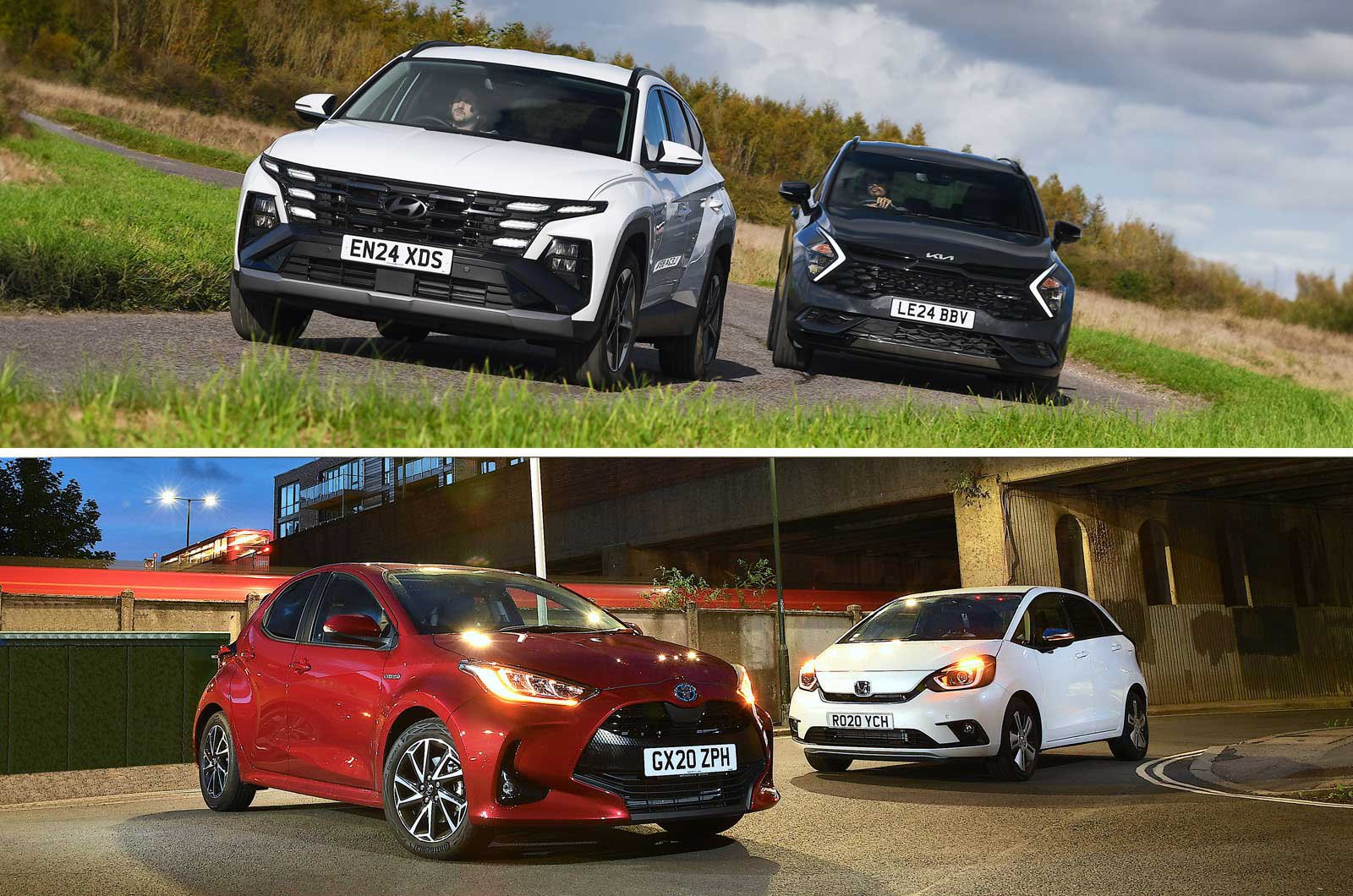
If you like the idea of driving a car with electrical assistance, but you don’t want to faff around with cables, then a self-charging hybrid car is the obvious way to go. Unlike plug-in hybrids and fully electric cars, you don’t have to worry about plugging in to keep the battery topped up, and you still benefit from the low fuel bills that electric power promises.
But is a hybrid car right for you? Here we explain what you should take into account if you’re thinking of buying one.
What is a self-charging hybrid car?
Self-charging hybrid cars, or full hybrids as they’re more accurately known, are powered by either a petrol or diesel engine and an electric motor (which gets its power from a small battery). As such, they can run on just the combustion engine or for short distances on pure electric power – or on a combination of the two.
Unlike plug-in hybrids or electric cars, self-charging hybrids don’t need to be plugged in to charge the battery. Instead, the battery is recharged by running the engine or by regenerative braking – a system which harvests waste energy and feeds it back to the battery.
This electrical assistance means that hybrids are very economical, as the car doesn’t rely on the combustion engine as much as a regular model would. You won’t be stopping for fuel as often, which equates to lower running costs, and if you drive a lot around town, you could be able to do a good portion of the journey on electric power alone.
However, hybrid cars can’t travel for nearly as long on pure electric power as plug-in hybrids, because they have a smaller battery. If you want to travel a significant amount of petrol-free miles, you’d be better off with a plug-in hybrid or fully electric car.
How efficient are hybrid cars?
Hybrid cars are often bought on the strength of their fuel economy. Every car with a combustion engine has an official miles per gallon (mpg) figure, which indicates how far you should be able to travel on one gallon (or 4.55 litres) of fuel.
It’s important to understand that the official figures you see in sales brochures don’t usually reflect what’s possible in real-world conditions.
At What Car?, we carry out our own Real MPG tests to find out how far your car will go in real-world driving. Our results show what’s achievable if you’re driving gently and sticking to speed limits, but aren’t resorting to any unrealistically slow acceleration or special ‘hypermiling’ techniques.
Some of the best-performing models to have gone through our tests have been hybrids, including the most efficient model we’ve ever tested: the Toyota Yaris Cross. That car managed an impressive 60.1mpg, compared with its official figure of 62.7mpg. Indeed, the Yaris Cross, as well as the Toyota Yaris and Suzuki Ignis hybrids, outperformed the most efficient petrol and diesel cars in our tests.
How much is road tax on hybrid cars?
It’s true that hybrid cars generally cost more than petrol and diesel rivals to buy, though due to their smaller carbon footprint, they can qualify for lower tax bands.
That’s most pertinent for the first year tax rate, which is based on the car’s carbon dioxide (CO2) emissions. This can range from £110 to more than £5000.
However, after this, you’ll pay the same rate of VED road tax each year. From 1 April 2025, there’s no longer a £10 annual discount relative to regular petrol or diesel cars.
Additionally, if you buy a hybrid car that exceeds £40,000, you’ll have to pay a £620/year Expensive Car Supplement (luxury car tax) on top.
As company car tax is based on a mix of a vehicle’s CO2 emissions, its purchase price (the P11D value), and your income tax band, ‘self-charging’ hybrids often cost less than a car powered solely by petrol or diesel.
Are hybrid cars being phased out?
Hybrids and plug-in hybrids can remain on sale in the UK until 2035, under changes to the Government’s ZEV Mandate announced on 7 April 2025. Previously, hybrids had been included in the 2030 ban of petrol and diesel cars; however, sales of electric cars have been lagging behind targets for quite some time, so with the inclusion of hybrids, car manufacturers will be able to more flexibly choose how they meet the ZEV mandate targets.
Should I buy a hybrid car?
Buy one if:
You want the convenience of a combustion engine for longer tripsYou want to lower your running costsYou can easily charge at home or at work
Don’t buy one if:
You have no easy access to chargingYou regularly cover long distancesYou regularly travel with a full boot