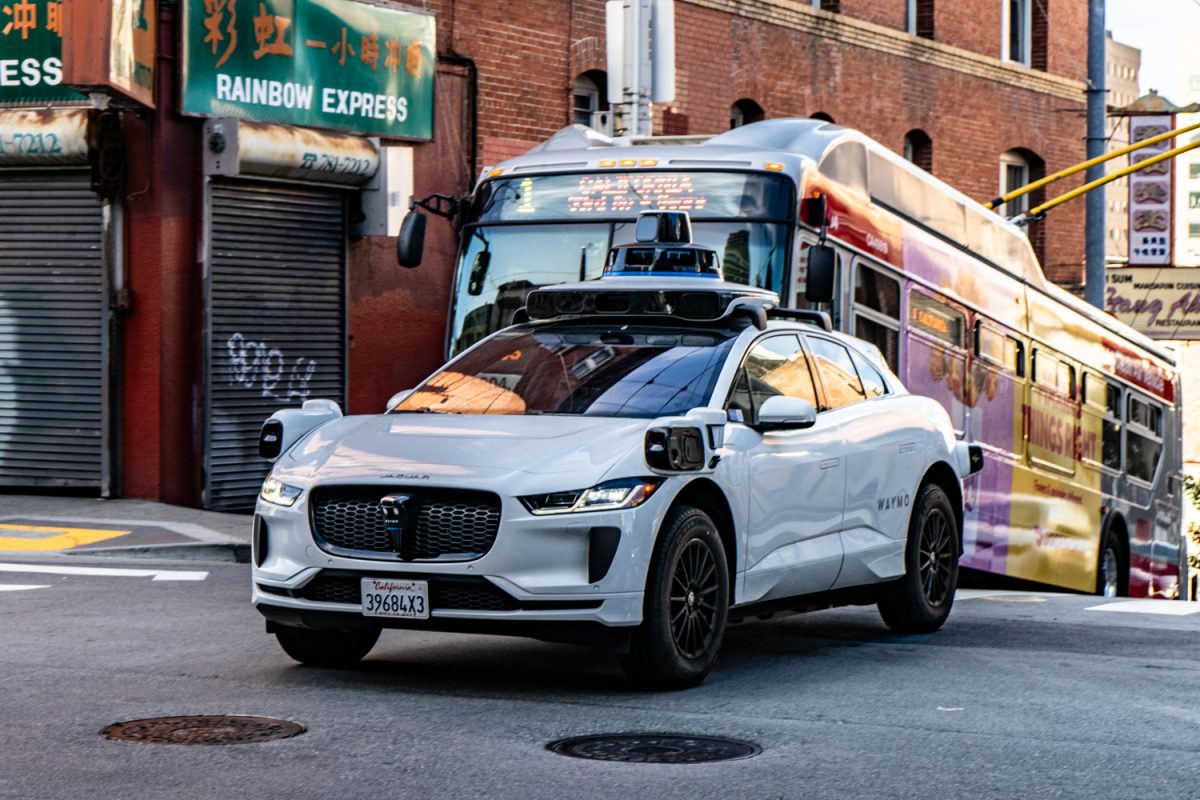
Waymo test car / Han Zheng / Wikipedia Commons / CC BY-SA 2.0
A Waymo car travels down a street in San Francisco. According to a study from the Journal of Transport Geography, focusing on electric and autonomous vehicles alone will not meaningfully reduce traffic-related harm or environmental damage, which would ultimately require reducing overall car ownership.
The United States Environmental Protection Agency (EPA) has laid out four main ways to decarbonize the transportation industry, which accounts for 29% of the nation’s greenhouse gas emissions that are plunging our planet into a bleak (and scorching) future.
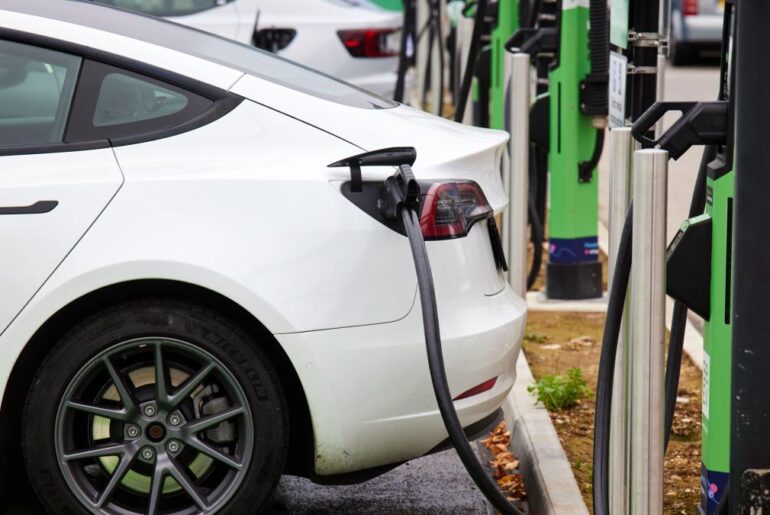
However, their suggestion to switch en masse to electric vehicles (EVs) has received the majority of the national attention in the past decade, including in the Biden administration’s EV rebates.
Many people believe that buying an electric car is a sufficient solution to decrease their carbon footprint, and the data certainly points in that direction: various scientific reviews sponsored by, for example, the Union of Concerned Scientists and the International Council on Clean Transportation, have found that green-energy powered cars have one-fifth of the lifetime emissions of gasoline-powered vehicles.
However, electric vehicles are not the transportation silver bullet. They are merely a part of the solution.
I believe that the overwhelming focus on electrifying the American private vehicle fleet has actually distracted us from a more holistic solution, which is summarized well in the final, often-overlooked strategy laid out by the EPA on their website: decreasing the amount that people drive.
One reason why electric vehicles are not the perfect solution that some make them out to be is that they still come with the vast majority of the negative impacts of cars.
Firstly, according to a study sponsored by the Union of Concerned Scientists, electric cars cause more greenhouse gas emissions in their production than gasoline-powered cars do, producing the equivalent of taking 15 cross-country flights before they even hit the road. The manufacture of an average e-bike, on the other hand, produces 86 times fewer emissions.
Beyond carbon emissions, law professor Gregory Shill argued in a 2019 article in The Atlantic that “85% to 90% of toxic vehicle emissions in traffic come from tire wear and other non-tailpipe sources,” which electric cars do not mitigate.
While it doesn’t contribute to global warming, particulate matter produced primarily from tires is still no joke — it pollutes our air and water with microplastics. A study from the Journal of Transport Technology has linked such emissions to an increased risk of asthma in kids, as well as various neurological issues such as depression, anxiety, and even Alzheimer’s.
As if this isn’t enough, this same study reasoned that the political prioritization of electric vehicles “is unlikely to result in large reductions in deaths, injuries, injustices, or the environmental damage caused by automobility,” emphasizing the broad-reaching impact of our car-centric society.
While electric cars aren’t much better than internal combustion engine cars, autonomous vehicles (AVs) have a hazy future and only perpetuate societal car-centrism. Many people envision them as the next logical development of vehicles, since they may prove safer than human drivers in many cases and would also enable would-be drivers to be productive during travel rather than focusing all of their energy on driving.
These are very real possibilities that would improve the lives of those dependent on cars, but in my opinion AVs raise more questions than they answer.
For instance, would the widespread adoption of AVs actually decrease the amount of traffic in cities, or would empty cars circling around waiting for passengers cause a corresponding increase in traffic?
It is likely that autonomous vehicles will eventually dominate the private vehicle fleet as people seek out the benefits that they bring over regular vehicles, but they are still cars with all the same downsides, and it is important to consider that many of their benefits, such as being productive while traveling, can be reaped simply through the use of public transportation.
I could explain at length the negative externalities of cars, but this article isn’t called “The Anti-Car Manifesto.” I am writing this article because we live in the Silicon Valley region, where technological innovation is praised and thus sought out in every facet of our society.
However, the desire to innovate our way out of the issues posed by our car-centric society while holding cars up on a pedestal leads us to push unideal solutions, such as the widespread adoption of autonomous and electric vehicles, as if they are the only option. In reality, they should be one of many tools used to decarbonize transportation along with the less flashy but proven technologies of public transportation and active transportation.
In sum, EVs and AVs both inflict numerous negative impacts on their surroundings, a consequence inherent to the fact that they are still cars. My recommendation? Consider biking, walking, or taking the bus to school, to start. When you go off to college, try not to own a car, and see where alternative transportation can take you. Who knew innovating a better future could be this easy.