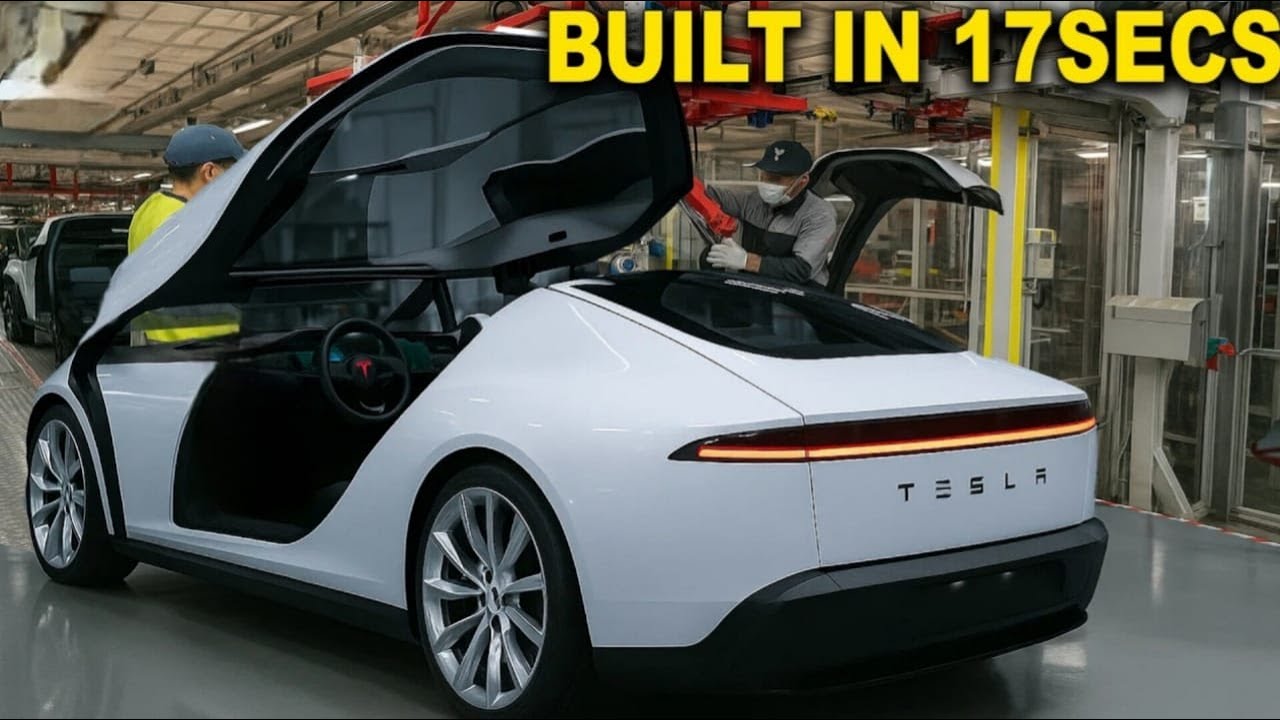
Tesla Model 2: Elon Musk’s $17,500 Electric Car Shocks The Auto Industry!
For a long time, being affordable meant giving something up. Smaller batteries, weaker motors, and plain interiors. But that’s not what Elon Musk meant when he spoke about creating a car that everyone would love and could afford. It was right there. In September 2025, in Giga, Texas, the sound of 50,000 ton presses echoed through the air. Transformers the size of buildings rolled past the factory gates. While the rest of the auto industry kept arguing whether cheap electric cars could ever feel premium, Musk crushed that entire debate with one bold move, a new kind of production line that breaks through every wall of cost, complexity, and scale. And today, we’re diving deep into this new innovation that’s changing everything. If you want to be one of the 222,555 people who truly understand where car manufacturing is really heading, not just where marketing says it is, hit the subscribe button now. and the bell icon ensures you don’t miss the kind of in-depth technical insights that others pay experts to explain. So, how does 100% American manufacturing actually make the Model 2 faster to build? The biggest problem holding Tesla back from building an ultra cheap car has always been its global supply chain. The newly launched Model Y Juniper 2025 starts at about $46,630 and nearly 25% of its battery and electronics still come from overseas. But with the Model 2, Tesla has flipped the script. It’s the first car where nearly everything is made in America, cutting imports down to less than 2%. The biggest difference comes from the batteries. Tesla is moving away from traditional lithium ion packs to sodium ion batteries. That means no more dependency on imported lithium, cobalt, or nickel from China. These materials aren’t just expensive. They come with hidden costs, transpacific shipping, import tariffs, and long wait times. Every lithium-based battery basically includes a global supply chain tax that American buyers end up paying. Dot sodium- ion changes that entirely. The US, especially Texas, produces over 10 million tons of salt every year. Using only 0.1% of that can produce between 14 and 16 million50 kWh battery packs for the Model 2 annually, all without worrying about shortages. On top of that, by cutting out four weeks of Chinese refining, 30 to 45 days of ocean shipping, and middlemen, Tesla can now produce a battery in just 1 to two weeks. Compared to the 6-month timeline that the old process required, this change doesn’t just save money on materials. It also eliminates what Tesla calls peripheral costs. Sodium batteries are about 60 to 70% cheaper to produce than lithium ion ones. A 50KWH lithium pack costs roughly $7,500, while a sodium pack is only about $1,500. That’s $16,000 in direct savings per car. But Tesla didn’t stop there. Their new production line doesn’t just make batteries faster. It reimagines the entire manufacturing chain. Traditional automakers follow a linear process. Mine raw materials, ship them overseas, refine, build cells, assemble battery packs, then install them in vehicles. Each stage has to wait for the one before it. Tesla has completely changed that with vertical integration at Giga Texas. Salt is extracted in West Texas, processed in Austin, and turned into batteries on the same campus, all happening at once. This isn’t just faster, it’s a whole new way of thinking about manufacturing. For comparison, Toyota’s top tier supply chain can turn over its inventory in about 45 days. Tesla’s model to production aims for an 8-day cycle. That’s not a small upgrade. It’s a 5.6 improvement in capital efficiency. Tesla can build cars more than five times faster than its biggest rivals. In 2026 manufacturing terms, speed equals profit. And it’s not just the batteries that are transforming. Tesla is also reducing its reliance on foreignade electronics. At Giga Texas, they’re moving chip production in-house and working with Texas Instruments to produce local control chips. These chips used to cost $2,000 per set when imported, but now cost between $900 and $1,200, saving about $1,500 per car. What makes Tesla’s chips unique is their design. Instead of buying generalpurpose chips like most car companies do, Tesla creates domain specific chips made for car control, battery management, and self-driving functions. They’re then mass-produced locally. The result, Tesla’s chips process vehicle data 40% faster while using 30% less power than off once. That extra performance gives the model to an additional 1518 mi of range per charge. All thanks to smarter silicon. Altogether, Tesla’s import reliance drops from 25% in the Model Y to nearly 2% in the Model 2, making it 99% Americanmade. And here’s where it really benefits you, the buyer. Building in the US helps Tesla save around $110,000 per car while qualifying for federal tax incentives and subsidies. For example, the $7,500 EV tax credit applies to vehicles with over 85% domestic components. That means Tesla can sell the Model 2 for an official price of $25,000. But after credits, you can actually get it for under $17,500. That’s cheaper than a brand new Toyota Corolla. So, if Tesla can offer premium EV technology at the price of an economy car while keeping jobs in production in America, which breakthrough impresses you most? Comment. One for sodium ion batteries, two for domestic chip production, or three for Tesla’s complete vertical integration strategy. Now, how does Tesla’s casting technology remove over 5,600 possible failure points? The strength of any electric car depends on its frame and at Tesla’s Model 2 production line. The question was simple. How can you make a frame that stays solid for 20 years and doesn’t rust no matter where it’s driven? The answer lies in Tesla’s revolutionary casting technology, something every automaker is now trying to catch up with. While Ford only recently began using a 9,300 ton Giga Press, Musk has already unveiled massive 50,000 ton machines. These giants can cast the entire car body in just three major pieces, the front, rear, and floor. That eliminates about 90% of the welds you’d find in a traditional car. For example, a Model 3 has over 6,000 weld points. The Model 2 only around 400. That’s thousands of weak spots gone. Fewer joints mean fewer cracks, less vibration, and a smoother ride. When the car hits a pothole at 40 mph, the impact doesn’t slam into fragile welds. It spreads evenly through the frame. Dot. In standard car production, you have 300 to 400 separate stamped parts, each needing millimeter level precision. Stack up those tiny tolerances across hundreds of parts, and you end up with misalignments. That’s why traditional cars often have uneven panels or body gaps. Tesla’s mega cast process removes that problem entirely. Casting the rear as one solid piece means there’s no stacking of microscopic errors. The precision of Tesla castings is within 0.0197 0197 in across the whole structure about five times more accurate than welded assemblies. And the speed difference is incredible. BMW’s most advanced factory welds a 3 series frame in 96 seconds using 18 robots. Tesla’s Gigapress casts the Model 2’s rear in just 90 seconds using a single machine. That’s an 18 to1 capital efficiency advantage. Across the full frame, Tesla uses 83% fewer robots, 67% less floor space, and 45% less energy than traditional body shops. This isn’t just new technology. It’s a complete rewrite of industrial engineering. Tesla is not even using standard car aluminum. The Model 2’s frame is built from a TX7A aluminum alloy with a yield strength between 140 and 175 me. Its nano crystallin structure lets it absorb vibrations without deformationation and survive millions of stress cycles from rough roads. In TX7A isn’t just strong, it’s incredibly recyclable. Most car frames mix different aluminum alloys in different sections, making recycling complicated and inefficient. Those alloys have to be separated, remelted at varying temperatures and often lose quality. But TX7A keeps its nano crystalline properties even after re meaning retired model two frames can be melted down and reused to make new ones with no loss in performance. Tesla’s goal is 95% closed loop recycling the highest in the auto industry.
The future of affordable electric cars has arrived — and it’s 100% made in America. In this video, we explore how Elon Musk and Tesla have revolutionized the EV industry with the all-new Tesla Model 2. Built using advanced sodium-ion batteries, ultra-strong aluminum casting, and full vertical integration at Giga Texas, this car breaks every rule of automotive manufacturing.
Discover how Tesla’s new production line slashes costs, reduces import dependency, and delivers a premium experience at an unbelievable $17,500 price. From the massive 50,000-ton Giga Press to the AI-powered Grok 4 assistant and FSD V14, the Model 2 proves that the future of smart, affordable mobility is already here.
Stay tuned to see why experts call it the most important car Tesla has ever made. Don’t forget to like, subscribe, and hit the bell icon for more deep-dive Tesla updates and future tech breakdowns.
#TeslaModel2 #ElonMusk #Tesla #ElectricVehicle #EVRevolution #AffordableEV #SodiumIonBattery #GigaTexas #TeslaInnovation #FutureCars #TechNews #AI