
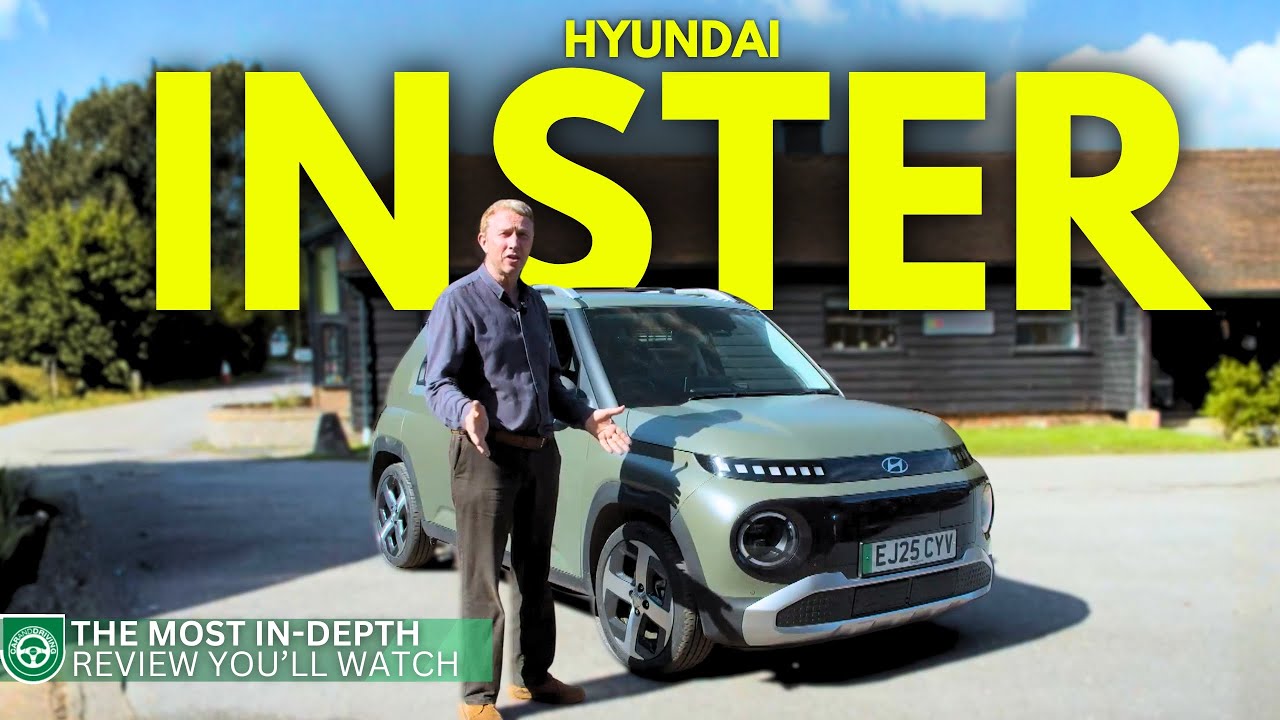
Is This The TRENDIEST EV Out There?! Hyundai Inster 2025 Full Review
[Music] Choosing a really cheap small EV doesn’t necessarily mean you have to choose a really boring one. Also, Hindi thinks anyway. For proof, check out this car, the Insta. It’s supposed to be fun. It’s certainly practical, and if you’re shopping in this segment, it might just be what you’re looking for. My name is Jonathan Crouch. I’ve been testing cars for over 40 years. You’ll find them all on the Car and Driving Car Abuse app. Here, I’m going to try and tell you everything that you really need to know about this car in a way you’ll find nowhere else. Let me hand you over to our presenter, Colin. [Music] Hyundai brings a splash of fun and versatility to the small EV market with this car, the Insta. Here, we’ll take a closer look. It’s aimed at the pricier, trendier end of its segment. And in case you’re wondering, the name isn’t short for Instagram. No, instead, the Korea maker claims it’s a mix of the words intimate and innovative. You might think it more logical for the brand to have once more used its familiar Ionic tag, perhaps badging this car Ionic 2, but apparently that name plate’s reserved for Hyundai with the group’s advanced 800vt EV platform. And there’s nothing like that here. What this car actually should be called is the Casper because a petrol-powered Korean market Hyundai of that name is what the Insta is actually based on. Though for this EV variant, an extra 180 mm of length has been inserted into the wheelbase, which as we’ll see is significant because the very young and very old customers being targeted here are getting a small EV more internally versatile than any of its rivals. Sounds interesting. Now, you can find out more about this kind of car by downloading the car and driving app. But if your interest is specifically in this Insta, you’ll need to stay with us for the industry’s most comprehensive review, the car and driving road test. You’d hope that a car looking like this might raise a smile in the way that it drives, but that’s asking a lot given the heaviness that comes with EV propulsion. In this Hyundai’s case, the 1,423 kilo curb weight figure is getting on for half a ton heavier than the brand’s equivalent combustion model, the i10. Imagine the extra originally coal fire sourced blast of energy that’s necessary to push that extra bulk through the air. What’s ecocentric about that? Answers on a postcard, please. Still, similarly, hobbled rivals don’t do much better and a big advantage the Insta has over all of them is its extra narrowness, which you really appreciate on the crowded city streets that will be this Korean runabouts preferred habitat. helped by its dimminionative size. On the move, you’ll immediately notice that this Yundi is nippy and agile, though response from the front mounted motor isn’t quite as peppy as you’ll find with some rivals. Two versions of it are available, but both perform quite similarly. The standard range 42 kWh model has 97 PS, which allows 62 mph to be reached in 11.7 seconds. or if you drive more sensibly, an official EV range of 203 mi to be approached on those occasions where you’re in a lethargic mood. The alternative, which most customers will prefer, is the long range 49 kWh model we’re trying here, which gains a supposedly perkier 115 PS version of the same motor. This lowers the 62 mph time fractionally to 10.6 6 seconds. Though, as the torque pulling power figure of 147 new m doesn’t change, you won’t notice much realworld difference. As for the long range bit, well, don’t get your hopes up too much. The official figure of this pricier variant rises to 229 mi. Though, as with any EV, if your mileage is exclusively city-based, you might well do quite a bit better than that. Assuming, of course, you keep the car in the most frugal of its provided drive modes, eco. The others are normal, sport, and snow. Unlike with quite a few rivals in this segment, there are steering wheel paddles for proper brake regen control with a fiercer setting almost enough to bring the car to a complete stop when you come off the throttle. That’s great for city traffic where you’ll appreciate the excellent all round visibility afforded by the tall glassy body. The 10.6 m turning circle though can’t match what you get from larger rear driven EVs. A bigger Shakoda Lro for instance turns in just 9.3 m. There’s an SUV style Insta Cross variant available at the top of the lineup, but it’s no differently engineered from this standard version. The low-speed ride is quite soft and supple, though predictably. The unsophisticated torsion beam rear suspension gets caught out by larger potholes and more intrusive speed bumps. Beyond the city limits, there’s less body roll than you might expect from such a high-sided little car and plenty of traction through the turns, but we could do with a touch more feedback from the slow geared steering. On the highway, the bluff aerodynamics inevitably result in a bit of extra wind noise. But on the plus side, there’s standard fit adaptive cruise control with integrated semiautonomous highway drive assist. So, you still might feel more inclined to attempt a longer trip in one of these than you might in some rivals. Unlike rivals Renault and Fiat, Hyundai can’t call on a back catalog of classic small models from which to inspire retro design. So instead, there’s something quite different here that in its own way is equally distinctive. The brand calls the Insta’s exterior charismatic with its high nose and boxy proportions. Some will think it ungainainely, others will like the combination of friendliness and ruggedness. That’s something emphasized by all this pseudo SUV style body cladding and by the chunky roof rails you get above base trim. There’s an even more overtly styled cross variant if you want the full lifestyle effect. It’s all unapologetically square and Hyundai hopes it’ll make you feel quite adventurous. Size-wise, it’s 3.8 m long and 1.6 m tall. If you’re making comparisons, think somewhere between a Dacia Spring and a Citroen EC3. And the whole thing sits on dinky little wheels that are 15 in in size with base trim, or as here, 17 in otherwise. At the front, well, it’s all going on, isn’t it? Upper pixel graphic turn signals, while big circular daytime running light clusters adorn either side of the big black bumper with silver scuff plating surrounding the lower intake. You’ll certainly get them talking in that gym car park. We gave you this car’s length dimension earlier, which had to be extended by 230 mm from its Casper Korean market donor model to make the rear less cramped. This Insta has kept that Casper’s dimminitive width, though it’s much narrower than its rivals, just 1.6 m from side to side. Originally designed that way so as to be able to be classified as a light car in its home market, which releases for it tax incentives and attractive parking rates that sadly aren’t replicated here. The trendiness of the front is replicated with these round lower light clusters and with the pixel lights on the vertical tailgate, a Hyundai EV signature touch. Further down, there’s more silver scuff plating trim, and it all sits on Hyundai’s K1 platform, a much simpler, lighter chassis than the EGMP underpinnings of the brand’s larger Ionic EV models. Time to find out what it’s like inside. Well, not as narrow feeling as the external dimension suggest, which is a good start. The spacious vibe is helped by the flat floor and the way the front seats blend together in a kind of bench with front folks separated only by a couple of cup holders. Burlier applicants though might still want to try before they buy. The vast boxy glass area helps with this illusion of roominess though this airy feel is somewhat hindered by the unnecessarily large panel above the rear view mirror. Also rather overlarge is the steering wheel. Its bezel featuring these curious four little pixel dots. Through it, you view a digital instrument cluster which can display speed and range in curious cubes. The other thing that quickly hits you about the Insta’s interior is that in an age of physical button scarcity in automotive cabins, Hyundai has here gone completely the other way. There’s switch gear all over the place, but it’s all sensibly placed and ergonomic to use. But this cabin could have done with a bit more love though from its designers. The sort of soft touch and material finishes you get in a Renault 5, say, or the trendy little tabs from a Citroen EC3. But some effort has been made to lift the budget feel. The metal effect door handles, the central fold down armrest, and the silver tips on the column stalks are all welcome additions. There are two of those stalks. Unlike in Arrival Ford Pummer, the designers have still kept one on the right, even though another thicker stalk protrudes below it for gear selection. Virtually all the materials used are from notably ecoentric sources like recycled PET plastic bottles and a bio polyropylene material extracted from sugar cane. Unlike with larger Hundies, no attempts been made to blend the two screens together, even though they’re both 10.25 25 in in size. We mentioned the instrument display which can show its two main readouts in either the pixel boxes we mentioned earlier or with conventional dials. Below the speed readout is a battery indicator and below the range readout you can see the chosen level of brake regeneration selected by the provided steering wheel paddles. In the center of the screen is a section for selectable readouts covering drive assist functions, trip data, navigation, compass readings, and tire pressures. The same sized infotainment screen placed high over the two central vents works like any other Hyundai or Kia central monitor, namely with a choice of two types of home screen. either an uncluttered one with just time, date, media setting, and nav mapping, or a screen full of little icons, including all the little extra features that the brand habitually includes and which really might sell you this car. Things like a valet mode, a voice memo system, sounds of nature, soothing music themes, and a quiet mode that cuts off the speakers in the back for when you want to listen to things without disturbing little ones dropping off to sleep in the rear. avoid base trim. And from here, you can control a 64 color ambient lighting system as well. What else? Well, there’s an electronic handbrake switch, but you’ll hardly ever use it because the car operates that feature automatically. And as you’d expect in such a boxy, glassy design, all round visibility is great. So, you’ll rarely need the rear sensors or the camera that’s fitted with 02 spec. The connectivity options are strong, as well as this rather overprominent USB port ahead of the passenger. This 02 model’s optional tech pack adds a lower 230 volt socket for a V2L utility mode that can allow you to plug electrical devices, say a laptop, camping equipment, or even an ebike into the car’s drive battery. If you can ignore the almost uselessly small door bins, there’s lots of space to put things to. The aforementioned cup holders between the seats, a big glove box with a batlit ledge above it, and a bin below the climate controls, which can incorporate a wireless charging mat with further storage below. In theory, this cabin offers a walkth through design, enabling passengers to get out on either side. though this protruding center stack means you’re not going to be tempted to exercise that option very often. Let’s take a look in the rear. Now, as on this car’s Casper donor model, the rear door handles are hidden in the SE-pillars, and almost all of the Insta’s 180 mm wheelbase length increase over that original design is to the benefit of rear passengers, which you really feel once inside. It really is very spacious indeed in here for a car of this size. Though that outer body narrowness has to tell somewhere. Predictably, what it means here is the lack of a middle seat belt, which might be restrictive if you habitually give other people’s kids lift home from school. The two folk who can fit though can be basketball playing sixoot adults if need be. And if you’ve avoided base trim and got yourself an Insta with this sliding bench, there’s loads of leg room too. Plus, the back rest recines right back. Lovely. As in the front, there’s a completely flat floor, which is good, and uselessly sized door bins, which isn’t. There are curious plus signs that adorn the door panels. There’s just a single overhead coat hook, and this USB port is only fitted above base trim. There are no seat back pockets either, possibly because, cleverly, the front seats can be folded right flat. So, if a passenger side seat is occupied up front, a rear passenger sat behind can fold that front seat right forward, use it as a footrest, and imagine that they’re in a limo. Let’s finish as usual with a look out back where more curiosities await. A tiny parcel shelf linked by fabric panels attached by straps to the headrests and arrangement necessary to accommodate that reclining back rest. Strange flat panels sit on the boot floor beneath which there’s loads of storage though only because like every other contender in this segment Hundi declines to offer any kind of spare wheel. There’s a narrow compartment below that lower floor too with a sliding rear bench fitted. Luggage capacity obviously depends on the position of the seat ahead. anything between 238 and 351 liters. Given the boxy shape, you might hope that the top figure would be class leading, but alas, it’s not really. With the rear bench in the position you’ll have it in most of the time, boot capacity isn’t going to be much different to the 326 L figure you’d get in a rival Renault 5. And the 574 L figure of a Ford Puma Gen E gives you a boot that’s nearly twice as big. And unlike that Ford, there’s no under bonnet frunk space. If you’re not using the rear bench in your Insta, flattening it in its 50/50 split frees up as much as 1,59 L of space. That’s where these flat panels come in useful. You can turn them back to protect the rear seatbacks from grime and dirt. Need to take really long items? Well, there’s the further option of flattening the front passenger side seat. You can also flatten the driver’s seat as well to create a kind of metal tent for camping, should you be so inclined. Hundi reckons that the Insta isn’t directly aimed at either the A segment for city cars or the B segment for super minis. Instead, it’s been designed to sit in the middle of both. And that’s certainly how it looks from a pricing perspective. The Insta range starts with 01 trim available with either the 42 kWh 97 PS drivetrain or the longrange 49 kWh 115 PS package. As we filmed in Autton 2025 01 trim was starting from around 235,000 in 42 kWh form with another £1,500 necessary to get the larger 49 kWh battery to get the clever sliding and reclining rear seat. That’s a signature feature of this Hyundai. You have to stretch to the plusher 02 trim level. And with that, you have to have the bigger long range battery. The combination of those two things pushes the Insta’s price up quite a lot to £26,755 as we filmed. Another £1,000 on top of that gets you the top SUV themed Insta Cross model, also only offered with the 49 kWh battery. These days, the small EV hatch segment has split into two parts. Cheapest of all from around £15,000 or less are budget brand models like the Dacia Spring and the Leap Motor T03. Only slightly pricier is the BYD Dolphin Surf. Stretch your budget up to just over the £20,000 mark and you start to get a bit more style for your money. There’s the Fiat Grande Panda EV and also two cars that unlike this Hindi qualify for the 1,500 pound band two part of the government’s electric car grant. The Citroen EC3 and the Renault 5 E Tech electric. Originally, Insta pricing was comparable with that Renault, but the grant has given the French brand a key advantage. Now, a better price comparison against this Hyundai can be made with the Renault 4 E Tech Electric, which also qualifies for band two of the government’s grant. And as we filmed, was priced from just over £25,000 grant inclusive. That’s about the same level as another BYD, the Dolphin. And only around £1,000 more than that would get you the much more powerful and rangier Ford Pummer Gene E. Though that Ford’s only that cheap because it qualifies for the top band one £3,750 government grant. push up towards the £27,000 budget necessary for this plusher 02 spec and other rivals come into play like base versions of the Vauxil Corsa electric and the MG4. So, this Hyundai will need all its cheeky charm to sell. And you’re also going to need to be pretty convinced by the EV Revolution to want one, given that the brand’s equivalent combustion model, the i10, could be yours for nearly $10,000 less than the car we’re trying here. Still, if you find yourself seduced by an Insta, then you’re going to need to know about standard spec. So, let’s take a look at that. Now, there really is an awful lot included here. Base01 trim includes 15in alloy wheels, electrically adjustable and heated door mirrors, rear parking sensors, a rear view camera with dynamic parking control, automatic headlights, and a smart key with keyless entry, plus a smart cruise control with stopgo system that works with an integrated highway drive assist setup to give the car a limited amount of level two autonomous driving capability. ility. Unusually in this segment, a heat pump, normally a pricey extra on cars like this, comes as standard there to preserve driving range in cold conditions. Inside there’s a 10.25 in digital instrument cluster, air conditioning with climate control, a leather steering wheel, and a 10.25 25 in central touchscreen display with navigation plus Apple CarPlay and Android Auto along with Blue Link connected car services with overtheair updates. We mentioned earlier that you’ll need to stretch to this plusher 02 trim level if you want all the slidy foldable rear seat theatrics. As well as that, at 02 level, your Insta will come with larger 17-in alloy wheels, front parking sensors, LED projection headlamps, and LED rear lights, rear privacy glass, and roof rails. Interior enhancements include LED multi-function steering wheel lights and ambient lighting with a choice of 64 colors. The 02 also includes heated front seats, a heated steering wheel, automatically dimming rear view mirror, metal paint effect door handles, speaker tweeters, a rear USBC charging port, and a wireless charging pad. If you want to go even further, there’s the top off-road themed Cross variant, which only comes with a larger 49 kWh battery and costs £28,745. That’s £3,000 more than the standard model. This comes with bespoke 17-in alloy wheels, distinct front and rear bumpers, unique cross side skirts, and embossed black claddings with bodycoled door mirrors and exterior door handles. Plus, there’s also a powered glass sunroof, a surround view monitor, and a parking collision avoidance assist system that’ll automatically apply the brakes to stop you from hitting things at parking speeds. As for options, well, the main one is the optional tech pack we have fitted here only offered above base trim and comprising a vehicle to load internal three pin socket and a digital key system that allows the vehicle to be unlocked and started with a compatible smartphone. Beyond that, there are various special paint shades. We’ve got Bardim Khaki here with 02 trim. You can have two-tone neutral beige and khaki brown interior finishing. On to safety. Now, not many cars in this category. The exception is the BYD dolphin get a five-star Euro NCAP rating, but this Hyundai must have got close to that benchmark because it provides plenty of standard safety kit. All Instas get forward collision avoidance assist which senses pedestrians, cyclists, and vehicles coming towards you at junctions. There’s also lane keep assist, lane follow assist, and traffic sign recognition that drives the intelligent speed limit assist setup. Hyundai also includes a driver status monitor, plus seven airbags, front, front, side, and curtain airbags. The rival Citroen EC3 gets only six. all linked to an e- call system. The Insta Cross also gets blind spot collision avoidance assist and a blind spot view monitor. We gave you the EV range figures in our driving section. 203 mi for the 42 kWh battery and 229 for the longrange 49 kWh model we’re trying here which has been returning about 4 m per kWh during this test. To give you some class perspective, the 42 kWh battery figure is about the same as you’d get from a rival Citroen EC3, but the 49 kWh battery mileage stat, though close to the strong selling Ford Pummer Gen E is 70 mi less than the 52 kWh Renault 5 and four models that are key competitors to this Hyundai. like Renault, but unlike quite a few other rival brands, Hyundai includes a heat pump across the lineup as standard to preserve the range of the nickel manganese cobalt batteries. Let’s get to the charging figures, which aren’t particularly fast, even from a small cheap EV. You’d hope for at least 100 kW DC charging speed in this day and age, which is the level of market leaders like the Vauxil Corser electric and the 52 kWh version of the RA 5. In contrast, a 42 kWh Insta DC charges at a maximum of 73 kW. It’s 85 kW hours with this test car’s long range 49 kWh battery. Despite that, you can still achieve a 10 to 80% battery charge in about half an hour with both battery sizes. At home, using a typical singlephase 7.4 kW wall box, a complete charge of the standard range 42 kWh battery takes just over 6 hours. With this longrange 49 kWh battery, it’s around 7 hours and 30 minutes, which you can improve to 4 hours and 35 minutes if you’re able to AC charge with a three-phase 11 kW supply. The charge ports located in the nose with top 02 trims optional tech pack as fitted here. There’s the option of vehicle to load technology which enables you to plug in external devices to the car like say a camping lamp or charging for an electric scooter or a drone. There are of course all the normal advantages to buying an EV with low BK benefit in kind taxation rated at 3% until spring 2026 along with savings in not having to pay the London ULES congestion charge. As usual with a Hyundai, you can budget ahead with prepaid servicing plans. And all Insta models come with Hyundai’s 5-year unlimited mileage warranty, an 8-year 100,000mi high voltage battery warranty, a 5-year annual health check, a 3-year map care navigation update program, a roadside assistance package, and a 12-ear anti-corrosion warranty. Rival brand Kia claims to better the 5-year warranty package by offering a similar 7-year deal, but there you’re limited to 100,000 mi. Insurance is group 21 for the standard range, 42 kWh model, or group 23 or 24 for this 49 kWh longrange variant. That’s similar to a Citroen EC3, but a chunk above a rival Renault 5 rated in groups 18 to 22. That Renault does better in terms of depreciation, too. This Insta is expected to hold on to about 40% of its value after 3 years and 36,000 mi. If you’re irritated by the on trend name, then this probably won’t be your sort of car. But if you can get beyond that, there’s actually a lot to like about the Insta, assuming you’re a fan of the high-sided chunky looks, which quite a few people won’t be. Still, if you’re hooked on the look of this car, then you’ll probably feel that nothing else will smarten your driveway in quite the same charismatic manner, and you’ll love the clever, space efficient interior design, which is way nicer for rear seat passengers than anything else in the class. It’s a very thoroughly engineered little EV as well with important features that go missing on some rivals like proper brake regen paddle shifters, an optional V2L system for plugging in external devices and a standard heat pump. All this is important, but is it enough? We wonder, to justify pricing, which can’t be alleviated by a government grant and finds itself on the high side for this segment if you avoid base trim. as most customers will. Hyundai, of course, has no doubts, convinced that this car will not only carve its own niche in the small EV market, but also help the brand reach beyond it, rather like the Fiat 500 did in an earlier era. The Insta might just do that. It certainly shows that a small electric car could be a slightly more interesting proposition than you might first have thought. [Music]
Lease A Car With LeaseLoco: https://leaseloco.sjv.io/LXzKoL
Is This The TRENDIEST EV Out There?! Hyundai Inster 2025 Full Review
Jonathan Crouch writes an in-depth #hyundai Inster 2025 Review. If you want to watch more reviews on vehicles like this #hyundaiinster 2025 #carreview make sure to #subscribe to our #channel and comment what YOU want us to #review next.
Hyundai brings a splash of fun and versatility to the small EV market with this car, the Inster. Jonathan Crouch drives it.
Choosing a really cheap small EV doesn’t necessarily mean you have to choose a really boring one. Or so Hyundai thinks anyway. For proof, check out this car, the Inster. It’s supposed to be fun. It’s certainly practical. And if you’re shopping in this segment, it might just be what you’re looking for.
Hyundai brings a splash of fun and versatility to the small EV market with this car, the Inster. It’s aimed at the pricier, trendier end of its segment and, in case you’re wondering, the name isn’t short for ‘Instagram’. Instead, the Korean maker claims it’s a mix of the words ‘intimate’ and ‘innovative’. You might think it more logical for the brand to have once more used its familiar IONIQ tag (- perhaps badging this car IONIQ 2?). But apparently that nameplate’s reserved for Hyundais with the group’s advanced 800V EV platform – and there’s nothing like that here.
What this car actually should be called is the ‘Casper’ because a petrol-powered Korean market Hyundai of that name is what the Inster is actually based on, though for this EV variant, an extra 180mm of length has been inserted into the wheelbase. Which as we’ll see is significant because the very young and very old customers being targeted here are getting a small EV more internally versatile than any of its rivals. Sounds interesting.
If this is the type of vehicle you are interested in, we recommend also viewing our review on the Hyundai Tucson 2024 linked here: https://youtu.be/4ckgmzZnLqQ
SUBSCRIBE to watch more Expert Vehicle Reviews here: youtube.com/channel/UC3BpdoZL-k3AzJYrwQBVe2w/?sub_confirmation=1
Join this channel to get access to perks:
https://www.youtube.com/channel/UC3BpdoZL-k3AzJYrwQBVe2w/join
overview 00:00
background 00:44
driving experience 02:12
design and build 06:00
market and model range 16:06
cost of ownership 23:31
summary 27:05
Find out more:
Website: https://www.caranddriving.com/
Instagram: https://www.instagram.com/caranddrivingvideo/?hl=en
Twitter: https://twitter.com/CarDrivingVideo
Facebook: https://www.facebook.com/caranddrivingltd/
LinkedIn: https://www.linkedin.com/company/caranddriving
#car #cars #carreview
: Amazon :
Wireless Car Stereo : https://amzn.to/422dcu2
ULTRA SAFE Jump Starter : https://amzn.to/3JKelQB
Easy Phone Mounting : https://amzn.to/45Q7KLO
Garmin Dash Cam : https://amzn.to/4mJXsnX
Boost Pro Phone Charger https://amzn.to/4mHBT7i
Scosche Magnetic Dash Mount : https://amzn.to/4ncBV77
TESLA Storage Optimiser : https://amzn.to/45Q8kJu